The White Working Class in the USA
The White Working Class in the USA
By Manuel E. Yepe
http://manuelyepe.wordpress.com/
Exclusive for daily POR ESTO! of Mérida, México.
The surprising successes of Bernie Sanders on the left flank and Donald Trump on the right flank –in part, believed to owe something to the new positions of the “white working class” in the US– have sparked new interest within the political outlook of the nation.
So writes Zoltan Zigedy, a prominent American Marxist political commentator in his “ZZ” column.
The Wall Street Journal calls them the “forgotten Americans.” Others see them as racist and xenophobic. In 2008, then-aspiring-President Obama characterized them way: “And it’s not surprising then that they get bitter, they cling to guns or religion or antipathy to people who aren’t like them or anti-immigrant sentiment or anti-trade sentiment as a way to explain their frustration.” Whether they are forgotten, dismissed, or demonized, the “white working class” has been discovered this election season.
Even a decade ago, it was widely believed that there was no working class in the US –only a vast middle class and the poor. Fostered by social scientists, mainstream politicians, and trade union functionaries, the fiction prevailed that, apart from the very rich, everyone was either middle class or poor.
Of course, this illusion began to shatter in the wake of the 2008 crash and the ensuing economic stagnation. Likewise, the rebellion against corporate, cookie-cutter candidates in the 2016 primary contests exposed a class division that fit poorly in the harmonious picture of one big class with insignificant extremes at either end.
Whatever else the 2016 electoral campaigns have revealed, they certainly have shattered the illusion that the US is largely a classless society. But US elites and their opinion-making toadies struggle to find the “white working class,” says Zigedy.
Just as the mass media has fostered caricatures of African-Americans, the media and cultural/entertainment corporations craft an unflattering image of white, working class citizens. Whereas Black people are saddled with images of violence, idleness, promiscuity, and criminality, white workers are portrayed as bigoted, socially, culturally and intellectually backward, superstitious, and conservative.
One would never know from the “hood” movies, talk radio hysteria, and the crime-obsessed news anchors, that most African-Americans are a significant part of the working class, maintain stable households, and work diligently for a better life. Similarly, most white workers are neither gun fanatics nor Bible-thumpers. Most white workers do not attack gays, abuse their spouses and children, torch mosques or lynch Black people.
According to Zigedy, the common perception dished out by the mass media is that white workers constitute the electoral base for Donald Trump, when the truth is that the median household income for his primary voters shows that Trump’s followers are more typical of the white petty-bourgeoisie than the white working class.
Certainly media elites, pundits, and politicians do not want to talk about the latent rebelliousness of the white working class. There is a large majority of white workers who believe that the country is heading in the wrong direction. This is an opinion that should not surprise anyone since the median household income in the US has declined by 7% since 2000.
The current crisis of political credibility shows that they, like most of the rest of the population, have yet to find a way out.
Social scientists have begun to acknowledge the toll that corporate pillage has taken on the working class, very dramatically of late in the case of the white working class.
Death rates, especially from alcoholism, drug abuse, and suicide have risen sharply among white workers. The institutions that formerly traded a measure of privilege to white workers for their compliance and docility have now abandoned them.
According to Zigedy, the Democratic Party, for example, is so thoroughly corrupted by corporate money that when a benefit or privilege is wiped out linked to interracial prejudice, false friends and bombastic demagogues, enemies of the working class, take the opportunity and use it to mask the identity of the common enemy and thus weaken the unity in the ranks of U.S. workers.
August 13, 2016.
A CubaNews translation. Edited by Walter Lippmann.
The Strip-Tease of Imperialist Politics
The Strip-Tease of Imperialist Politics
By Manuel E. Yepe
Exclusive for daily POR ESTO! of Merida, Mexico.
http://manuelyepe.wordpress.com/
A CubaNews translation.
Edited by Walter Lippmann.
Today increasingly-substantial financial resources are being invested in the creation of new technologies of war and weapons of mass destruction, though there isn’t the least defensive justification for it in the conditions of the post-Cold War world.
Europe, which benefited so much from the conquest and colonization of America, Africa and Asia, has been responsible for dragging the world into two global wars. The so-called old continent should have made a supreme effort to avoid catastrophes like those in the former Socialist Republic of Yugoslavia, Afghanistan, Iraq, Libya and Syria, as well as the criminal extermination actions which for many years have been perpetrated by the Zionist forces against the martyred Palestinian people, to mention only the bloodiest.
Only 19 years elapsed between the first and second world wars. World War II ended 71 years ago. However, since then there have been conflicts and wars that have employed several times more explosives and chemical weapons than both world wars together.
The policy of allocating more massive budgets for war and lowering taxes for the more powerful contributors means less money for social expenditures. This does not affect the entire US population equally. Neo-liberal practices, together with globalization, ensure that the rich continue to increase their wealth while the poor continue to grow in number and become increasingly poorer.
In the United States, federal programs for education, community development, grants to agencies for environmental protection, financing for development, low-cost alternative energy, disease control, drug abuse treatment, health and occupational security management, as well as public safety are reduced or eliminated; this list includes only the most recently and hardest hit areas.
The United States presents the paradox of being the richest country in the world
and at the same time it has one of the highest indices of poverty among developed countries. The US currently has, proportionally, the largest number of poor people without health insurance, yet with insecurity and food deficiency among the rich countries.
These sad social realities for the people of the United States, caused by imperialist wars in terms of soldier casualties and injuries, cannot compare, however, with the enormous damage that these disproportionate wars have meant for the attacked peoples.
The farcical excuses presented by the United States, first, to justify the occupation and, then, to save face in view of the evidence of a lost war, have been grotesque.
This happens when Washington cannot find a way out of the attacked countries without obtaining substantial economic benefits for the transnational monopolies that were the real reason for the aggression in the first place.
The noble aspiration of mankind to make the twenty-first century the first in history without wars died early. Against the accumulation of hardships, atrocities, cruelties and sacrifices that characterize the reality of war, the struggle of humanity for peace becomes a vital necessity.
Humanity today has sufficient culture and experience to reject the notion that peace must be imposed by war. Peace can and must be a conscious objective of human intelligence and solidarity.
It has been said many times that the people of the United States are the only ones who can carry out the titanic feat of bringing down the most powerful and bloodthirsty empire ever known to humanity. Today, humanity anxiously waiting to see that people react to give it the solidarity it deserves!
These days, people around the world have been able to follow, sometimes with disgust, the process of elections that every four years takes place in the United States.
On this occasion, however, new and striking manifestations of the profound crisis that engulfs the political system of the only superpower of this era have become apparent.
The campaign of the Republican candidate Donald Trump has allowed everyone to see, in all its crudeness, the terrible fascist danger that looms over humanity. By contrast, the Democratic Party candidate, Bernard Sanders, had encouraging messages that had never before been heard from within the highest echelons of imperialist politics.
July 28, 2016.
Donald Trump and His Psychopathology
Donald Trump and His Psychopathology
By Manuel E. Yepe
Exclusive for daily POR ESTO! of Mérida, México.
http://manuelyepe.wordpress.com/
A CubaNews translation.
Edited by Walter Lippmann.
Nobody in the world doubts that a victory by Donald Trump in the US presidential election would mean a devastating blow to Americans who are struggling to save democracy and avoid a reversal and the country´s political shift to the right that would be even worse than the one caused by the election of Ronald Reagan in 1980.
The most politically-advanced sector of the citizenship of the United States fears, rightly, that the world’s only superpower is living through a crucial time when fascism is casting its ominous shadow.
Trump’s social base consists of an alliance between billionaires and snippets of the lower middle class, which already resulted in such other monstrosities as the Tea Party. Its greatest danger lies in his social base and will be there beyond the elections.
The class struggle opposing this alliance is concentrated, for now, in communities such as the immigrants, women and the Black Lives Matter (BLM) movement, and not in the working class, where it has a relatively low support.
But to slow the rise of the right and stop its xenophobic attacks, it is imperative that immigrants, the BLM movement, women and youth form an alliance to strengthen their ranks in the struggle against their oppression by US capitalism.
Trump has been called a megalomaniac, paranoid, a racist, xenophobic… But, in a speech on the third day of the Democratic National Convention, former New York City mayor Michael Bloomberg clearly questioned the sanity of the US Republican presidential candidate: “Does Donald Trump only say crazy things, or does he say crazy things because he actually is crazy?”
More importantly, the issue of Trump’s emotional stability has also been raised by a growing number of influential and highly-respected mental-health professionals. They have done so out of a sense of urgency, even in the face of a code of conduct promulgated by the American Psychiatric Association that cautions psychiatrists against making public statements about individuals whom they have not formally evaluated.
Political commentator William Blum, in his widely-read column published in progressive US media, warns that if Donald Trump is elected president of the United States, he could well be the most profoundly-disturbed occupant of the Oval Office since Richard Nixon, “whose extreme paranoia brought us Watergate and precipitated the most far-reaching constitutional crisis of the late 20th century.”
“Ordinarily, as someone licensed to practice law rather than psychology,” wrote Blum, “I’d stay out of the debate, and remain in my comfort zone of traditional legal and political commentary, committed to exposing the policy shortcomings of both major-party candidates and their surrogates.”
“But Donald Trump has secured the GOP nod for president. He’s one election away from being the commander-in-chief of the most powerful nation the planet has ever seen. As such, he, like Democratic presidential nominee Hillary Clinton, deserves heightened scrutiny, both as to policy and personality.”
“Some readers, particularly on the progressive left, who by orientation are predisposed to policy critiques, may not be comfortable with my approach. Some may even ask if it isn’t a waste of time to examine the psyche of a president or a presidential hopeful, noting that even a paranoid Nixon agreed to end the Vietnam War and opened the door to normalized relations with China,” said Blum.
A consensus has emerged that Trump suffers from narcissistic personality disorder (NPD) described as a “condition in which people have traits that cause them to feel and behave in socially-distressing ways. This limits their ability to function in relationships and other areas of their lives, such as work or school.”
According to Blum, Trump embodies –in the US electoral scenario– a society brutally-conditioned to accept a dictator in the future.
Trump embodies the US conservative feeling that sees in him the recovery of world power, undermined by Russia and Syria and commercially by China. It is a reality riding on a character who seeks power based on racial superiority.
If Trump made it –as a fascist incarnation—to be a presidential candidate, it is as a result of the extreme right’s work and their well-developed media power.
The political pendulum in the US has swung to extremes since Obama’s election. Everything has been radicalized and, as Blum points out, even if Trump loses the election, the country will have become further polarized.
August 9, 2016.
Tourism and Religion in the Caribbean
Tourism and Religion Go Hand-in-Hand in the Caribbean
By Manuel E. Yepe
Exclusive for daily POR ESTO! of Merida, Mexico.
http://manuelyepe.wordpress.com/
A CubaNews translation.
Edited by Walter Lippmann.
“Religious tourism is part of the Caribbean culture, and is also good business. The local religions of the beautiful islands of the Caribbean, from voodoo in Haiti to obeah in Jamaica and santería in Cuba, provide valuable cultural and historical information about the Caribbean. This type of tourism allows visitors to become acquainted with the main religious sites in the region that are also related to important historical events.” This is the recommendation of a paper published by the Italian magazine TTC Caribbean dedicated to the promotion of tourism to the region.
“The voodoo cult, born in Haiti, has for decades been a good theme for horror movies; but along with other Caribbean religious creeds, it has also become a real attraction for international tourism,” says the promotional article about tourism in the Caribbean Sea area.
In Bonaire –an island in the Leeward Antilles in the Caribbean Sea– churches, mosques and synagogues provide a comprehensive service in Papiamento, Dutch, English and Spanish.
In Anguilla, a guide to “Places of Worship” was published with a list of churches of the predominant religious denominations, their addresses and schedules.
In the Dominican Republic there is the “Route of Faith” consisting of a journey or pilgrimage that stops at many monuments and sites of religious significance for Catholics. It includes a visit to Santo Domingo, the city that experienced the first evangelization in America. In addition, there is the “Holy Hill Sanctuary” where Christopher Columbus ordered the first Christian cross to be placed in America.sz
In eastern Cuba, there is the temple of Our Lady of Charity, also known as the Virgin of El Cobre or Our Lady Virgin of Charity in honor of the Virgin Mary, pontifically designated as the Patroness of Cuba.
The image of the virgin in Cuba is enshrined in the Basilica that is the National Sanctuary of Our Lady of Charity of El Cobre, built in 1926. The sanctuary is in the picturesque village of El Cobre, very near Santiago de Cuba.
On December 20, 1936, Pope Pius XI granted a canonical coronation of the image of the virgin which was found at sea in the 17th Century.
The Caribbean has also become a frequently visited site by tourists as a destination for weddings and other religious ceremonies.
The opinion of experts, says the TTC digital magazine, is that the Caribbean needs to constantly innovate the tourist offers. Religions have a crucial influence in the popular culture and are a major attraction, but they are not sufficiently exploited in the Caribbean.
The religious tourism sector is strongly rooted in Europe where it is estimated that more than fifteen million people enjoy some kind of tourism of this nature every yar. In Latin America, there are several specialized tourist agencies in this sector.
Generally, the main motivations for religious travel are visits to shrines and holy places, as well as pilgrimages, visits to the tombs of saints, attendance and participation in religious celebrations, visits to religious leaders, eucharistic congresses, holy years, etc.
Traditional African religions in the Caribbean and Brazil can greatly benefit tourism in the area, in the same way that religions have promoted the movement of people to remote sites since ancient times.
Religious tourism, says TTC, may be the main reason for travelling, but it can also be part of a holiday trip and provide additional attractions to a destination.
Such is the case, for example, of millions of non-Catholic persons who visit the Vatican each year.
All this makes religious tourism a thriving business. Two years ago, the annual value of religious travel around the world was estimated at 18 billion dollars, involving 300 million travelers.
Religious tourism, unlike all other segments of the tourist market, has faith as its fundamental motivation. At present, the holy cities that have historically been the destination of pilgrimages –Jerusalem, Mecca or Rome– continue to be important tourist landmarks. Perhaps the Caribbean region could also be one soon. Why not?
August 5, 2016.
Psychological War and Ideological Struggle

Psychological War and Ideological Struggle
By Fabián Escalante
June 7, 2016
A CubaNews translation.
Edited by Walter Lippmann.
These days, in the heat of the latest political developments in our country –the restoration of diplomatic relations with the United States– many people are concerned, and rightly so, about the capabilities of the empire to destabilize our society from within. Thus, it seemed appropriate to clarify the concepts of psychological warfare and ideological struggle, because, by knowing them, we will be in a better position to face and overcome in the new battles that lie ahead.
The concept of “psychological warfare” began to take shape in the United States in the late 1940s of the last century, at the outset of what was called the “cold war”. It was precisely in 1951 that the term appeared for the first time in the US Army dictionary with the following definition:
“Psychological warfare is the set of actions undertaken by one or several nations through propaganda and other media against enemy, neutral or friendly groups of the population to influence their ideas, feelings, opinions and behaviors so that they come to support the policy and objectives of the nation or group of nations that this psychological warfare serves”.
Probably for this reason, one of the leaders of the “Cold War”, the legal representative of the well-known “United Fruit Company”, John Foster Dulles, Secretary of State of that country in the fifties, expressed a little later:
“We have spent millions of dollars preparing for the war of weapons, but we have spent little in the war of ideas, and now suffer failures that cannot be compensated for with our military power.”
At the same time, the director of the US Information Agency (USIA) enriched the concept with the following idea:
“The simple introduction of doubt in people’s minds is already a great success.”
Psychological warfare is, therefore, a set of enemy actions that, using the mass media, seeks to influence groups of people or societies and to modify their feelings, opinions and behavior. Its purpose is to undermine and destabilize the country, organization or person targeted by the project. In other words, “psychological warfare” is the art of manipulation of social awareness. It is necessary to unmask and denounce it systematically, by all means at our disposal.
An example of what the enemy has accomplished by this means was the “custody law” of 1961. It was an act of psychological warfare in which the CIA and its allies at the time, using various means (propaganda, rumors, falsification of official documents, radio programs, etc.), were able to confuse and terrorize a sector of the Cuban population so that they would send their children to the United States. Consequently, more than 15,000 children were sent out of the country because their parents, terrified by the slanderous comments that were disseminated, believed that the revolutionary government would “re-educate” their children in the USSR and take away parental authority over them.
In all these years, Cuba has been a laboratory for these “cold warriors”. Among the actions in preparation for the Bay of Pigs mercenary invasion, the CIA created a radio station, located in a key in Honduras, that was called Radio Swan. Its mission was to transmit –24 hours a day– manipulated news, rumors, smear campaigns and anything that could contribute to confuse Cubans in order to disarm them on the eve of the aggression. More recently the misnamed Radio and TV Marti replaced it with similar goals.
Millions of leaflets have washed up on our shores or have been dropped by air in pursuit of these goals; while in other countries experts, political scientists, lecturers and filmmakers have worked for the same purpose. It has been a war in every sense of the word, but without firing a single shot.
In the eighties, during the fierce and merciless war unleashed by the United States against Nicaragua, the US Central Intelligence Agency invented a “Manual of Operations for Psychological Warfare” to train their counterrevolutionary “guerrillas”. Among many other concepts, including political assassination, this manual declared that:
“Guerrilla warfare is essentially a political war. That is why its areas of operations exceed the territorial limits of conventional wars to enter into the consciousness of man (….). Human beings must be considered the priority of political warfare, and conceived as the military target of guerrilla warfare. The most critical point in human beings is their mind. Once its mind has been reached, the political animal has been defeated, without necessarily being hit by bullets.”
Guerrilla warfare is born and grows in a political environment; in the constant struggle to dominate that area of political awareness that is inherent to every human being, and that collectively constitutes the “environment” in which guerrilla warfare operates. That is precisely where its success or failure is defined. This conception of guerrilla warfare as political warfare makes psychological operations the determining factor in the results. The target is then the minds of the people, of the entire population, our own forces, the enemy and the civilian population. “
This definition, that came thirty years after the first operations, explained the experience gathered by the services and specialized agencies of the United States in their actions against our peoples. Many “non-governmental” institutions (NGOs) have emerged in the public arena for such purposes. Among them, the National Endowment for Democracy (NED), the International Republican Institute (IRI), together with the arch-reactionary “Heritage Foundation” occupy a privileged place. They manufacture articles, campaigns, images of people and everything imaginable to achieve their aims: to confuse, deceive, divert. Moreover, in each US embassy a section –be it the CIA, the USIA or other specialized agency– is in charge of dealing with the mass media and media campaigns.
Every day in the capitalist press, or in other innovative means, (including the Internet), one can find news, discussions or opinion articles concerning political, social, labor or other conflicts with critical tones. With apparent neutrality they pass judgment on this or that situation, or the performance of a given political personality, or of any social sphere, with the covert intention of molding or creating a certain state of mind. So, day after day, information accumulates in our psyches that later become criteria, states of mind, adverse opinions and contradictions which are intended to act upon, modify or even change a given scenario. That is precisely what specialists have called “psychological warfare”. Its political and ideological aims are obvious.
While writing this, I recall images of that great US film Wag the Dog, with Robert de Niro and Dustin Hoffman, in which a US president, troubled by the scandal caused by a love affair close to his re-election hires a Hollywood producer to fabricate a nonexistent war and produce heroes to divert the public’s attention. That is the purpose: to make believe, to win hearts and minds for something that simply doesn’t exist. Consequently, the aim of “psychological warfare” campaigns is to break down a society, discredit its leaders, institutions and vanguard organizations, sow doubt, distrust and politically subvert its target area, soften it, dismantle it and then take it over.
Today, new ways have been developed and since the collapse of the European socialist camp, so-called “soft coups” and “popular rebellions” emerged stimulated by external ideological centers to overthrow an existing government, with support from international media agencies of information. The use of factual powers has been added, as in the cases of Honduras, Paraguay and Brazil, or the campaigns of shortages and discredit in Venezuela, all of them aimed at eroding local and international public opinion in order to bring about the desired government change.
Thus, psychological warfare is essentially a premeditated, external action with an ideological purpose that combines clandestine and conventional methods. These can resort even in a political crime as was the case of the indigenous leader Berta Caceres, recently murdered in Honduras for her struggle in defense of the land of their ancestors. Ideological struggle is the battle of ideas to which Fidel called us; one that we must fight against all forms of “psychological warfare”, ideological penetration, or whatever name it takes. It is a concept that extends to all forms of thought, to every existing political, cultural, philosophical, economic and social current. It is the concept that sets the patterns of a given socioeconomic system and from which all actions in those areas derive.
The dissemination of socialist ideas, the study of Marxism-Leninism and, in our case, the profound study of Marti and Fidel, allows ideas to be expounded and examples to be contrasted. These allow us to persuade, discuss, propose and achieve a more just and equitable society. Revolutionary ideological activity cannot be schematic or dogmatic and must know what the central themes of psychological warfare are. These must be taken into account when planning ideological actions which, of course, pursue more comprehensive goals, since they expose the most advanced social ideas of our era. These actions will require the support of our media, political and mass organizations. These are indispensable channels for dialogue with the people in order to persuade and convince them of our truths and reasons.
In short, we must discuss, think and analyze more and use all possible spaces, which also include the study and research centers of the ideas of Marti and Che Guevara, as well as our military, cultural, political and economic thought. And we must especially delve into the political and social thinking of Fidel Castro, where we can find the most noble and solidarity causes undertaken by our people for more than half a century.
The press and audiovisual media, like all political and social organizations in the country, must play a fundamental role in this struggle through criticism, exposure of our realities and the mistakes that have been made. They must also reflect on the profound changes that the revolution has introduced in our society, which went from being an example of consumerism, to one of profound solidarity and internationalism. Those are our best values, which convince and persuade, the ones we need to face the new battles: the ones that are present in the daily lives of all Cubans.
Division General (ret.), former head of Cuban intelligence services. Author of several books on the intelligence services of the US against Cuba and has investigated the assassination of John F. Kennedy from the Cuban viewpoint.
Revolutionary Russia Photos – 1918
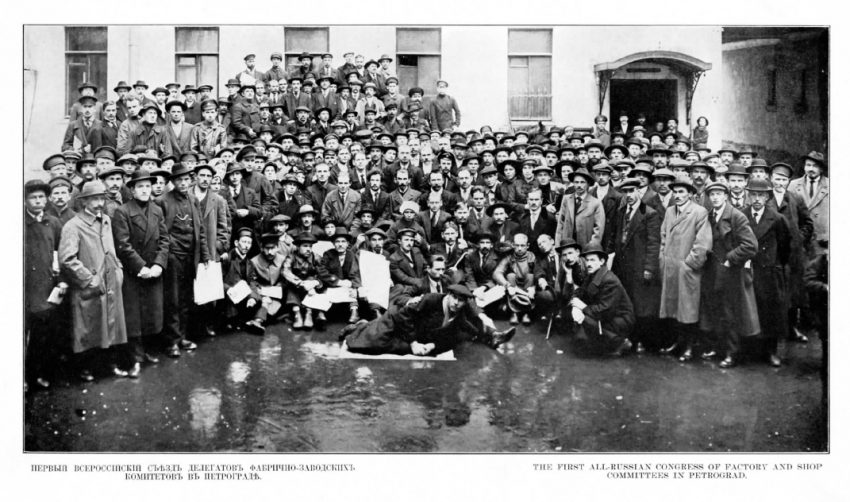
Album of Revolutionary Russia
Archivist’s notes:
This is a 14 inch x 11 inch book of black and white photographs, printed in relatively high resolution half tone fashion on one side only (other side is blank) on somewhat glossy, relatively robust, relatively archival paper. To be sure, the paper at this time (August 2016) is getting just slightly brittle toward the edges, and is very slightly yellowing around the edges as well.
There is no initial page informing when this was printed, or who printed it. There is also no table of contents, and indeed the pages do not bear any numbering. Our clues about it consist of the fact that none of the photos date from later than 1918, and it is in both Russian and in English. And the fact that V. Volodarsky is noted as having been assassinated in Petrograd in July of 1918
From this our consultants at the Riazanov Library digital archive project (John Holmes and Tim Davenport) speculate that it was printed in late 1918 or 1919 by either the Communist Party of America (CPA) or the Communist Labor Party (CLP) Russian Federation. After 1919 these would have been driven underground and would not have had the resources to print something like this.
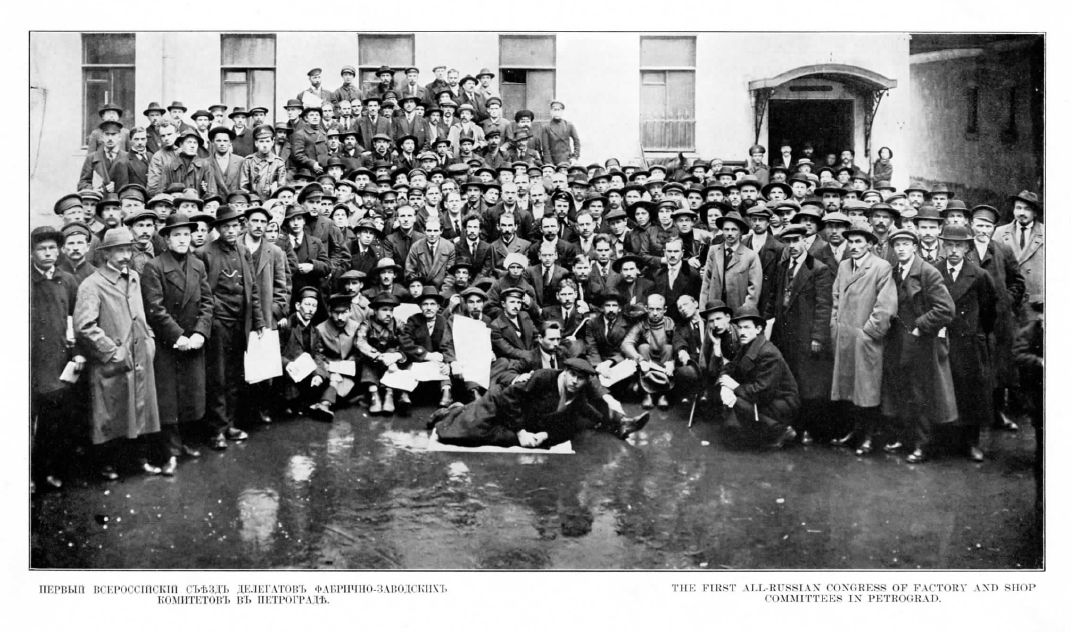
Rev-Russia-Photos-1918-200-dpi
“The Change in Cuban Journalism is Within Ourselves”
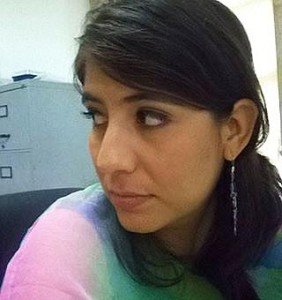

Karina Marrón: “The Change in Cuban Journalism is Within Ourselves”
By Karina Marrón, Chief of National Information, Granma daily
October 5, 2015, 8:58 PM
A CubaNews translation.
Edited by Walter Lippmann.
These are comments by Karina Marrón, who heads the paper’s national editorial staff.
At barely 30 years of age, leading the national news staff of the country´s highest-circulation newspaper is no easy task. Karina Marrón, who is head of the national news staff of Granma newspaper, can tell us about it because every day she faces the enormous challenge of trying to bring a balanced Cuba to its pages.
“It is not easy to fit into just eight pages our nuances plus characters, events, news from all provinces, recognition and criticism,” she assures me. But Karina does not give up her desire to transform Cuban journalism for the better from her daily space.
On the occasion of Granma’s 50th anniversary, we spoke with Karina regarding changes necessary for Cuban press and the challenges, challenges and opportunities for Granma in present-day Cuba.
Q: When you came to lead Granma´s national news staff you already had a record in the newspaper Ahora! Now, how much change and continuity was there between what you were doing –thinking mainly of Holguin– and what you began to conceive for the national audience?
“I started with Granma in October 2013 and although work on Ahora! was certainly a great school –due to the quality of the professionals with whom I worked and the concepts of journalism that have become a tradition in that newspaper– Granma was quite different.”
“If we talk about continuity, I think I can mention two fundamental things: being the official organ of the Cuban Communist Party –each medium adjusted to its aim– and the need to address issues that matter to the population. The challenge of reconciling both, of delving into the issues that people care about and doing so with the social responsibility that comes from being the official voice of the Party, that’s something I saw as continuity, even though, as I said, the scope is different.”
“When I think about change, I must necessarily refer to daily editing. It is not even remotely similar to work in a weekly. This is because, in a daily journal, even when you strive to have a good online edition of your newspaper, in our minds the printed paper is still the main media. So, I had to adapt to a different pace of work, different conceptions of space; to think about a country and not just one province, different relationships with information sources, and new styles of work.”
“In essence the job remains the same, because the work of any news media, even the smallest, implies preparing yourself to inform correctly, implies sacrificing to investigate and to finding the best way to say things. The big difference is the impact and what can be achieved through a media like Granma.“
Q: What was your relationship with the daily Granma before you joined it? The Granma that you used to read and the one which you are now part of; how much has the image of that paper changed in your mind?
“Honestly, I think I was pretty severe. As a reader and as a journalist I was full of dissatisfaction with what I read, and had many ideas about how it should be. I think I’m not alone in that. I think every person who reads Granma is like I used to be. This is because for those who read us –whether in print, in Granma International or on the Web– the battles fought internally every day to get the newspaper out are invisible and all that matters is the result.”
“People expect more and more of this newspaper; and that’s fine, because it means that people are still confident that we can meet their expectations. The issue, the challenge, is not to leave them wanting, not to fall too short of what people are expecting.”
“Now that I’m part of the newspaper team and specifically of its editorial board, I understand many things: the professional limitations, the mediations in the process of preparing the paper and even the material problems. But as I said, none of that can justify us before those who follow our publication in any of their presentations; and that’s what we can not lose sight of.”
“I think the Granma that I used to “see from the sidelines” and this one which I am part of right now are different. The Web version of the newspaper is perhaps the most notable example, not only because of its new image and the possibility of interacting with users through their comments, but also because of the way of understanding the news coverage of certain events. In the printed version, there are also differences, especially in the still hesitant approach to research, and the diversity of journalistic genres. They are different, but they’re still not the Granma I’d like to read. “
Q: In your opinion, how is the Cuba that Granma presents? What is the challenge of putting together each day a national newspaper? What are you proud of? What would you change?
I think the Cuba shown in Granma still lacks many nuances. Characters are missing and sometimes facts are missing. It is very difficult at times to reconcile all interests so that Cuba is shown in its entirety every day in those 8 pages. This is because the newspaper is not only the place where people look for information as an instrument in the ideological struggle waged by our country. It’s also a document that remains in history. But it is also seen by many people as a place of recognition. So everyone wants to see themselves there, but not in criticism.”
“And it is very complex because, on the one hand, people question why Granma mostly publishes articles on positive experiences in different sectors: agriculture, construction, health, education … when there are so many problems to solve. On the other hand they do not want us to stop recognizing their work.”
“I think that’s the hardest part to fill every day in a national newspaper: balance. To have the different provinces represented, to include criticism and recognition, so we can fulfill the task of informing and stimulating thought. That is a score that is not yet settled, because, when we have gotten closer we always find that something is missing. For example: chronicles or life stories, which are other ways of showing Cuba and that breathe so much life into a publication.”
“Personally, I am proud to belong to this group. It gives me great joy when we do something that is well-received by those who read us. No matter if it’s something from my staff, or from culture or internationals, because if there is something positive in Granma it is that there are no individual “beats”; what is most important is the newspaper, rather than your own signature on an article.”
“As for change … I would change many things. Some within Granma; others outside, but that also have an impact on what happens inside. However, there are changes that do not happen just because you want them to –all the more so when you are dealing with a newspaper. There are changes that depend on many people, and take time. So I think it’s best to change myself slowly (it’s hard to get rid of certain habits and ways of thinking) and to try to be part of that change in other people and things.”
Q: For several years, now the staff of Granma has been characterized by being eminently young. Can you describe the challenge of being a very young leader who works with so many young people? What role will they play in the kind of journalism that we are called upon to do?
“What is most complex is that you yourself are learning and sometimes you do not have much to teach. Although I graduated ten years ago, I do not think my past experience is enough to become the mentor that the young people I lead need or to be the guide they need to fully develop their potential. The shortcomings of the national news team today are my fault, my own shortcomings; and that is what I feel when any of my staff’s work is rejected.”
“But it’s very rewarding to work with young people, especially in these times when generational leaps are faster. At least, that is how I see it. Today a five year difference can be a huge gap in terms of the way we see the world. To work with those who view things differently can open my eyes to things I had not seen before. In journalism that seems fundamental.”
“As to the role they should play … I think it’s essentially the same: to speak with the voice of the times. Ideally, without losing this new voice –controversial and full of color that youth always has– Granma would reflect the very serious issues that it has to deal with on account of its role in Cuban society.”
Q: If I asked you for a kind of SWOT matrix with respect to Granma today, what strengths, weaknesses, opportunities and threats would you identify? How can we change it for the better? How would you like Granma to be in the next five years?
“It’s a fitting question for a thesis, but I will try to answer briefly on the basis of the analysis we have done within the editorial board of Granma.”
“Threats: unfair competition from the so-called alternative media, both printed and digital, which offer better economic compensation and do not have the editorial pressure of the official media. To this I could add the inconsistencies in the information policy of the country, and the general absence of a culture of communication on a societal scale (hence the excessive secrecy and excessive regulation, etc.).”
“Weaknesses… Lack of professionalism and continuous emigration of an important part of young, trained journalists for a number of reasons. There are also the material limitations which we cannot overcome. This is coupled with a limited administrative autonomy (believe me… this also has a bearing on the newspaper we make).”
“These are just two, but I could mention others such as insufficient readership studies to know our public, generational gaps that exist in our newsrooms, self-limitations and lack of self-preparation by some professionals, not just journalists.”
“As for the strengths … Having achieved a system of collective leadership in decision-making and a growing collective construction of the media’s agenda which takes into very serious account the interaction with its readers. Furthermore, it is also very positive to have a Web page that technically allows us to be “up-to-date” with what goes on in the world of hyper-media journalism. There is also an understanding of the need for convergence between the traditional and the digital media.”
“If we consider the opportunity of having professionals who are mostly willing to make the changes and the training to do so –especially young people– then arguably part of the way towards the transformation we want is clear. But of course, there are things that do not depend on Granma, and these are matters of time and effort. And finding the way to do it, which is not always as easy as identifying problems.”
Q: For several years you´ve had the blog “Espacio Libre [Free Space]”, which is well-liked. I see that you haven’t written for some months. What is the relationship between Karina the blogger and the Karina who carries a national newspaper on her shoulders? What is the contribution of the blogosphere to the journalism we build in the media?
“Blogger Karina has many debts to those who read her, because I dedicate a lot of time to the newspaper and the blog is the most affected by that. On the other hand, I have run into an ethical dilemma, because when I want to write something for the blog I immediately think: why don’t I write about that for Granma?”
“Sometimes one is seduced by the magic of the fact that on the blog you’re the journalist, the editor, the one who dictates the information policies, the editorials and the writing manuals and therefore it is somewhat easier to write about anything. You don´t even have to convince those who read you. In the end, whoever comes to your blog knows in advance that he or she will find their personal criteria and they can share it or not, but that is your very own space to comment.”
“A public media like Granma has to respect its public service and, therefore, even if you are giving an opinion, you are obliged to present arguments; to think carefully what you want to convey to your readers; what use they can find in what you do. It is not a space for personal catharsis.”
“That’s why I was talking about an ethical dilemma, because if I want to write about something controversial in my blog, for instance, I always ask myself why not do it for the newspaper, which also needs these things. Often these ideas end in stories I ask my own reporters to cover because I realize that for Granma, I can’t present certain subjects with just my limited personal perspective. Thus, the blog has been going dry or includes texts that are closer to my experiences as an individual than to journalism.”
“That competition between Karina the blogger and the editor, I think, is one of the main contributions that the blogosphere makes to journalism today: to show all roads that are still untravelled. If the media tapped more into the multiple voices that are there, either to nourish ourselves with issues, or even publishing the best that we find in the blogs, Cuban journalism would breathe fresher air.”
Q: As for the debate on the need for a change in the Cuban press: What role do you see for ethics, the participation and leadership of young people in the journalism that we all want to see? What can we ourselves do?
“I think that if there is something that those of us who work in the media and the population agree on is that the Cuban press must change. Better yet, I would say that the system of the press in Cuba must change. Now then, in that change ethics is essential.”
“We want a press that has nuances, colors, where each publication is distinguished by its exclusive content, and that is closer to the people. However, to achieve this goal we cannot become frivolous, sensationalist tabloids. Ethics is the only thing that can save us when we fail to see clearly the boundaries between achieving a product that is attractive, even entertaining, and entertainment per se, i.e., populism.”
“The Cuban press has a tradition of defending truth, of patriotism: and, although this can sound like a “spiel” to some, I think they are values that we can never forget.”
“And it is also ethical to prepare every day to do a better job in the media; to fight against those who want to hide information … So for me any path toward change must be linked to ethics.”
“Furthermore, in that change, young people are the key, because they have the strength, the momentum, the new knowledge and the time to go tearing down walls. But first they must feel the commitment to do so.”
“Today’s world promotes many different ways of disconnection, of individualism. There are many people waiting for the guy next to them to resolve the problems that affect us all while they care only about their own. I think the first thing we can do is begin to realize that change is also in us and we must join forces with those who think alike. Only then will we be taking the step in the right direction. At least that is the way I see it, and I try.”
Source: María del Carmen Ramon – Cubahora
The American People Will Have the Final Word
The American People Will Have the Final Word
By Manuel E. Yepe
Exclusive for the daily Por Esto! of Merida, Mexico.
A CubaNews translation.
Edited by Walter Lippmann.
Humanity has lost all hope that the end of the Cold War would open the way to a world without wars. A galloping race along the paths of neoliberal globalization has turned imperialism into the dark reality it is today: the mightiest, most brutal and ruthless hegemonic superpower in the history of humanity, bearer of the greatest dangers to the survival of our species.
Seventy years ago, humanity placed its hopes in the United Nations to be the promoter and guarantor of world peace. At the Millennium Summit, the states represented there solemnly announced their decision to establish a just and lasting peace, worldwide, in accordance with the purposes and principles of the Charter.
Yet, only two and a half years after this oath, the aggression against Iraq was perpetrated. This was not only against the opinion of the peoples of the world, but, despite the express opposition of the overwhelming majority of governments comprising the international community. The Security Council was ignored and later on suffered the humiliation of docilely accepting a war of pillage which the majority of its members had previously opposed.
The precarious balance of forces of the bipolar world we lived in after World War II prevented US imperialism from imposing its absolute hegemony worldwide based on the nuclear blackmail that the US began after its genocidal bombings on Hiroshima and Nagasaki.
The unipolar world that resulted after the disappearance of the Soviet Union, with a single superpower imposing its selfish interests on the rest of the planet, starkly confirmed the predatory nature of the prevailing capitalist order and the vital need for its replacement by a new, just, and humane order.
Neoliberal capitalism –with its proclamation of the market and not the human being as the measuring rod for the performance of society– has increased human misery, while neoliberal globalization has widened inequality universally.
A constant generator of crises, the capitalist order tries to ignore that it is the asymmetries that cause them, and always manages to pile their calamitous effects on the workers and humble people of the planet.
It grossly ignores the sovereignty of nations and imposes genocidal blockades with no other pretexts than its own will and the alleged interests of the superpower.
In order to control the energy resources of the planet, the capitalist rulers use –with absolute disregard for human intelligence– ridiculous pretexts such as the fight against drugs or terrorism or violations of human rights. They demonize those nations whose governments do not unconditionally submit to the imperial dictates of the superpower, through an extensive and intensive use of the mass media worldwide. Natural and human resources are irresponsibly exploited, deeply traumatizing future generations.
But what is most terrible is that it is common knowledge that, with the scientific and technical progress attained by human beings –capable of producing colossal wealth– many or all of the terrible problems that have three-quarters of humanity mired in poverty, could be solved if such progress were focused on development goals and the fair distribution of wealth,
Asymmetrical wars that overlook the principles, agreements and regulations of the United Nations continue to be waged. The richest and most powerful countries manipulate at will such principles as respect for human rights and individual freedoms enshrined in the United Nations Charter and international treaties.
In the decades of the 1970s and 80s of last century in Latin America the monstrous Operation Condor murdered, tortured, mutilated or disappeared a still unknown number –which runs into the hundreds of thousands– of progressive and independent-thinking people in almost all countries of the region. That infamous operation was organized and directed by the Central Intelligence Agency of the United States through the military governments they imposed in many countries of the hemisphere or through recruited mercenary agents acting in nations where they had not been able to dismantle the entire democratic order.
It has been said many times that the people of the United States of America are the only ones who can perform the Herculean feat of bringing down the most powerful and murderous empire ever known to mankind.
The whole of humanity anxiously waits to see the people of the US take action. It will then offer them the solidarity they will deserve!
July 27, 2016.
Notes of A Veteran Fidelista
Notes of a Veteran Fidelista
By Ricardo Alarcón de Quesada
A CubaNews translation.
Edited by Walter Lippmann.
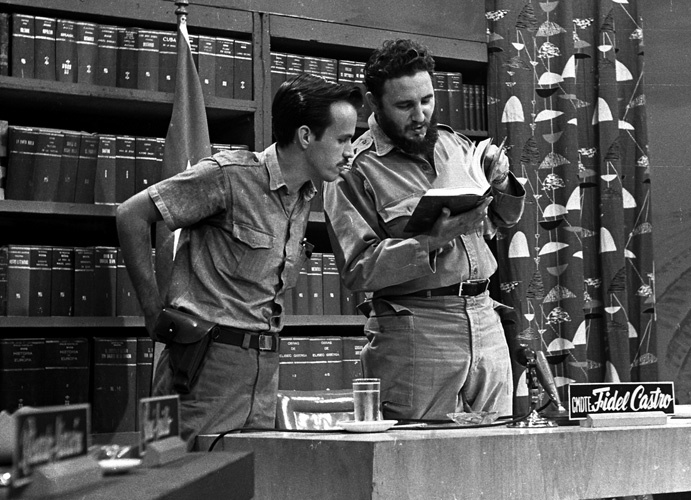
Ricardo Alarcón and Fidel Castro Ruz, Popular University Program, circa 1960- Photo: Liborio Noval.
On March 10, 1952, with a door slam, a chapter of Cuban history came to a close. Fulgencio Batista –who, two decades before, had introduced a harsh dictatorship– seized power once again with a handful of his former collaborators had liquidated the revolutionary government of just one hundred days which had emerged in 1933 after the fall of Gerardo Machado. The new coup took place without major setbacks and thus ended Cuba’s brief experience with “representative democracy”. This had lasted for only two terms of the Cuban Revolutionary Party (Autentico), which had governed for little more than seven years.
The “Autentico” Party presented itself as heir to the Revolution of 1933, in which its leaders had had played an outstanding role, but did not go beyond national-reformism, creating some necessary institutions and showing an independent foreign policy on some important issues at the UN and the OAS. Its work was, however, hampered by government corruption which invaded almost all branches of the administration. Besides, its adherence to McCarthyism led to the division among the trade union and popular movement, and the assassination of some of its main leaders.
The prevailing dishonesty caused the split in the “Autentico” Party and the emergence of the Cuban People’s Party (Orthodox) which raised the slogan “Vergüenza contra Dinero [Shame against money]” as its main banner. Among its founders was a recently graduated lawyer named Fidel Castro Ruz.
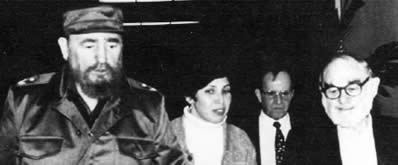
Fidel Castro, Juana Vera, Victor Rabinowitz and the author in Havana.
The general elections scheduled for June 1952, brought face-to-face, according to all polls, two candidates: the “orthodox”, headed by a respected university professor [Roberto Agramonte], and the government official, led by an “autentico” whose honesty was beyond doubt. A third candidate, Batista, supported by reactionary groups, appeared in a distant last place and no one gave him the slightest chance of winning in the polls. Everyone in Cuba knew this, including Batista who, for that reason, prevented the people from deciding.
The coup and its immediate aftermath deeply wounded Cuban society. Batista received immediate support from the big property owners as well as from the conservative political forces and corrupt trade union bureaucracy. Political parties –the ones close to the government as well their opponents– were trapped in inaction and inconsistency. Authenticism and orthodoxy were divided into contradictory trends and new parties emerged from them; some willing to collaborate or compromise with the new regime. These and all other parties engaged in endless controversies unable to articulate a path against tyranny.
Resistance found refuge in the universities. Out of these came the first demonstrations and acts of protest. Among the students there was a growing awareness of the need to act and to do so using methods different from those of the politicians who had failed miserably. There was talk of armed struggle, but nobody knew how to wage it or had the resources to undertake it. There were some isolated attempts while rumors spread about plans led or linked to the president overthrown on March 10.
For those of us who were still in secondary education, the assault on the military barracks in Santiago de Cuba (Moncada) and Bayamo (Carlos Manuel de Cespedes), on July 26, 1953, was a complete surprise. We knew nothing of an event that would change our lives forever.
The news highlighted the name of someone previously unknown to us: Fidel Castro.
The political crisis deepened. The tyranny became even more aggressive. The Communist Party (Partido Socialista Popular [Socialist People’s Party]) was banned and its publications closed, while increased repression against the student movement became the norm. Batista’s accusations against the Communists sought the sympathy of Washington, but had nothing to do with reality. The PSP was not only alien to those events, but rather condemned the action of the young revolutionaries as did the other opponents to Batista, almost without exception.
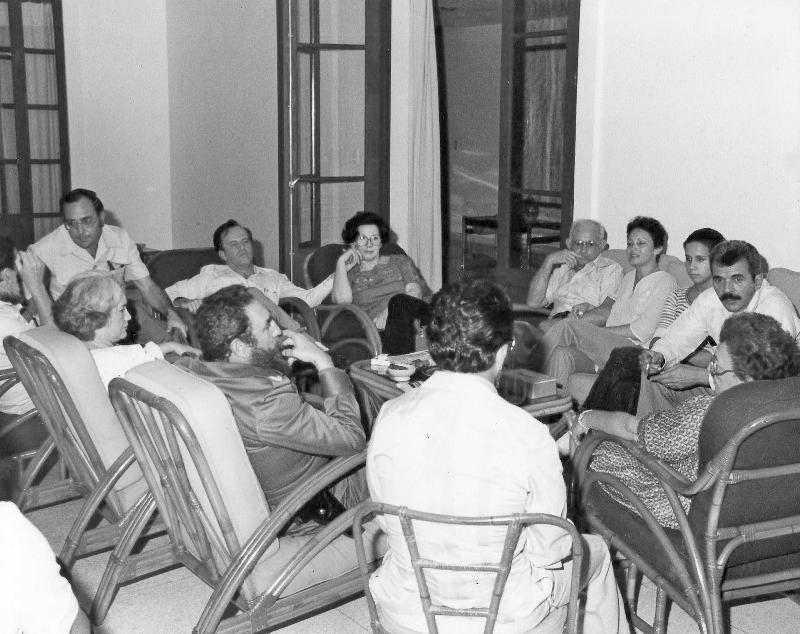
With Puerto Rican Independentists, Lolita Lebrón, Rafael Cancel Miranda, Irving Flores and Oscar Collazo, Havana 1979.
Once again it fell to the students to replace the parties that had proved incapable of fulfilling their role. The Federation of University Students (FEU) sympathized with the attackers of the Moncada garrison and called for a campaign for their release. This soon acquired a national dimension and forced the dictatorship to grant them amnesty in 1955.
That same year, Fidel founded the July 26th Movement. Along with the survivors of the initial action, it counted especially on young people who, in neighborhoods and study centers, identified themselves with that heroic deed against tirades and criticism from Tiryns and Trojans.
Their ranks were filled with youths, no few of them teenagers, who rebelled amid frustration, inertia and division, inspired by a feat that had shaken the tyranny and its opponents as well. Antonio López (Ñico), who had led the attack on the barracks in Bayamo, was responsible for organizing the youth brigades of the M-26-7 until he went to Mexico to return with Fidel and die fighting in the Sierra Maestra. He was replaced in Havana by Gerardo Abreu (Fontán), a black man of very humble origin, who had not completed primary school. He managed, on his own, to acquire a broad cultural background and a poetic sensibility that caused astonishment among us college students who had the privilege of fighting under his leadership. Ñico and Fontán –both from the Orthodox Youth– knew Marxism, shared socialist ideals, and were profoundly anti-imperialist. They were determined to create an organization that would massively bring in the new generation. They succeeded. Their followers were identified with a single word: “fidelistas”.
The presence of the Brigades was felt quickly by sending their message directly to the people. While the press and politicians criticized Fidel and the Moncada action, everywhere, in every corner of the capital –on walls and facades– using very modest resources, Brigade members painted a brief slogan which everyone understood: M-26-7, or a name that others wanted to silence: Fidel.
In view of the hostile environment which made it impossible to wage open political struggle, Fidel went to Mexico in order to organize the return to carry out the battle that would end the tyranny. He proclaimed it openly, undertaking a historic commitment: “In ’56, we will be free or we will be martyrs” thus challenging the followers of inaction and despair once again. And also their jokes: a government newspaper carried on its front page every day the number of days which had elapsed that year without the defiant promise being kept. 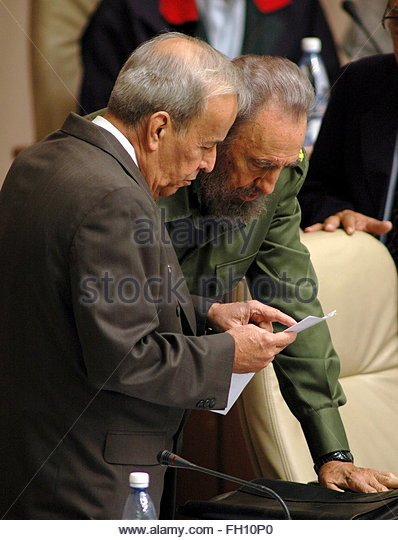
Well into November, the propaganda against the Moncadistas intensified. Demonstrations, organized by the FEU and the newly created Revolutionary Directorate, climaxed and led to the closure of the university. The last day of the month, to support the landing [of the Granma expedition], the M-26-7 carried out an uprising in Santiago de Cuba. Two days later Fidel and his companions arrived at the eastern shores aboard the yacht Granma, in what Che described as a “shipwreck”.
Scattered and persecuted by the Army, a small group finally managed to reunite in the Sierra Maestra. Many members of the expedition died fighting, or were assassinated.
Among these, as the US news agencies reported, was its main leader. Fidel’s death was reported on the front page of every newspaper. Anguish and uncertainty remained until after a passage of time that seemed endless. Gradually and by clandestine channels, the truth came to be known.
The last two years of the dictatorship were rife with crimes and abuses in the urban areas while the initial guerrilla force grew to become the Rebel Army.
“Fidelismo” reached massiveness. On the night of November 8, 1957, one hundred simultaneous explosions rocked Havana, each in a different neighborhood and distant from one another. They were practically heavy firecrackers –rather homemade devices– that only made noise. No one was injured and no one was arrested by the police who went around frantically from one place to the other. It was sound evidence that the “26th” was everywhere and showed the youth brigades’ efficient organization.
The murder of Fontan, on February 7, 1958, sparked a students’ general strike which lasted until May. It paralyzed all education centers, including private universities and academies, and led to the consecutive resignations of two of Batista’s Education Ministers of Batista.
Never before had such a movement occurred in Cuba to such extent and for so long. For three months, all attempts, violent or “peaceful” to end it failed. The student walkout continued, even several weeks after the movement suffered in its most painful and bloody defeat in Havana.
The failure of the attempted general strike by the workers, on April 9, was a very severe blow. It decimated urban militancy, almost completely destroyed the underground structures, and allowed the dictatorship to mobilize thousands of troops to launch what it thought would be the final battle in the Sierra. Once again everything depended on Fidel and his leadership.
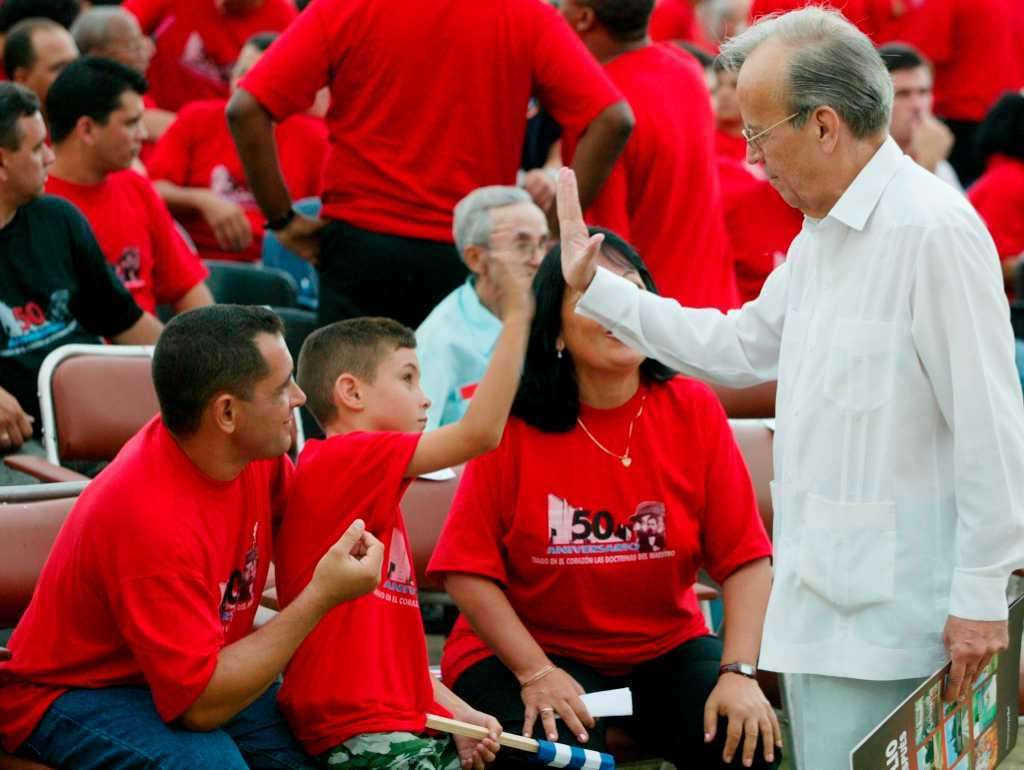
PHOTO Elian and Juan Miguel Gonzalez, at the Celebration of the 50th Anniversary of the Moncada assault.
Batista’s offensive proved a complete failure. The Rebel Army –well-established in the East– sent two columns led by Che and Camilo Cienfuegos, which crossed half the island and won many battles in its central region. The rebels were close to liberating the cities of Santiago de Cuba and Santa Clara. The last day of December, the dictator arranged his escape and –in close coordination with the US Ambassador– left behind a military junta in Havana that would have been the continuity of his regime. To thwart the maneuver, Fidel called for a general strike.
In the early hours of the first day of the New Year, the people took over the streets in the capital. The youth brigades –almost totally unarmed– occupied all police stations without meeting resistance from the demoralized and nervous troops of the regime. However, in other parts of the city, armed paramilitary groups of Batista henchmen had to be confronted. The strike continued until the total collapse of the tyranny. On January 8, Fidel rode triumphantly into a city that was already and finally “Fidelista”.
The victorious Revolution would have to face more powerful obstacles and even greater risks for over half a century: Political, diplomatic and propaganda aggression, armed attacks, subversion and sabotage, and the economic blockade that is still ongoing and is the longest genocide in history. Another blow was the collapse of the U.S.S.R. and the disappearance of allies and trading partners plus the complete isolation of the island. It has been a long and stormy path that the people have weathered under Fidel’s guidance.
Ninety years of age has now come to the man who had to face more than six hundred assassination plots against his life and whose death has been announced countless times by imperialist propaganda. Maybe someday his enemies will have to admit that they were never able to kill him. This is because Fidel and his people are one and the same. And that people, largely thanks to him, is invincible.
Racial Gap Deepens in the United States
- English
- Español
Racial Gap Deepens in the United States
By Manuel E. Yepe
http://manuelyepe.wordpress.com/
Exclusive for daily POR ESTO! of Mérida, México.
A CubaNews translation.
Edited by Walter Lippmann.
Race relations have worsened in the United States since Donald Trump’s electoral campaign began. With his recent confirmation as the Republican presidential candidate, this deterioration appears to have reached a critical state.
Upon accepting the presidential nomination at the National Republican Convention in Cleveland, Trump described himself as the “law-and-order candidate”, and declared he was ready to restore in the country a security “that is out of control and needs a leader” capable of implementing sharp measures to protect Americans.
“The first task of my new administration will be to relieve our citizens from the crime, terrorism and anarchy that threaten their communities,” he said.” I have a message for every person who threatens peace in our streets and the safety of our police: when I take office next year: I will restore law and order in our country”.
Appealing to the anguish of the voters who feel that the rest of the world no longer respects the United States, Trump pledged to act quickly so that Americans feel better about the sad image their country projects. He promised to warn allies and enemies that Washington would focus exclusively on protecting US’s own interests.
Without softening his tone, or departing from the hardline that has characterized his campaign, Trump described Americans as victims of immigrants, international companies and irresponsible leaders. He presented himself as the defender of the “forgotten men and women in our country”.
By explicitly affirming white identity and voicing the most widespread complaints, Trump has galvanized the marginal world of white nationalists who describe themselves as “racial realists”. They hail him as the man who has helped millions of white Americans to understand that race should matter to them as much as to everyone else.
The pro-Trump activists say he has freed Americans to say what they really think. A survey conducted by CBS News in April showed that half of those surveyed admitted there is a problem and more than 60% considered that race relations had worsened.
More recently, an investigation conducted nationally by the Pew Research Center of Washington, DC (PEW) between June 5 and July 7, involving 4,602 adults, showed that black and white Americans have profoundly different views on racial equality, and they also differ on the extent to which a person’s race can be a burden or a benefit.
For blacks, the answer is clear: 65% say “it is a lot more difficult to be black in this country than it is to be white.”
Fewer than half as many whites (27%) agree. The racial gap in perception of white advantages is even starker: 62% of blacks say “white people benefit a great deal from advantages in society that black people do not have.” Just 13% of whites say whites have benefited a great deal from advantages that blacks lack.
Commenting on the evidence of this study on perception of race advantages or disadvantages, PEW researcher Shiva Maniam wrote on July 18 that among Latinos, 37% say it is lot more difficult to be black than white, which is higher than the share of whites who say this but far lower than the number of blacks who do so.
Most Latinos say white people benefit from advantages in society that blacks do not have; 33% say whites benefit a great deal from these circumstances, compared with 62% of blacks and 13% of whites.
About the perception of how blacks are treated in different areas, another recent survey revealed that most blacks believe they are treated less fairly than whites in dealing with the police, in the courts, when applying for a loan or mortgage, and in the workplace. At least four out of ten interviewed said that blacks receive much worse treatment in stores and restaurants and when voting in elections.
July 22, 2016.
SE AHONDA LA BRECHA RACIAL EN EE.UU.
Por Manuel E. Yepe
http://manuelyepe.wordpress.com/
Exclusivo para el diario POR ESTO! de Mérida, México.
Las relaciones raciales han empeorado en Estados Unidos desde quecomenzó la campaña electoral de Donald Trump y con su recienteconfirmación como candidato republicano a la presidencia de lanación este deterioro parece haber alcanzado un estado crítico.
Al aceptar en Cleveland la nominación presidencial en la ConvenciónNacional Republicana, Trump se describió a sí mismo como el “candidatode la ley y el orden” y se declaró dispuesto a restaurar la seguridaddel país, “que está fuera de control y necesita un líder” capaz deimplementar medidas tajantes para proteger a los estadounidenses.“La primera tarea de mi nueva administración será liberar a nuestrosciudadanos de la delincuencia, el terrorismo y la anarquía queamenazan a sus comunidades”, dijo.
“Tengo un mensaje para cada persona que amenaza la paz en nuestrascalles y la seguridad de nuestros policías: cuando tome posesión delcargo el próximo año, voy a restaurar la ley y el orden en nuestropaís”.
Apelando a la angustia de los votantes que sienten que el resto delmundo ya no respeta a Estados Unidos, Trump se comprometió a actuarcon rapidez para que los estadounidenses se sientan mejor sobre latriste imagen que proyecta su país y prometió que advertirá a aliadosy enemigos que Washington en lo adelante se centrará exclusivamente enla protección de sus propios intereses.
Sin suavizar su tono ni apartarse de la línea dura que hacaracterizado su campaña, Trump describió a los estadounidenses comovíctimas de los inmigrantes, las empresas internacionales y loslíderes irresponsables, y se presentó como el defensor de los “hombresy mujeres olvidados de nuestro país”.
Al afirmar de manera explícita la identidad blanca y hacerse eco delas quejas más generalizadas, Trump ha galvanizado el mundo marginalde quienes se declaran nacionalistas blancos y se describen a símismos como “realistas raciales”.
Ellos lo aclaman como el hombre que ha logrado que millones deestadounidenses blancos entiendan que la raza les debe importar tantocomo a todos los demás. Los activistas pro-Trump dicen que él haliberado a los estadounidenses para que digan lo que realmentepiensan.
En una encuesta realizada en abril por la cadena CBS News, casi lamitad de los consultados admitió esa problemática y más del 60 %consideró que las relaciones raciales empeoraban.
Más recientemente, en una pesquisa llevada a cabo a nivel nacional porel Centro Pew de Investigaciones, de Washington, DC (PEW) entre el 5de junio y el 7 de julio con participación de 4.602 adultos, se pusode manifiesto que los estadounidenses blancos y negros tienen puntosde vista sumamente diferentes acerca de la igualdad racial y quetambién difieren en cuanto a la medida en que la raza de una personapuede serle una carga o un beneficio.
Para los negros, la respuesta es clara. El 65% dice que en EstadosUnidos “es mucho más difícil ser negro que ser blanco”. Solo el 27% delos blancos coincide en este aserto.
La brecha racial en la percepción de las ventajas del blanco sobre elnegro es también significativa. El 62% de los encuestados negrossostiene que “la gente blanca se beneficia de muchas ventajas que lesofrece la sociedad que no tienen los negros”. Sólo el 13% de losblancos admite que los de su raza se beneficien mucho de ventajas delas que carecen los negros.
Comentando las evidencias de esta investigación sobre quienes sonayudados o perjudicados por su raza, Shiva Maniam, investigadorasistente de PEW escribió el 18 de julio que entre los hispanos, 37%señala que es mucho más difícil ser negro que ser blanco, pero essuperior la proporción de blancos que así piensan y mucho menor elnúmero de negros que lo hacen. La mayoría de los hispanos apunta quelos blancos se benefician de ventajas en la sociedad que los negros notienen; 33% dice que los blancos se benefician mucho de estascircunstancias, proporción que se eleva al 62% de los negros y un 13%de los blancos a nivel de la nación.
Acerca de la percepción de cómo son tratados los negros en diferentesáreas, otra encuesta reciente reveló que la mayoría de los negrosafirma que recibe un trato menos justo que los blancos en su relacióncon la policía, en los tribunales, al solicitar un préstamo o unahipoteca y en su centro de trabajo. Por lo menos cuatro de cada diezentrevistados dijeron que los negros reciben un trato bastante peor entiendas o restaurantes, así como al votar en las elecciones.
Julio 22 de 2016.
You must be logged in to post a comment.