REVIEW: Vicki Huddleston’s Cuba memoir
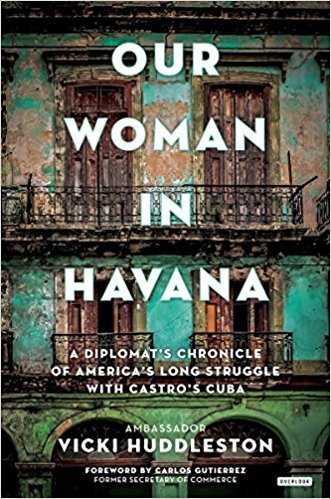
Comments by By Dr. Néstor García Iturbe Translated and edited for CubaNews The first commentary on this book refers to what is printed on the cover as it is announced as “a diplomat´s chronicle of America´s long struggle with Castrós Cuba”, which does not reflect the reality of what is presented in the book. Part 1 of the book recounts Vicki Huddleston’s stay at the State Department’s Office of Cuban Affairs from 1989 to 1993. In referring to this stage, the author failed to take into account 30 years of aggression by the United States against Cuba, including the beginning and strengthening of the economic blockade, the invasion by the Bay of Pigs, the Missile Crisis and the thousands of terrorist activities and sabotage that Cuba suffered during those thirty years. That’s actually an important part of “Americás long struggle with Castro´s Cuba.” The correct thing would have been for the cover to show that the chronicle to which reference is made only from 1989 onwards, since in the way it is written it seems to have been written to cover the whole period since the beginning of the Cuban Revolution. In the first chapter she gives us a sample of the alliance between the U.S. government with the worst of the Cuban exiles, mainly with the Cuban American National Foundation and the Brothers to the Rescue [BTTR]. It presents the latter as an almost philanthropic organization dedicated to rescuing rafters, when it repeatedly violated Cuban airspace to launch propaganda and explosive devices. The author herself reports that, as a State Department official, in some of these violations of Cuban airspace, she travelled as a passenger on one of the BTTR planes. This is an example of something that an U.S. government official is not supposed to do. In her book, Mrs. Huddleston tries to describe, according to her, the police regime in Cuba, especially organized by the State Security, which she says does not miss any movement of foreign diplomats. Assuming that the author was totally convinced of what she said, we could describe what she sees as naïve during Illinois Governor George Ryan’s visit to Cuba. She states that during his stay she prepared a meeting attended by various ambassadors, and several of the so-called “dissidents”. And that in order to be able to speak freely, at the end of the meal she offered in her home, she waited for the servants to leave the room where they were gathered to begin the testimonies and opinions of each of them. If Cuban security has such a broad and efficient control, how many microphones would there be in the premises selected by Mrs. Huddleston to hold the secret meeting? The interference in Cuba’s internal affairs is also recognized by the former ambassador, when in a meeting with Colin Powell, she told him how she carried out actions with dissident groups, private libraries and independent journalists, adding that if they had more resources they would do much more. What would be the attitude of the U.S. government if Cuba or another nation were to begin to foment opposition for the purpose of overthrowing the established regime? Is that the right attitude of a diplomat representing his country to another? The book, at least, gathers the maneuvers and activities carried out by the United States against Cuba in order to destroy the Cuban Revolution. A true compendium of illegalities, dirty maneuvers, violations of diplomatic law, conspiracies and interference by the United States in Cuba’s internal affairs. A better title for the book would have been “Our Crook in Havana”. June 6, 2018
Comentarios del Dr. Néstor García Iturbe El primer comentario sobre este libro se refiere a lo que tiene impreso en la cubierta pues se anuncia como “a diplomat´s chronicle of America´s long struggle with Castrós Cuba”, lo cual no refleja la realidad de lo que se expone en el libro. La parte 1 del mencionado libro relata la estancia de Vicki Huddleston en la oficina de Asuntos Cubanos del Departamento de Estado a partir de 1989 hasta 1993. Al referirse a esa etapa el autor ha dejado de tomar en consideración 30 años de agresiones de Estados Unidos hacia Cuba, lo que incluye el inicio y fortalecimiento del bloqueo económico, la invasión por Bahía de Cochinos, la Crisis de los Misiles y miles de actividades terroristas y sabotajes que durante esos treinta años Cuba sufrió. Esa es en realidad una parte importante de “Americás long struggle with Castro´s Cuba.” Lo correcto hubiera sido que en la cubierta apareciera que la crónica a la que se hace referencia e solamente a partir de 1989, pues en la forma en que está redactado parece que fuera durante todo el período desde el inicio de la Revolución Cubana. En el primer capítulo nos da una muestra de la alianza del gobierno estadounidense con lo peor del exilio cubano, principalmente con la Fundación Nacional Cubano Americana y con los Hermanos al Rescate mostrando estos últimos como una organización casi filantrópica dedicada rescatar balseros, cuando la misma en repetidas oportunidades violó el espacio aéreo cubano para lanzar propaganda y artefactos explosivos. La propia autora relata que siendo funcionaria del Departamento de Estado, en algunas de esas violaciones del espacio aéreo cubano viajó como pasajera en uno de los aviones. Una muestra de algo que supuestamente no debe hacer un funcionario oficial del gobierno estadounidense. En su libro la señora Huddleston trata de describir, según ella, el régimen policiaco en que se vive en Cuba especialmente organizado por la Seguridad del Estado, que según ella no le pierde movimiento alguno a los diplomáticos. Partiendo de que la autora estuviera totalmente convencida de lo que dice, pudiéramos calificar de ingenuo lo que describe durante la visita a Cuba del Gobernador George Ryan. Plantea que durante la estancia del mismo preparó una reunión a la que asistieron distintos embajadores, varios de los llamados “disidentes” y que para poder hablar libremente, al terminar la comida que ofreció en su casa, esperó a que los sirviente abandonaran la habitación donde estaban reunidos para comenzar los testimonios y opiniones de cada uno. ¿Si la seguridad cubana tiene un control tan amplio y eficiente, cuantos micrófonos habría en el local seleccionado por la señora HUDDLESTON para efectuar la reunión secreta? La injerencia en los asuntos internos de Cuba también es reconocida por la ex embajadora, cuando en una reunión con Collin Powell, le relataba como realizaba acciones con grupos disidentes, bibliotecas privadas y periodistas independientes, agregando que si tuvieran mas recursos harían mucho mas actividades. ¿Cuál sería la actitud del gobierno de Estados Unidos si Cuba u otra nación comenzara a fomentar la oposición con el propósito de derrocar el régimen establecido? ¿Es esa la actitud correcta de un diplomático que representa a su país ante otro? El libro, al menos, recoge las maniobras y actividades realizadas por Estados Unidos contra Cuba con el fin de destruir la Revolución Cubana. Un verdadero compendio de ilegalidades, maniobras sucias, violaciones a lo establecido en el Derecho Diplomático, conspiraciones e injerencia por parte de Estados Unidos en los asuntos internos de Cuba. El mejor titulo para el libro “Our crook in Havana. 6 de junio 2018
Our Woman in Havana by Vicki Huddleston
by Walter Lippmann.
Our Woman in Havana por Vicki Huddleston
Where Will US Domestic Politics Go?
Where Will US Domestic Politics Go?
By Manuel E. Yepe
http://manuelyepe.wordpress.com/
Exclusive for the daily POR ESTO! of Merida, Mexico.
Translated and edited by Walter Lippmann.
The surprising performance of veteran Senator Bernie Sanders in the 2016 presidential elections and the disappointing performance at the top post by the unpredictable Donald Trump have stimulated a very large part of the US public – especially (but not only) Democratic Party supporters – to believe that the United States needs a Sanders and a new party.
Many of those who reason in this way believe that the old Vermont politician should take up the challenge to defeat Trump in 2020, with or without the backing of the machinery of the historic “donkey” party. Others feel that the energy of a younger leader who would take up the ideological banner of the old Sanders, with the support of a new party with or without Bernie, should be available.
These and many other variations have in common the assumption that the current President Donald Trump has already dug the grave of the Republican party and his own with his performance in the first two years of his catastrophic term.
According to the most credible polls, about 60% of U.S. voters in general, and nearly 80% of those who are not affiliated with either of the two major parties, are in favor of the emergence of a new party of majorities.
Writing in the Huffington Post, September 27 of last year, writer and journalist Gail Mellor quoted Sanders’ words calling for “the unity of the vast majority of Americans to survive together, because if we start divided, we will not succeed”. However, she recalls that at least four times in the last two years, when she has been ready to start up a new progressive party, it has been Bernie himself who has blocked it.
According to Mellor, Sanders has been working to unify the deeply-divided and corrupt Democratic party – to which he himself does not belong – but, in practice, his position has not contributed to the rise of a new progressive political force with the potential to come to the forefront of the country’s leadership. This is because he has insisted on the survival of the Democratic Party with a different set of policies as a prerequisite.
The main support Bernie Sanders had when he aspired to the White House came from “Generation Y,” also called “the millennials,” names demographers and researchers give to people born between 1980 and the early years of the new 21st century, who represent 28% of United States voters today.
He sought the Democratic presidential nomination in 2016 because young progressives from that party dragged him into an effort to clean up U.S. politics, end ongoing wars, restore social safety nets and confront climate change. They had not been able to recruit someone at the national level of the Democratic or Republican parties to lead the fight for this agenda who was not receiving money from global corporations.
Sanders, an independent (non-partisan), had held state and federal office without party or corporate backing for 42 years. Despite being a convincing, passionate and well-informed politician, he was a stranger at the national level.
It was the millennials of the Democratic Party and its environment, the supporters of the country’s withdrawal from imperialist activity, of a policy of cultural and political change, and of the reorientation toward social democracy, who made him a national public figure and led him to compete for the Democratic Party’s nomination for the White House.
Although formally independent, Bernie acted as a Democrat because he was aware that the two dominant parties of the system had closed access to the Presidency of the nation to anyone who did not do so through them. The Democrats welcomed Sanders as their candidate because he gave the party’s primary campaign an illusion of competition that would help its already elected candidate to legitimize herself.
The Democratic National Committee (DNC) calculated that Hillary Clinton would easily beat Trump because she had a huge amount of corporate money, while Sanders, with the support of young progressives, was able to gather, in a short time, large crowds for Hillary Clinton campaign rallies.
It seems obvious that Sanders dreams of the possibility of taking the Democratic Party over, at the head of a vigorous minority movement. This would not be an easy thing to achieve but there remains the alternative, feared by the neoliberals of the party, of going on to the formation of a new independent progressive party.
June 4, 2018.
MDC Meets Jeff Flake and Google President
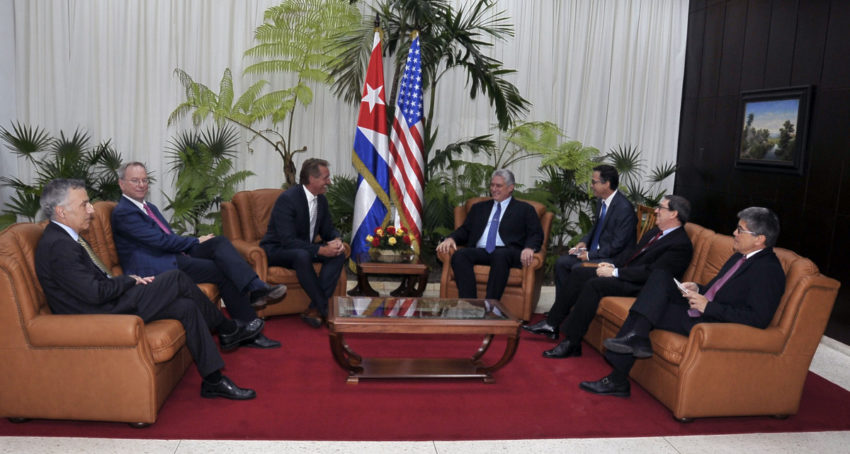

Diaz-Canel Receives U.S. Senator Jeff Flake and Google President Eric Schmidt
During their meeting, they exchanged views on the status of bilateral relations between Cuba and the United States, as well as possible areas of cooperation of mutual interest.
Posted: Monday 04 June 2018 | 03:03:04 PM
By Juventud Rebelde
digital@juventudrebelde.cu
A CubaNews translation.
Edited by Walter Lippmann.
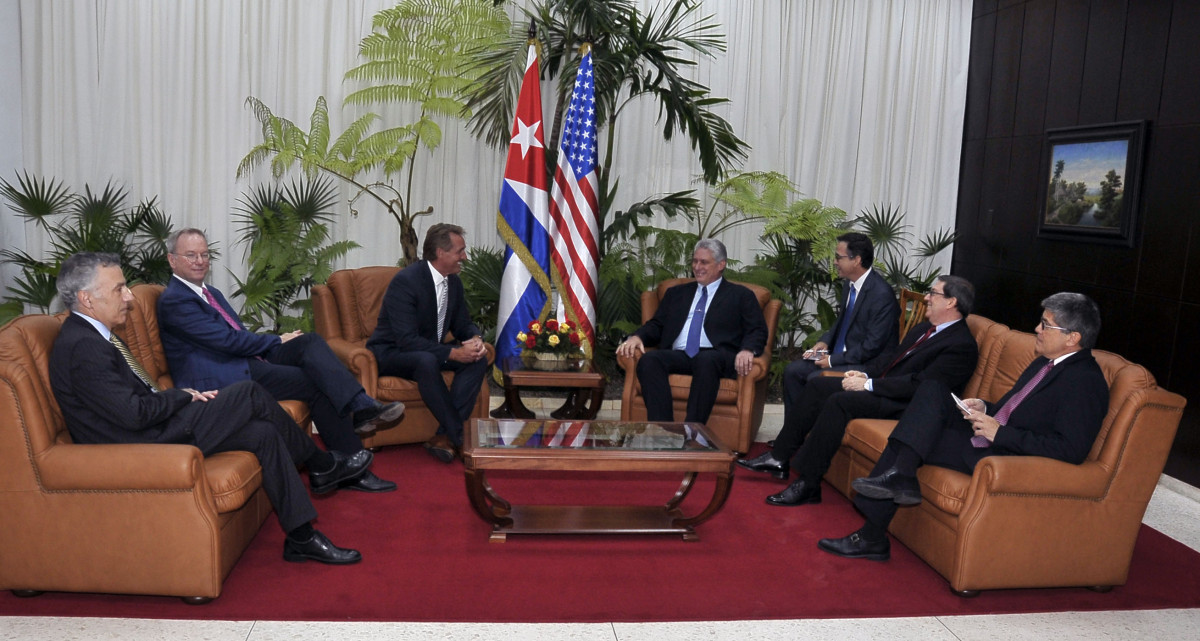
Diaz-Canel received U.S. Senator Jeff Flake and Google President Eric Schmidt Author: Revolution Studies Published: 06/04/2018 | 02:58 pm
President of the Councils of State and Ministers, Miguel Diaz-Canel Bermudez, received Republican Senator Jeff Flake and Google’s Executive President Eric Emerson Schmidt on Monday afternoon. During the meeting, they exchanged views on the status of bilateral relations between Cuba and the United States, as well as possible areas of cooperation of mutual interest. The distinguished visitors were accompanied by the United States Chargé d’affaires in Cuba, His Excellency Philip Goldberg. On the Cuban side, the Minister of Foreign Affairs, Bruno Rodríguez Parrilla, and the United States Director General of the Foreign Ministry, Carlos Fernández de Cossío Domínguez, were present.
Six Minutes and Twenty Seconds
SOMOS JOVENES
Six Minutes and Twenty Seconds
By Gisselle Morales
Translated and edited by Walter Lippmann for CubaNews
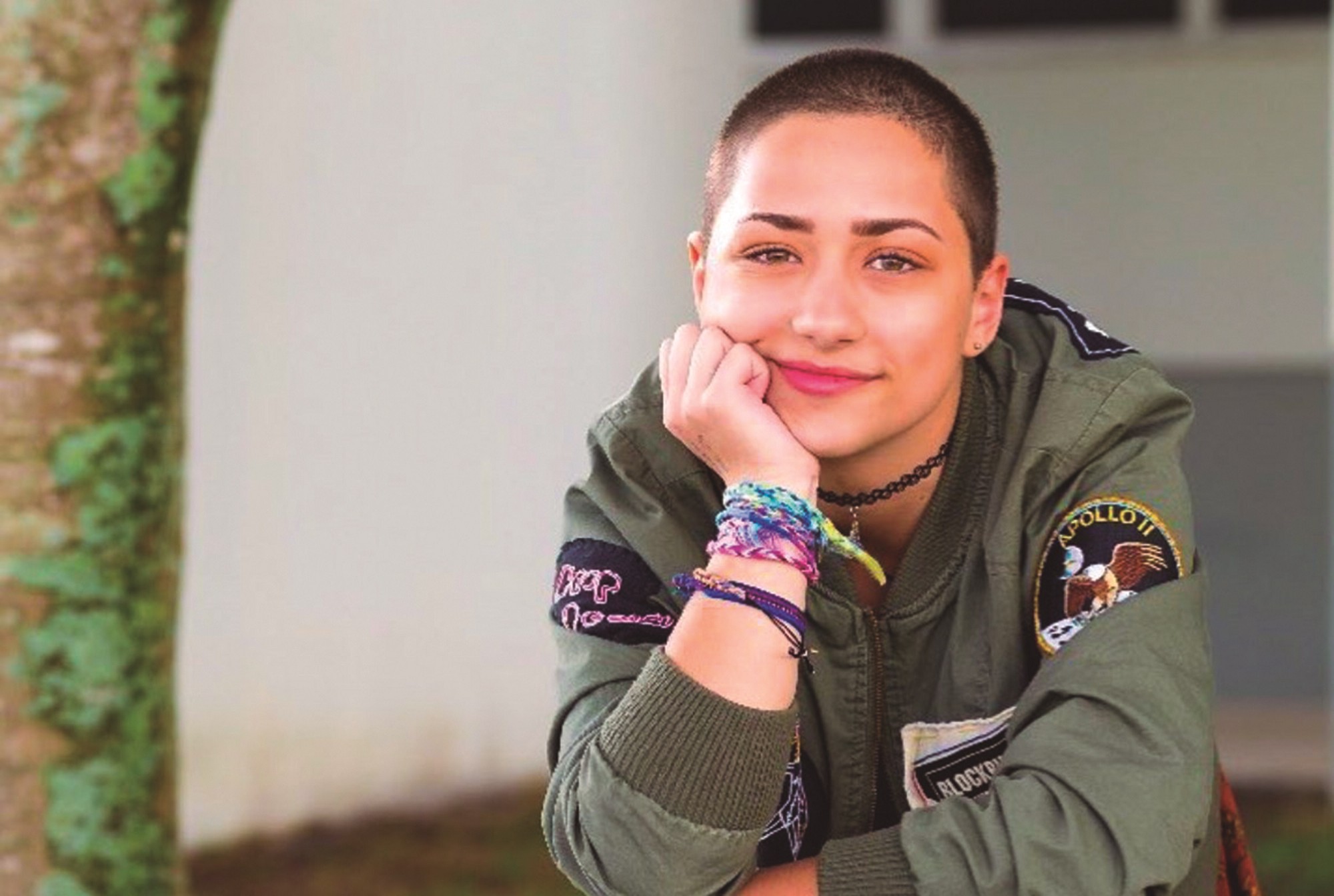
Photo: Internet
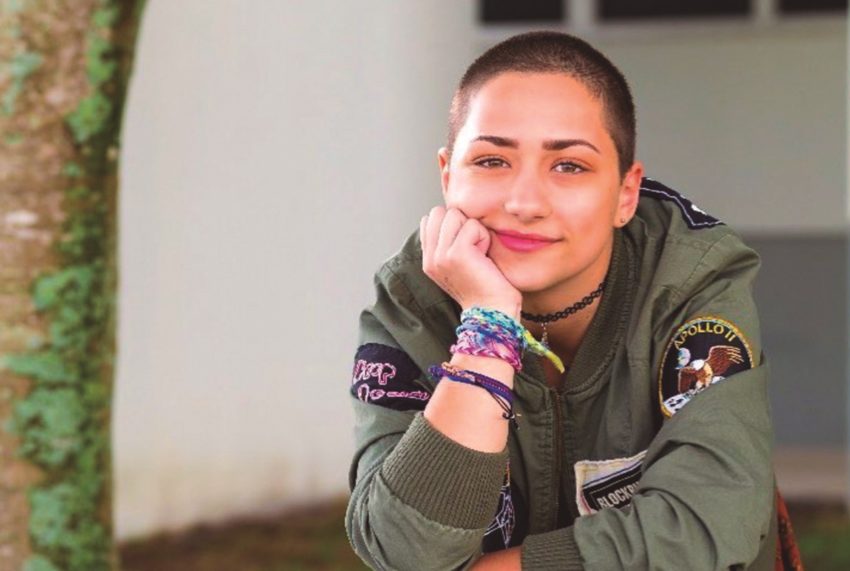
She may not be communist, as the National Rifle Association has begun to call her. It is most likely that he is not a communist, to be clear, but neither does she have to be a communist for me to admire the determination with which she has stood up for arms control. Her name is Emma González and she is a descendant of Cubans.
She wasn’t supposed to go through what happened, crouched in what a madman did in high school with a combat weapon. Nor should she have become the leader of a movement that demands the right to life over the right – “blessed be the Second Amendment” – to own and bear arms. Politicians over the age of eighteen should be responsible for ensuring the safety of citizens.
“If the president comes to tell me in my face that he regrets this tragedy, which should not have happened, I would ask him how much money he receives from the National Rifle Association,” she had cried out to the crowd outside the Fort Lauderdale Federal Court, just days after the massacre, to ask the government for regulations to stop the lucrative arms trade.
But Trump, who often has the delicacy of a hippopotamus, didn’t think it would be a good idea to ban the sale of automatic rifles to citizens with psychiatric histories. The first thing that came to his mind – and he shot off his mouth without thinking too much – was the proposal to distribute weapons to teachers and students, bulletproof vests. After that, turn it off and let’s go.
Luckily, Emma Gonzalez and the rest of Parkland’s survivors have it made it clear: they had warned about Nikolas Cruz’s mental problems and are sure that the nineteen-year-old boy would not have done so much damage with a knife.
It is true that spooky assaults do exist, because some people cut themselves and even kill themselves with machetes and knives at popular festivities or in any corner fights, but there is no comparison between the magnitude of both types of killings.
That is why, on Saturday, March 24, 2018, while young people, adults, the elderly and children were demonstrating in the main American cities, and in cities around the world the, rise of the pacifist movement gave it a universal character. Emma González, wearing an olive green jacket with a Cuban flag sewn on her right shoulder, stood in front of the microphone in Washington and was silent; a silence of almost six minutes and twenty seconds, just the time it took the shooter to kill seventeen students and traumatize a school, a city, a state, a country forever.
Emma González, a descendant of Cubans, knows it like no one else: there are silences which speak volumes.
Originally published in the blog Cubaprofunda.
Crossings


Crossings: Eleven Ways to Be, to Exist and to Enter the “Closet”
May 20, 2012
By: Marta María Ramírez
Translated and edited by Walter Lippmann for CubaNews.

Travesías exhibition, one of the collateral exhibitions of the Biennial
Crossings: eleven ways of being, coming out and entering the closet
In this article: 11 Havana Biennial, Art, Havana Biennial, CENESEX, Cuba, Culture, Havana, Manuel Mendive, Mariela Castro Espín, Sexuality, Society
20 May 2012 | 33
By: Marta María Ramírez
11 exponents of the plastic and visual arts from Cuba gathered in a collective exhibition to represent the experience of homosexual people in the public recognition of their sexual preference.
They were joined by Mariela Castro Espín, director of CENESEX, whose idea was not only original, but also part of the curatorship of Travesías, the title of the exhibition, which opened at the Rubén Oliva Gallery in the capital’s Bertold Brecht Cultural Center.
“To understand the stories of suffering and happiness it has been essential to listen. We saw the possibility of telling it through art and the looks of these artists, whom I invited,” said Mariela.
For the Cuban sexologist, who makes her debut as a curator in the visual and plastic arts, “decision-making is always a journey. It is necessary to show what these people experience because their experiences can be very cruel.
Manuel Mendive was the first to enlist. Mariela went on her search to her retreat-study in the rural town of Santa María del Rosario.
“I’m very excited about the idea. It is a challenge to represent a process that can be difficult because of the homophobia that reigns in the world, including in Cuba,” Mendive told me at the time.
The famous plastic artist is accompanied by Adonis Flores, Alejandro Calzada, Carlos Martiel, Elizabeth Ceviño, Humberto Días, I.A., Lázaro Saavedra, Marianela Orozco, Ricardo Rodríguez and Andrés D.Abreu, the latter sharing the curatorship with the sexologist.
“Each artist has communicated in their own way, with their own codes and in the way they interpreted this reality,” said Mariela.
It is not the first time in Cuba that people have created and exposed their perceptions of homosexuality. However, the contribution of Travesías lies in the fact that it is the result of a workshop in which creative people exchanged with gay, lesbian, transgender and heterosexual Cubans in March 2012.
Questioned about the reasons for the choice of plastic and visual arts, the sexologist said that “since the Havana Biennial was coming, there was an opportunity to use it as a communication resource”.
In this sense, D.Abreu pointed out that “art has shown that it is part of that great accumulation of things that make up the imaginary and thought of society. I can’t say that it alone is a transformer, but that it helps the transformation, so you have to take advantage of his possibilities.
“Three spaces for debate were created. One discussed what it felt like and how it was like to be inside the closet, because they fear that society would reject them; another group was for people who had freely decided to be who they are, and a last group was for those who are still in the process, in the journey,” he said.
Travesías, sponsored by the Brownstone Foundation, will be open to the public until next June, as part of the collateral activities of the 11th International Conference of the Red Cross. Havana Biennial and the V Cuban Day Against Homophobia
Mariela Castro lectures in Finland
ANPP Deputy Mariela Castro Espín lectures at the University of Helsinki
May 30, 2018
Translated and edited by Walter Lippmann for CubaNews
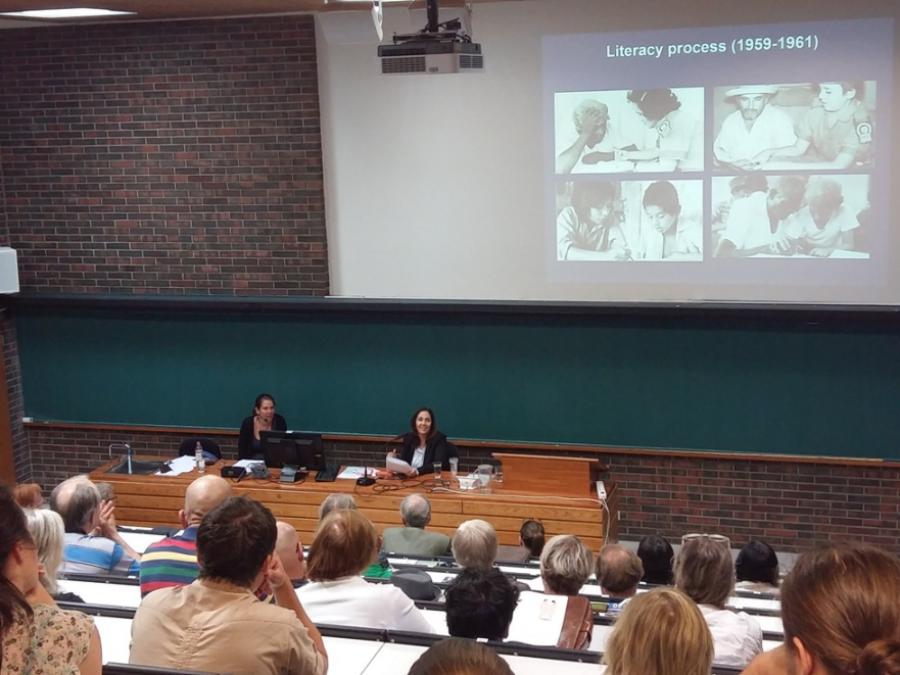
Deputy Mariela Castro, R, during her keynote address.
Cuban Congresswoman Mariela Castro Espín, director of the National Center for Sex Education (CENESEX) of Cuba, gave a keynote speech on Monday at the School of Social Sciences of the University of Helsinki, which was attended by about a hundred people.
Among those present were Tarja Halonen, former president of Finland, Eduardo Lazo Pérez, Cuban ambassador, authorities of the Deanery of the aforementioned faculty, as well as professors, students, Cubans living in the Nordic country, members of the Finland-Cuba Friendship Association, journalists and businessmen.
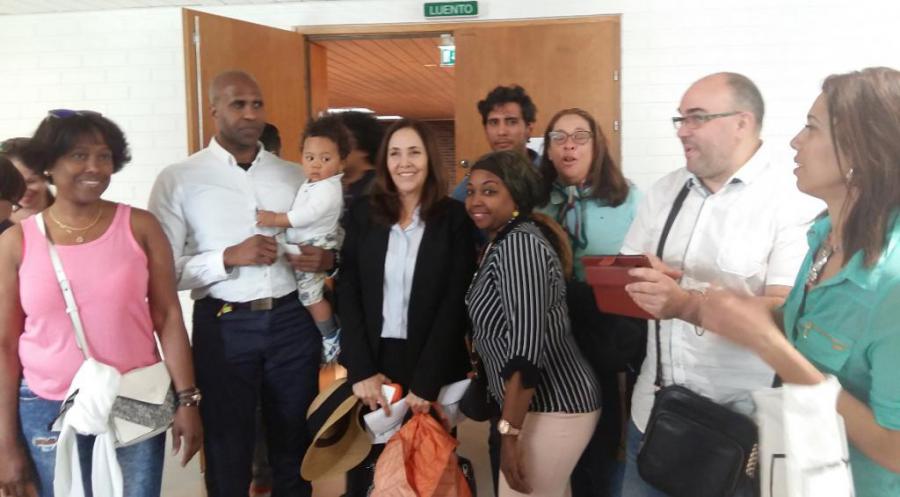
Castro Espín (C), with Cubans living in the Nordic country.
In her presentation entitled “Sexuality education in the social transformation processes of the Cuban Revolution”, the expert from the largest of the Antilles argued how sexuality education was shaped in the social policy of the Revolution from the early stages of the process, and the role of the Communist Party of Cuba and the Federation of Cuban Women in the recognition of sexuality education as the responsibility of the State.
After the remarks by the Director of CENESEX, the former Finnish President, current President of the Board of Directors of the University of Helsinki, took the floor. She praised the Cuban experience in the treatment of the aforementioned issues, explained their historical evolution in Finland and the current role of the United Nations in this matter and thanked the Cuban representative for the conference given.
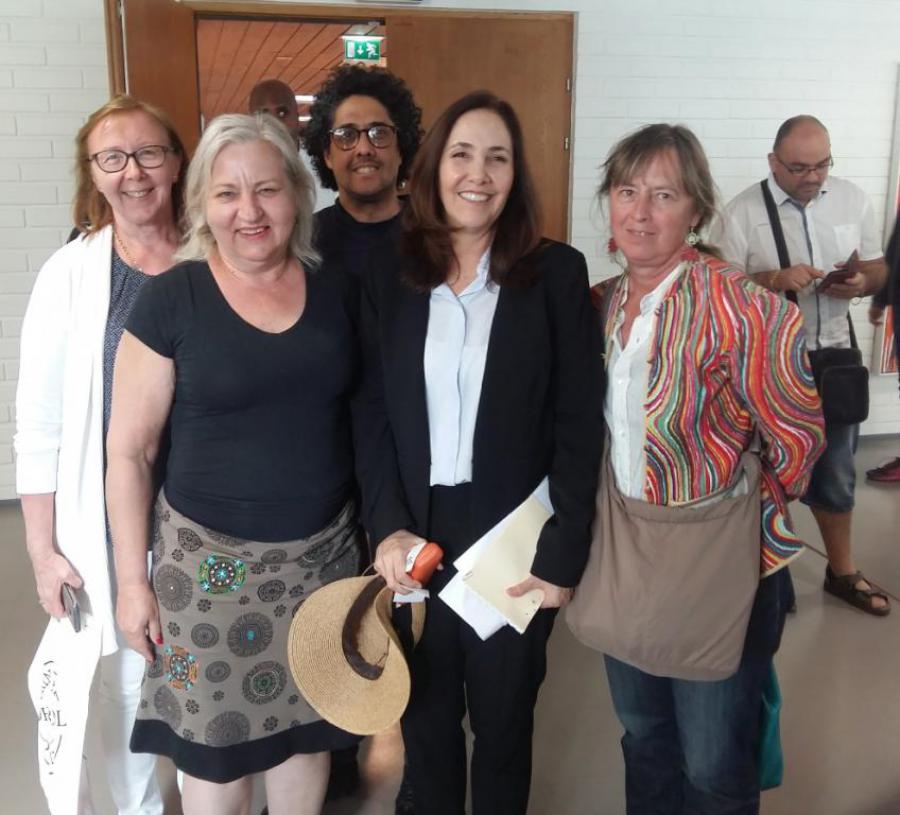
With members of the friendship with Cuba group.
Those attending the meeting had the opportunity to ask questions and exchange ideas with the Cuban parliamentarian, who received her Doctor Honoris Causa degree in Psychology from the Åbo Akademi University in Turku on May 25
(With information from the Cuban Embassy in Finland).
Support for Gun Control on the Rise
A Mass Killing Filled the Glass. Now it Must Be Emptied
By Manuel E. Yepe
http://manuelyepe.wordpress.com/
Exclusive for the daily POR ESTO! of Merida, Mexico.
Translated and edited by Walter Lippmann.
The shooting that broke out in mid-March at the Parkland student complex in the state of Florida, which killed 17 students and teachers, was greeted in the United States with a sense of fatalism that that the public was destined to become familiar with. While still howling ambulances with their cargo of bodies and survivors in the direction of the hospitals, the authorities of the country, the state and those of the center itself began to make clear their prayers and laments, expressing their deep regret and anguish for what had happened.
A few voices rose to condemn the facts without venturing to blame anyone or anything for the horrible crime. Paul Ryan, a Republican leader in the U.S. Congress and second in the line of presidential succession (after the vice president), warned against unthinking, overly sentimental reactions.
But, surprisingly, something strange happened: the students of the Marjory Stoneman Douglas Pre-University in a gathering that they called to that effect, came out against official inaction.
“Every single person here today, all these people, must have been grieving in their homes. But, on the contrary, we are here today united, because if all our government and our president can do is let us know their sorrow and their prayers, we think it is time for the victims to be the motivation for the changes we need to see,” said student Emma Gonzalez in tears and sobs on behalf of everyone.
“To the politicians who remain in their golden seats in the House and Senate, funded by the National Rifle Association (NRA) telling us that nothing could be done to prevent that we call B.S.,” the student leader said.
The broadcast of her speech was cut off, but that last sentence of Emma’s words became the slogan calling for gun control that would lead the plans for an upcoming national student strike and march on Washington.
A substantial article by George Zornick, editor of The Nation, argues that the power of the NRA as a protective shield for the freedom to buy and sell arms in the United States is rapidly being demystified.
As proof, Zornick says that last November in Virginia, the NRA backed Ed Gillespie as a Republican candidate for governor and he was widely defeated. It supported 13 candidates competing fiercely for seats in the state House of Representatives and 12 of them failed, while the other won by a narrow margin.
At the Virginia state level, gun control advocates have been able to obtain the passage of resolutions and measures that have not been passed by the state legislature, although it should be noted that this occurred when the movement was not as strong as it was after the Sandy Hook massacre in 2012 when the largest pro-arms control groups were formed.
It should also be noted that Democratic politicians, until recently, never spoke out against gun control for fear of the NRA’s wealthy congressional lobby.
“For the characteristics of our ossified political system, and especially with Trump in the White House thanking the NRA for the $30 million it donated to his campaign, the United States will never pass gun control legislation. But while waiting for the time to elect a new congress and a new president, something can be done considering that arms manufacturers value above all other things, even more than human life: money,” Zornick says.
The journalist from The Nation calls on activists to help deal a decisive blow to these traffickers by withdrawing financial or commercial support from their companies until the arms industry becomes an unviable business. In 2013, the California State Teachers’ Retirement Fund voted to divest itself of millions of dollars in gun industry investments.. The same was done in 2016 by the New York City Public Employees Pension Fund, which also withdrew funds from other large sporting goods stores that deal in arms.
Today, the arms giants are full of debt and face a decline in consumer demand. Centers such as GoodbyeGunStocks.com have been set up to inform about stockholding entities that trade in arms to guide activists eager to boycott those who do so.
The relentless shootings that kill innocents have filled the cup of resistance of the American citizenry. Its assimilation capacity is running out and if that giant rises it would not be unusual for the arms business to be forced to start a countdown sooner rather than later in the United States and around the world.
May 31, 2018.
Demonizing Defenders of the Peoples
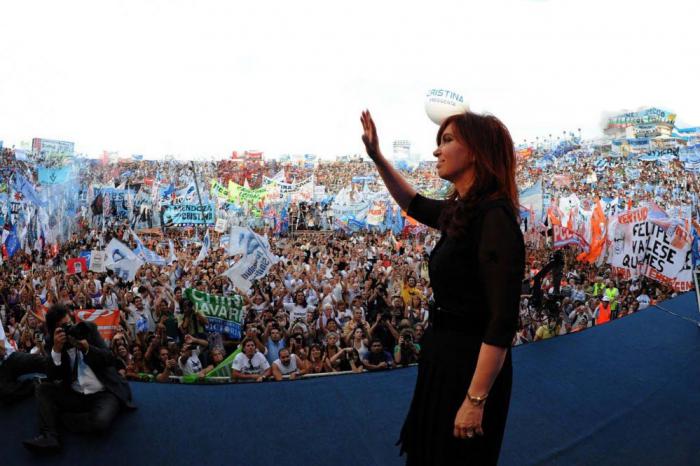

FROM THE LEFT
The dominant world power demonizes those who defend the peoples
Without the de-demonstration of Kirchnerism, it is impossible to understand the different policies being pursued in the country, and half the population will continue to be subject to constant deception. Economic power has the great capacity to permanently change its discourse to cover up every new step it takes in the looting it carries out.
—————————————————————–
Author: Carlos A. Larriera | internet@granma.cu
27 May 2018 20:05:48
A CubaNews translation.
Edited by Walter Lippmann.
Photo: Pagina 12
There is no fact that justifies the closed hatred of many people with Cristina Fernández de Kirchner (CFK) embodying Kirchnerism in general.
This hatred is deep in the bones of a large part of the population, based on the very effective media campaign that “reported” many actions of the previous government that never happened, but they did so following “post-truth” methodology. That is, “it doesn’t matter if what we say is true, but if people believe it”. Of course, in order to achieve this, they had a near monopoly on all the media, TV, radio, newspapers, magazines, internet, etc.
For those people who are interested in knowing the truth and doing small or large investigations on their own, alternative websites were enough to expose the lies of the government’s dismissive opposition to the previous government, and those of the current government. But a large part of the population does not carry out this task. And the progressive press, like Page 12, was also demonized, and still is.
To create such a false negative image of CFK, they also used a propaganda apparatus aimed at manipulating people’s subjectivity instead of arguing, with some basis, using real facts. Not only was and is Durán Barba, but a whole team of publicists, Argentine and foreign, many of them appointed by the U.S. Embassy, who organized the “subliminal” campaign against Kirchnerism.
The previous one was a middle-class government, which respected the general functioning of capitalism; therefore it did not affect economic concentration, large agrarian property and the economy in its almost totality in private, foreign and oligopolistic hands. At the same time, it carried out a very important series of social reforms and infrastructure growth more than any other government in Argentine history, as well as the extension of human rights.
Without directly confronting the concentrated and centralized international capital (CCyCI), which is the true power that dominates Argentina and the world, it laid the foundations for a more integral economic development, promoting science and technology, education, health, employment, retirement, the interconnection of long distances with electricity, the beginning of the reconstruction of railways, sewage pipelines, running water and in general it laid the foundations, to a certain extent, for a greater “growth with social inclusion”. In addition, it was freed from the burden of foreign debt, albeit by paying millions of dollars, but much less than the nominal demand for it. The country thus acquired a certain degree of economic independence, and the increase in the number of schools and universities, the recovery of technical schools, the return of more than a thousand scientists to the country and the construction of laboratories to enable them to carry out their work at the level of global technological progress. It manufactured three satellites entirely in the country, which placed it in eighth place in this area.
However, the international CCYCI remained intact, made large profits and continued its concentration, centralization, foreignization, oligopolization and privatization.
Despite all this, the Kirchnerist government was unbearable for the CCYCI for a multitude of reasons. In the first place because it hindered their open and implacable plundering, as the current government does. Second, because it showed that within capitalism one can live better, and that was increasingly incorporated into the consciousness of the people, who could not know that under capitalism it is impossible to maintain that improvement for long.
Big capital always ends up annulling these reforms in one way or another. Thirdly, because a large part of the population began to understand, albeit with distortions inherent in the class-conciliation ideology of Kirchnerism, the nature of the CCyCI, its global economic power, and this increased awareness was becoming increasingly dangerous to the power of big business.
It is now said that CFK cannot be a candidate because she has a limited ceiling as a result of this demonisation. It cannot be that there are candidates, not just CFKs, who are demonized and therefore unable to stand for election, or at least see their presentation as very restricted.
It is necessary to know the differences, on the one hand, of a government with all its limitations such as Kirchnerism, but which had sincere intentions to promote “growth with social inclusion”.
The main need for the de-demonstration of Kirchnerism lies in being able to see reality objectively, in being able to see the differences between one government and another, between its different politicians, and in its different objectives: the previous “growth with social inclusion”, the current one, looting.
And this difference in objectives is reflected in different repressive policies. The previous government promised not to repress social protest, and as far as the national government is concerned, it did 90%. The strategy of the current government is to repress social protest, to repress dissenting voices, to repress anything that may come between its policy of looting with greater or lesser force. The latter is complemented by a very effective and sophisticated policy of deceiving the people. This deception must be fought.
Under the previous government, the social struggle was mainly focused on improving living conditions, on going for more, with practically no repression of social protest. In today’s world, the social struggle is increasingly dedicated to preventing murder, repression, unjustified imprisonment, and the freedom of political detainees; in short, the struggle is essentially defensive, rather than “going for more”.
Without the de-demonstration of Kirchnerism, it is impossible to understand the different policies being pursued in the country, and half the population will continue to be subject to constant deception. Economic power has the great capacity to permanently change its discourse to cover up every new step it takes in the looting it carries out.
The songs insulting the president reveal that a good part of the people have taken note of what the real policy of this government is. The dominant power has a great capacity to permanently deflect political protest that is directed directly at the president and the government in general by constantly inventing scapegoats to replace them. Big capital is causing the crisis, the population is increasing its resistance. The economic power itself is working to divert this protest to the representatives closest to the people, who are the ones who disturb the power.
The de-demonstration of Kirchnerism is a necessary condition for advancing in the general consciousness of the people, without which victory over the current dominant world power is impossible.
My Return to Alma Mater
My Return to Alma Mater, or, Proximities and Political Clashes
May 31, 2018
Translated and edited by Walter Lippmann for CubaNews.
Thanks to Alma Mater, specifically its director Mayra García Cardentey, for insisting that I write again for the magazine of the Cuban university community, the one in which I once collaborated in the early 1990s, when I was still studying journalism.
I remember with particular satisfaction those years when the publication almost disappeared due to lack of paper, and with a thousand efforts we rescued it in a tabloid format, almost a pamphlet, of bad material and worse printing, which luckily never came back.
With not very different difficulties for its print run in this 21st century, its young collective decided to bet on new technologies, and does not wait for its graphic editions to disseminate the texts it produces and proposes to its reading public.
So it is an honour for me to be able to collaborate again with the magazine founded by the beautiful and courageous communist Julio Antonio Mella, as far back as 1922.
Now, no longer so young or unredeemed, I offer only my humble opinion on matters where it is the new generations who teach me a little more each day, and I – a tepa that I refuse to grow old – try to accompany them at the rate that my (in)capacity allows me.
Here I am reproducing the comment that I was published in Alma Mater.
Political debate and social networks in Cuba: Proximities and clashes
Social networks on the Internet are a relatively new and growing scenario of political participation, which in Cuba complements the options, not infrequently too formal or uniform, that we already had for the exchange of ideas.
It’s not often, but still happens, that someone tries to question the motley and seemingly chaotic political affiliation of my friends on Facebook, or the strategy of moderating comments on my blog www.paquitoeldecuba.com. The answer I give is almost always the same: in order to exchange with fellow members I already have enough space, I am interested in debating and learning about other points of view.
I use this personal example to illustrate an increasingly evident reality. Social networks on the Internet are a relatively new and growing scenario of political participation, which in Cuba complements the options, not infrequently too formal or uniform, that we already had for the exchange of ideas.
It is no secret that regardless of the extroversion and spontaneity with which Cubans ventilate about any economic, social or political aspect of daily life, the specific forums for such discussion – including political, student, professional and mass organizations – can be quite reluctant or hermetic to channel or reflect in public the natural diversity of thoughts that exist within them.
Faced with this fact, social networks would seem to be in the Cuban context a much more flexible, horizontal and visible alternative for direct confrontation between different political positions. But beware. Let us not be too naive either.
Block or learn to accept?
Asymmetry is the first and main flaw that I would identify in that ideal state of participatory and democratic dialogue that social networks on the Internet want to appear to be (and to some extent achieve).
In the very nature of its functioning, the interests and ideology of capital and the system that represents it predominate: capitalism. We may or may not be aware of, be or not more sensitive to or aware of the manipulation that is proposed to us as a tendency, but it is an element that we should not ignore.
Advertising, consumerism, violence, individualism, are motives that from their innards – hidden or not – drive the networks. Of course, it is possible to take a critical, political stance in the face of these proposals, and even to oppose them with other values that we would pretend to be closer to Cuban society, such as humanism, solidarity, altruism and equity.
But this implies, without a doubt, an intense and profound training in the art of doing and influencing politics. And here comes another key disadvantage for our people, beyond even any generational or other considerations: the lack of civic practice we have of political debate, and I would add that of almost any kind of debate.
Agreeing or finding a consensus between more than two people can be complicated in our daily lives. It is still very difficult for us to listen to and respect a different approach than the one we defend. As a result, even in the midst of an alleged dialogue on social networks, violent reactions, offenses and disqualifications can abound, and ultimately it is easier for us to block, eliminate and disappear the other person from our contacts than to try to reason or accept disagreement.
Crimes of cordiality against them
There are concrete practices in the management of social networks that favor or hinder political debate among several people or groups of people. Without pretending to make a recipe book, because everyone builds their cyberspace according to priorities and interests, I would risk commenting on some variants according to my experience.
The first thing is the audience we select and give access to our profiles or admit them to our personal pages. As I said at the beginning, there is not much use – if we want to promote a political exchange, and not just maintain family or playful relationships in the networks – in reducing our circle to those who think in a very similar way to ourselves.
Here I would like to warn about a curious phenomenon that social networks on the Internet reveal within the Cuban political spectrum: the wide variety of positions on dissimilar issues, even among friends, colleagues, relatives and other people who perhaps in other contexts would seem to have coinciding positions.
The feasibility of a freer discussion, with a greater number of actors and actresses, today gives as a result of the political debate in the social networks a clearer and more public perception that unanimity is not necessary – impossible, moreover – to achieve unity, as long as we do not intend to impose a single line of thought or action. It is also important not to be invasive or abusive of other people’s spaces. This recommendation applies to any use of networks, but is particularly relevant when we talk about political debate.
Labeling other people constantly in our publications, indiscriminately breaking into other people’s walls, introducing or replicating information that is foreign to a discussion already underway, to take advantage of the visibility of a debate that we are not initiating, are some of the crimes against cordiality that are most damaging to the healthy and respectful exchange of criteria in social networks and other collaborative spaces on the Internet.
New and renewed militancies
I could not conclude this brief analysis without mentioning the importance of social networks to stimulate, make visible and coordinate multiple social and political activities in Cuba today.
With a traditional civil society whose institutions may seem to us to be aging or which subsist more because of the inertia and convenience of political power than because of its effectiveness in mobilizing citizens, cyberspace – with its social networks, blogs and other alternative publications – would seem to be reactivating and even creating militancies that did not exist in Cuba or were not very visible enough to achieve real political impact.
Issues such as racial, gender, sexual orientation or identity discrimination, animal and environmental protection, among many other noble and controversial causes, with political implications and debts still important in our context, emerge in social networks through multiple individual and collective initiatives.
On more than one occasion, they have already managed to overcome scandal or media pressure to achieve specific solutions or actions on the part of the institutions or entities responsible.
In this effort, the work of the most formalized organizations and organizations is praiseworthy for trying to insert their messages and communicative proposals into the whirlpool of the Internet, and even to stop and provide a direct response to the people who demand and control them through social networks. This can contribute in the medium and long term to articulating a more direct relationship between the State and the government with the citizenry. Also through these digital channels, in what would be another way – with the addition of their greater transparency, immediacy and public character – of strengthening the participatory and democratic ideal of socialism.
Who is Paquito el de Cuba?
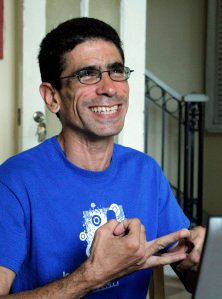
Cuban blogger Francisco Rodriguez Cruz known as Paquito from Cuba declares:
I am Fan of Jose marti, I am journalist communist and gay Photo taken on
Sept.29.2010. in Havana, Cu ba By Jose Goitia
I am Paquito, from CUBA; I am a Marti follower and a an author; I am a communist and gay journalist; I am a convinced and superstitious atheist; I am the father of a son whom I have adored and have been a partner for fifteen years with a seronegative man who loves me; I have been an AIDS patient since 2003 and am a survivor of non-Hodgkin’s lymphoma for more than twelve years; I am a university professor and a student of life; a follower of Cuban economic issues and a passionate devourer of universal literature; an incontinent and belligerent moderate; a friend of my friends and a compassionate friend of my enemies; often wrong and never repentant; a hardened and eternal enthusiastic optimist; alive and kicking; in short, another ordinary man who wants to share his story, opinions and desires with you…
Venezuela Will Continue to Resist
Venezuela Will Continue to Resist
 By Lázaro Fariñas
digital@juventudrebelde.cu
A CubaNews translation.
Edited by Walter Lippmann.
With reference to the last elections that took place in Venezuela only a few days ago, we must remember those who said: do what I say, not what I do’. Those who call themselves the international community’ are furious that the Venezuelan government has called a presidential election, carried it out and won it.
Aren’s elections one of the demands made by these so-called constitutional governments of the West? If so, why were they opposed to Venezuela carrying them out? Why did they demand that the opponents boycott them? Afraid they’d go to the polls and lose?
They got it right and came to the conclusion that it would be impossible for them to beat Nicolás Maduro at the polls, so they decided to boycott the electoral process that they themselves had demanded so strongly.
When mobs took to the streets to burn down buildings and some declared that they wanted elections immediately, when part of this fragmented opposition went to the talks in the Dominican Republic, the first demand was also for “elections now”.
It was then that they realized that, if they lost in the elections, they had only two options: to declare that a fraud had occurred or to recognize the legitimacy of the Bolivarian ruler and, therefore, to accept him before public opinion as the legitimate president of the country. Since that is not what they wanted to do, they decided to go down the road of non-participation and denunciation.
First, they left the Mesa de Diálogo and then they began with the international campaign, in which they declared the election call spurious. Then they accused accusing the opposing candidates, who did agree to participate, of playing the Chavistas game. In other words, they saw as illegitimate an action that they themselves had previously demanded from the Bolivarian government.
The votes, according to their criteria, were fraudulent. But how could that be if they hadn’t even been cast? In this they were not even original, as they were copying what Donald Trump had previously stated during his election campaign for the presidency of the United States.
Although perhaps I am exaggerating a little when I say that they were not original, since on second thought, they have said this every time they have participated or not in the marathon electoral processes in Venezuela during the last 20 years. In those leaderships, the opposition won twice and the government acknowledged the results, but when the government won, the word fraud was always used.
The 2013 presidential election, in which Maduro beat Capriles by just over 200,000 votes, by just over one percent, was a cheat for part of the opposition. How was it possible that the government had engaged in fraud and succeeded by such a small margin? Who would think of cheating and getting so small a margin of victory?
On this occasion, as on so many others, the opposition was accompanied by the so-called “international community”. It’s is made up of the United States Government, the governments of the European Union and their loyal followers in Latin America. For example, Brazil, which is governed by the most unpopular president in its history and is also the product, not of the results of elections, but of a parliamentary coup d’état, and Peru, where the president was appointed in the face of the resignation – due to corruption – of the constitutional president.
This misnamed “international community” says it does not recognize the Venezuelan elections and their results. We should ask ourselves what matters to Venezuelans what this group of nations recognizes or does not recognize?
In 2013, opposition candidate Henrique Capriles had no choice but to acknowledge his defeat, but since then, European governments, the United States and other nations have accused Nicolas Maduro of being an illegitimate dictator and have imposed unjust sanctions on him.
The campaign against Venezuela has been intense by the big media allied to the international right, by the colonized opposition, by the parliaments and by the governments of the West. However, the Bolivarian government has resisted. Who says it’s not going to resist now?
You must be logged in to post a comment.