In the Background of the Wifi

In the Background of the Wifi…
Author: Claudia Padrón Cueto
September 24, 2015
A CubaNews translation.
Edited by Walter Lippmann.
Photo: Yaimí Ravelo
For the browsing experiences of web users to remain pleasurable in the country, the information strategy of our society must achieve a greater synergy. This is the responsibility of all those who are concerned with the education on the use of Information Technologies.
This past holiday season will probably be remembered as the “wifi summer in Cuba”. Undoubtedly the period was marked by the extension –through this type of connection– of the opportunities for web surfing at 2 CUC’s an hour. And while it is true that the price is still high for most, the wifi is welcomed.
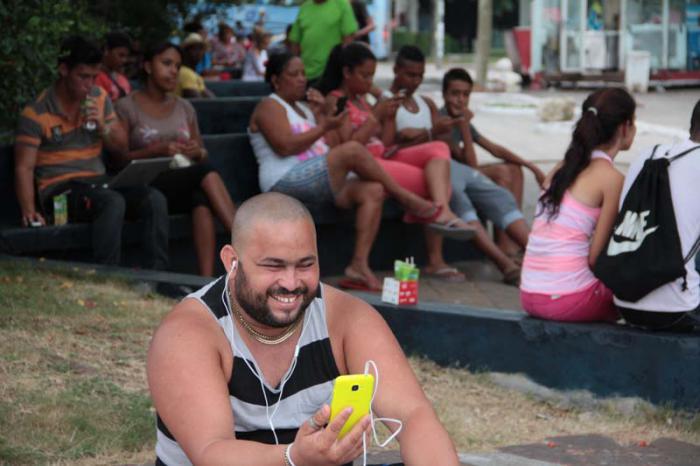
Every day people go to the squares, parks or places with wifi reach to make use of internet navigation services. Many go to make video calls (using IMO) or check their Facebook profiles; while others find –in the wake of the wifi– a way to profit.
This is how it works in the city of Pinar del Rio: At the different access points some young people wait for new arrivals at the park or connection area and immediately offer “one hour of connection for only 1 CUC”, that is, half the official price.
They act as go-between working on commission for a percentage of the total amount collected. They take their customers/users to other persons who use their PCs and cell phones with wireless connection and sell the service to these temporary users.
Connectify Hotspot is a software –one of many– that allows sharing Internet by several users. Of course, in accepting this browsing option the speed and original connectivity potential is reduced, but still it is possible to access the web and even make video calls.
In addition to these agents of shared wifi, and of those others who hoard coupons to then sell them for 75 Cuban pesos [official price 2 CUC = 50 Cuban pesos], this journalist and some close friends were able to confirm the existence of other “merchants” who charge for a simple advice, for example: how to recharge a Nauta account that only requires to enter portal@…, and from this address type the card code.
This is a simple procedure that only takes a few minutes; but lack of knowledge makes some users resort to these “advisers” who take advantage of the inexperience and charge for the service 10 Cuban pesos. Such practices also involve certain risks, because those who offer “help” could even keep the data of the customer (username and password) and then use this information to access their accounts.
There are many who connect without even knowing how to turn on the wifi on their phone or what a browser is, what a web site, a web page or a network profile are. This is simply because without practice there is no possible knowledge. And such lack of knowledge frustrates the browsing experience of some, while others fill their pockets.
It’s been three months after the opening of the areas of wireless access service –indispensable in any modern society—and they are very much appreciated; but still the telecommunications company needs to improve its management so it is not limited only to the signing of contracts. It is also necessary to expand the benefits at the Joven Club [Free Computer Service Facilities] and provide guidance on the use of new technologies to solve the most dissimilar demands and problems of Cuban society in its way to computerization.
Schools should also join in this instruction task considering that today’s students options lead to new tools and benefits, provided by the use of ITs. These options need to be managed with dexterity so that users do not become easy preys to deception and theft.
LGBTI Human Rights and National Unity

Speech at National Assembly on LGBTI Rights and National Unity
By Luis Ángel Adán Roble
Posted: 22 Jul 2018 09:59 PM PDT
Translated and edited by Walter Lippmann for CubaNews
Gays May Now Serve in Cuban Military
Young Gays Can Now Complete Military Service in Cuba
August 8, 2017
A CubaNews translation.
Edited by Walter Lippmann.
Cuban deputies received an explanation of a policy of the Revolutionary Armed Forces (FAR) that has been in force for a year or two to accept and place young homosexuals in military service, respecting their right to participate in the defense of the country.
The issue arose during the work session of the National Defence Commission, which on last July 10 evaluated the results of the inscriptions in the Military Register and the incorporation of young people into active military service (SMA).
As part of the debates prior to the last ordinary session of the National Assembly of People’s Power, representatives of military institutions and members of other permanent commissions such as Health and Sport; Education, Culture, Science, Technology and the Environment; and Care for Youth, Children and Equal Rights of Women also participated in this meeting.
Although this aspect of the discussion on compliance with the SMA did not transcend any of the journalistic versions I could consult on the meeting, its approach in our Parliament is undoubtedly of great news, relevance and political and public interest for the Cuban LGBTI community.
That is why I sought information from fellow journalists there, but it was not until only a few days ago that I had access to the audio recordings of the question posed by Joaquín Lázaro Cruz Martín, a member of parliament for the municipality of Boyeros in the capital and a member of the Committee on Youth, Children and Equal Rights for Women; and the response given by Brigadier General Juan Rafael Ruiz Pérez, also a member of parliament and chairman of the Committee on National Defence.
Perhaps another time is left for the analysis of the importance of this event. I believe that both interventions deserve to be analysed. I confess as an advance that right now it is difficult for me to assess what is more important, if the fact that a deputy asked about the participation of homosexuals in the army and defended it in public; or the response of the president of the National Defence Committee, when reporting on a policy that still has obvious discriminatory features – he himself admits that it is not perfect – but that in practice it represents without doubt a qualitative leap towards the recognition of the rights of LGBTI people in Cuba.
However, many concerns and doubts remain unresolved, not only regarding the inclusion of gay soldiers in the FAR, but also regarding the rights of gay, lesbian, bisexual and transgender people who aspire to or even become officers.
Without further ado, I transcribe the question and the answer in its entirety, with only small adjustments that I had to make to try to be faithful in the written language to the tone and intention of the speaker, to separate the ideas into sentences as brief as possible, as well as to avoid direct or colloquial references and mentions to some people present whose names I found unintelligible in the recording.
Deputy Joaquín Lázaro Cruz Martín: The other issue I have, which concerns me greatly, is exactly what would be the policy to follow, in this material specifically, with young homosexuals and bisexuals.
How it is treated, how politics is with these young people, who are not different at all in our society; that is, they deserve a place of respect too, that is their sexual preference and I do not think that this will influence at all….
Right now it’s time to add, not subtract, and we need everyone’s support. It is no secret to anyone that at the moment, as we can see that they are not being discriminated against as much as in previous times – although discrimination still exists, it is a problem that concerns us all – many more are increasingly identified…
Thank you very much.
Congressman Juan Rafael Ruiz Pérez, President of the National Defence Committee: I am going to take the floor on this last issue to explain and make it clear.
As you have heard, there is in the Armed Forces – we have known this before – a commission of the body that establishes policy for the performance of military service.
In other words, military service is in a law, the law has its regulations, but this commission is establishing policies. For example, no law says anything about the year deferred, about the boy who took a college degree. That’s a policy.
Service is two years, everyone must complete it, et cetera, et cetera, et cetera… Ah, but if you pass the entrance exams and get a degree, then the policy is that you must only serve one year, to interfere as little as possible in your incorporation. That’s politics.
Then, with regard to this issue raised by the companero, a policy was established and approved a year ago, perhaps two years ago, which is essentially the following:
First, no young person, because of his social preference (sic) is excluded from being able to fulfill his preparation for the defense of his country.
Second, if that young man is called, but he considers that for this reason, he will not be able to perform his service in the conditions of a military place, he is excluded.
And thirdly, we also try to apply a third alternative that exists, and that can allow you to comply with the first, without having to fall into the traditional, let’s say, two-year service in a military unit, in maneuvers, etc…. It can also be conducted so that the performance of your military service, and therefore of the law, does so through alternative forms.
Therefore, a young person with these characteristics is called military service, gives basic military training, if possible, and is assigned to alternative military service. Say, he can be a nurse, an auxiliary in a hospital, he can even be in a military hospital, or he can be assigned to work elsewhere.
He’s doing his service, he’s complying with the law, he’s carrying out his duty to the homeland. He may have prepared for defense, and yet he is in conditions that may be more appropriate for the situation.
Ah, no, you’re capable that even if you have your… overcome that, and keep yourself… Because also the environment can influence a lot. We’re talking about a barracks with 80 of another preference, talking about other things, saying other things… Oh, not you?… Right, you’re not called and you’re given that chance.
What happens, that sometimes this happens when they say about a case that came in and that after it was detected. Well, this is sometimes not detected, because sometimes even the person doesn’t want to say it yet….
Is it detected later? We do that. You can’t, Counselor. Yeah, you’re licensed. Any chance you’re going to finish it by alternative means in one place, according to a plan, et cetera? That’s a variant. Another variant? No, you’re going home.
That is to say, what must be clear: that is why nobody is exempted – by politics – from their right to prepare themselves to defend their homeland.
But, taking into account the existing conditions and so on…. As you say yourself, military service is not a panacea, that’s what it is, that’s what it takes, that’s what it takes, that’s what it takes, that’s what it takes and so on. No (can’t)…, well, it’s not going, now. It’s not going. It’s not a disease, it just doesn’t go, because of the conditions, it’s a possibility you give it. Or also, to go towards that other channel that can be service through alternative forms.
That is the policy that is approved, in writing, oriented towards the whole country, what happens is that these things happen, because sometimes they are not detected and can be chosen, well, then you do what you did, you know what I mean?
But the policy is approved, and this is what is being followed. Doesn’t mean it’s perfect, everything here is provisional. But the issue has already been identified, and that is what is being done.
Who is Paquito?
I am Paquito, from CUBA; I am a Marti follower and a an author; I am a communist and gay journalist; I am a convinced and superstitious atheist; I am the father of a son whom I have adored and have been a partner for fifteen years with a seronegative man who loves me; I have been an AIDS patient since 2003 andam a survivor of non-Hodgkin’s lymphoma for more than twelve years; I am a university professor and a student of life; a follower of Cuban economic issues and a passionate devourer of universal literature; an incontinent and belligerent moderate; a friend of my friends and a compassionate friend of my enemies; often wrong and never repentant; a hardened and eternal enthusiastic optimist; alive and kicking; in short, another ordinary man who wants to share his story, opinions and desires with you…
Summertime Electricity Fraud
Summertime Electricity Fraud, An Evil with a Cure
The confrontation with electrical fraud will continue throughout the summer, a period in which this negative phenomenon for the economy is tending to grow, Nílver Guerrero Piñero, a commercial specialist with the Provincial Electric Company of Holguín, told this newspaper.
———————————————–
Author: Germán Veloz Placencia | german@granma.cu
24 de julio de 2018 22:07:37
A CubaNews translation.
Edited by Walter Lippmann.
It’s Not Trump. It’s the Military-Industrial Complex
It’s Not Trump. It’s the Military-Industrial Complex
By Manuel E. Yepe
http://manuelyepe.wordpress.com/
Exclusive for the daily POR ESTO! of Merida, Mexico.
Translated and edited by Walter Lippmann.
An interesting controversy has been sparked on the Internet. It’s being reproduced by the conservative publication The American Conservative (TAC), published in Washington DC, on the role of US President Donald Trump in the alleged rapprochement with Russia that culminated with his meeting with Russian President Vladimir Putin in Helsinki.
Ultra-conservative lawyer and writer Bruce Fein, senior partner at Fein & DelValle, former deputy attorney general and general counsel to the Federal Communications Commission during Reagan’s presidency, assesses Trump’s merits in defending the most reactionary positions and their contradictions with those of Putin:
“President Donald Trump has strengthened, not weakened, U.S. military and economic opposition to Russian President Vladimir Putin. This situation has not been properly clarified and is of the utmost importance. Regardless of the triumphs Trump claims over NATO or Vladimir Putin, the Military-Industrial Counter-Terrorism complex (MICC) governs U.S.-Russian ties as it has for seven decades. The nightmare of the MICC is not to lose a friend, but to lose an enemy, says Fein.
“False information is obsessed with personalities. Authentic information assumes that nations have no permanent friends or enemies, but only permanent interests. The executive branch, in particular, has a permanent interest in exaggerating threats in order to increase its own power and superfluous military spending.
According to Fein, President Barack Obama, in opposition to Russian objectives, refused to provide military assistance to Ukraine, while Trump has authorized the transfer of military weapons to that country. Obama limited the U.S. military mission in Syria to the goal of defeating ISIS or the Islamic State, while Trump has expanded that mission to remain in Syria indefinitely and to influence the outcome of that country’s protracted civil war.
Trump plans to invest $1.2 trillion in upgrading the U.S. nuclear arsenal, including low-yield tactical weapons, directed largely against Russia. In a recent report on national security strategy, Trump said Washington will respond to the economic, political, and military challenges posed by China and Russia to U.S. power, influence, and interests by attempting to erode U.S. security and prosperity. “They are determined to make their economies, less free and less fair, to increase their armies and the repression they exert on their societies.
Trump has supported the 30,000-strong NATO rapid response force in the face of a hypothetical Russian attack. He has has called on NATO members to increase their contributions to the alliance from 2 to 4 percent of their GDP.
Trump has stated that the attack on any NATO member will be considered an attack on the United States and will be responded to militarily, without the prior declaration of war required by the Constitution. Not a single soldier out of the more than 50,000 currently on US bases in NATO countries has been withdrawn.
Trump has maintained economic sanctions against Russia for its annexation of the Crimea and new military invasions in eastern Ukraine. He signed the Law to Counter America’s Adversaries through Sanctions, which the Russian Prime Minister called a “large-scale trade war” against his country.
In April, the Office of Foreign Assets Control (OFAC) of the Trump administration – in consultation with the State Department – sanctioned seven Russian leaders and 12 companies owned or controlled by them, 17 Russian government officials and one Russian state-owned arms trading company and one of its subsidiary banks.
The assets of a sanctioned person or entity are frozen and business with Americans is prohibited.
Trump supported Montenegro’s NATO membership despite its obvious irrelevance to US national security.
Trump’s critics criticize his cowardice toward Putin. They deplore every positive thing he says about Russia and its alleged interference in American politics. But they cannot point to a single thing that the Trump administration has done to diminish Washington’s overwhelming military and economic superiority over Russia or to deter Russian aggression.
“Trump is just the background noise; the enduring script of American national security is written by the Military Industrial Complex with the consent of the American people while its armored knight gratifies him as always with the vicarious thrill of power and domination,” concludes the reactionary Bruce Fein.
July 23, 2018.
This article may be reproduced by citing the newspaper POR ESTO as the source.
Simone de Beauvoir
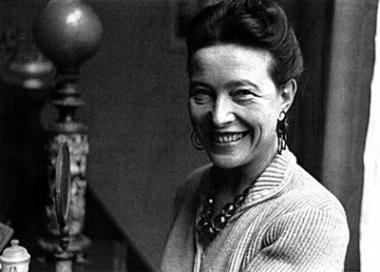
 Simone de Beauvoir
A tireless fighter for women’s rights
Symbol of the and militant protesting woman of the feminist movement, the French novelist visited Cuba and, hand in hand with its main leaders, learned about the Revolution and the role of the so-called weaker sex in the emerging Caribbean social process.
By Javier Gómez Lastra
May 26, 2016
Translated and edited by Walter Lippmann for CubaNews
“The fact that determines the present status of women is the stubborn survival of the oldest traditions in the new civilization being outlined. That is what is unknown to hasty observers who see women as inferior to the opportunities offered to them today, or who see only dangerous temptations in those opportunities. The truth is that her situation lacks balance, and for that reason it is very difficult for her to adapt to it. (…)
“Everything still encourages the unmarried young woman to expect ‘Prince Charming’ fortune and happiness rather than to attempt the difficult and uncertain conquest alone. In particular, it will give her the hope of reaching a higher social stratum than her own, a miracle that will not reward her life’s work. But such hope is dire, because it divides their energies and interests; it is a division that is perhaps the most serious disadvantage for women. The parents still educate the daughter with a view to marriage more than they promote her personal development, and the daughter sees in it so many advantages (…)”.
This text, taken from the work “Le Deuxième Sexe” or “The Second Sex” by Simone de Beauvoir, a French writer, narrator and philosopher and an essential figure in 20th-Century literature and thought, was a theoretical starting point for various feminist groups and became a classic work of contemporary ideology.
The piece, which breaks the existing canons in Europe since the Second World War, tells a story related to the social status of women and analyzes the different characteristics of male oppression.
It also exposes the gender situation from the point of view of biology, psychoanalysis and Marxism, and destroys the existing feminine myths, inciting the search for the authentic and full gender liberation.
Considered ambitious, the text also maintains that the struggle for women’s emancipation is different and parallel to that of the classes and that the main problem to be faced by the so-called weaker sex is not the ideological but the economic front.
The publication evoked strong reactions because of the marked character of nonconformity that the women of that time began to show.
The big push for gender equality
The beginning of the second half of the 20th century had very particular characteristics in the socio-cultural field in Europe. If anything brought about radical changes in ethical, political and philosophical thought in the countries of the Old Continent after the World Wars, it was the enormous need to achieve fundamental human rights and the emancipation of women.
Faced with the example of the policy of equality for all, applied by the governments of the nations of the newly created socialist bloc, many thinkers, human rights fighters, writers, poets, philosophers, and even politicians in Western Europe took a 180-degree turn in their way of valuing life and began to call for true equality between men and between men and women.
It was in this context that Simone de Beauvoir stood out and left a deep mark on the universal history of the world, leaving behind not only her extensive literary work, but also her tireless struggle.
In spite of her bourgeois origin, from a very young age the intellectual knew the difficulties of her contemporaries in a world dominated by men, markedly masculine, made in the image and likeness of the male and where women were relegated to domestic chores or simply to love.
Her work reflected women’s problems, marked by exclusion from production and home-based processes and purely reproductive functions, which represented the loss of all social ties and the possibility of being free.
A radical change
Simone was born in Paris on January 9th, 1908, in a district where coffee shops were beginning to proliferate, where literary gatherings were present and intellectual environments that logically influenced the writer’s education were created.
Very early on she excelled as a brilliant student and studied philosophy at the Sorbonne. Until 1943, she was involved in teaching in high schools in Marseille, Rouen and Paris.
At the age of eighteen, she wrote the first literary essay where the protagonist has many traits in common with her. From that moment on, literature played an essential role in her work.
In 1929 he met the philosopher Jean-Paul Sartre, who became her companion for the rest of her life. Together they shared almost five decades of existence.
Sartre’s influence was unquestionable and Simone began to make use of her existential freedom. This led her to renounce her family and friends, adapting to the real world and choosing a new system of life based on her encounter with the philosopher.
Under these principles, she managed to penetrate the world of the Parisian intellectuals of the 1930s, being one of the few women that this closed universe came to accept.
 Extensive literary legacy
According to the vast majority of critics, researchers and scholars of Simone’s literature, in her literary texts she dared to revise the concepts of history and character and incorporated, from an existentialist perspective, the themes of freedom, situation and commitment.
Together with Sartre, Albert Camus and Merleau-Ponty, among others, she founded the magazine Les Temps Modernes [Modern Times], whose first issue was published in October 1945 and became a political and cultural reference point for French thought in the mid-20th century.
The thinker’s extensive work includes the texts “The Guest” (1943), “The Blood of Others” (1944), “Pyrrhus and Cinema” (1944), “All Men are Mortal” (1946), “For a Morality of Ambiguity” (1947), “America Today” (1948) and “The Farewell Ceremony” (1981).
In the latter, she openly dealt with the curious love relationship, from her youthful days to her old age, and the death of her companion, which implies their hard separation. Despite the absolute identification between them, they never shared the same roof, making use of freedom and with no other purpose than the mutual need to find each other, which allowed them to achieve a perfect symbiosis.
The work ends with the striking phrase: “His death separates us. My death will not bring us together, it is so. It’s been a long time since our lives could have melted together.
In the mid-twentieth century, with some feminists, she also established the Women’s Rights League, which set out to react firmly to any sexist discrimination, and prepared a special issue of Modern Times to discuss the subject.
Her many testimonial and autobiographical titles also included other texts such as “Memoirs of a Formal Young Woman” (1958), “The Fullness of Life” (1960), “The Power of Things” (1963), “A Very Sweet death” (1964), “Old age” (1968), “The End of Accounts” (1972) and “The Farewell Ceremony” (1981).
Character is destiny
The Algerian war broke out in 1954 and Simone felt powerless in the face of reality, thus beginning her period of political struggle.
She took part in anti-fascist demonstrations and gave lectures to the students, but all attempts to impose criteria against the system were unsuccessful, and, despite her efforts, Charles de Gaulle was declared President of the Republic.
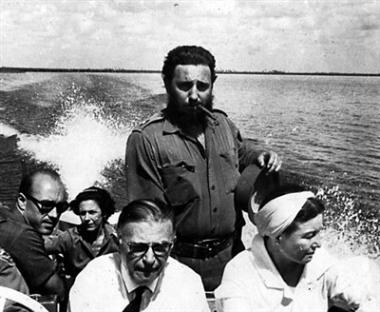
This new political situation prompted Simone to rekindle the need to rebel once again, and she agreed to accompany Sartre to Cuba in 1960. There she met Fidel Castro and Ernesto Che Guevara, among other revolutionaries, in Havana. Cuban photographer Alberto Korda documented the meeting between the couple and the two leaders.
Both Sartre and Simone were always fascinated by the Heroic Guerrilla. At the time of his death, seven years later, Sartre wrote: “Che was not only an intellectual, but also the most complete human being of our time”.
The couple spent almost two months working on the main island of the Antilles, which led to their subsequent and continued dedication to the defense of the Cuban Revolution.
They made an intense tour of the island, which included a tour of the Ciénaga Zapata swamp, the inspirational examination of the book “Sartre Visits Cuba”, published in Havana in 1960 by Ediciones Revolución. In its pages, the philosopher narrated his experiences in the country.
Fundamental decade for women and their rights
The Frenchwoman’s ideas soon reached the rest of the world and Simone de Beauvoir centers began to proliferate everywhere.
The emancipation of women was her ideal of struggle. Without denying the biological differences, she was able to denounce a whole system of oppression that worked – and still persists – from levels such as the home and that can extend to entire nations where one sex is established and dominated by another.
Her main ideology was based on equal opportunities for both men and women and on the true emancipation of all, both at work and in society.
Simone disappeared physically in 1986, but her intense work of ideological activism and broad literary exercise remain imperishable as a sure guide to the struggle for full equality. This is what her work testifies to.

The Essence Hidden Behind the Clown’s Nose

The Essence Hidden Behind the Clown’s Nose
The trivialization of the art of clowning is a widespread phenomenon in our society, rooted essentially in its conversion into a lucrative business.
Author: Leidys María Labrador Herrera | internet@granma.cu
29 March 2018 20:03:13
A CubaNews translation. Edited by Walter Lippmann.
A unique music sounds and at its rhythm, the picturesque character comes out, dressed in big shoes, colorful clothes, a funny wig or hat, painted face and the unmistakable red nose. He or she stumbles forward, laughs loudly and always has a joke up their sleeve.
Surely, if we were to conduct a survey of the Cuban population about their idea of what a clown is, the descriptions would more or less revolve around the one we presented at the beginning of this report. I can bet that most people would think the question was a little silly because who doesn’t know what a clown is? But this is accompanied by another question: do we really know?
We are not far from the truth when we say that behavior and clothing largely define a clown, but they are only its superficial shell. Behind that peculiar being that we see before us, there are other elements that make up its essence and that, unfortunately, have been diluted in the limbo of having certain acting qualities, some vis comic and the idea] that with that they are already suitable to make people laugh.
However, a deeper approach to this subject allows us to understand that clowning is an art that has become trivialised and commercialised in our society. Many have turned it into a lucrative business, to the detriment of the most important function of the clown: touching human sensitivity.
From the opinion of well-known personalities of Cuban theater and some of the most faithful exponents of this type of acting, Granma approaches the dilemma of the true differences between the clown who is sustained only in the material interest, and the one who starts from the actor’s ethics, the conscious dramaturgy and the need to transmit true messages to the people.
HOW DO YOU BUILD A CLOWN?
It is not necessary to be a theatre specialist to understand that any actor or actress, when she or he plays a role, if she or he does so with responsibility for her or his art and the unavoidable commitment to the audience, is capable of changing her or his skin. During the time that a production lasts, it assumes another life, other conflicts, another reality.
Building a character doesn’t mean it’s anything like him. In other words, it is possible to assume values, ways of acting, norms of behavior, even a temperament that has nothing to do with the actor’s true personality. In the case of the clown, although there must be the same level of responsibility, ethics, and commitment, the clown and the actor are the same person. The one cannot exist without the other.
This is what a man who, like many others, began as a clown for parties and birthdays, but then decided to take a step forward, because he understood the need to dignify such an ancient and vilified art. Perhaps this is the greatest merit of the group he founded and which today has become a paradigm of clowning in Cuba, Teatro Tuyo. Ernesto Parra, its director, knows very well what the birth of a clown is all about.
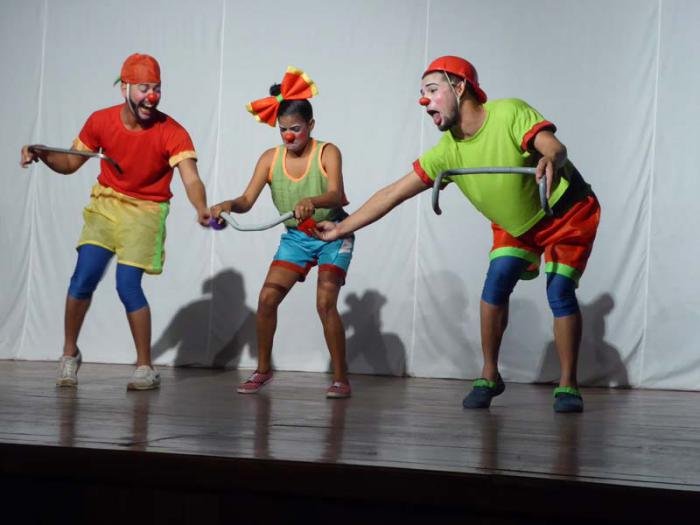
A clowns show needs dramaturgy, aesthetics and a conscious exercise on the part of the actor pursuit of the message, as in any other theatrical form. Photo: Leidys María Labrador Herrera
“Actors in our profession have the ability to approach lives from a character. The actor in the dramatic theater is going to play the role of a doctor and does not necessarily have to have studied medicine, he can play the role of a drunkard and be a teetotaler, but in the case of the clown the difference, which is not tacit, but only the adaptation to this concept of acting, is that yes, we are playing a character who is the clown, but it has been made with the actor’s own characteristics. There is no distance between the character I am going to play and the person I am.
“In any case, the actor who plays a clown, whether it be on a birthday, in a theatre, in a circus… when the performance is over, is once again the normal person who goes home to face his routine. What happens is that this character is constructed from his own psycho-physical characteristics. The mythical example is that of Charles Chaplin, who built a Charlot, the little tramp, through his own experiences.
A similar opinion is shared by young Adrián Bello Suárez, who has carried out all his acting growth in Teatro Tuyo.
“My clown’s name is Belo, and I started to find him after I had been in the group for some time. In fact, I’d say he’s still a long way off. I have drunk from Belo and Belo from me, I could tell you that we are walking hand in hand along the same path. Because that’s what the art of clowning is all about, of finding the clown that we all have inside us which is unique for each person, and building it with your own emotions, feelings…”.
Such experiences show that playing a clown is more than just having a red nose. Perhaps it is from this ignorance that the superficial vision of those who believe that dressing up in colorful costumes and stumbling senselessly is to be a clown.
THE DEFORMATION OF THE REAL CLOWN
The children are seated awaiting the presentation. The birthday boy’s parents are also anxious to see the protagonist who, frankly, has a tight budget The time comes, but there is no music of bugles or cymbals, what begins is the thunderous reggaeton and the clown comes out wagging his waist in an act that has nothing to do with comedy but borders on the obscene.
I’m not saying this is always so. We cannot commit the sin of absolutists and say that all those who today entertain in children’s parties act in this way. But how many of us haven’t had regrettable experiences like that? The saddest thing is that this person continues to do his “job” and we continue to open the doors of birthday parties to him.
NOTE: Sound file is in Spanish:
https://soundcloud.com/user-315115220/opiniones-acerca-del-clown-mp3
For Rubén Darío Salazar, director of the “Teatro de las Estaciones” group, this process implies a step backwards when talking about clowning.
“The art of clowning in our region, and in Cuba specifically, has suffered a regression. This is because it is something that many people feel entitled to do without, schooling, without training. They think they can just play the clown without any of that. But the worst part is that people believe it, and they are paid and hired and they cause a distortion in the profession.
“Being a clown has long been an art form looked down upon, and I don’t know why, because we have had in our country people with a powerful history in clowning, like Edwin Fernandez, known as Trompoloco. He was an actor who played the clown with a mixture of impressive lyricism and satire. I believe that this has been lost, it has been deformed, it has been devolved, without any of us noticing that the art of clowning is the new comedy, if we take it seriously, with the discipline and commitment it demands”.
TRIVIALIZATION, A LATENT PROBLEM
Ernesto Parra himself has a similar opinion. He says the trivialization of the art of clowning is a resident problem in today’s Cuba, especially when the real perspective of any actor performing a clown is lost, driven by economic need.
“We cannot say that the art of clowning is made in a single way, nor that it has these or those typical characteristics. The clown genre, according to the master Dario Fo (Italian actor and writer, recipient of the Nobel Prize for Literature), is the preparation of an artist who becomes a total actor and is the one who transmits, through humor, not as an end but as a means, an emotion, poetry, an idea, tackles a problem. It is not the stereotyped clown, of screams, of colourings, of jumps, of falls, of stumbles. Although they are elements that he uses to construct his dramaturgy, they do not constitute his main objective. That is to say, to take the spectator by the hand to arrive from humor to touch the soul and to move”.
Emptiness, lack of real, direct communication with the public, and in many cases, a total lack of tools to enrich the character, are some of the most common aspects when analyzing this phenomenon of the “multiplication” of clowns. The sharp vision of the master Roberto Gacio, who is a theatre institution in Cuba, allows us to evaluate some of the most notorious weaknesses that these clowns face.
“It is necessary to investigate, deepen, and be in a very serious position to transmit messages, not so much from social reality as from human existence. This, like other phenomena, is also marked by the loss of values, the lack of interest in personal and collective improvement and, of course, the economic factor.
“The way to save the clown’s art is to realize that you have to say things out of sensitivity, out of humanity. The clown and the clown, in general, are also like big children, who talk about serious adult things or children’s things, but with a lot of tenderness”.
Logically, like other similar dilemmas that take place within all artistic expressions, this process cannot be seen as alien to the social context, nor divorced from everyday realities or the way people perceive the world around them. These are aspects to which researcher, theatre critic, and director of the magazine Tablas-Alarcos, Omar Valiño Cedré, attaches great importance.
“There are two different dimensions to the problem. The abundance of clowns, which in reality there are not, should not be seen as excessively pernicious. It is simply an economic reality, in which people who have a certain capacity for animation, entertainment and the world of acting, seek that economic reinforcement for their profession, although they are not necessarily clowns [themselves]; and of course, there is the dimension that Teatro Tuyo and other artistic groups and entities represent, which is the dimension of the real clown, of the clown as a very singular priest of the performing art.
“Being a clown is the greatest thing in the performing arts. A real clown moves an amount of energy, of metaphors, of symbols, of abilities around him that is hardly achievable with any other scenic material. I believe that the challenges are, for all those who want to evolve from one side to the other, to know technically, spiritually and intellectually, what a clown is and how to train. Knowing how to be up-to-date, how to be effective in terms of communication and how to establish new pacts, new links with today’s public that is not the same as it was a few years ago”.
That is precisely the perspective of a group that has managed to fill theatres, to be loved by young and old and become an obligatory reference point whenever there is talk in Cuba of the worthy profession of the clown.
Vietnamese to produce menstrual pads


Vietnamese company will manufacture sanitary pads and diapers in Cuba
In the first quarter of 2019, the production of sanitary pads and disposable diapers will begin in the Mariel Special Development Zone (ZEDM), the Vietnamese company Thai Binh Investment Trading Corp.
By Juventud Rebelde
digital@juventudrebelde.cu
Posted: Monday 26 March 2018 | 11:09:09 PM
A CubaNews translation.
Edited by Walter Lippmann.
In the first quarter of 2019, the Vietnamese Thai Binh Investment Trading Corp, which has been operating in the Mariel Special Development Zone (ZEDM) since 2016, will start producing sanitary pads and disposable diapers.
In a statement to the Cuban News Agency, Vi Nguyen Phuong, director general of the consortium, said the factory, which is currently under construction, will produce 40 million diapers and 150 million sanitary pads annually.
The investment, which totals more than nine million dollars, aims to provide local consumers with high quality, Cuban-made items, said Thai Binh, a company that has been present in the country for almost 20 years.
To meet the growing demand from domestic customers, the company decided to expand its investment activities in the ZEDM, where it also plans to build a powder detergent plant with a capacity of 50,000 tons annually, the directive said.
He argued that this new project will be under the form of a joint venture, in partnership with the commercial company Industrias Nexus S.A. of Cuba, a proposal that they plan to submit to the Mariel Office next April to become operational in 2020.
Today, Vietnam is Cuba’s second largest trading partner in the Asia-Pacific region and its main supplier of rice. The two countries have a relationship of more than half a century, which will be strengthened by the visit to Cuba of Nguyen Phu Trong, secretary general of the Communist Party of Vietnam, from 28 to 30 March.
Safe Abortion in Cuba
Safe Abortion in Cuba:
Avoidance is a better way
By Tania Rendón Portelles (ACN)
Tuesday, 17 July 2018 11:25
Translated and edited by Walter Lippmann for CubaNews
The protagonist of this story, Rosalba, may have several names, as there are many who, faced with an unexpected pregnancy, find themselves in the difficult situation of what to do: have a child or wait longer.
Many people in the home intervene and give their opinions left and right, and while Rosalba can hardly sleep and stress upsets her, she tries to listen to the views of each one to make the best decision.
Now, she regrets her own lack of care and that of her partner, and is afraid of using abortion as a contraceptive method, but at the same time, she has not yet planned or wanted to become a mother.
Rosalba will not be the first or the last woman between this three and two, and there is a question that she expects, without surprises, every time someone knows her condition: are you going to take have the baby or not?
In Cuba, contrary to other Latin American countries, social and moral acceptance of abortion, as well as its practice, is common.
The last National Fertility Survey was conducted in the Greater Antilles in 2009 by the National Statistics and Information Office. It highlights the high prevalence of these situations in Cuba, which has led specialists to say that these procedures are currently used as contraceptive methods.
In other words, abortion becomes an alternative to the non-use – or misuse – of different methods to avoid pregnancy.
Although the archipelago lacks an abortion law, its practice has been decriminalized since 1965. Up to 10 weeks of pregnancy you do not need to give any reason to opt for this practice.
The use of abortion as an alternative to avoid being a mother or having more children has also been due to the fact that medical professionals are safe and reliable to perform this procedure.
Here in the Caribbean nation, abortion or curettage is safe, comfortable and free, despite the discomfort it can cause in patients or the complications that sometimes occur.
Today, Cuban birth control is centralized from the primary health care level, which is a guarantee for any procedure in this regard. It includes counseling and family planning consultations, with the expectation of reducing unwanted pregnancy, maternal mortality, and infant mortality.
It is a strength for Cuban women their right to decide about their bodies. Specialists, however, warn that this practice should not become a common occurrence.
Even when school-based sex education campaigns are implemented, contraceptive methods are offered at very low prices, and it is emphasized that avoidance is best, there is generally little knowledge related to sexuality, especially among adolescents.
It is almost always women who decide whether or not to continue the pregnancy, partly because of their empowerment achieved and partly because of men’s lack of responsibility for reproduction and the consequences of unprotected sex.
It is also recognized that there are multiple causes involved in the decision to be a mother or to have more children. These include: unsuitable age for pregnancy, pregnancy very close to the last birth, ignorance, misuse, failures and limited availability of contraceptives, obstacles to personal projects, prejudice and poor material and family conditions.
Hence, the best method will always be protection, something that Rosalba understood very well, for whom the termination of her pregnancy was traumatic.
Whoever has gone through that tough time knows how difficult it is to make that decision, she shared with ACN.
It should also be noted that in Cuba, the illegal termination of pregnancy is criminalized, i.e., outside health institutions, as established by the Criminal Code since 1979.
Previously, since 1965, the procedure had been hospitalized, after many women died on the island due to poor home practices; however, in 1968, the official figures for abortion in the country began to be recorded.
There remain several questions which need to be answered, even in the face of the high number of abortions. A few are collected in a 2014 research study by the University of Havana:
To what extent has safe abortion and its social legitimization created a “culture of abortion” among Cuban women? Do they really know the risks involved in abortion? Do men and women receive age-appropriate sexual and reproductive health information and services? Is there awareness that prevention is better than action?
Despite the possibility of betting on safe and legal abortion, an inalienable right conquered by Cuban women as a result of the Revolution, this option does not eliminate its risks and consequences for women’s health.
Sonic Attacks Mystery Revealed
Sonic Attacks Mystery Revealed
By Manuel E. Yepe
http://manuelyepe.wordpress.com/
Exclusive for the daily POR ESTO! of Merida, Mexico.
Translated and edited by Walter Lippmann.
“Despite the unknowns, as far as we know, the recent increase in brain injuries suffered by several U.S. diplomats may have been caused not by sonic attacks from host countries, but by their own superiors at the Pentagon or by the CIA running some kind of undercover program to create super spies.
Such is the revelation contained in a study sponsored by the Strategic Culture Foundation, a Russian-based global think tank that has investigated the background to alleged acoustic attacks on U.S. diplomats, first in Cuba and more recently in China.
The study concludes that speculation Cuban and Chinese state agents may have used some sort of sonic weapon against U.S. diplomats falls further into the realms of fantasy and science fiction. The authorities of both nations deny the existence of such a weapon and any such activity in their territories. U.S. experts who examined their diplomats evacuated from Cuba found no causal explanation.
Significantly, however, the examination by U.S. doctors who studied the Cuban cases revealed that all individuals may have had a common experience related to their brain injuries.
Clearly, instead of speculating on the possibility that a foreign agency might have caused the ailments of US officials, who were known to be engaged in spying under diplomatic cover, they should have focused their suspicions on their own side. That is to say, to have specified whether these individuals had undergone any high-tech training directed by the Pentagon or the CIA.
It has been reported that the Pentagon’s Advanced Defense Research Projects Agency (DARPA) is investigating brain stimulation devices to greatly improve the learning ability of its agents.
Last year, DARPA reported the successful use of transcranial Direct Current Stimulation (TDCS) devices to increase cognitive skills in experimental monkeys. Subjects treated with such head-hooked devices were reported to show a significant increase in learning and intelligence compared to individuals who did not receive treatment. DARPA reported a 40% increase in learning capacity among macaque monkeys undergoing brain stimulation.
According to one of the program’s leading researchers: “In this experiment, we target the prefrontal cortex of the brain with individualized noninvasive stimulation mounts. That brain region controls many executive functions, including decision making, cognitive control, and contextual memory retrieval. It’s connected to almost every other cortical area of the brain, and stimulating it has widespread effects.
On the positive side, the Pentagon seeks to boost human intelligence and learning, which is nothing new. For decades, U.S. military intelligence agencies, as well as Hollywood in its science fiction films, have cherished the idea of harnessing the human brain and exploiting the increased levels of its intelligence.
But the quest for superior intelligence may well have unintended harmful side effects. Note that the Pentagon researcher cited above said that stimulation of the prefrontal cortex of the brain could have “far-reaching effects. These effects, in addition to increasing intelligence and learning skills, could be lethal, since the area of the target brain of the experiment is crucial for the control of “executive functions”.
The CIA is known to have carried out drug and hypnosis programs such as the famous MK-ULTRA in the 1950s and 1960s aimed at finding “super spies” and “super killers”.
It is also known that the Pentagon, in recent research, has been using electronic brain stimulation devices to improve the cognitive performance of monkeys. It is therefore conceivable that he has also carried out unpublished research experiments on human beings.
At no point during the investigative phase has any information been provided on the work assignments of the “diplomats” concerned in Cuba and China. They don’t even know each other’s identities. They were probably all involved in espionage duties.
It seems unlikely that the Pentagon or affected personnel will publicly declare that they were subjected to any brain stimulation devices. In any case, staff could easily be silenced by career warnings or other repressive, administrative or military methods.
July 19, 2018.
You must be logged in to post a comment.