Ricardo Alarcón on Micheal Ratner
- English
- Español

Micheal Ratner
By Ricardo Alarcón de Quesada
A CubaNews/Google translation. Edited by Walter Lippmann.
He came to Cuba often. The last time was in February 2015, on the occasion of the International Book Fair in which the Spanish edition of “Who Killed Che? How the CIA Got Away with Murder” was presented. It was the result of painstaking research and more than ten years demanding access from relevant authorities to official documents jealously hidden.
The work of Michael Ratner and Michael Steven Smith proved beyond doubt that the murder of Ernesto Guevara was a war crime committed by the US government and its Central Intelligence Agency, a crime that does not have a statute of limitations, Although the authors are on the loose in Miami and flaunt their cowardly misdeed.
We met again in July on the occasion of the reopening of the Cuban Embassy in Washington. We were far from imagining that we would not meet again. Michael Ratner looked healthy and showed the optimism and joy that always accompanied him. Then we celebrated the return of our Five anti-terrorists Heroes to the country and also the fact that President Obama had no choice but to admit the failure of Washington’s aggressive policy against Cuba.
Michael was always in solidarity with the Cuban people since as a very young person he joined the contingents of the Venceremos Brigade. That solidarity remained unwavering at all times. His participation in the legal battle for the freedom of our companions, including the “amicus” he presented to the Supreme Court on behalf of ten Nobel Prize winners, was decisive.
A tireless fighter, for him no cause was alien. He stood always on the side of the victims and faced with courage, even at the risk of his life, the oppressors who dominated that judicial system. He also did it with rigor, integrity and love. More than a brilliant legal professional, he was a passionate fighter for justice.
He was present in 1968 at the Columbia University strike before completing his studies, and fought racial discrimination together with the NAACP. The recent graduate represented the victims of brutal repression at the Attica prison. Thus he began a remarkable career –impossible to describe in an article– which knew no borders: Nicaragua, Haiti, Guatemala, Palestine, and so on.
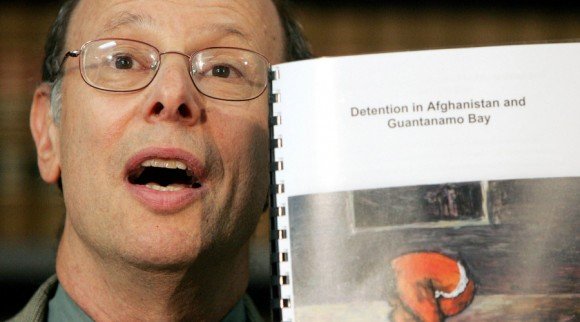
When nobody did, he undertook the defense of the hostages in the illegal naval base in Guantanamo. He convened more than 500 lawyers to do so –also for free– and achieved a legal victory with an unprecedented decision by the Supreme Court recognizing the rights of the prisoners.
Many other cases absorbed his time and energy, working in a team, without necessarily appearing in the foreground. He did not hesitate, however, to legally prosecute powerful characters like Ronald Reagan, Bill Clinton and George W. Bush whose “impeachment” he tried very hard to obtain.
He also accused Nelson Rockefeller, when he was governor, and more recently Defense Secretary Donald Rumsfeld. He published books and essays in favor of legality and human rights. He was considered one of the best American lawyers and chaired the National Lawyers Guild and the Center for Constitutional Rights and founded Palestine Rights. He combined his work as a litigator with university teaching at Columbia and Yale and helped train future jurists able to follow his example.
He was the main defender of Julian Assange and Wikileaks in the United States. An insuperable paradigm of a generation that wanted to conquer the sky, he was an inseparable part of all their battles and will remain so always until victory.
—–
Reposted: https://ajiacomix.wordpress.com/2016/05/19/micheal-ratner/
juhn
Micheal Ratner
Por: Ricardo Alarcón de Quesada
Muchas veces vino a Cuba. La última fue en febrero del 2015, con motivo de la Feria Internacional de Libro en la que fue presentada la edición en español de “¿Quién mató al Che? Como la CIA logró salir impune del asesinato”, fruto de minuciosa investigación y más de diez años reclamando a las autoridades el acceso a documentos oficiales celosamente ocultos. La obra de Michael Ratner y Michael Steven Smith demostró de manera inapelable que el asesinato de Ernesto Guevara fue un crimen de guerra cometido por el gobierno de Estados Unidos y su Agencia Central de Inteligencia, un crimen que no prescribe aunque sus autores andan sueltos en Miami y hacen ostentación de la cobarde fechoría.
Nos encontramos de nuevo en julio en ocasión de la reapertura de la Embajada cubana en Washington. Lejos estábamos de imaginar que no nos veríamos más. Michael Ratner parecía saludable y mostraba el optimismo y la alegría que siempre le acompañaron. Celebramos entonces que ya nuestros Cinco Héroes antiterroristas habían regresado a la Patria y que el Presidente Obama no tuvo otro remedio que admitir el fracaso de la política agresiva contra Cuba.
Porque Michael fue siempre solidario con el pueblo cubano desde que muy joven integró contingentes de la Brigada Venceremos y esa solidaridad la mantuvo sin flaquezas en todo momento. Fue decisiva su participación en la batalla legal por la libertad de nuestros compañeros incluyendo el “amicus” que presentó a la Corte Suprema a nombre de diez ganadores del Premio Nobel.
Incansable luchador para él ninguna causa fue ajena. Se puso siempre del lado de las víctimas y encaró con valor, aun a riesgo de su vida, a los opresores que dominan aquel sistema judicial. Y lo hizo, además, con rigor, entereza y amor. Más que un brillante profesional del derecho fue un apasionado combatiente por la justicia.
Estuvo presente en 1968 en la huelga de la Universidad de Columbia y antes de concluir sus estudios combatió la discriminación racial junto al NAACP. Recién graduado representó a las víctimas de la brutal represión en la prisión de Attica. Inició así una trayectoria admirable imposible de describir en un artículo y que no conoció fronteras: Nicaragua, Haití, Guatemala, Palestina, y un largo etcétera.
Cuando nadie lo hacía asumió la defensa de los secuestrados en la ilegal base naval de Guantánamo, pudo incorporar a más de 500 abogados que lo hicieran también gratuitamente y alcanzó una victoria jurídica sin precedentes con la decisión de la Corte Suprema reconociendo los derechos de los prisioneros. A muchos otros casos también dedicó su tiempo y energías, trabajando en equipo, sin aparecer necesariamente en primer plano. No vaciló sin embargo en encausar legalmente a personajes poderosos como Ronald Reagan, Bill Clinton y George W. Bush cuyo “impeachment” trató afanosamente de conseguir, y acusó también a Nelson Rockefeller cuando era Gobernador y más recientemente al Secretario de Defensa Donald Runsfeld. Publicó libros y ensayos a favor de la legalidad y los derechos humanos. Considerado uno de los mejores abogados norteamericanos presidió el National Lawyers Guild y el Center for Constitutional Rights y fundó el Palestine Rights. Conjugó su labor como litigante con la docencia universitaria en Columbia y Yale y ayudó a la formación de futuros juristas capaces de seguir su ejemplo.
Era el principal defensor en Estados Unidos de Julian Assange y Wikileaks. Paradigma insuperable de una generación que quiso conquistar el cielo fue parte inseparable en todas sus batallas y lo seguirá siendo hasta la victoria siempre.
Youth in the USA Reject Capitalism
- English
- Español
Youth in the USA Reject Capitalism
By Manuel E. Yepe
http://manuelyepe.wordpress.com/
A CubaNews translation.
Edited by Walter Lippmann.
A very recent survey by the elite and prestigious, Harvard University in Massachusetts, indicates that most young Americans reject the basic principles of the US economy and do not support capitalism.
This is a fact of major political importance, considering that, since the end of the Cold War, all US internal and external propaganda has had as its primary objective the formation of a free market-oriented consciousness and the protection of corporations and private capital in general, dismissing the social purposes of the state.
In fact, in its foreign policy, Washington conflates the terms “capitalism” and “democracy”, to the extent that it almost never uses the first term. Its capitalist allies in are called “democracies” and those who do not accept its global hegemony are not. It’s as simple as that.
The Harvard University survey, which polled young adults between ages 18 and 29, found that 51 percent of respondents do not support capitalism. Just 42 percent said they support it.
According to the pollsters, most respondents who said they don’t support capitalism said they were concerned about the unpredictability of the free-market system.
“Capitalism can mean different things to different people, and the newest generation of voters is frustrated with the status quo, broadly speaking.” Zach Lustbader, a senior at Harvard involved in conducting the poll, argues that “the word ‘capitalism’ doesn’t mean what it used to in the US. For those who grew up during the Cold War, capitalism meant freedom from the Soviet Union and other totalitarian regimes. For those who grew up more recently, capitalism has meant a financial crisis from which the global economy still hasn’t completely recovered.”
Although the information on the results of the survey, provided by Amy Cavenaile in The Washington Post on April 24, 2016, does not clarify what alternative socio-economic systems the young people in the poll would prefer, it indicated that 33% percent said they supported socialism. The survey had a margin of error of 2.4 percentage points.
A subsequent survey that included people of all ages found that somewhat older Americans also are skeptical of capitalism. Only among respondents at least 50 years old was the majority in favor of capitalism.
Although the results are startling, Harvard’s questions are in accord with other recent research on how Americans think about capitalism and socialism. In 2011, for example, the Pew Research Center found that people ages 18 to 29 were frustrated with the free-market system.
In that survey, 46 percent had positive views of capitalism, and 47 percent had negative views. As to socialism, by contrast, 49 percent of the young people in Pew’s poll had positive views, and just 43 percent had negative views.
On specific questions about how best to organize the economy, the Harvard poll found a greater influence of capitalist ideas among young people. Just 27 percent believe government should play a large role in regulating the economy, and just 30 percent think the government should play a large role in reducing income inequality. Only 26 percent said government spending is an effective way to increase economic growth.
Yet 48 percent agreed that “basic health insurance is a right for all people.” And 47 percent agreed with the statement that “basic necessities, such as food and shelter, are a right that the government should provide [it] to those unable to afford them.”
It has been considered that Bernie Sanders’ campaign for the Democratic Party nomination for the Presidential election has been a significant factor in the changes detected now. The fact that so many young people feel moved by the word of a candidate of such an advanced age was a great surprise.
What the polls are now showing about US youth is rather significant. It could be the prelude to major changes within and beyond the borders of the American superpower.
May 3, 2016.
Jóvenes en EEUU Rechazan el Capitalismo
Por Manuel E. Yepe
http://manuelyepe.wordpress.com/
Una muy reciente encuesta realizada por la elitista, aunque prestigiosa, Universidad de Harvard, en Massachussets, indica que la mayoría de los jóvenes estadounidenses rechaza los principios básicos de la economía de Estados Unidos y que no se consideran a sí mismos compatibles con el capitalismo.
Es este un dato de la mayor importancia política, razonando que desde el fin de la guerra fría toda la propaganda interna y hacia el exterior de Estados Unidos ha tenido como objetivo fundamental la formación de una conciencia orientada al libre mercado y a la protección de las corporaciones y el capital privado en general, con desdeño de los fines sociales del Estado.
De hecho, en su política exterior, Washington confunde los términos “capitalismo” y “democracia” a tal extremo que casi nunca utilizan el primero. Sus aliados en el capitalismo son “democracias” y los que no aceptan su hegemonía global no lo son, así de sencillo.
La pesquisa de la Universidad de Harvard, que encuestó a jóvenes estadounidenses de entre 18 y 29 años de edad, reveló que el 51% de ellos no apoya al capitalismo contra el 42 % que si es partidario de este sistema.
Según los encuestadores, la mayoría de los encuestados que dijo no sentirse compatibles con el capitalismo atribuyen sus discrepancias a los vaivenes del libre mercado.
“El capitalismo puede significar diferentes cosas para diferentes personas, y la generación más nueva de votantes está frustrada con el status quo, en términos generales”. Zach Lustbader, uno de los expertos de Harvard que condujo la encuesta, argumenta que el término “capitalismo” no tiene hoy en Estados Unidos el mismo significado que antes. A los que crecieron durante la Guerra Fría, les inculcaron la idea de que el capitalismo era un arma para liberar a la Unión Soviética y a otros regímenes totalitarios. Pero para otras
generaciones mas recientes el capitalismo ha significado una crisis financiera constante de la que la economía global aún no se ha recuperado.
Aunque la información sobre los resultados de la encuesta que brinda Amy Cavenaile en The Washington Post el 24 de abril de 2016, no aclara cuales otros sistemas socio-económicos preferirían los jóvenes como alternativa, se indica que el 33 % de ellos elegiría el socialismo. La encuesta tiene un margen de error de 2,4 puntos porcentuales. Un posterior estudio que incluyó a personas de todas las edades reveló que entre estadounidenses algo mayores también existe escepticismo acerca del capitalismo. Sólo entre encuestados que sobrepasan los 50 años de edad hubo una mayoría a favor del capitalismo.
Aunque estos resultados son sorprendentes, Harvard los compara con otros estudios recientes acerca de lo que piensan los estadounidenses sobre el capitalismo y el socialismo. En 2011, por ejemplo, el centro de Investigación Pew encontró que en personas de 18 a 29 años de edad existía mucha frustración con el sistema de libre mercado.
En ese sondeo se constató que el 46% de la ciudadanía tenía puntos de vistas positivos acerca del capitalismo, y 47 % tenía opiniones negativas. En relación con el socialismo, por el contrario, 49 % de los jóvenes en la encuesta de Pew tenían opiniones positivas, y sólo el 43 % tenían opiniones negativas.
La encuesta Harvard halló una mayor influencia de las ideas capitalistas en los jóvenes estadounidenses ante preguntas específicas sobre la mejor manera de organizar la economía. Sólo el 27 % cree que el gobierno debe jugar un papel importante en la regulación de la economía, únicamente el 30 % cree que el gobierno debe desempeñar un papel substancial para reducir la desigualdad de los ingresos y apenas el 26 % dijo que el aporte gubernamental era una manera eficaz para impulsar el crecimiento económico.
Pero el 48 por ciento aceptó que “tener seguro de salud es un derecho para todas las personas”. Y un 47 % estuvo de acuerdo con la declaración de que “las necesidades básicas, como alimento y vivienda, son derechos que el gobierno debe proporcionar a quienes que no pueden pagarlos”.
Se ha considerado que la campaña de Bernie Sanders por la candidatura presidencial del partido demócrata ha constituido un factor significativo en los cambios que ahora se constatan. El hecho de que tanta gente joven se sintiera movilizada por el verbo de un aspirante de tan avanzada edad sorprendió grandemente.
Lo que ahora las encuestas están demostrando en la juventud estadounidense no es algo de poca monta. Podría ser el preludio de grandes cambios en y más allá de las fronteras de la superpotencia americana.
Mayo 3 de 2016.
The People of the U.S.A. Will Have The Final Word
- English
- Español
The People of the USA Will Have the Final Word
By Manuel E. Yepe
http://manuelyepe.wordpress.com/
A CubaNews translation.
Edited by Walter Lippmann.
It has been repeatedly said that the American people are the only ones who could perform the Herculean task of bringing down the most powerful and bloodthirsty empire ever known to humankind. Humanity anxiously hopes to see the US people act, and will provide the solidarity they would have earned.
The frequent US asymmetric wars against countries incomparably poorer and militarily weaker than the only superpower have awakened the humanitarian consciousness of many Americans who have strongly demonstrated solidarity with these abused peoples.
The continuous embarrassing exposure of prisoners’ human rights violations – including torture and serious indignities– in US public or secret prisons scattered around the world, have awakened the awareness of millions of Americans who condemn such injustice.
However, as a result of the manipulation and deceit they are subjected to in their religious faith, or the naivete that for years has been instilled by the media dominated by corporate and banking elites, Americans have been impregnated –for more than a century– with the influence of a neo-conservative policy with fundamentalist traits that today some consider their national feature.
After the collapse of the USSR and the European socialist bloc –which meant the end of the Cold War– the US government intensified its economic war against Cuba, a country that had remained as a thorn in the throat of imperialism.
With new laws, there was a better definition of the set of tools aimed at the economic and financial drowning of the island. There were also other measures whose goal was to “cause shortages, suffering, and the overthrow of the Cuban government” –as originally defined, more than half a century ago, by the objectives of the US blockade, euphemistically called an “embargo”.
Fidel Castro, called on the Cuban people to “tighten their belts” and prepare for shortages and greater sacrifices. Cubans responded by closing ranks around the leader of the Revolution. The results of their heroic resistance can be seen today. Reason, justice, and patriotism were victorious. The internationalist solidarity of countless people around the world who stimulated the success of the Cubans with their sincere help has also been victorious.
A uni-polar world followed the end of the Cold War. A single superpower tries to impose its selfish interests on the rest of the planet. The neoliberal globalization imposed on the world’s peoples, with its consequences of hunger, disease, illiteracy, environmental degradation, discrimination, and many other ills of humanity. This proves that it is not geographical fatalism, or an alleged racial inferiority, but the very essence of the bourgeois order that determines these evils in human societies.
Neo-liberalism, the order which the North spreads, imposes on the South, and recommends itself as a panacea for all the misfortunes of humankind that which is precisely the basic cause of the great evil and cruel abandonment suffered by the peoples living in the poor countries, and the poor who live in the rich countries.
Neoliberal capitalism, with its praise and proclamation of the market –not the human being– as the absolute axis for the functioning of society, has increased poverty and expanded inequalities on a universal scale. Constantly generating crises, the capitalist order tries to ignore the asymmetries it causes, and always manages to unload its effects on the humble people of the planet.
The capitalist system of relations, instead of calling for cooperation and solidarity, calls for competition, selfishness and the law of the richest.
With Bernie Sanders’ campaign for nomination as Democratic Party candidate in the United States presidential election, Americans have begun to hear about many things that were not mentioned in the recent past.
Sanders offers to end nearly four decades of neo-liberal policies. He condemns Wall Street greed, the corruption of the electoral and political systems, and the stealing of the futures of young people and American workers. He recalls the glorious struggles for equality, civil and labor rights, and the rights of immigrants.
These are things not heard in the United States for a long time. Let’s hope they are a prelude to a change that only the US people can promote.
April 26, 2016.
Los Propios Estadounidenses Tendrán La Palabra
Por Manuel E. Yepe
http://manuelyepe.wordpress.com/
El pueblo de Estados Unidos -se ha dicho muchas veces- es el único que podría llevar a cabo la titánica hazaña de hacer caer al imperio más poderoso y sanguinario que haya conocido la humanidad, que espera ansiosa ver a ese pueblo actuar para ofrecerle la solidaridad a que se hará acreedor.
Las frecuentes guerras asimétricas de Estados Unidos contra países incomparablemente mucho más pobres y militarmente débiles que la superpotencia única, despertaron la conciencia humanitaria de muchos estadounidenses que se ha manifestado enérgicamente en solidaridad con estos pueblos abusados.
La continuada exposición de vergonzosas violaciones de los derechos humanos de prisioneros, incluyendo torturas y gravísimos vejámenes en cárceles públicas o clandestinas estadounidenses diseminadas por el mundo, despertaron la conciencia de millones de estadounidenses que condenaron tales injusticias.
Sin embargo, como resultado de la manipulación y el engaño a que han estado sometidos en su fe religiosa o por la ingenuidad que durante años han inculcado en el ciudadano común de ese país los medios de publicidad y de prensa dominados por la élite corporativa y bancaria, los estadounidenses han sido sometidos durante más de un siglo al influjo de una orientación política neoconservadora con proyecciones fundamentalistas, que algunos consideran hoy su característica nacional.
Tras el derrumbe de la URSS y el bloque socialista europeo, que significó el fin de la Guerra Fría, el gobierno de Estados Unidos intensificó su guerra económica contra Cuba, que quedó como una espina en la garganta del imperialismo.
Con nuevas leyes, la codificación del conjunto de instrumentos destinados a ahogar económicamente a la isla y otras medidas dirigidas a “provocar escaseces, sufrimientos y el derrocamiento del gobierno cubano” según fueron definidos originalmente, más de medio siglo antes, los objetivos del bloqueo que Estados Unidos eufemísticamente llama “embargo”.
Fidel Castro, llamó al pueblo a “apretarse los cinturones” y prepararse para carencias y sacrificios mayores. Los cubanos respondieron cerrando filas en torno al líder de la Revolución y ya se han podido ver los resultados de la heroica resistencia. Triunfó la razón, la justicia, el patriotismo. Venció también la solidaridad internacionalista de innumerables personas en todo el mundo que han estimulado la proeza de los cubanos con su ayuda sincera y, por ello, son también dueños del éxito.
El mundo unipolar que siguió al fin de la Guerra Fría, con una única superpotencia que imponiendo sus egoístas intereses al resto del planeta y la globalización neoliberal impuesta a los pueblos, con su secuela de hambre, enfermedades, analfabetismo, degradación ambiental, discriminación, y tantos otros males que sufre la humanidad, puso de manifiesto que no es el fatalismo geográfico, ni una supuesta inferioridad racial, sino la esencia misma del orden burgués lo que determina estos males en las sociedades humanas.
El neoliberalismo, ordenamiento que el Norte disemina, impone en el Sur y recomienda como panacea para todas las desventuras de la humanidad, es precisamente la causa fundamental de los grandes males y los crueles desamparos en que viven los pueblos de los países pobres y los pobres en los países ricos.
El capitalismo neoliberal, con su proclamación del mercado y no del ser humano como eje absoluto del funcionamiento de la sociedad, ha multiplicado la miseria y ampliado las desigualdades a escala universal. Generador constante de crisis, el orden capitalista pretende ignorar que son las asimetrías las que las provocan y se las arregla siempre para descargar sus efectos en las personas humildes del planeta.
El sistema capitalista de relaciones, en vez de convocar a la cooperación y la solidaridad, llama a la competencia, el egoísmo y la ley del más rico.
Con la campaña de Bernie Sanders por lograr incluirse como candidato del partido demócrata en las elecciones presidenciales de Estados Unidos, los estadounidenses han comenzado a oír hablar de muchas cosas que no se mencionaban en el pasado reciente.
Sanders ofrece poner fin a casi cuatro décadas de políticas neoliberales. Condena la avaricia de Wall Street, la corrupción del sistema electoral y político, y el robo del futuro de los jóvenes y de los trabajadores estadounidenses. Recuerda las gloriosas luchas por la igualdad, los derechos civiles y por los derechos laborales y de los inmigrantes.
Son cosas que no se escuchaban hace mucho tiempo en Estados Unidos y que ojalá fueran la antesala de un cambio que solo a los estadounidenses corresponde promover.
Abril 28 de 2016.
The Big and the Small Lies
- English
- Español
THE BIG AND SMALL LIES
By Manuel E. Yepe
http://manuelyepe.wordpress.com/
A CubaNews translation.
Edited by Walter Lippmann.
Any reasonably sane person would assume that after the recent public acknowledgment by US President Barack Obama of the foreign policy errors that are implicit, and even explicit, in his efforts to normalize political relations with Cuba, there would be a process of apologies and explanations for the big and small lies that the immense defamation apparatus of Washington has spread about Cuba around the world, trying to justify its economic, commercial and financial blockade against the rebel island.
Even in the simplest parts of the propaganda war against Cuba, we find evidence of the lies with which the smear campaign has sought to support its purposes –to the embarrassment of honest Americans who are becoming aware of the truth- as the curtain is drawn aside as a result of the timid measures that the White House has taken citing legal incapacity to eliminate the shameful blockade.
An example of this is provided by José Manzaneda, site coordinator of Cubainformación that originates in Spain and is dedicated to promoting solidarity with the island on the Internet. Manzaneda recalls one of the many deceitful facets of the propaganda campaign against Cuba that somehow now clashes with the truth.
Cuba has rock bands in all genres –from heavy metal to hardcore, death metal, alternative rock and punk. The Caribbean country hosts local and international groups that take part in thirteen festivals of rock music (Caimán Rock, Brutal Fest, Festival Metal HG among them) and has a unique experience in the world: a state-owned Cuban Rock Agency devoted to the promotion, distribution and hiring of rock bands. Despite this, during the recent Havana concert by the English band the Rolling Stones, the US-financed media from around the world devoted extensive space to promote their stale falsehoods against Cuba.
Manzaneda notes that Spanish channel La Sexta, in its coverage of the Stones’ artistic visit, said “Cuba has vibrated to the sound of those “Satanic Majesties” (…) and showed their trademark tongue after 40 years of rock censorship in the island “.
Another Spanish channel, Cuatro, repeated the same nonsense about the alleged “censorship” that Cuba applied to the music of the British band “whose music had been banned in Cuba until now”.
The same lie was repeated by Antena 3, another Spanish channel: “The Rolling Stones displayed their energy in the same island where their sound was banned until recently.”
Other media did not go that far but repeated over and over the same message: not now, but for decades the Cuban Revolution “censured”, “discriminated” or “banned” rock “.
Meanwhile, the international corporate media insisted on another message openly more counterrevolutionary: the concert was due to a supposed transition, an opening, or even a political “spring” in Cuba. “A concert that marked the cultural opening of Cuba,” said Deutsche Welle TV). “A historic event that shows the opening of Cuba to the West –that albeit slow, is already unstoppable.” (Cuatro TV).
In almost all news reports, this great concert was linked to the absurd events and incomprehension towards rock that occurred in Cuba in the 60s. But the reality is that if the Rolling Stones and other big bands did not act earlier on the island it was not due to obstacles from Cuba other than economic. There were big free concerts in Havana, like the Manic Street Preachers in 2001 and Audioslave in 2005. All of these, as with the Stones now, were funded by the artists themselves.
Manzaneda recalls: “It is not Cuba that has made a cultural opening to the world. What has really changed is that the US government and its accompanying media have modified their policy of aggression against Cuba. And now, for a band like the Rolling
Stones, performing on the island they are no longer at high risk of reprisals and
smear campaigns; but rather the opposite.”
It is true that in the early years of the Revolution, and until the mid 70s, rock and English language were not broadcast by Cuban radio stations as part of an inexperienced and naive defensive reaction against the huge cultural aggression promoted and financed by the United States.
In those years, Cubans certainly committed many errors of this type, including their dislike of persons that were then, and remain today, idols of US American youth, who were inspired precisely by the ideals and struggles of Cuban youth and their leaders, such as Fidel Castro and Che Guevara.
April 22, 2016.
SIN OLVIDAR LAS GRANDES Y PEQUEÑAS MENTIRAS
Por Manuel E. Yepe
http://manuelyepe.wordpress.com/
Cualquier persona medianamente sensata podría suponer que, tras el reciente reconocimiento público por el Presidente de Estados Unidos, Barack Obama, de los errores de su política exterior que están implícitos, e incluso explícitos, en su propósito de normalizar las relaciones políticas con Cuba, ocurriría un proceso de disculpas y justificaciones por las grandes y pequeñas mentiras que sobre Cuba ha difundido por el mundo el inmenso aparato de difamación de Washington, pretendiendo justificar su bloqueo económico, comercial y financiero contra la isla rebelde.
Hasta en las más simples piezas de la guerra propagandística contra Cuba hallamos elementos demostrativos de las falsedades con que la campaña de infundios ha pretendido fundamentar sus propósitos, para vergüenza de los estadounidenses honestos que se van enterando de las verdades a medida que se descorre el telón por efecto de tímidas medidas que la Casa Blanca ha tomado, alegando incapacidad jurídica para eliminar el bochornoso bloqueo.
Un ejemplo de ello lo ofrece José Manzaneda, coordinador del sitio “Cubainformación” originado en España, dedicado al fomento en Internet de la solidaridad con la isla, quien recuerda una de las muchas facetas embusteras de la campaña propagandista contra Cuba que de alguna forma choca ahora con la verdad.
Habiendo en Cuba bandas de rock en todos sus géneros -desde el heavy metal al hardcore, pasando por el death metal, el rock alternativo y el punk- y siendo el país caribeño sede de agrupaciones locales e internacionales que participan en trece festivales de este tipo de música (Caimán Rock, el Brutal Fest, Festival Metal HG, entre ellos) y donde existe, como experiencia única en el mundo, una Agencia Cubana del Rock, de propiedad estatal, dedicada a promover la distribución y contratación de bandas de rock, — durante el reciente concierto en La Habana de la banda inglesa de los Rolling Stones, la prensa financiada desde Estados Unidos en todo el mundo dedicó extensos espacios a su pretensión de justificar sus añejas falsedades contra Cuba.
Manzaneda hace notar que en el canal español La Sexta, en su cobertura sobre esa visita artística, dijo que “Cuba ha vibrado al son de esas “satánicas majestades” (…) enseñando su característica lengua por esos 40 años de censura del rock en la Isla”.
Otro canal español, el Cuatro, repetía este mismo disparate, refiriéndolo a la supuesta “censura” que Cuba aplicaba a la música de la banda británica “cuya música había estado prohibida en Cuba hasta ahora”.
La misma mentira repetía Antena 3, otro canal español: “Los Rolling Stones desplegaron su energía en la misma Isla donde sus acordes estaban prohibidos hasta hace poco”.
Otros medios no llegaban a tanto pero “repetían, con precisión machacona, un mismo mensaje: ahora no, pero hace décadas la Revolución cubana “censuró”, “discriminó” o “prohibió” el rock”.
Al mismo tiempo, los medios corporativos internacionales insistían en otro mensaje más directamente contrarrevolucionario: el concierto se debió a una supuesta transición, una apertura o incluso a una primavera política en Cuba. “Un concierto que marcó la apertura cultural de Cuba”, decía Deutsche Welle TV). “Un evento histórico que demuestra que la apertura de Cuba hacia Occidente, aunque lenta, es ya imparable” (Cuatro TV).
En casi todas las noticias se asocia este gran concierto con los absurdos e incomprensiones hacia el rock que ocurrieron en los años 60 en Cuba. Pero la realidad es que si los Rolling Stones y otras grandes bandas no actuaban antes en la Isla no era por obstáculos desde Cuba que no fueran los económicos. Hubo grandes conciertos gratuitos en La Habana, como el de Manic Street Preachers en 2001 y el de Audioslave en 2005. Todos, como ahora el de los Stones, han sido costeados por los artistas.
Manzaneda recuerda: “No es Cuba la que realiza una apertura cultural al mundo. Lo que ha cambiado realmente es que el Gobierno de Estados Unidos y los medios de comunicación que le acompañan han relajado su agresión política a Cuba. Y ahora, para una banda como los Rolling Stones actuar en la Isla ya no supone un alto riesgo de represalias y campañas de desprestigio. Sino más bien todo lo contrario”.
Es cierto que en los primeros años de la Revolución y hasta mediados de la década de los 70, el rock en idioma inglés no era programado en las emisoras de radio cubanas como parte de una reacción defensiva inexperta e ingenua ante la magnitud de la agresión cultural promovida y financiada por Estados Unidos.
En aquel período los cubanos ciertamente cometieron no pocos errores de este carácter, incluyendo su ojeriza ante figuras que constituían entonces, y siguen siendo hoy, ídolos de la juventud norteamericana que se inspiraron precisamente en los ideales y las luchas de la juventud cubana y en sus líderes, como Fidel Castro y Che Guevara.
Abril 22 de 2016.
Cuba: Permit Me To Disagree

- English
- Español
Cuba: Permit me to disagree
By Guillermo Almeyra
A CubaNews translation.
Edited by Walter Lippmann.
[Reformatted for easier reading on the web.]
Two kinds of problems arise in the recent changes made in the Cuban government, some of form, others of content.
Regarding the former, neither Raúl nor Fidel, or any other official, have taken into account the need to make room for an economic alternative other than the existing one that depends on rules dictated by the market forces, or, for that matter, the need to introduce economic methods based on direct democracy and self-management, where the Cuban citizens-producers would play a more active role as much in decision-making as in the implementation of what is decided thereby.
More centralization, more institutionalization, more resolutions coming from the pinnacle of power, and more wartime-like economics has been the motto, and even the ousting of Pérez Roque and Lage were made, it has been said, to create a more functional structure of government, which reveals unspoken criticism leveled at the typical voluntarism practiced both by those seen as Fidel’s men and by Fidel himself.
That way Cuba has taken some sort of step toward the Chinese path… which we all know where it ended. In other words, a strong power underpinned by its single monolithic party that tries to steer its way into a pragmatic opening to the capitalistic market in order to modernize the country’s economy, increase labor productivity and reduce production costs without too much heed to the social consequences.
However, Cuba is not China, as it has a small, if highly educated, population with a low birth rate and a history of poor productivity, unable to resort to huge amounts of foreign capital because of its very limited domestic market and the lack of a powerful and wealthy Cuban nationalistic bourgeoisie overseas which might be willing to invest in the island.
To cap it all off, a relative shortage of young people makes labor more expensive and, truth be told, Cubans are not easily satisfied, since the Revolution taught them to protest and demand. Furthermore, Cuba can’t just apply the Chinese recipe in the middle of a terrible worldwide crisis which is bound to become worse.
So much for the problems of form: rather than democratize the country, laying the foundations of a government planned from the bottom up by workers’ councils and sidelining the State’s bureaucratic apparatus, the Cuban establishment chose to have a go at the utopian purpose of rationalizing red tape and make the arbitrariness and squandering typical of any vertical system even more effective.
Moreover, I also differ on other points: why weren’t these problems happening in the highest circles informed to or discussed with the men and women in the street?
Instead of presenting the people with a number of faits accomplis, unexplained and obscure as befits a government-owned media which fearful of critical thinking and prone to underestimate the workers’ level of comprehension, why weren’t the merits and flaws of each leader publicly debated?
If the foreign minister and the vice-president of the Council of Ministers misbehaved and misused their status, as hinted in the press release, how responsible are their fellow leaders, starting with Fidel and Raúl?
If they were comrades in the said statement, and kept their high-ranking positions in the Political Bureau, the Central Committee and the government up until they announced their resignation in regrettable Stalin-like self-critical notices where they admit to mistakes not even mentioned, why does Fidel Castro, by whose side they worked for many years, say they became greedy and unworthy men who fed on the sweet nectar of power and had thus played into the hands of the enemy?
Do Raúl and the political and state leaders call comrades and invest powers in unworthy potential traitors, as Fidel tagged them, or is he (Fidel) using their statements to wreck another line –the victorious one?
Was the remark thrown over to Michelle Bachelet about vindicating Bolivia’s right to an outlet to the sea just a gaffe or an internal maneuver about an issue the Cuban government had decided to hush while awaiting for the Chilean president’s visit to consolidate his comeback to the Latin American stage?
Is the uncalled-for anger oozing from Fidel’s statements a symptom of old age or a camouflaged political torpedo destined to keep the various bureaucratic factions –the victors, the centralist military brass, and the vanquished– from engaging in a certain modus vivendi?
What does such cloaked goings-on in the upper echelons have to do with the battle of ideas, that is, with the socialist moral and political education (a task which Raúl has just assigned to the former chief of police Ramiro Valdés)?
What was discussed with Hugo Chávez? The possibility that Venezuela may be forced to cut down on the assistance he gives to Cuba given the fall in oil prices and Cuba’s necessity to take immediate economic action as a result?
Why not disclose and hold an open discussion about Cuba’s outlook and future tasks, especially now that it’s making preparations to hold the Party Congress and restructure the State apparatus?
Are by any chance the moral lynching of leaders who are answerable to and controlled by collective bodies a blow to the ethics of the Party’s rank and file and the respect they deserve?
Socialism cannot break away from democracy, and democracy requires freedom of information and forthright discussion of ideas and proposals.
Bureaucratic secrecy opens your flank to the enemy no less served by those who are always ready to welcome whatever comes down from the state Olympus and spit today on those who until yesterday were their leaders. It’s criminal, particularly in difficult times, to mislead, misinform and depoliticize those who will have to put their creativity, understanding and effort to good use in order to overcome hardship.
Cuba: permítanme discrepar
Por Guillermo Almeyra
Domingo 8 de marzo de 2009
institucionalización, más decisiones desde el vértice, desde el poder, más
economía de guerra, ha sido la consigna, e incluso los cambios de Pérez Roque y de Lage han sido efectuados en el nombre del funcionamiento de las intituciones, en crítica implícita al voluntarismo que caracterizó tanto a los que aparecían como hombres de Fidel como a Fidel mismo. Se abre así una especie de
camino cubano a la vía china… que todos sabemos adónde condujo. O sea, a un poder fuerte basado en el partido único monolítico que trata de pilotar una apertura pragmática al mercado capitalista para modernizar la economía del país, aumentar la productividad de los trabajadores y reducir los costos de los productos, sin tener demasiado en cuenta las consecuencias sociales.
Además, discrepo igualmente en lo que se refiere a la forma: ¿por qué no se informó y se discutió con los cubanos de a pie
lo que estaba pasando en el aparato? ¿Por qué no se discutieron abiertamente los méritos y defectos de cada dirigente y, en cambio, se prefirió presentar hechos consumados, sin explicarlos y en la oscuridad tan característica de la prensa oficial que teme el pensamiento crítico y subestima la capacidad de comprensión de los trabajadores? Si el canciller y el vicepresidente del Consejo de Ministros fueron indisciplinados y poco institucionales
, como sugiere el comunicado, ¿cuál es la responsabilidad de sus colegas dirigentes, empezando por Fidel y Raúl? Si para el comunicado eran compañeros
y siguieron ocupando altos cargos (en el Buró Político, el Comité Central y el gobierno) hasta que renunciaron
con lamentables autocríticas de tipo estalinista, reconociendo todos sus erroes
que ni siquiera mencionan, ¿por qué Fidel Castro, a cuyo lado trabajaron por muchos años, dice que eran ambiciosos e indignos, cebados en las mieles del poder
y proclives a ser utilizados por el enemigo? ¿Raúl y la dirección política y estatal califican de compañeros y dan responsabilidades a indignos y potencialmente traidores como sugiere Fidel, o éste utiliza sus declaraciones como torpedos contra otra línea, la triunfante? ¿No fue una gaffe sino una maniobra interna el arrojarle a Michelle Bachelet la reivindicación de la salida al mar para Bolivia cuando el gobierno cubano callaba al respecto para aprovechar la visita de la presidenta chilena para afianzar su retorno al concierto de los países latinoamericanos? ¿La furia fuera de lugar que empapa las declaraciones de Fidel no es una manifestación de senilidad sino una cobertura para un torpedo político destinado a impedir unmodus vivendi entre las diversas facciones burocráticas, la vencedora, la militar burocrática centralista, y la perdedora? ¿Qué tendría que ver esa fronda en el aparato con una batalla por las ideas, o sea, con la educación moral y política socialista? (que ahora Raúl ha dejado en manos del ex jefe de policía Ramiro Valdés). ¿Qué discutieron con Hugo Chávez? ¿La posibilidad de que Venezuela pueda verse obligada a reducir su ayuda a Cuba ante la caída del precio del petróleo y la necesidad, por consiguiente, de que Cuba tome desde ya medidas económicas? ¿Por qué no informar, no discutir abiertamente las perspectivas y las tareas, sobre todo en un periodo de preparación del congreso del partido y de reorganización del aparato del Estado? ¿Los linchamientos morales de los dirigentes que siempre responden a organismos colectivos y están controlados por éstos no son acaso un golpe a la ética y al respeto a los militantes? El socialismo no se puede escindir de la democracia y ésta exige libertad de información, plena discusión de ideas y propuestas. El secreto burocrático abre el flanco al enemigo y a éste sirven también los que dicen sí a todo lo que viene del Olimpo estatal y están dispuestos a escupir hoy sobre quienes hasta ayer consideraban sus dirigentes. Particularmente en las épocas difíciles es criminal confundir, desinformar y despolitizar a quienes deberán superar las dificultades con su creatividad, su comprensión, su esfuerzo.
Unexpected Challenges for Cuba’s Tourist Industry
- English
- Español
Unexpected Challenges for Cuba’s Tourist Industry
By Manuel E. Yepe
http://manuelyepe.wordpress.com/
A CubaNews translation.
Edited by Walter Lippmann.
2016 is an extremely tense year for Cuba’s tourism industry. The island has had to face many challenges arising from the need to respond to a surprisingly high number of visitors. This was caused by the coincidence of a series of factors that turned the country into the absolute star of the leisure industry in the Caribbean and a “fashionable” destination on a world scale, with the successive visits of celebrities, including the President of the United States with his family, which attracted immense publicity.
Paradoxically, the US government has maintained gigantic campaign against Cuba, for seven decades, with the support of all the resources of its espionage and subversion agencies. As well, Washington has had the open complicity of their capitalist satellites around the world.
This has been recognized as the most intense, prolonged and costly libelous campaign launched against any nation in the history of the planet. This policy contributed to the intensification of global curiosity about this small country and its people which was so persistent and determined to decide its own destiny despite a hostile global context.
A basic factor in the sudden success has been, obviously, the sustained development of the tourism industry designed by the Cuban government more than twenty years ago. Its goal was to cope with the effects of US policy. The economic blockade –still in place– imposed by the United States against the Island,was aggravated by the disappearance of the Soviet Union. The USSR was a bastion of solidarity in the economic field for the resistance of Cuban against the ravages of Washington’s imperialist policy.
At the end of December 2015, it was reported that, in the course of that year, the total number of visitors to Cuba had surpassed the three and a half million. This was by far the highest figure in the country’s history with a growth over the previous year that also amounted to a historical record.
This result was obtained despite the fact that Cuba remains the only country where citizens of the United States –the natural and traditional source of visitors to the island for historical and geographical reasons– are forbidden by US law to travel to Cuba as tourists. This prohibition has been in force for over half a century.
It is true that this prohibition began weakening when the United States proclaimed a policy called “people-to-people”. The aim of that policy was to allow certain categories of citizens to visit Cuba on the assumption that this would stimulate the exodus of Cubans from their country once they learned of the “benefits of capitalism.”
Cuba accepted the challenge –even knowing its hostile purposes– with the certainty that it would provide an opportunity to dismantle, through these exceptionally authorized travelers, the falsehoods of Washington’s great disinformation campaign against Cuba. Cuba aimed to turn the “people-to-people” policy around into a boomerang against its promoters in Washington as it has turned out to be.
The sudden growth of international arrivals has not only been due to the increase in visitors from the US who are exceptionally authorized by Washington and who require special authorization be granted for twelve categories of US citizens. Apart from a certain flexibility in the application of these requirements, after the official announcement of Obama’s visit to Cuba, there has also been a significant growth in the number of visitors from Canada, Europe, Asia and Latin America.
However, the phenomenon of such a broad acceptance of the Cuban tourist product
has brought out much evidence of the shortcomings in the infrastructure of the island’s tourist sector. These are not only in hotel capacity, transportation and distribution of food, but also in quality of services and the lack of some essential supplies for the development of an industry that demands many unique services for very demanding consumers.
According to Zane Kerby, President of the American Society of Travel Agents (ASTA), “at least two million US Americans could visit Cuba in 2017, if Congress finally votes to lift the current restrictions.
To manage this increase in a sector that is accurately identified as the engine of the economy and that now faces new challenges derived from the complex international scenario, Havana and Washington have decided to restore their diplomatic ties despite the persistence of significant differences in both their political views and principles.
April 7, 2016.
Retos Turísticos Inesperados Para Cuba
Por Manuel E. Yepe
http://manuelyepe.wordpress.com/
Para Cuba, 2016 está siendo un año extremadamente tenso en su industria del turismo. La isla se vio obligada que encarar un cúmulo de retos derivados de la necesidad de responder a una demanda sorpresivamente elevada de visitantes por efecto de la coincidencia de una serie de factores que convirtieron al país en vedette absoluta de la industria del ocio en el Caribe y destino “de moda” a escala mundial, con la visita sucesiva de un buen número de celebridades diversas, incluyendo la del Presidente de Estados Unidos con su familia, que concitó una inmensa publicidad.
Paradójicamente, la gigantesca campaña contra Cuba que ha mantenido el gobierno estadounidense con apoyo de todos los recursos de sus agencias de espionaje y subversión, con la abierta complicidad de sus satélites del capitalismo en todo el mundo durante siete décadas -reconocida como la más intensa, prolongada y costosa campaña difamatoria contra cualquier nación en la historia del planeta- contribuyó a la intensificación de la curiosidad mundial por conocer ese pequeño país y su pueblo tan persistente y decidido a darse su propio destino pese a un contexto mundial tan hostil.
Factor básico del éxito repentino ha sido, obviamente, el desarrollo sostenido de la industria del turismo diseñado por el gobierno cubano desde hace algo más de una veintena de años a fin de hacer frente a los efectos del aun vigente bloqueo económico impuesto por Estados Unidos a Cuba, agravado éste por la desaparición de la Unión Soviética, bastión solidario en el terreno económico de la resistencia de los cubanos frente a los embates de la política imperialista de Washington.
A fines de diciembre de 2015 se conoció que, en el curso de ese año, el total de visitantes a Cuba había superado la cifra de tres millones y medio, por mucho la más alta en la historia del país, con un crecimiento respecto al año anterior que igualmente constituía record histórico.
Este resultado se obtuvo no obstante el hecho de que Cuba sigue siendo el único país del mundo a donde los ciudadanos de Estados Unidos, -que son la cantera natural y tradicional de los visitantes a la Isla por razones tanto geográficas como históricas-, han tenido prohibido por el gobierno estadounidense, desde hace medio siglo, viajar como turistas.
Es cierto que esta prohibición comenzó a presentar fracturas cuando Estados Unidos proclamó una política que llamó de “pueblo a pueblo” porque su objetivo era permitir a ciertas categorías de ciudadanos suyos visitar a Cuba en el supuesto que con ello estimularía el éxodo de cubanos de su país al conocer las “bondades del capitalismo”. Cuba aceptó el reto, aun conociendo sus torcidos propósitos, con la certeza de que ello daría oportunidad para desmontar –por conducto de esos viajeros excepcionalmente autorizados- las falsedades de la gran campaña de desinformación sobre Cuba y hacer de esa política “pueblo a pueblo” un boomerang contra sus promotores en Washington , como así resultó en efecto.
Este crecimiento repentino de las llegadas internacionales no se ha debido solo al incremento de los visitantes norteamericanos
–excepcionalmente autorizados por Washington a hacerlo mediante permisos especiales previstos para doce categorías de ciudadanos de Estados Unidos. Además de cierta flexibilización en la aplicación de estos requisitos a tenor del anuncio de la visita oficial de Obama a Cuba, también se han registrado importantes crecimientos de viajeros procedentes de Canadá, Europa, Asia y América Latina.
Pero el fenómeno de la aceptación del producto turístico cubano de manera tan amplia ha traído consigo muchas evidencias de carencias en la infraestructura del sector en la isla, tanto en capacidad hotelera como en transporte y distribución de alimentos, calidad de los servicios, carencia de algunos abastecimientos imprescindibles para el desenvolvimiento de una industria que demanda muchos servicios singulares para sujetos que son consumidores muy exigentes.
Según Zane Kerby, presidente de la Sociedad Americana de Agentes de Viajes (ASTA, por sus siglas en inglés) “al menos dos millones de estadounidenses más podrían visitar Cuba en 2017, si finalmente el Congreso vota por levantar las restricciones vigentes.
Para manejar este incremento en un sector que justamente se identifica como locomotora de la economía y ahora se enfrenta a nuevos retos derivados del complejo escenario internacional, La Habana y
Washington, han decidido restablecer sus nexos diplomáticos no obstante la persistencia de sus grandes diferencias políticas y de principios.
7 de abril 2016
Has respect been thrown in the trash?
- English
- Español

Has respect been thrown in the trash?
By Jorge Camarero Leiva, Social Communications student
March 18, 2009 01:27:03 GMT
A CubaNews translation by Giselle Gil.
Edited by Walter Lippmann.
If anyone wants to see the reverence and affection the citizens of Havana have for their city, they can take a stroll around trash bins and enjoy the festival of ugliness and uncleanness that surround them.
Absent from our neighborhoods for many years, sorely deficient in quantity, the poor containers have been saddled with the blame for the violation of the hygiene and cleanness of our streets. “What can I do if there are no trash cans?”, says our everyday negligent citizen flinging his detritus into the air and letting it fall every which way.
During the most agonizing days of the special period trash containers from Seville, Valencia and the Basque Country appeared as a result of the solidarity among citizens and mayors. And, predators followed who, trampling on the nobility of our friends, began cannibalizing those containers. They removed, and remove still, the lids and wheels, especially the wheels, to build wagons, in high demand among street vendors.
In recent years, with great effort, the country has acquired trash containers, and still the needs of communal services are not met. That’s why it hurts so much that these hooligans viciously butcher them until they render them useless.
Poor containers! Do they feel it? Soon we will have to switch and instead of saying something lasts as long as candy in a school yard, we’ll have to say, as long as a trash container on a street corner.
But, the greatest mockery, the absolute insult, is watching the dumping sites teeming around containers. It’s a scorn on decency and civility. They’re throwing respect in the trash and burying it there forever.
TRANSLATOR’S NOTE: I spent several hours trying to find an idion that speaks about fleeting things. I didn’t find it and so, I had to translate the idea of the one we have in Spanish.
¿A la basura el respeto?
Por: Jorge Camarero Leiva, estudiante de Comunicación Social
Si alguien quiere constatar la veneración y el cariño que profesan muchos habaneros por su ciudad, que merodee por los contenedores de basura y se sumerja en esos festivales de fealdad y desaliño que los rodean.
Ausentes durante años de nuestros barrios, agónicos en cantidades, los pobres contenedores cargaron con la culpa de tanto atropello al ornato y la higiene: No hay cesto, qué voy a hacer, decían los displicentes de siempre, lanzando al aire, en cualquier sitio los detritus.
En los días más agónicos del período especial aparecieron los contenedores de Sevilla, Euskadi o Valencia, frutos de la solidaridad de los pueblos y alcaldías. Y no faltaron los depredadores que, pisoteando la nobleza de los amigos, comenzaron a eviscerar aquellos depósitos: se llevaban —se llevan aún— las tapas y las ruedas. Sobre todo las ruedas, para armar carretillas, muy demandadas en los negocios callejeros.
A puro esfuerzo, en estos años el país ha ido adquiriendo contenedores, sin que aún se satisfagan todas las necesidades de Servicios Comunales. Por eso duele más aún que los vándalos se ceben sobre estos, hasta inutilizarlos.
Pobres depósitos… si sintieran. Falta poco para que cambie el refrán, y en vez del merengue en la puerta de un colegio, haya que decir: Dura menos que un contenedor en la esquina.
Pero la burla mayor, el escarnio sin límites, es ver cómo pululan los vertederos a la sombra de los tanques. Algo así como un reto a la decencia y la urbanidad. ¿No estarán vaciando el respeto allí, hasta enterrarlo para siempre?
The price of “errors”
- English
- Español
Larioja.com
The price of “errors”
Some who have fallen into disgrace have ended up shot, others in prison, and the rest live poorly, isolated from power.
By M.L. DE GUEREÑO/ Havana
March 8, 2009
A CubaNews translation.
Edited by Walter Lippmann.
Carlos Lage and Felipe Pérez Roque have had to pay for their “errors” by being forced to resign from all their positions, and from the privileges that go with them. They are the latest, and highest ranking of the functionaries who have been purged for similar motives in the course of the history of the revolution.
Unless their removal from power leads to a criminal trial, both will be able to return to the working world in posts related to their training. Lage is a pediatrician and his natural destiny would be a hospital. Pérez Roque’s would involve chemical engineering related to agronomy. Another option would be for them to spend a period of time in the “pajama plan,” as it is known in Cuba when someone remains home without any specific assignment.
That would not be so bad either considering that some of their predecessors ended up in front of a firing squad, like General Arnaldo Ochoa, a soldier honored as a “hero of Cuba” who was a member of the Central Committee of the Communist Party (PCC). His participation in missions in Nicaragua, Angola, and Ethiopia did not save him from being tried for drug trafficking and finally executed on July 13, 1989, when he was 59 years old.
Linked to the “Ochoa case,” General José Abrantes also fell. Abrantes had been for thirty years chief of Fidel Castro’s escort, minister of the Interior, and member of the Political Bureau of the PCC. He was dismissed for laxity, abuse of power, negligence in service, and wrongful use of resources. He was sentenced to 20 years, but died in prison of a heart attack in 1991 at age 55.
Torralba and Aldana
In 1989, Diocles Torralba, vice-president of the Council of Ministers and in charge of Transportation, was sentenced to 20 years for embezzlement, abuse of authority and wrongful use of resources. He was released before completing his whole sentence and lives in the Cuban capital. The fall of the all-powerful Carlos Aldana was also much discussed. At 50 years of age he was the head of International Relations for the PCC, one of the revolution’s ideologues, and was considered the number three man in Cuba. He was accused of “deficiencies and grave errors” in 1992, and since then he has resided on the island completely removed from power.
Roberto “little Robbie” Robaina, saw his shining carrier cut short, a carrier that overnight catapulted him from leader of the Communist youth to Foreign Minister in 1993. Six years later he was removed from that post for “disloyalty to Fidel Castro.” He spent some years as head of Almendares Park and recently found a better means of living in painting. Another who was shown the door was Luis Ignacio Gómez, member of the Central Committee of the PCC and in charge of Education. In April 2008 he was removed from that post. In one of his “reflections,” Fidel asserted that it was for having lost “revolutionary energy and consciousness” and for having traveled abroad “more than seventy time” in ten years.
The fall of Carlos Valenciaga, the Comandante’s personal secretary until just a few months ago, was more circumspect. It has not been announced in the media, but he no longer has use of an official car, he travels by “guagua” (bus) and has a new job in the archives of the National Library.
Larioja.com
Carlos Lage y Felipe Pérez Roque han tenido que pagar con la forzada renuncia a todos sus cargos, y los privilegios que estos implicaban, por sus ‘errores’. Son los últimos, y de más alta jerarquía, en la relación de funcionarios que a lo largo de la historia de la revolución han sido purgados por motivos similares.
Salvo que su alejamiento del poder derive en un proceso penal, ambos podrían ser reincorporados a la vida laboral en puestos relacionados con su formación. Lage es pediatra y su destino natural sería un hospital. El de Pérez Roque se acercaría a la ingeniería química en su apartado agronómico. Otra opción es que pasen una temporada dentro del ‘plan pijama’, como se conoce en Cuba a quedarse en casa sin cometido específico.
Tampoco estaría tan mal, considerando que algunos de sus predecesores acabaron en el paredón, como el general Arnaldo Ochoa, militar distinguido como ‘héroe de Cuba’ y que pertenecía al Comité Central del Partido Comunista (PCC). Su participación en misiones en Nicaragua, Angola y Etiopía no impidió que fuera juzgado por narcotráfico y finalmente fusilado el 13 de julio de 1989, cuando contaba 59 años.
Vinculado al ‘caso Ochoa’ también cayó el general José Abrantes, que durante treinta años fue jefe de la escolta de Fidel Castro, ministro de Interior y miembro del Buró Político del PCC. Lo destituyeron por tolerancia, abuso de poder, negligencia en el servicio y uso indebido de recursos. La pena fue de veinte años, pero murió en prisión de un infarto en 1991, a los 55.
Torralba y Aldana
En 1989, Diocles Torralba, vicepresidente del Consejo de Ministros y titular de Transporte, era condenado a veinte años por malversación, abuso de autoridad y uso indebido de recursos. Fue excarcelado antes de cumplir la totalidad de la condena y vive en la capital cubana. Muy sonada fue también la caída del todopoderoso Carlos Aldana. Con 50 años era el jefe de Relaciones Internacionales del PCC, uno de los ideólogos de la revolución y se le consideraba el tercer hombre en Cuba. Acusado de «deficiencias y graves errores» en 1992 reside desde entonces en la isla completamente ajeno al poder.
Roberto Robaina, ‘Robertico’, vio truncada su fulgurante carrera que le catapultó de la noche a la mañana de dirigente de la juventud comunista a ministro de Exteriores en 1993. Seis años después fue separado del cargo por «deslealtad a Fidel Castro». Pasó varios años dirigiendo el parque Almendares y recientemente encontró en la pintura un mejor medio para vivir. Otro defenestrado fue Luis Ignacio Gómez, miembro del Comité Central del PCC y titular de Educación. En abril de 2008 era separado del cargo. Una ‘reflexión’ de Fidel aseguró que fue por perder «energía y conciencia revolucionaria» y haber viajado al exterior «más de setenta veces» en diez años.
Más discreta fue la caída de Carlos Valenciaga, secretario personal del Comandante hasta hace apenas unos meses. No ha sido anunciada en los medios, pero ya no dispone de coche oficial, viaja en ‘guagua’ (autobús) y tiene un nuevo trabajo en el archivo de la Biblioteca Nacional.
Stan Mack: “Getting Personal”
Thanks to cartoonist Stan Mack for permission to share.
To me it’s a great commentary on the perfectionism which some women put in their personal ad profiles describing the kind of men they’re seeking. Published in 1987, in New York’s VILLAGE VOICE newspaper, and still valid, three decades later. (in 2016)
Stan Mack’s website: http://www.stanmack.com/
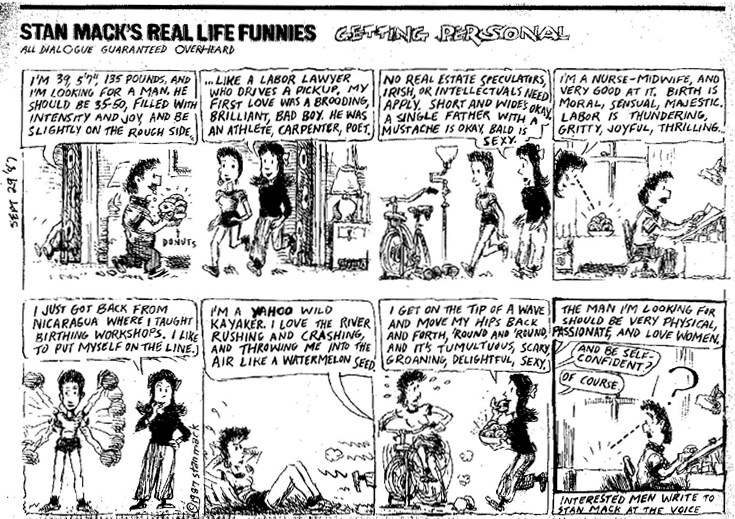
To me it’s a great commentary on the perfectionism which some women put in their personal ad profiles describing the kind of men they’re seeking. Published in 1987, in New York’s VILLAGE VOICE newspaper, and still valid, three decades later. (in 2016)
You must be logged in to post a comment.