Notes on Returning from Cuba
CUBAN CHRONICLES
by Walter Lippmann
NOTES ON RETURNING FROM CUBA TO LOS ANGELES
January 14, 2018. (I’m 74. January 6 is my birthday.)
================================================
If you haven’t had the chance to look at two unusually positive articles, one in the NY last Sunday, the other in the Wall Street Journal. We get so few on-scene reports from people who’ve actually been there, and provide good reports on what they’ve seen. But all the more surprising, and pleasing, to be published in these usually unsympathetic publications. Don’t miss them!
A Cuban Island That Has Played Both Paradise and Prison
The Isle of Youth — which has been both a Communist Utopian getaway and home to a brutal prison that housed Castro for a time — is a world apart, even by Cuban standards.
https://www.nytimes.com/2018/01/02/travel/cuba-isle-of-youth-isla-de-juventud.html
A Trip Through Cuba—by Bike, Bus and Cadillac
Even with the latest round of changes to the U.S.-Cuba tourism policy, American vacationers can still legally visit. Our reporter sets out on a weeklong excursion through the countryside, from verdant valleys to white-sand beaches.
https://www.wsj.com/article_email/traveling-to-cuba-is-still-easier-than-you-think-1515694877-lMyQjAxMTI4NDE3MzcxMzM5Wj/
================================================
ON A PERSONAL NOTE
Anyway, in 2017 I did these three notable (to me) things:
First, after thirty years living in the same house, I had the kitchen remodeled. It looks really nice now. I’m very happy with it.
Second, I went to Cuba for a month (Nov. 14-Dec. 14). My goal, as usual, was to learn. And I learned a lot, even, as an inpatient in the famous Cira Garcia hospital for three days. On discharge, they advised me against long walks and heavy exercise.
Back here I’ve been seeing a lot of doctors, trying to figure out what’s is really going on, and what I can or should do, or not do. One gave me shots in my knees which took most of the pain away, but I’m being very careful about how I move around. These were the planned achievements (not the hospital stay).
Alas, my energy level is way below what I think it ought to be, so I find myself frequently napping during the day. It’s taken quite a lot of time to write this over several days. It’s the energy level that’s bothersome.
Third, a surprise that I didn’t realize until New Year’s Eve. Though I had no specific goal, I lost FIFTEEN POUNDS last year. No diet, no special exercise, no tracking, no program, just learning to eat less and be satisfied les. I’m really pleased and proud of this, and all the more so as it was unplanned.
And, no, I don’t think there’s any connection between losing the weight and lack of energy. I’m in no hurry (where would it get me?) and, it’s counterintuitive. I’m having good communications with my doctors.
I’m 5-7, and hovering just below 180. This year 180 can be my ceiling. l hope to go further but no timetable, etc. I’ve dealt with this issue all my adult life. I’m thrilled with this. It’s the second biggest behavioral change I’ve ever made. (I gave up cigarets on June 11, 1981.) For now, along this path, this is my main personal priority. I’m doing as much written work as I’m able.
Perhaps if I lose more weight my energy level will improve. I’m feeling OK about my doctors here at Kaiser. Yes, including a psychologist.
My personal point of view when thinking and writing about Cuba.
From time to time I think it’s useful explain how I look at Cuba. Perhaps we can call it “stopping for station identification”. I think of it as a “Cuba-centric” approach. When I read about something, I wonder: How does this affect Cuba? What do Cubans think about it? What’s the Cuban media saying? That’s one of the reasons I like to provide original translations from the Cuban media.
Yes, I have my own politics. They are leftist and socialist, but I don’t belong to any socialist group or party. My goal here is to try to understand, and then to share, what things mean and how they and Cuba affect each other.
And I strongly support the Cuban Revolution, otherwise I wouldn’t be spending my time doing this. When I was 20 and 30, I thought I had all the answers. Now I know I don’t even have all the questions.
And so I always keep in mind Fidel’s November 17, 2005 explanation that,
among all the errors we may have committed, the greatest of them all was that we believed that someone really knew something about socialism, or that someone actually knew how to build socialism. https://walterlippmann.com/fc-11-17-2005.html
After nearly twenty years of visiting Cuba, I Iike to say: I am BEGINNING to think that I’m BEGINNING to understand what I THINK I see. My writings and translations aim at helping people to understand Cuba’s complex, and sometimes boring, social and policial process.
People from the United States, the most uninformed people on earth, often think they know everything about everything, especially about Cuba. And few hesitate to express the sharpest criticism of Cuban life and politics. Many who’ve never been to Cuba, or just gone there to attend a meeting, seem to think they know everything about Cuba, especially what’s wrong with it.
My approach is that I try to look and listen when on the island, and read the Cuban media when not there, trying to understand the complex society which exists there.
The CubaNews Yahoo news group, and the translations I share from the Cuban media, are all designed to help readers try to understand a complex society. It is my hope and desire that readers find the materials informative and useful in their efforts to understand the island and it society. That’s my goal in this work.
Cultural shift
Today is Sunday, and one of the main differences between Los Angeles and Cuba is that in Cuba, the Sunday Juventud Rebelde is 16 pages. Normally it’s just eight. And no advertising. And if I wanted to get it today, I’d have to go where someone is selling them, or know someone and pay them in advance to be sure to get it today. Every kiosk in Havana has a nice pre-printed sign which says “la prensa no llegado” (the papers aren’t here) so they don’t have to explain it to each person every time. Delivery is sometimes erratic.
Here in Los Angeles I receive the Los Angeles TIMES and the New York TIMES in print every day. On Sunday the papers are filled with advertising. Actually, before taking a look at the articles, I have to spend time shucking all the advertising sections which I don’t read. I give them to someone who collects coupons. Delivery is pretty prompt most days, Monday through Friday around 5 AM, 7 AM weekends. It’s a veritable mountain of paper, some very pretty, but most of it trying to sell me things I know I don’t need. Or even want.
We kind of take it for granted, or don’t think much about how the newspaper we receive is a private business whose main purpose is to make money by selling things through advertising.
The Cuban media, limited as it is by many factors (resources, attitudes, etc.) give the reader eight or sixteen pages of information, presented from the PCC viewpoint, on major issues. Its primary audience is Cubans on the island.
I’m a bit more interested in how Cubans and the Cuban media look at developments here in the US, like the Hollywood Sex Abuse scandals (deliberate capitalizing), etc. Through the years CubaNews Yahoo news group has been providing translations of from Spanish about life in the US and elsewhere..
Because of my various health issues and reduced energy, I’ve given up cutting, pasting and sharing long articles from sources like the NY TIMES, WALL STREET JOURNAL and so on. It’s simply much too much work. And, I think most of the Cubans who want to read such things now have internet access.
For now, I’m going to focus on editing translations and my own writing. Some translations I do myself, others are by native Spanish speakers whose work I edit for English fluency. I always indicate that the translations are “edited by Walter Lippmann.” That’s me taking credit, responsibility or blame, as appropriate.
One very special translation currently in process is the epilogue to a 472 page anthology of Trotsky’s writings by Fernando Rojas, Cuba’s Deputy Minister of Culture. Here’s the catalogue entry to the book. In the epilogue, Rojas gives his take on Trotsky’s writings and his relationship with the Soviet government. http://www.oceansur.com/catalogo/titulos/leon-trotski/
What am I looking for when I go to Cuba?
When traveling to Cuba, my main goal is to try to understand a complex society. Cuba has achieved much because of its revolution. However, Cuba has plenty of problems, and they’re not all caused by Washington. The Cuban media provides occasional reports of such things, but they’re not always translated. I like to bring readers translations of some precisely because they are from the Cuban media.
While willing to share my experiences and ideas with Cubans, my goal there is to mostly to learn. The main things I have to teach my Cuban friends are some of the finer points of English grammar, spelling, sentence structure and headline-shortening and the occasional false cognate.
Preparation for going to Cuba, and even for coming back:
Before traveling to Cuba, I strongly recommend that everyone read, or re-read, HOW TO VISIT A SOCIALIST COUNTRY by Richard Levins to context for what one. People who’ve never been to Cuba before are often surprised at seeing many run-down buildings, streets with potholes and so on. Levins, who was also a member of the Cuban Academy of Sciences as well as a Harvard, provides indispensable context to prepare for a visit to Cuba. I try to re-read it before I go, and after returning. I cannot recommend it more highly.
Settling in and getting re-oriented in Cuba
During this visit, I had a chance to catch up with people, some of whom I’ve known ever since my first adult visit, in 1999. And I keep meeting new people and making more friends. I’m going to write about and how I came to meet them, and what I learn from these people. And nearly everyone has something I can learn from. Will share some photos as well. In this way, to an extent, my eyes are yours and you can see Cuba somewhat through my eyes. Hopefully not through my blind spots…
When you have people you’ve known for long periods, you always bring hard-to-find items. Here in the US, nearly anything (except love) can be found online, in or big stores, if you have the money. In Cuba, one learns that if you see something and they have it, you buy it NOW because it’s likely to be gone tomorrow.
You might have the money, but the item is out of stock and who knows when more will come? So I bring things like books, over-the-counter medications, vitamins, and, this time, adult diapers for a friend from that 1999 visit, who now needs them, and they don’t have them there. Occasionally I bring balsamic vinegar, often impossible to find in Cuba, but this time I found three bottles of the genuine stuff from Modena, Italy, with the certification seal. It’s unpredictable.
A touristy stop
For many years, used book and memento vendors have surrounded the Plaza de Armas in Old Havana with rows and racks of books (mostly) and used cameras, old coins, and such. Those vendors have now been moved about a block away to a rather less-accessible place. I’m sure their foot traffic is way down, and they complain about it. Some are selling Cuban movie posters, a few political posters, and such.
I found posters from last year’s ROLLING STONES concert in Havana. I bought some and donated them to the Center for the Study of Political Graphics, a wonderful activist-archive which collects and mounts theme-based exhibits. In time, CSPG will be selling these.
If you have political posters which are sitting in the garage, perhaps getting mildewed, consider donating them to the CSPG. Read about them: http://www.politicalgraphics.org/
Thanks and appreciation
Today I want to publicly thank two young Cuban compañeros who contribute to making the Yahoo news group I direct most useful. Abel Gonzalez of the Cuban News Agency (ACN) and Dunia Torres of Granma post the English-language materials readers regularly receive. Through their efforts, readers get the information and analysis which Cuba makes available in English. I am deeply grateful to them for their quiet and consistent participation. CubaNews wouldn’t be the same without them.
A monthly celebration you can easily participate in.
ETECSA has just cut the price of domestic cell phone calls. It’s modest, but anything which saves Cubans money is always appreciated, especially by them.
Each month the Cuban phone company, ETECSA, has a special one-week promotion during which anyone living abroad can recharge the cell phones of Cubans on the island. During this period, for a small charge, fully legal under US law, anyone can recharge Cuban phones, and receive a more than double number of minutes.
This is the week that these special deals are offered. There are several companies which provide this. I personally use hablacuba.com because I save money on calls TO Cuba with it as well as doing the recharges. ding.com is another, and it provides the fastest service of all, often in just a few minutes. Help your friends and family in Cuba by recharging their phones now. https://hablacuba.com/buy/mobile_recharge
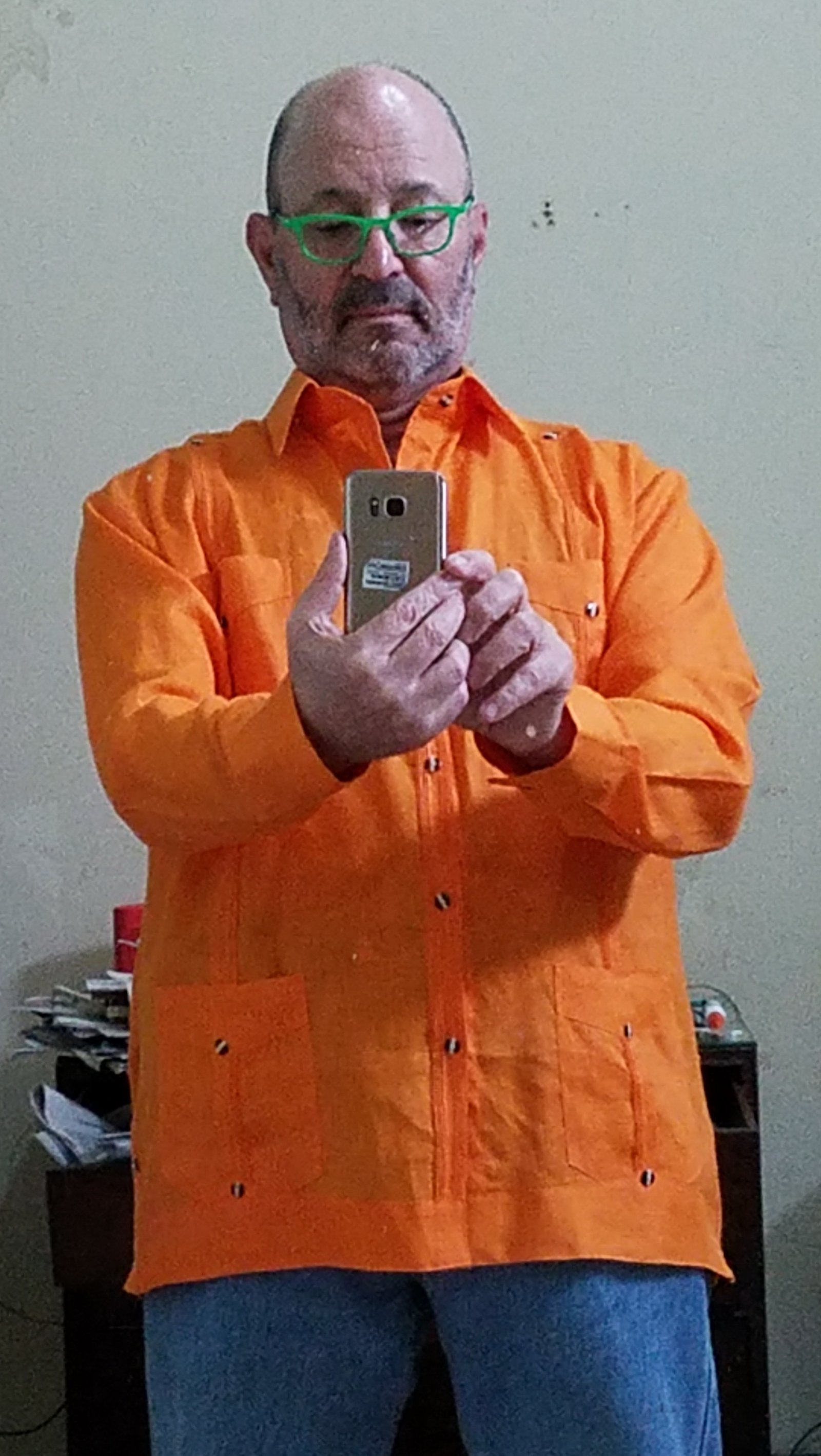
The one special treat I got for myself on this trip was the beautiful guayabera you see here. Every year just in time for Christmas shopping, there’s a big arts and crafts fair, FIART, held at Expo Cuba. Thousands of people come to look for clothing, furniture, shoes and so on. There are booths selling Cubang in national currency. Though I’m a very good photographer of other people, I’m a difficult subject when the camera is turned on me. This one’s pretty nice, I think.
From now on, I plan to write and edit more, as time and my energy level permits. Thanks for taking the time to read this.
SOMOS – Photographs by Roberto Chile
- English
- Español
SOMOS
Photographs by Roberto Chile
A CubaNews translation.
Edited by Walter Lippmann.
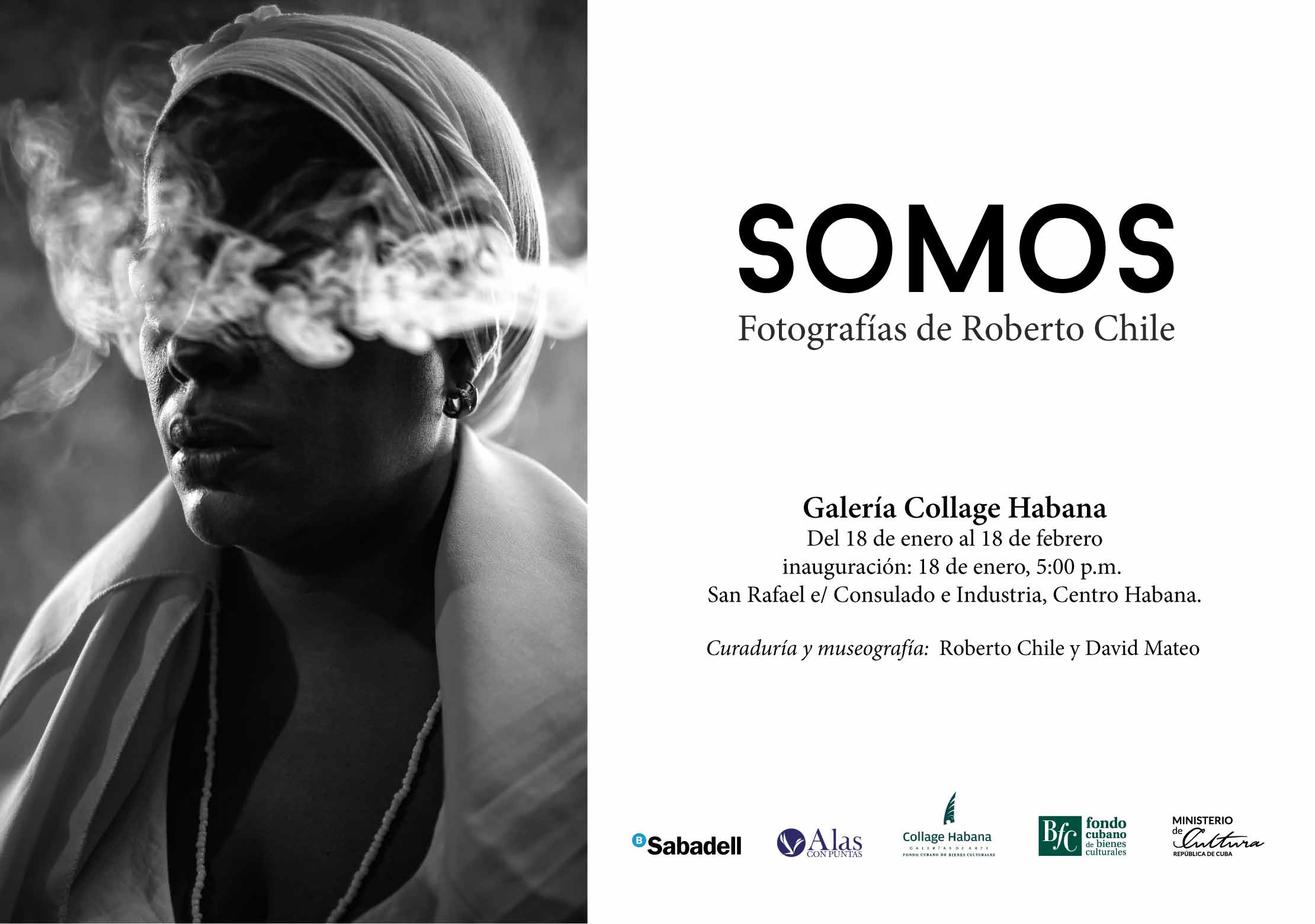
On January 18, at 5:00 PM, the photographic exhibition SOMOS, by the visual artist Roberto Chile, will open at the Collage Habana Gallery of the Cuban Fund of Cultural Assets
From the representation of faces, symbols, rituals and offerings, perfectly captured by the insightful and timely viewpoint of the artist, we discover the mysticism and charm of an environment forbidden to many and that is exhibited here and now, as a photographic essay.
At the same time – in what constitutes one of the fundamental contributions of this exhibition – Chile shows us that imaginary bundle with which the slaves were brought to the Island: memories, dances, songs, languages, ceremonies, which, when interacting between yes and with the dominant culture, motivated the so-called religious expressions of African origin.
In the words of Rafael Acosta de Arriba, in his words to the catalog, “all the religious syncretism that these images reflect is based on the strength and relevance of the subjects who stage them, masterfully recorded by their eye”.
Somos, dedicated to the memory of Enriquito de La Hata, will remain open to the public until February 18, at the headquarters of the gallery, which is located on San Rafael, between the Consulado and Industria, Centro Habana, and may be visited at the usual hours.
SOMOS
Fotografías de Roberto Chile
La galería Collage Habana del Fondo Cubano de Bienes Culturales, inaugurará el 18 de enero de 2018, a las 5:00 p.m., la muestra fotográfica Somos, del artista visual Roberto Chile.
A partir de la representación de rostros, símbolos, rituales y ofrendas, perfectamente captados por la mirada perspicaz y oportuna del artista, se nos revela el misticismo y encanto de un ámbito vedado para muchos y que se exhibe aquí y ahora, cual ensayo fotográfico.
Al mismo tiempo – en lo que constituye uno de los aportes fundamentales de esta muestra – Chile nos asoma a ese fardo imaginario con el que los esclavos fueron acarreados a la Isla: memorias, bailes, cantos, lenguas, ceremonias, que, al interactuar entre sí y con la cultura dominante, motivaron las llamadas expresiones religiosas de origen africano.
Al decir de Rafael Acosta de Arriba en sus palabras al catálogo, “todo el sincretismo religioso que reflejan estas imágenes parte de la fuerza y relevancia que poseen los sujetos que las escenifican, registrados magistralmente por su ojo”.
Somos , dedicada a la memoria de Enriquito de La Hata, permanecerá abierta al público hasta el 18 de febrero, en la sede de la galería, que se ubica en San Rafael, entre Consulado e Industria, Centro Habana, y podrá ser visitada en los horarios habituales.
Bayamo, July 26, 2006)
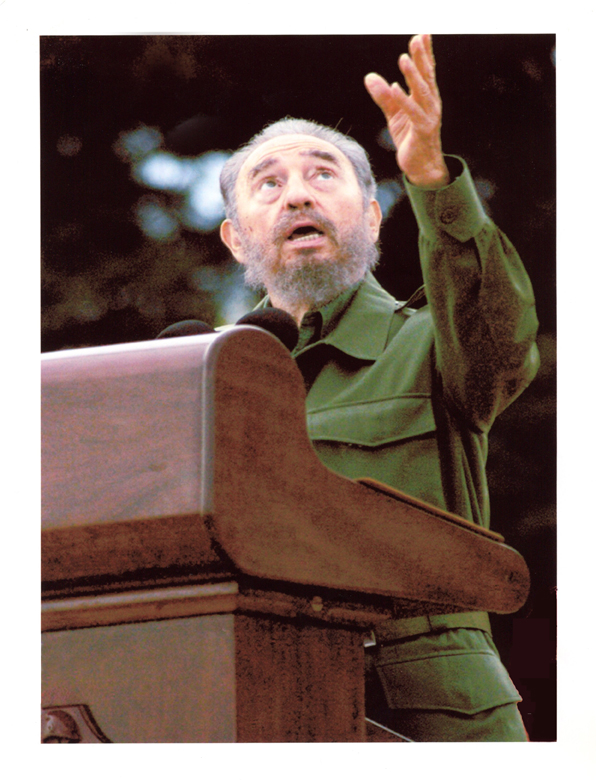
Fidel Castro, speaking in Bayamo, Cuba, July 26, 2006. I took this picture, surrounded by tens of thousands of Cubans. It is my favorite picture of the historic leader of the Cuban Revolution.
He’s got a ticket to fly…
CUBAN CHRONICLES
by Walter Lippmann
THANKS TO MODERN TECHNOLOGY Thanks to modern technology I can use the cell phone’s ability to transcribe the spoken word into the written word. I was able to do this at the hospital and because we do have WiFi here at the airport I’m going to try to make at least a little report to you now. This morning I began to write a report and I got several parts of it done but then I had to pull away from the hotel’s computer near where I live and take care of yet another few final errands.
Try as I might it just became impossible today to share last Impressions before leaving I do have about an hour but I’m not sure I want to try dictating this kind of report to a cell phone. It’s surprisingly hot and muggy here in the airport which is different from the way it is outside where it’s actually brisk and cool today. Maybe they turned the air conditioner off because of that and they’re always try to save on unnecessary electricity usage anyway.
As I leave Cuba after a month I have to tell you I’m in very hopeful spirits. I’m leaving a country which is working very hard to try to resolve its many problems. It would not be fair to say that all of Cuba’s problems are caused by the US blockade. But there’s no question in my mind and there shouldn’t be any question in the mind of any reasonably objective person that every problem that this country faces is made worse by that blockade.
No I am not going to give you a speech.
The flight is almost 6 hours long. My house sitter will meet me at the airport and take me back home. I’m very much looking forward to getting into that convertible bed that I bought recently which has the wonderful capability of being able to raise the head and the feet at the same time. It’s sort of like and it works the same way except that it’s a double.
Most likely I’m going to have to try to do some more of my work in bed because of the ruptured muscle that I have in my right leg.
Other than drinking a bottle of lemon flavored Perrier and maybe eating an apple or something my plan is to try to avoid as many outside stimuli as I can and will endeavor to write a more detailed report,or, more to the point to complete the report that I started this morning and was unable to complete.
I’m really quite tired now and I also just had a shot here at the airport by a nurse to try to prevent me from having a thrombosis on the flight. If I have any other thoughts before getting on the plane well maybe I’ll make them.
Just getting back to home in Los Angeles
CUBAN CHRONICLES
by Walter Lippmann
December 15, 2017
Just getting back to home in Los Angeles. Trip was quiet, flight half-full, mostly tired and sleepy people. The flight attendants were older women who were a delight to be around, enthusiastic about helping people. Just great. No exit tax anymore. First time in ages I didn’t get called to customs because my bags are always filled with books. A doctor and nurse attended me in a private room and she gave me the shot. Painlessly.
I’ve been thinking now I just have to take some time to give some thought to what I’ve seen and heard in Cuba during this past month. I don’t want to start to create lots more cutting and pasting. I want to share it with those who’d be interested. I left there and came back feeling very enthused about what I think they’re trying to do and plan to write about it in some detail. Just kind of shapshots or vignettes from a month in Cuba. There’s plenty of work to be done. Let me tell you. Well, I WILL tell you as I get a handle on it.
I’ll share my thinking as it develops. Stay tuned, please.
And thanks for listening.
Originally posted to Facebook Friday, December 15, 2017
12:23 AM
Gender Violence…Does does it have to do with me?

Gender Violence…Does it have to do with me?
 Author:
A CubaNews translation.
Edited by Walter Lippmann.
It has to do with all people, human groups and institutions that share their existence in concrete socio-historical and cultural spaces. It could be thought that it is a question of women, or rather of “some women”. Some people believe that it is not a problem in Cuba, it is not so serious, or it is simply a fad that seeks to change our language by forcing people to talk about “the” and “the”. by using inclusive words such as “it” instead of using “he” when referring to both men and women.
THE ORIGINS
Let’s go in parts and start with its origins. Before having sons and daughters, people usually make up images about what the process would be like. Even if you do not think carefully or plan, in our heads, ideas and sensations are activated about what the child will be like, what name it will be given, how it will be dressed, what qualities it will have, what its occupation will be, what its relationship as a couple will be like and even the children it will have in turn.
A human being is built over the years. It’s a process in which not only the mother and father participate, but the rest of the family members with their diverse beliefs. In addition, the neighborhood, the school, friends, the religious group, workspaces, membership organizations, social media and many others play a role. In all that framework, the teachings and learnings, as a tendency, are marked by differences depending on whether the newly arrived child is considered a man or a woman
It is common to frame education or socialization according to pre-conceived beliefs that we transmit from generation to generation. The process starts at an early age and is reinforced throughout life. At pre-school age we teach children’s songs that forbid a girl to play because she has to do the laundry or iron the clothes on different days of the week «Monday before lunch, a girl wanted to play, but she could not play because she had to do the laundry…».
Likewise, in the song about the playful she-ant: “… she did nothing but play and her mom told her to come and help her clean …”. She is given the care of her sick mother, who only stops doing domestic work when she has to stay in bed due to incurable health problems. Girls are often given brooms and mops, cooking toys, ironing boards, princess dresses and make-up sets. Boys are given trucks, machines, pistols, baseball bats, swords, etc. As they grow up, each learns skills, trades and different professions for male and female, as well as ways of thinking, feeling and behaving.
FROM DIFFERENCES TO VIOLENCE
Society as a whole is transmitting these beliefs and stimulating a prevailing single acceptable way of being a man or woman. Women are supposed to be beautiful, delicate, obedient, passive, conciliatory, docile, weak, sacrificed, motherly, dedicated to domestic work and the care of sick and elderly people, given more to the private world of the family. Men are supposed to be strong, independent, competitive, virile, active, dominant, powerful, providers of family income, intrepid and daring, given more to the public. This pattern includes heterosexuality for both. As people move away from these sexist patterns, they are more likely to be rejected, discriminated against and violated. The type of society in which the dominance of the masculine and the subordination of the feminine is promoted is called patriarchy.
If these were just differences, it would not be so impressive. The issue becomes more complex when a deeper analysis leads us to understand that these differences become inequalities with negative effects for both. They become straitjackets that imprison the liberties and rights of people, based on false gender beliefs, on asymmetries of power between the feminine and the masculine that determine everyday life.
So-called gender violence lies in acting (or not acting), deliberately, based on inequalities and asymmetries of power. These are anchored in what is considered valid for the feminine and masculine from a patriarchal perspective and which causes physical, psychological, sexual, and economic damage.
Victims of gender violence can be found among people of any age, school level, social class, territory, income level or skin color. None of these variables excludes people from being victims or perpetrators of violence. Of course, when there are unfavorable living conditions, situations of violence and their solutions become more complex.
It is important to say that violence intersects. A person can be violated on the basis of gender and at the same time because someone is black, follows a certain religion, has a disability, poor [material] resources and/or lives in a specific region. The possible combinations demand the attention of each dimension.
CONSEQUENCES
Some of the costs of assuming the prevalent or hegemonic sexist masculinity include: difficulties in expressing painful emotions and feelings; pressure to maintain control over the partner, and violent handling of conflicts; non-responsible paternity and deprivation of the enjoyment of this role; problems with self-care such as resistance to exams for prostate cancer screening, or silencing health issues such as sexual dysfunctions; having simultaneous partners, promiscuity, risky sexual practices and permanent seduction; suicide and alcoholism when the role of provider cannot be fulfilled; obligation to have children; restraint of sexual orientation and gender identity; accidents.
While there are negative costs of the male pattern for men in patriarchy, the punishment for women who deviate from the norm established by this system has been widespread in the history of humanity and still is today. Gender violence against women is the most extensive and serious of gender inequalities. Among the consequences of this form of violence for women we can mention: personality problems such as insecurity, low self-esteem, little perspective for the future; depression, anguish, fear, sleeping and eating disorders; physical and psychological injuries; effects on health due to continued domestic overload throughout life; isolation from social spaces (family, school, friendships); limitations on autonomy due to prohibitions on their insertion and promotion in working life; sexually transmitted diseases and unwanted pregnancies; sequels of sexual violations; suicide and death.
The balance of damages transcends personal stories. The implications reach a high economic cost for people and for a country that needs to optimize resources to ensure sustainable development. The other side of the effects is social. As long as gender violence exists, it constitutes in itself a benchmark for the education of all generations. This means that if attention is not paid, if this is not taken care of, if this is not stopped, sexist patterns will continue being reproduced with social behaviors and fantasies that “justify” this type of violence against women as something “normal” that has always existed.
CUBAN CONTEXT AND THE COMPASS IN THE WALK
Thanks to social policies implemented decades ago, Cuba has very favorable indicators in gender equality. There are no identified forms of violence in the country that still exist in other regions of the planet. For example, ablation (amputation) of the clitoris [aka genital mutilation], sexual enslavement and torture of women as spoils of war in armed conflicts, or mass killings of women with impunity. However, there are forms of violence against women in our context, as shown by social research, health institutions, instances of the Cuban judicial system and the Houses of Counseling for Women and the Family (COMF) of the Federation of Cuban Women among others.
There is sexual, physical, economic and psychological violence. The latter, is always the most frequent because it is linked to the previous ones and can appear alone, is invisible or neglected. Some believe it does not leave traces when, in reality, it is necessary to “train” the eyes to identify it with its consequences. Some of its forms are shouting, silence as punishment and condemnation, prohibitions, impositions, disqualifications, threats, emotional blackmail, etc. Gender violence and especially that perpetrated against women constitutes a social, health and rights issue.
If situations of violence are experienced, the first recommendation is to ask for help. The problem is not private even if it occurs in the family or another social space. People can contact the COMFs that exist in each municipality, the doctor’s offices and polyclinics, Mental Health Community Centers, the National Revolutionary Police stations and the Attention Offices of the Attorney General’s Office.
Gender violence requires attention and prevention. The solutions need a look at the system, the analysis of its causes and the participation not only of different professionals, sectors and institutions, but also of state coordination and monitoring. This system is under construction so that it can yield real and sustainable results. It is essential that the whole society be involved. No one is left out. And yes, it has to do with me and with you, with men and women who want a just society without victims of gender violence.
* Psychologist at the Oscar Arnulfo Center
No to Gender Violence


No to Gender Violence
The violence that is externalized in public spaces against women, girls or other men according to their gender identity or sexual orientation, is barely ten percent of what occurs in an imperceptible way
 By Mileyda Menéndez Dávila
sentido@juventudrebelde.cu

NO to gender violence Author: Juventud Rebelde Published: 01/12/2017 | 09:30 pm
A CubaNews translation.
Edited by Walter Lippmann.
To banish gender violence from our lives, we must begin by accepting its multiple guises and propose worthy alternatives to everyday behaviors that normalize that scourge from male and female roles.
The violence that is externalized in public spaces against women, girls or other men according to their gender identity or sexual orientation, is barely ten percent of what occurs in an imperceptible way. It leaves no physical traces because it is exercised at the symbolic and psychological level, and is not denounced because it generates feelings of shame or disability. This is especially if the violent act comes from people who should guarantee us affection and protection.
Also influences the social tendency to tolerate other manifestations of violence reaffirmed through popular music and sporting events, the relaxation of the rules of coexistence or the misrepresentation of creeds that assume male supremacy as natural and necessary.
More than obeying
To modify this practice, it is necessary to understand the impact of intimidation on individual health and the well-being of society. Dozens of institutions investigate its causes and paths in Cuba, including the Institute of Legal Medicine, the Attorney General’s Office, the National Center for Sex Education (Cenesex), the chairs of women, the Center for Women’s Studies and the Family, the Cuban Women’s Federation (FMC), the Center for Youth Studies and the Center for Psychological and Sociological Research.
The work of the Oscar Arnulfo Romero Reflection and Solidarity Group is an example of how Cuban civil society is also involved in the transformation of these lessons. Since 2007, that body has generated messages of public good that invite reflection on psychological violence, involving students and professionals of design, social communication, journalism and audiovisual media in the creative process.
This is how the Eres Más campaign was born, which, in addition to using traditional media circuits, occupies visible spaces in billboards and other media to reach all the municipalities in the country and make stereotypes problemmatic or to dismantle myths and macho customs.
Its main goal is to urge adult women of any race and origin to become aware of their rights and adapt the response to that aggression (subtle or obvious) that seeks to perpetuate the economic and sexual dominance of the masculine.
It also invites men to gradual change in beliefs and habits, in order to establish more equitable relationships from a spirituality committed to solidarity, plurality and participation.
More than resist
One campaign does not change the reality, but it makes the evil visible and appeals to feelings and principles to overcome the resistance to change of those who live with the abuse, although as they praise equal rights, sowing in the new generations those double standards, loaded with discriminatory prejudices .
Some patterns survive in our identity to such an extent that many people justify male violence unconsciously. Society is silent when the man controls or limits the woman, but is scandalized if it is she who tries to “put on pants” because that subverts the supposed natural order, and the same happens with the distribution of passive and active roles in homosexual couples .
Neither of the two extremes is right: It is necessary to educate ourselves in amorous dialogue to break such habitual mechanisms. It may also be necessary to seek legal or therapeutic help in the orientation centers for the woman and the family, the National Revolutionary Police, the Primary Health and the offices of attention to the citizen rights of the municipal Prosecutor’s Office.
The invitation to change is made: As a man, you can make the decision to try a different behavior, more respectful and consistent with your feelings. As a woman you have the challenge of suspending the legitimacy of violence, not allowing it in your environment or transmitting it uncritically to your children.
Do not accept being imposed on the road: build your reality according to your dreams and potentialities knowing that you are more, much more than what they make you see. You are not responsible for the suffocating behavior of significant men in your life (couple, father, brothers, colleagues, religious leaders, formal authorities), even if they try to justify centuries of patriarchal domination.
________________________________
Day dedicated to youth
The main activities will take place in Las Tunas province from December 7 to 9. There will be held the National Meeting of the Platform of Cuban Men for Nonviolence and Gender Equity
Gatherings
 Author: Iviani Padín Geroy
Published Friday 01 December 2017 | 09:44:47 PM
The capital city of Tuesday 12 in the Mathematics Department of the University of Havana and will be dedicated to people with special needs, and their ability to love and enjoy the erotic without limitations
ASK UPFRONT
 Author: Mariela Rodríguez Méndez
digital@juventudrebelde.cu
Masters in Clinical Psychology, counselor in STDs and HIV/AIDS and psychoanalyst
I do not know if I’m gay or bisexual
Posted: Friday 01 December 2017 | 09:46:58 PM
The confusion begins when I spend time without having sex with girls and I begin to get attention from men
JB: I’ve spent my whole life studying. That’s not why I stopped going out, having sex with girls and feeling good about them. The confusion begins when I spend time without having relationships with girls and I begin to draw attention to men … The problem is that I do not know if I’m gay or bisexual. I do not know in what direction my sexual orientation is. I am a 26 year old young man.
It’s better not to impose an answer that you still do not have. You must wait for experiences that allow you to distinguish your preference. You would have to define if you are only with men when you lack famale options or if you wish,in the first place, to be intimate with them, with women or both.
Sexual orientation is defined by preference; not by practices or conveniences. A person, due to multiple circumstances, can have sexual practices with people whom they do not prefer.
Homosexuality refers to the preference for people of the same sex, heterosexuality refers to the preference for people of the other sex and bisexuality supposes that they like with the same intensity people of both sexes, without being able to do without one or the other.
From what he says, until now he is doing well to be surprised by his experience. It is striking that he is not interested in being part of a couple and now he is worrying about an answer that would tie down his future decisions. Why define your orientation now? What good would it do to have that answer now? What else is going on?
Hondurans Seek Revenge at the Ballot Box
- English
- Español
Hondurans Seek Revenge at the Ballot Box
 By Manuel E. Yepe
http://manuelyepe.wordpress.com/
Exclusive for the daily POR ESTO! of Merida, Mexico
Translated and edited by Walter Lippmann.
The deceptive trickery of the bourgeois governments sponsored by the United States has no limits. A few hours were enough for the candidate for presidential re-election in Honduras, Juan Orlando Hernandez (JOA), to convert, a difference of 5% of the votes counted in favor of his opponent, Salvador Nasralla, into an advantage of for him that would proclaim him reelected President.
JOA had remained in an electoral campaign throughout his government. While locking up, banishing or burying his adversaries, he gave away balls, cardboard houses, bags of beans labeled with his photograph and the logo of his party and other sacramental gifts “blessed with the blood of Christ”. He distributed even 50 Lempiras (equivalent to 2.5 dollars) to all impoverished voters.
Depressing was the surprise for him and his cohort when, at the end of the November 26 vote, the Supreme Electoral Tribunal (TSE) announced that the candidate of the Free Alliance-PINU, Salvador Nasralla, was ahead of him by 5 points.
A few minutes later, the TSE suspended the count due to “technical problems of the system” and shortly thereafter announced that, in a new calculation, JOA was ahead of Nasralla by 1 point.
Popular protests immediately broke out. Hondurans could not placidly accept the monstrous fraud, which came to fill the cup of humiliation that infringed the nation’s coup that ousted President Manuel Zelaya in 2009.
Ollantay Itzamná, a Quechua nomad, son of Pachamama, activist and reflective defender of human rights and of Mother Earth, who also trained as a lawyer, anthropologist and theologian in Western science, has narrated, as a brilliant journalist, an understandable synthesis of the historical background of the phenomenon that is taking place in Honduras.
“The State of Honduras, in its almost 200 years, has been controlled and governed by an elite of landowners and self-designated conservative and liberal merchants. During the first 100 years, the leaders of Honduras were selected by means of bayonets and shotguns. At the beginning of the 20th century, the conservatives, to make the pantomime appear democratic, created the so-called Liberal party and, from that, Honduras lived a whole century under National-Liberal bipartisanship.
With the politico-military coup d’état of 2009, the rich in power accelerated their own political destabilization. In fact, the emergence of the social movement that became the National Front of Popular Resistance (FNRP), demanded the return to power of the deposed President Manuel Zelaya. It proposed profound structural changes in impoverished and alienated Honduras.
Beginning in 2012, the FNRP gave birth to the current political party Freedom and Free Refoundation, made up mostly of former liberal politicians, who, in its first participation in elections, took second place in the general elections of 2013, with 37 deputies from the 128 that make up the Congress of the Republic.
But the government of JOA, co-author of the coup d’état, which had control of the legislative and judicial powers, and made political life almost impossible. Not only did it exclude them from parliamentary committees, it systematically blocked their legislative initiatives.
After the 2009 coup, Honduras experienced a systematic “democratic” dictatorship, where illegality, corruption and the dissolution of rights were constantly promoted.
The illegality of the JOA dictatorship reached its maximum expression when, contrary to the provisions of the country’s Political Constitution, the presidential candidate announced he was seeking re-election, under the slogan: “The best life for Honduras can not stop”. Something unlikely in a country that has conquered the world record as “the country with the most violent war in the world,” and where the level of poverty worsened more than 10% after the 2009 coup.
Dissent or disseminating a critical thinking has been punished with harsh penalties and disrespect for human rights. It took on a murky look with massacres and selective killings, such as the murder of Berta Cáceres which was denounced worldwide.
“In these conditions, Honduras was forced to return to the ritual of the polls. The dictator, believing that his victims were defeated, tried to re-elect himself in the polls claiming to be ‘s anointed by God to continue governing Honduras for Christ. “
But, the resistance was not dead. It returned to him to ashes and defeated the dictatorship of fear, the dictatorship of the media and the divine dictatorship in which the oligarchy enrolled even the Cardinal, bishops, priests, pastors and apostles, says Itzamna.
At the end of this article, and without knowing the final pronouncement of the TSE, everything seemed to indicate a new confrontation between the oligarchy at the service of US imperialism and the mocked people. It could now be more violent and bloody than in 2009, if the poor don’t win electoral vengeance.
November 30, 2017.
VENGANZA HONDUREÑA POR LA VIA DE LAS URNAS
By Manuel E. Yepe
http://manuelyepe.wordpress.com/
Exclusivo para el diario POR ESTO! de Mérida, México.
By Manuel E. Yepe
http://manuelyepe.wordpress.com/
Exclusivo para el diario POR ESTO! de Mérida, México.
La prestidigitación de los gobiernos burgueses patrocinados por Estados Unidos no tiene límites. Unas pocas horas bastaron para que el candidato a la reelección presidencial en Honduras Juan Orlando Hernández (JOA), convirtiera, una diferencia del 5% de los votos computados a favor de su contrario, Salvador Nasralla, en una ventaja suya que lo proclamaría Presidente reelecto.
JOA se había mantenido en campaña electoral durante todo su gobierno. Al tiempo que encerraba, desterraba o enterraba a sus adversarios, regalaba pelotas, casitas de cartón, bolsitas de frijoles rotulados con su fotografía y el logo de su partido y otros regalitos sacramentados y “bendecidos con la sangre de Cristo”. Distribuyó incluso 50 Lempiras (equivalente a 2.5 dólares) a todos los empobrecidos electores.
Deprimente fue la sorpresa para él y su cohorte cuando, al término de la votación del 26 de noviembre el Tribunal Supremo Electoral (TSE) anunció que el candidato de la Alianza Libre-PINU, Salvador Nasralla, le aventajaba por 5 puntos.
Algunos minutos más tarde, el TSE suspendió el conteo por “problemas técnicos del sistema” y poco después dio a conocer que, en un nuevo cálculo, JOA iba delante de Nasralla por 1 punto.
Enseguida estallaron las protestas populares. Los hondureños no podían aceptar plácidamente el monstruoso fraude, que venía a colmar la copa de la humillación que infringió a la nación el golpe de estado que defenestró al Presidente Manuel Zelaya en 2009.
Ollantay Itzamná, nómada quechua, hijo de la Pachamama, activista y defensor reflexivo de los derechos humanos y de la Madre Tierra, formado también como abogado, antropólogo y teólogo en la ciencia occidental, ha narrado, como brillante periodista que es, una comprensible síntesis de los antecedentes históricos del fenómeno que está teniendo lugar en Honduras.
“El Estado de Honduras, en sus casi 200 años, estuvo controlado y gobernado por una élite de terratenientes y comerciantes auto titulados conservadores y liberales. urante los primeros 100 años, los dirigentes de Honduras eran colocados por medio de bayonetas y escopetas. A principios del siglo XX, los conservadores, para hacer aparecer democrática a la pantomima, crearon el denominado partido Liberal y, a partir de ello, Honduras vivió todo un siglo bajo el bipartidismo Nacional-Liberal.
Con el golpe de Estado político-militar de 2009, los ricos en el poder aceleraron su propia desestabilización política y, de hecho, el surgimiento del movimiento social que significó el Frente Nacional de Resistencia Popular (FNRP) que exigía la restitución en el poder del depuesto Presidente Manuel Zelaya y proponía cambios estructurales profundos en la Honduras empobrecida y enajenada.
A partir del 2012, el FNRP dio origen al actual partido político Libertad y Refundación Libre, conformado en su mayoría por políticos ex liberales, que en su primera participación en comicios, ocupó el segundo lugar en las elecciones generales del 2013, con 37 diputados de los 128 que integran el Congreso de la República.
Pero el gobierno de JOA, coautor del golpe de Estado, tenía el control de los poderes legislativo y judicial, y les hizo la vida política casi imposible. No sólo les excluyó de comisiones parlamentarias, sino que les impidió sistemáticamente sus iniciativas legislativas.
Después del golpe de 2009, Honduras vivió una sistemática dictadura “democrática”, donde la ilegalidad, la corrupción y disolución de los derechos fueron constantemente promovidas.
La ilegalidad de la dictadura de JOA alcanzó su máxima expresión cuando en contra de lo dispuesto por la Constitución Política del país, se autoproclamó candidato presidencial buscando su reelección, bajo el lema: “La vida mejor para Honduras no puede parar”. Algo inverisímil en un país que conquistó la marca mundial de “país sin guerra más violento del mundo”, y donde el nivel de pobreza empeoró más del 10% tras el golpe de Estado de 2009.
Disentir o difundir un pensamiento crítico se ha castigado con duras penas y el irrespeto a los derechos humanos cobró visos dantescos con las masacres y asesinatos selectivos, con el caso del homicidio de Berta Cáceres como el más repudiado mundialmente.
“En estas condiciones, la hondureñidad fue obligada a volver al ritual de las urnas. El dictador, creyendo que sus víctimas estaban vencidas, intentó reelegirse en las urnas alegando ser el ungido del Dios para seguir gobernando en Honduras para Cristo”.
Pero, la resistencia no estaba muerta. Volvió sobre sus cenizas y derrotó a la dictadura del miedo, la dictadura de los medios de prensa y la dictadura divina en la que la oligarquía enroló hasta al Cardenal, obispos, curas, pastores y apósteles, señala Itzamná.
Al cierre de este artículo sin conocer el pronunciamiento final del TSE, todo parecía indicar un nuevo enfrentamiento entre la oligarquía al servicio del imperialismo estadounidense y el pueblo burlado, que pudiera ser ahora más violento y cruento que en 2009, si se desconoce esta venganza electoral de los pobres.
Noviembre 30 de 2017.
Beyond Just Saying ¨No¨

Beyond Just Saying “No”
By David Brooks, US correspondent for Mexico’s LA JORNADA daily
Translated and edited by Walter Lippmann for CubaNews.
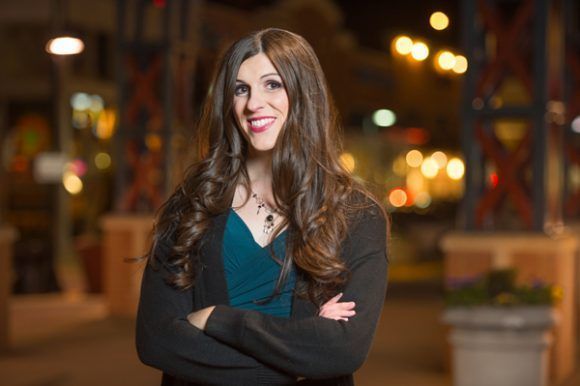
Danica Roem became the first trans woman elected to a legislative position in the United States. Photo taken of Rosa Sheep.
Faced with the increasingly obscene and dangerous political landscape in this country, we hear responses that are moving from the simple no to Trump and his agenda, to something that could generate a progressive change in this country.
The most recent state and local elections in various parts of the country held on November 7 were what some expected, wished, prayed for … that is, a first warning of what could be a wave of repudiation and even progressive change through the the polls in the intermediate elections (federal legislative and several governorships) in 2018 and through new, or renewed, decentralized but allied social movements.
Not only did the Democrats sweep away Republicans in states like Virginia, Pennsylvania, New Jersey and others, but many of the electoral winners were not only Democrats but progressives, and in many cases these victories had a tinge of divine vengeance.
For example, Lee Carter, a marine veteran of the Iraq war, who identified himself as a democratic socialist, defeated a Republican to take his place in the lower house of Virginia, and celebrated that night by inviting everyone to sing Solidarity Forever, the hymn of trade union movement.
Also winning a seat in that same chamber wasa Danica Roem, defeating a Republican who had promoted anti-transgender measures and who had declared himself the main anti-homosexual in the state; She is now the first transgender state legislator in the country. Elizabeth Guzman and Hala Ayala became the first Latinas to become state legislators in Virginia’s history.
In Hoboken, New Jersey, the new mayor is Ravinder Bhalla, a Sikh lawyer, who declared: I am everything Trump hates: a dark man in a turban, and a proud American with the knowledge to stop his assault on the values of our country. . In Helena, Montana, the progressive Wilmot Collins is not only the first African-American to be mayor in the history of the state, but is a refugee from Liberia who won against the Republican mayor who opposed to the entry of refugees to this country.
In Philadelphia, perhaps the most radical district attorney in the country, Larry Krasner, civil rights lawyer, fierce critic of the massive incarceration in this country and who has represented Black Lives Matter and Occupy Wall Street activists was elected. In the Atlantic County commissioner race in New Jersey, Ashley Bennett defeated the Republican in that position; She decided to challenge him at the polls after he via Facebook if they would return home in time to cook their. dinners.
Braxton Winston, who won a seat in the city council of Charlotte, North Carolina, is an activist whose image went viral: his fist held high in front of a battalion of riot police before being arrested in a demonstration against the death of an African-American at the hands of police. In Albuquerque, New Mexico, the next mayor will be progressive Tim Keller, who replaces the outgoing conservative Republican.
The progressive triumphs were remarkable, as they offered more evidence of a growing sector within the Democratic Party outside the centrist leadership. Electoral organizations such as the Working Families Party and the Democratic Socialists of America (DSA) together with the growing diaspora of the support movement for the democratic socialist Bernie Sanders (still the most popular national politician in the polls), Our Revolution and new networks as Indivisible, they were key to generating these triumphs.
But it was also the result of new alliances between social groups, especially immigrant organizations that promoted candidates who directly faced the xenophobic policies of pro-Trump Republicans and other civil rights defense organizations such as Black Lives Matter, along with organizations defending the rights of women and environmentalists.
What happened in the November elections with hundreds of progressive local and state candidates is the beginning of a wave (…) a massive repudiation of Donald Trump, said Joe Dinkin of the Working Families Party. Independent experts, such as the influential Cook Political Report, indicate that the polls, for now, indicate that a political wave in favor of the Democrats is being glimpsed in 2018, implying that they could retake control of one, and even both houses of Congress.
The wide range of active resistance against Trump is showing its potential to go beyond being just opposition to the populist and at the same time plutocratic right-wing agenda and pushing forward a progressive agenda both at the polls and in the social sphere, where some claim it is growing a movement of many movements, varied and decentralized, as described by LA Kaufman in The Guardian. He argues that, in addition to established progressive organizations that have seen their membership grow (as in the case of Working Families and DSA), an impressive number of local grassroots groups have flourished -but at the same time, adding to national networks as Indivisible- that as a whole are six times bigger than the Tea Party (the most influential rightwing current within the Republican Party).
And not everything is manifested or has an end in the electoral field, with these movements -inmigrants, indigenous people, anti-war military veterans, defenders of freedoms and civil rights, environmentalists, professional athletes, artists, students, workers’ organizations and trade unions- fighting in several fronts, but with more and more solidarity among them, which makes them very dangerous for the guardians of power.
The “no” that defined the initial resistance to the seizure of power by Trump and his allies is now seeking to invent, to invite, to a yes.
(Taken from La Jornada )
My Last Farewell to Armando Hart
- English
- Español
My Last Farewell to Armando Hart
By Manuel E. Yepe
http://manuelyepe.wordpress.com/
Translated and edited by Walter Lippmann.
Tonight I will go to the Marti Studies Center of Cuba to give my last farewell to revolutionary combatant Armando Hart Dávalos, who died in Havana of a heart attack.
To say Armando Hart in Cuba is to invoke some of the most transcendental works of Fidel Castro’s revolution. Especially in the fields of education, culture, journalism and politics. Before meeting Armando Hart, I had had very casual relationships in the insurrectional camp with his brother Enrique Hart, whom I admired a lot but worked with very little, because although we both were active in the same revolutionary organization, the 26th of July Movement, my level in its hierarchy was far from from that which Enriquito and Armando had reached.
During my six years as Cuban Ambassador in Romania from 1962 to 1968, I used to do what I jokingly called “courtesy visits” to several colleagues with whom I had developed friendly relations at the time of the insurrectional struggle against the Batista dictatorship. which I consolidated during the period from 1959 to 1961 when I worked as “Introducer of Ambassadors”, a position that is also called Director of Protocol, in the Cuban Ministry of Foreign Affairs of Cuba, then headed by the Chancellor of Dignity, Raúl Roa.
One of those habitual friends contacted during my always short vacation in Cuba was the young Armando Hart, at that time Minister of Education, with whom I exchanged my new diplomatic experiences, with his as minister and political leader.
Each annual meeting with Hart was for me a master class that left me better prepared to contribute to the revolutionary cause in my country while I felt that the experiences in international politics that Armando narrated were also well received.
When I finished my mission as an ambassador in Bucharest and introduced myself to Roa, the foreign minister informed me that, by indication, President Osvaldo Dorticos would go to work in the Central Committee of the Communist Party of Cuba (PCC) with Armando Hart, who was then the Organization Secratary of the PCC. From then on, I served as head of the (unipersonal) section of international information of the Cuban party organization in a function that basically meant serving as Party spokesperson in permanent exchange with those responsible for international information of accredited national or foreign press organs.in Cuba.
For me, this was great news. It allowed me to continue for a few more years developing my intellect, which is the main benefit received by those who have had the honor to work as collaborators with Armando Hart.
A short time later, at Hart´s suggestion, I was selected Director General of the Prensa Latina news agency. There I maintained close working and friendship relations with this extraordinary Cuban revolutionary intellectual whose footprint will remain indelible in the history of the country.
In recent years I have shared with Dr. Armando Hart the role of collaborator with newspapers PORESTO! and a strong friendship with its General Director Mario Menéndez Rodríguez.
November 26, 2017.
MI ÚLTIMO ADIÓS A ARMANDO HART
By Manuel E. Yepe
http://manuelyepe.wordpress.com/
MI ÚLTIMO ADIÓS A ARMANDO HART Por Manuel E. Yepe
Esta noche acudiré al Centro de Estudios Martianos de Cuba a dar mi último adiós al combatiente revolucionario Armando Hart Dávalos, fallecido en La Habana a causa de una crisis cardiaca.
Decir Armando Hart en Cuba es invocar algunas de las obras más trascendentales de la revolución de Fidel Castro. En especial en los terrenos de la educación, la cultura, el periodismo y la política. Antes de conocer a Armando Hart, había tenido relaciones muy eventuales en el campo insurreccional con su hermano Enrique Hart, a quien admiré mucho pero traté poco, porque aunque militábamos en la misma organización revolucionaria, el Movimiento 26 de Julio, mi nivel jerárquico distaba mucho del que habían alcanzado Enriquito y Armando.
Durante los seis años que me desempeñe como Embajador de Cuba en Rumanía 1962 al 1968, acostumbraba a realizar lo que yo llamaba jocosamente “visitas de cortesía” a varios compañeros con quienes había desarrollado relaciones de amistad en la época de la lucha insurreccional contra la dictadura batistiana, que consolidé durante el período de 1959 al 1961 cuando trabajé como “Introductor de Embajadores”, cargo que también se identifica como Director de Protocolo, en el Ministerio cubano de Relaciones Exteriores de Cuba, entonces encabezado por el canciller de la dignidad, Raúl Roa.
Uno de esos habituales amigos contactados durante mis siempre breves vacaciones en Cuba era el joven Armando Hart, a la sazón Ministro de Educación, con quien intercambiaba mis nuevas experiencias diplomáticas, con las suyas como ministro y dirigente político.
Cada encuentro anual con Hart era para mí una clase magistral que me dejaba mejor preparado para aportar a la causa revolucionaria en mi país mientras sentía que las experiencias en política internacional que narraba a Armando también eran bien recibidas.
Cuando terminé mi misión como embajador en Bucarest y me presenté ante Roa, el canciller me informó que por indicación el Presidente Osvaldo Dorticós yo pasaría a trabajar en el Comité Central el Partido Comunista de Cuba con Armando Hart, quien era entonces el Secretario de Organización de esa colectividad. Serví a partir de entonces como jefe de la sección (unipersonal) de información internacional de la organización partidista cubana en una función que básicamente constituía servir de vocero del Partido en intercambio permanente con los responsables de información internacional de los órganos de prensa nacionales o extranjeros acreditados en Cuba.
Ello constituyó, para mí, una gran noticia que me permitió continuar algunos años más desarrollando mi intelecto, que es el beneficio principal que reciben quienes han tenido el honor e trabajar como colaboradores de Armando Hart.
Poco tiempo después, a propuesta de Hart, fui seleccionado Director General de la agencia de noticias Prensa Latina en cuyo desempeño mantuve estrechas relaciones de trabajo y amistad con este extraordinario intelectual revolucionario cubano cuya huella permanecerá indeleble en la historia de la patria.
En los años más recientes he compartido con el doctor Armando Hart la función de colaborador con los periódicos PORESTO! y una fuerte amistad con su Director General Mario Menéndez Rodríguez.
Noviembre 26 de 2017.
You must be logged in to post a comment.