“Excess enthusiasm when facing frustrations”

 PENSAMIENTO [THOUGHT]
“Excessive enthusiasm is a difficulty when facing frustrations.”
Hopefully, the empire will listen to its psychologists, and sometime understand that only new frustrations await it here, if it continues to trust advisors like Juan Gonzalez, Antony Blinken and the Miami haters.
Translated and edited by Walter Lippmann for CubaNews.
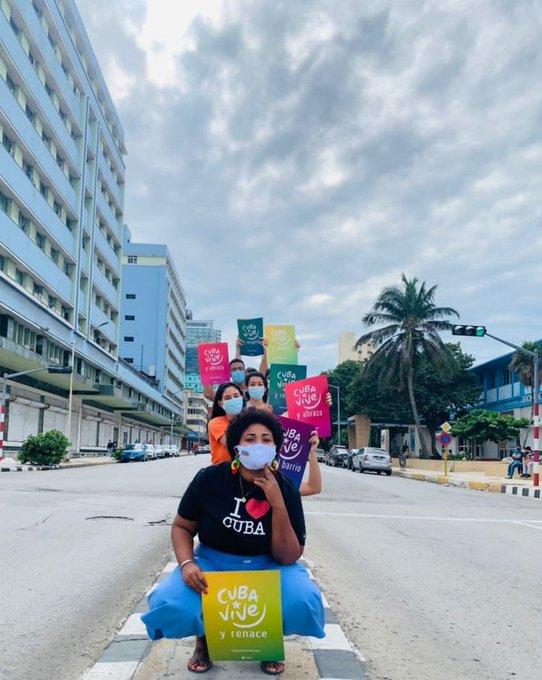
The United States has failed despite using all its unconventional warfare weapons against Cuba during the last two years. Photo: Taken from the Cuba Vive campaign.
Watching the events of the last few weeks in Cuba, it is easy to see the degree of frustration that must be gripping the U.S. power circles. They jumped, belly-first and with enthusiasm, into the waterless pool in which they found the intensive deployment against the island of all the weapons of unconventional warfare. During the last two years these included: economic, media and psychological warfare, terrorism, cyberwarfare, diplomatic pressure….
Those who for more than a decade have woven and financed in Cuba a dense network of media aimed at the most diverse sectors of society, collaborators in foreign correspondents, agents of change in the world, together with other forms of articulation, journalism and academia, leadership training courses, so-called thinking events in the United States, Latin America and Europe…, along with other forms of articulation, have had to see, I imagine not without sadness, how the current U.S. administration has thrown overboard all their patient work.
Juan Gonzalez, advisor for the Western Hemisphere of the National Security Council, and Antony Blinken, Secretary of State, violated, in their constant references to Cuba, what Niccolo Machiavelli suggested in the Prince: Never confuse desire with reality. The result is plain to see: the public exposure of U.S. interference in Cuba, the disarticulation of a good part of its internal subversion machinery and the discrediting before the Cuban people of those who have participated in it.
If one reviews the cable from the then-U.S. Interests Section in Havana, dated April 15, 2009, where its chief, Jonathan Farrar, described the failure of the traditional counterrevolution and suggests working with new actors such as bloggers, rappers and young visual artists, it is not difficult to understand how much the empire has lost in November 2021 in Cuba: at least 12 years of work!
But it is not triumphalism that should guide the work of Cuban revolutionaries after this 21st century Bay of Pigs. Washington lacks the humility to self-criticize its failures. Biden, even though he belongs to the same party, is not Kennedy, who had the courage to say to the mercenaries exchanged for compotes, when receiving them in a Miami stadium: “Victory has many fathers, defeat is an orphan”. Kennedy even attempted a secret rapprochement with Cuba that many believe is part of what cost him his life. And after the imperialist defeat at Playa Giron came the arch-terrorist Mongoose Plan, led at pencil point by the president’s brother, Robert Kennedy. Sobering, both Kennedy’s, John and Robert, were executed, not by the communism they fought so hard against, but by “lone assassins”, whose strings lead to the establishment they tried so hard to reform.
This time the decisive thing, again, has not been what our enemies have done, but what we have done. The key has been in the return to the people as the key factor, not only in processes such as the intervention of reality through the transformation of neighborhoods where numerous problems have accumulated. The key has been timely information about the war being waged against us, its characteristics and modes of operation. The latter -a missing element in our communicational work in previous years- assuming that a people capable of organizing itself in arms to defend its Revolution cannot be massively taught the weapons of the new war. We also underestimated the importance of broadly and deeply preparing all sectors of society for the not-so-new digital scenario, not only as critical receivers but, above all, as active participants.
It has been demonstrated, in recent months, that the media, state institutions, political and mass organizations, and the educational system weave a web that makes us invincible, if we are able to adapt it to the new circumstances and connect it with everyone who can be an ally in the anti-imperialist struggle, inside and outside our borders.
It’s a situation in which disinformation intoxication, through the growing use of digital social networks, serious economic shortages, shortages and consequent inflation, are joined by serious economic shortages, shortages and consequent inflation. It is necessary -in addition to the essential measures to stimulate the growth of the supply of goods and services, in addition to the successful control of the pandemic and the fact that blackouts are becoming less frequent, as is already happening, [to strengthen] ideological activity and, in particular, communications, as compañero Díaz-Canel has insisted, must be perceived by all revolutionaries as fundamental issues.
There are, to illustrate it, the material prosperity of Yugoslavia and Libya, razed to the ground with bombs after demonizing their governments, or more recently, the coups in countries like Bolivia and Nicaragua, with high economic performance indexes. Others believe that if we give institutional political space to the counterrevolution (multi-partyism it is called), the United States would begin to forgive us, but Antony Blinken’s response to the most recent multiparty elections in Venezuela should shake them out of their illusions: “it was not a free election”, he said, and, therefore, they will continue to support Juan Guaidó, who was indeed freely elected… by the Trump administration.
Not to rest in the battle for the truth, [we must] face decisively in confronting inequality where the disadvantages for the most humble have accumulated very significantly. [We must] create and enhance new economic, social, legal and cultural instruments against any inequality and discrimination, to intensely involve the people, and especially the youth, in the new and old fights. [That] has been the Fidelista response of the revolutionary leadership to the challenges of the present. And it has done so by listening to many, accepting criticism and speaking modestly, while working with intensity and transparency.
As the recently-deceased essayist, Juan Valdes Paz said in one of his last public appearances, the Cuban nation “does not have a solution vis-à-vis the US as we conceive it: independent, sovereign, self-determining”. But neither does Latin America and the world: independence, sovereignty and self-determination are obscene words in the empire’s dictionary.
The tribute paid by Washington and its allies to the last Human Rights Day was the announcement of the extradition of Julian Assange, to settle accounts with him for revealing, not State secrets, but war crimes and strategies of imperialist domination such as those exposed in the aforementioned cable, dated April 15, 2009.
It is the world upside down, where a Prometheus of our time must be tied to the rock so that the eagle devourer of entrails avenges, with exemplary punishment, the offense of exposing the Olympus of the dollar in its unspeakable crimes. Meanwhile, cardboard characters, in the tableau of dollars and technology paid by Wall Street, are applauded as heroes.
This is how the enthusiastic handlers of the N15 face their frustrations when there is no sovereignty to stop them. What would await the people of Cuba if they ever had the opportunity to impose on us what they understand by justice?
The social leaders shot and tortured en masse in our lands of America would be a colorful brushstroke for the hate-filled vengeance and bloodbath that the “military intervention” so often demanded from Miami in the last year would [actually] mean.
In the second season of the already old -and increasingly less outdated- Cuban series En silencio ha tenido que ser [It Had to Be in Silence], there is a scene in which the State Security agent, now a CIA prisoner, responds to a CIA psychologist, sent on a softening mission, with the advice she herself had given him during a training session when he and she were apparently on the same side: “Excessive enthusiasm is a difficulty when it comes to facing frustrations”.
Hopefully, the empire will listen to its psychologists, and at sometime [come to] understand that only new frustrations await it here, if it continues to rely on advisors like Juan Gonzalez, Antony Blinken and the Miami haters.
In the meantime, the signs are going in the opposite direction, so only the broadest culture and the most intense work can be our vaccines against an empire that, in its decadence, and worried about losing its hegemony at the global level, wants to gain a foothold in a territory it considers its backyard.
MININT news release on rescue operation


News release from the Ministry of the Interior
Surface units of the Border Guard Troops provided assistance to the castaways of a semi-sunken speedboat
Author:

Web Editor | digital@juventudrebelde.cu
Published: Saturday 11 December 2021 | 06:16:01 pm.
Translated and edited by Walter Lippmann for CubaNews.
At 21:30 hours on December 10, 2021, the Coast Guard Troops Maritime Search and Rescue Coordination Center received a distress call from a vessel in distress in the vicinity of the town of Santa Cruz del Norte, Mayabeque province.
Surface units of the Coast Guard Troops with the participation of a private boat, provided assistance to the castaways of a semi-sunken speedboat, with registration FL 7176SU of the United States, overloaded with people, in adverse hydrometeorological conditions with sea force three.
As a result of these actions, 2 minors, 7 women and 14 men were rescued, including two deceased.
Today, December 11, the search for possible missing persons continues, with the participation of naval units and other forces of the Ministry of the Interior, in the vicinity of the coast.
Once again, Cuban citizens are victims of the policy of the United States Government, which stimulates irregular emigration, which is taken advantage of by human traffickers, who, for profit, put the lives and deaths of human beings at risk.
Ministry of the Interior
MINREX on virtual “Democracy Summit”

A summit as unreal as the “democracy” it defends
Declaration by the Ministry of Foreign Affairs
Translated and edited by Walter Lippmann for CubaNews.
The virtual summit convened by the U.S. government on December 9-10, with pre-recorded speeches of the invited guests and a totally manipulated agenda, was a demagogic exercise, with no benefit for the international community and without any proposal to solve the most pressing problems of the world we share.
As a political artifice, it only served to show the growing isolation, alienation and loss of influence of the most powerful nation on the planet. In a practical sense, the only apparent result is the commitment of $400 million to the political subversion of sovereign states in blatant violation of international law.
A few hours have passed since the end of the event and few are able to explain or remember what happened there.
The U.S. government missed the opportunity to convene an inclusive meeting, promoting cooperation and the search for solutions to any of the problems that most urgently and seriously impact the lives of the majority of the world’s population.
It did not have the will to join efforts to face hunger, malnutrition, poverty and growing inequalities, unhealthy conditions, migratory problems, drug trafficking, organized and cross-border crime, the arms race or climate change. It did not even conceive the idea of convening world leaders to discuss and articulate a concerted response to the COVID-19 pandemic and other communicable diseases. The fact is that the United States cannot provide solutions as long as its policies are an essential part of such serious problems.
With great demagogy, IT called the unreal meeting under the theme of “democracy”, which it assumed as the defense of capitalism and applicable only to governments that do not challenge the hegemonic authority of the United States. Such a fabrication clearly shows the true divisive purpose and the interest in diverting world attention from the serious problems facing U.S. society and the U.S. political system today.
A country where money outweighs the popular will of its citizens, where the free sale and irresponsible use of lethal weapons, intervention and interference in the internal affairs of sovereign states is promoted, where racism is systemic and war is the most lucrative business, has nothing to teach the international community.
As Cuba has been warning, the U.S. government is leading a dangerous campaign aimed at creating an international schism, dividing the planet and punishing countries that defend progressive projects or do not accept the models imposed by the United States.
To try to impose a single acceptable recipe for a political system on all countries is, in itself, profoundly anti-democratic. It is contrary to the Proclamation of Latin America and the Caribbean as a Zone of Peace, signed in Havana by all the countries of our region, which establishes the commitment to fully respect the inalienable right of every State to choose its political, economic, social and cultural system, as an essential condition to ensure peaceful coexistence among nations.
This twisted vision is what leads them to act on the margins of the United Nations, where they suffer increasing isolation due to their repeated challenges to the principles of civilized coexistence, respect for multilateralism and the self-determination of peoples and sovereign equality among its Member States, concepts that today are unacceptable to the U.S. rulers.
More than 80 countries, including Cuba, were not invited, and this is not surprising, because we are a nation that for almost 63 years has successfully rejected the U.S. attempt to subjugate it and has effectively defended its inalienable right to self-determination. In a summit aimed at promoting capitalism, and the central and dominant role of the United States in its promotion, the presence of socialist Cuba should not be expected.
In the cooperation to find solutions to the serious problems of the world, the international community can always count on our support, on the constructive, active and supportive contribution of Cubans in the search for consensus, to unite wills, to enrich and benefit from diversity and to privilege what unites us instead of what separates us. The international trajectory of the last 60 years supports this affirmation.
The world demands peace, development, justice, solidarity, cooperation and mutual trust. It does not benefit from division, selectivity and unilateral impositions.
Caravanistas visit Denunciation Memorial
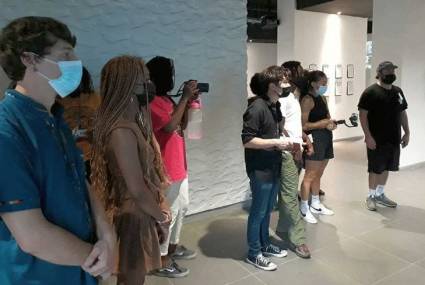
Members of Pastors for Peace caravan visit memorial in Cuba
The visitors learned historical facts about Washington’s aggressiveness against the Caribbean nation, and rejected that power’s interference in the island’s internal affairs.
Author:

Juventud Rebelde | digital@juventudrebelde.cu
Posted: Tuesday 16 November 2021 | 03:35:42 pm.
Translated and edited by Walter Lippmann for CubaNews.
Members of Pastors for Peace caravan visit memorial. Autor: PL Publicado: 16/11/2021 | 03:34 pm
Members of the U.S. interfaith organization Pastors for Peace arrived today at the Denunciation Memorial , in this capital, as part of its program of activities in solidarity with Cuba.
The visitors learned historical facts about Washington’s aggressiveness against the Caribbean nation, and rejected the interference of that power in the internal affairs of the largest Antillean island. In declarations to local television, the caravanistas recognized Cuba as an example and ratified their support to the socialist project.
The day before, the activists arrived at the capital’s José Martí International Airport. Upon their arrival, the director of that group, Gail Walker, stated that the 75 visitors from 20 U.S. states joined the 31st edition of these initiatives to show the majority feeling of the U.S. people with respect to Cuba.
She pointed out that her companions are especially interested in learning about the achievements of this Antillean nation in confronting the COVID-19 pandemic, in the midst of the tightening of the economic, commercial and financial blockade and other aggressions by the U.S. government.
During their stay until November 26, the members of Pastors for Peace will carry out an intense agenda in the provinces of Havana and Matanzas (western Cuba), which includes meetings with women’s and workers’ organizations, and tours of educational institutions of historical and social interest, according to PL.
US seeks a reason for war against Cuba
U.S. seeks to fabricate a reason for war against Cuba
The U.S. Government threatened Cuba on Monday with the application of new sanctions.
Translated and edited by Walter Lippmann for CubaNews.
U.S. seeks to fabricate a cause of war against Cuba Photo: Taken from Prensa Latina
The U.S. government threatened Cuba on Monday with the application of new sanctions “if repression and human rights abuses do not cease”, days before the provocation orchestrated from Washington for November 15.
In recent days, one after another, high-ranking officials of that government -this time it was the turn of State Department spokesman Ned Price- have publicly brandished the cudgel, recalling the era of the gunboats and the Platt Amendment, when a slight gesture from their proconsuls was enough for the presidents of the neo-colony to rush to comply with the orders of the White House.
None of this is casual. A veritable machinery of infamy, lies and provocations is at work against Cuba with the aim of fabricating a casus belli.
The general director of Press, communication and image of the Cuban Ministry of Foreign Affairs, Juan Antonio Fernández Palacios, denounced the use of social networks, especially Twitter, in the manipulation campaign promoted from the United States with the aim of destabilizing the country.
“A powerful machinery of communicational toxicity in the digital space greases its army of bots and trollers for the frontal attack to which they have set a date,” said the Cuban official from his Twitter account.
Mr. Agustín Antonetti, political operator and “expert” in black campaigns financed by the continental and U.S. right-wing, announced on Monday on Twitter: “All those who fight for the freedom and democracy of the Cuban people, get ready for what we are going to release tomorrow, it is going to be a news item that will be covered by the main international media”.
The hate campaign has no limits. They announce actions against the Cuban government in more than 90 cities around the world, they need to build a negative image of the Revolution that will clear the way for them to commit any ignominy.
They need to achieve through a systematic campaign of motivational influence, pure and simple, a psychological war; to turn Cuba into a prostrate nation, broken in its foundations, without joints, without a soul. But little do they know the Cubans, here they will find a people erect over the yoke they want to impose on us, proud to exhibit to the world, girded on their foreheads, the star that illuminates and kills.
Nicaragua goes to the polls
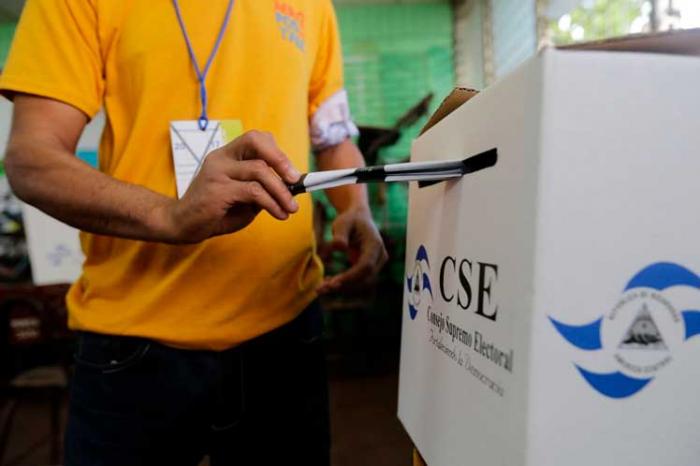
Nicaragua goes to the polls for general elections
In a true civic celebration, calm and safe, more than 4,478,334 Nicaraguans will elect the presidential formula that will head the Executive Power during the 2022-2027 five-year term.
Translated and edited by Walter Lippmann for CubaNews.
More than 4,478,334 Nicaraguans will have to elect the presidential candidate. Photo: Prensa Latina
In a true civic, calm and safe celebration, more than 4,478,334 Nicaraguans will have to elect the presidential formula that will head the Executive Power during the 2022-2027 five-year term, in addition to renewing the members of the National Assembly (unicameral) and the deputies to the Central American Parliament (Parlacen).
For this purpose, 3 106 voting centers and 13 459 Voting Boards (JRV) were set up in the 103 municipalities, 3 106 voting centers and 13 459 Voting Boards (JRV). They must guarantee the votes and issue a final result among the six political parties that participated in the contest, including the ruling Sandinista National Liberation Front (FSLN) with Daniel Ortega, who will seek his fifth mandate, the fourth consecutive and the second together with his wife, vice-mandate Rosario Murillo.
Prensa Latina reported that the Constitutional Liberal Party (PLC), the nation’s second political force, has accumulated in its contemporary history the mandate of two presidents: Arnoldo Alemán, and Enrique Bolaños and presents, in this opportunity, National Assembly deputy Walter Espinoza and Mayra Argüello.
Camino Cristiano Nicaragüense -founded in 1995 and ally of the FSLN in the 2011 and 2016 elections- intervenes with the evangelist pastor and deputy to the Parlacen, Guillermo Orozco, linked for more than two decades to politics, and Violeta Martínez de Moncada.
The Nicaraguan Liberal Alliance Party (ALN), created in 1999 under a liberal ideology, is running two candidates: lawyer Alfredo Montiel and business administrator Jennifer Espinoza; and the Independent Liberal Party (PLI) is running deputy Mauricio Orúe and Zobeida del Socorro.
Telesur reports that since the early hours of this November 7, in most of the voting centers the first citizens have been lining up to cast their vote.
The newspaper La Voz del Sandinismo reported that the Supreme Electoral Council (CSE), showed citizens that 232 electoral accompaniers from 27 countries and 600 Nicaraguan journalists and other nationalities will be present at the elections, after their accreditation.
The accompaniers come from the United States, Canada, Abkhazia, South Ossetia, Russia, Germany, Belgium, Spain, France, United Kingdom, Italy, Mexico, Argentina, Colombia, Chile, Paraguay, Peru, Uruguay, Costa Rica, Honduras, Guatemala, Puerto Rico, Dominican Republic, Panama, Venezuela, England, Russia, Cuba, Spain, Italy, Venezuela, Brazil, Chile, among other nations.
The United Socialist Party of Venezuela (PSUV) indicated in a press release that the delegation is made up of deputies Julio Chávez, Marelis Pérez Marcano and Fernando Soto Rojas.
Meanwhile, the National Police of Nicaragua reiterated security during the electoral process and in all tourist, recreational, sports, commercial establishments, cafeterias, restaurants and meeting and recreational places, which will work and operate normally.
The former president of Bolivia Evo Morales sent a message on Twitter to the Nicaraguan people: “I salute the democratic vocation and revolutionary conviction of the Nicaraguan people. We wish the greatest success in the development of the general elections to be held tomorrow”.
Nicaragua: the past counts
Nicaragua: the past counts
The Sandinista authorities have called for general elections today, but the U.S. and its allies will not want to recognize them.
Author:

Marina Menéndez Quintero | marina@juventudrebelde.cu
Translated and edited by Walter Lippmann for CubaNews.
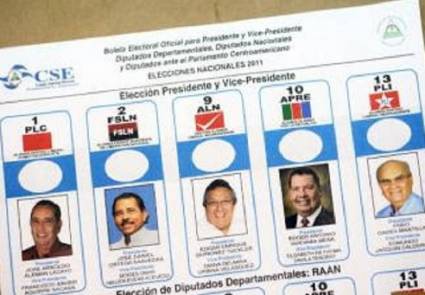
The Sandinista authorities have called for general elections today, but the US and its allies will not want to recognize them. Author: CSE published: 06/11/2021 | 09:33 pm
New sanctions against Nicaragua approved this week in the U.S. Congress, draw the real scenario in which today’s presidential elections take place: a scenario of harassment and undeclared war, which would seek to use the elections as a springboard for full interference.
The Renacer (Reinforcing Compliance with Conditions for Electoral Reform in Nicaragua) Act has just been approved by the House of Representatives and has already passed through the Senate, so it only awaits the approval of President Joe Biden.
Its harmful nature seeks to involve the European Union, Canada and Latin American and Caribbean neighbors in further cutting off loans from international financial institutions to Nicaragua, review its participation in the free trade pact between the United States, Central America and the Dominican Republic (Cafta-DR), and selective sanctions against Nicaraguan officials considered by the North to be “violators” of human rights, among other measures.
Its rapid passage through the lower house a few days before the presidential elections, confirms the presence on the proscenium of an invisible “candidate” whose determination is to overthrow a model that has given citizens more satisfaction than pain since the triumph of the Sandinista Revolution in 1979, which meant the end of the murderous dictatorship of Anastasio Somoza.
A decade later, that same phantom actor was the real protagonist of the defeat of Sandinismo at the polls on February 25, 1990, by promoting and financing an alternative personified as a solution to the naval blockade and the “contra” war -that is how the counterrevolutionary gangs were known-, which that same hegemonic intruder promoted and armed.
In search of peace, the votes then lost by the FSLN went to the so-called National Opposition Union represented by Violeta Barrios de Chamorro: the White House had made it clear that the presence of Sandinismo in power would mean more aggression.
There followed 16 years of corrupt and complicit executives allied with US decisions, which led to the extinction of all the measures implemented by the FSLN to alleviate the social backwardness enthroned by Somocismo, and the minimal but important steps taken in the economic field.
These anxieties, and a policy of alliances that untangled traditional entanglements with key sectors of society, such as the upper hierarchy of the Catholic Church and private enterprise, made possible the return of the FSLN to power in 2007.
It was necessary to launch another literacy campaign because a new generation had grown up without the facilities to learn to read and write, restore access to public health, and reimplement measures to support the peasantry, where the majority of the social base is located.
Stability and results in the economic sphere through a mixed economy system, accompanied by a policy of regional cooperation in a Latin America where similar models of solidarity and social justice had emerged, characterized the work of an FSLN that changed its image from red and black to fuchsia, but has kept the essence of its ideals unchanged.
By April 2016, the IMF, the watchdog of international financial policies, and propitiator of onerous indebtedness, would ratify the recognition it had made to Nicaragua seven years earlier: “The Nicaraguan economy continues to register high growth rates and sustainable macroeconomic policies. In 2015, the Gross Domestic Product (GDP) grew 4.9 percent and the average of the last five years (5.2 percent) is one of the highest in the region.”
But the bonanza would last until the next boom. By 2017, together with the third consecutive reelection of Sandinista leader Daniel Ortega and in the run-up to the November municipal elections that year, the U.S. Congress was already preparing the Nica Act, the first in a series of sanctions that would follow.
Finally approved in 2018, the law officially named the Nicaraguan Investment Conditionality Act sought to block loans from international financial institutions to Managua, among other punitive measures, unless it took “effective measures to hold free, fair and transparent elections,” argued its promoters of the Cuban-born Floridian ultra-right, as deceptively as it is done against Venezuela or against Nicaragua itself, again, right now.
Daniel Ortega’s response was consistent with the circumstances. It was, he denounced, “the continuity of historical policies of US imperial interference in Nicaragua”, which is what we see today.
History that is present
That, however, was not the only flank of aggression. In April 2018 itself, the unusual and massive demonstrations with which hundreds of Nicaraguans took to the streets after the triggering of a social security reform that had immediately been repealed, constituted the implementation in Nicaragua of a chapter of unconventional warfare that had already been tested in Eastern Europe and in some countries of the Middle East: “color revolutions” that are really very dark, and plunged Nicaragua into months of instability with its share of arrested, dead and wounded.
Money sent from the U.S. to foment opposition and subversion had been flowing through subway channels for some time, as in the late 1980s.
According to investigations cited by the site Misión Verdad, only to support a communication network that would sustain the media strategy against Sandinismo, some ten million dollars have been channeled through the US Agency for International Development (USAID) since 2009. Seven million of that total went to the so-called Violeta Barrios de Chamorro Foundation for Reconciliation and Democracy between 2014 and 2021.
The article calls the Foundation “a central vehicle for Washington’s massive financial, technical and logistical support to the Nicaraguan opposition, acting as what the CIA calls a “staging post”: a third-party organization that serves as an ostensibly independent channel for giving U.S. government funding to foreign political groups and media outlets.”
In total, it is estimated that since the Sandinista return to power, Washington has channeled tens of millions of dollars to the same cause.
However, the country is now accused of being a flawed democracy that disrespects human rights, a term that has been politicized and manipulated for decades. It is the same justification used to demonize and attack models of change in the face of the status quo of unbridled capitalism, which the right-wing powers would like to maintain globally.
Such background is essential to understand what is happening this Sunday around an electoral race for president and deputies which is questioned by the absence of right-wing candidates accused of corrupt management and of facilitating US interventionism; among them, two bear the last name of Chamorro.
In spite of the fact that some headlines are propagating that “there are no candidates” -a false assertion which could have penetrated part of the electorate since some of the polls, which were already wrong in Nicaragua in 1990, announce high abstention- five opposition candidates are competing against the FSLN and Daniel Ortega. Some of them are nominated by long-standing and experienced groups such as the Constitutionalist Liberal Party and the Independent Liberal Party.
The registry, the tables and ballots have been ready for some time now, and some 200 international observers will act as observers to attest to the transparency.
Everything seems to be in order. But that is not what the United States would like.
Censorship and freedom of expression
Censorship and freedom of expression
In 2017 first, and then in 2019, authors Tom Secker and Matthew Alford obtained declassified documents from the CIA, the U.S. Department of Defense, and the National Security Agency detailing the extent to which these institutions were involved in American film projects
Translated and edited by Walter Lippmann for CubaNews.
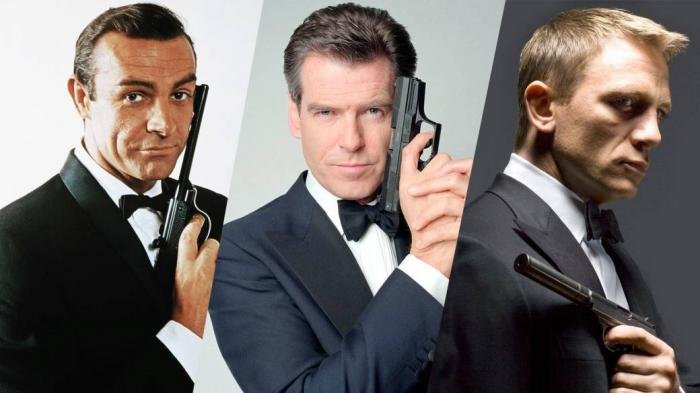
“There are themes that are not for laughs, neither are they for that school of filmmaking that brings Agent 007 to life.” Photo: Still from the Agent 007 films.
When James Bond producer Harry Saltzman seemed to be giving Costa-Gavras, after his first success, a blank check, saying: “What film do you want to make?”, he replied: The Human Condition, by André Malraux. The man cracked right there and then: “What? You need a lot of Chinese people, you can’t do that”, and closed the subject with a laugh.
Costa-Gavras confesses that at that time he was interested in films precisely about the human condition, about revolutions, daily struggles, the workers’ movement, the unions. At some point he worked on the project of making a feature film about Malraux himself, then deGaulle’s minister of culture.
There are subjects that are no laughing matter, nor are they for that school of filmmaking that gives life to agent 007. It’s risky to say the latter when thinking of Malraux, a man whose list of brave deeds, during the French Resistance and before, make him perfect legendary material for Ian Fleming’s literary creativity. However, I can’t imagine Bond writing something like The Human Condition. There is in the Anglo-Saxon character too much cheap philosophy, caricature of Nietzsche’s superman. Much less do I see Bond ending up being anyone’s minister of culture, no matter if it is the French warlord, or if it is Josef Stalin.
There is another more important reason that differentiates Malraux’s characters from Bond. The former seek with (futile?) desperation the simultaneous redemption and understanding of the sense of being in the face of the immeasurable anguish of having to kill. The latter assumes to his condition of existence a brute quality of polite murderer. It is known that originally the Bond character was to be a blunt weapon, lacking sophistication, with the mere function of murdering by the orders of another. That license to kill is really a license to carry out assassination orders and take the occasional macabre liberty.
The founding director of the CIA, Allen Dulles, was a friend of Ian Fleming. After the Bay of Pigs debacle, the agency sought in the fourth installment of the Agent 007 series of films, Thunderball (1965), a public relations operation to improve its image. It introduced a character, Felix Leiter, a CIA agent, as an empathetic character. The sympathetic agent, an employee of the agency promoting coups and political assassinations in so many parts of the world, lasts to this day.
In 2017 first, and then in 2019, authors Tom Secker and Matthew Alford obtained declassified documents from the CIA, the U.S. Department of Defense and the National Security Agency detailing the extent to which these institutions were involved in American film projects. The list totals 1,000 titles, including film and television material, and includes many of the most iconic products of American filmography.
According to Secker and Alford, in many cases, if there are “characters, scenes or dialogue that the Pentagon does not approve of, the filmmakers have to make changes to accommodate the military’s demands.” At the extreme, “producers have to sign contracts – production assistance agreements – that tie them to a version of the script approved by the military.” To make the reality even more interesting, in most cases, the agreements reached and the intervention of U.S. Government agents in a film product is confidential, protected by corresponding contracts. Not that they like it to be known out there that they are systemic censors, the public defenders of free speech: it is not a happy combination to support their employees or co-optees in other geographies as victims of censorship, and at the same time appear to cut scenes from films because the nuance is contrary to the imperial machinery.
In Goldeneye, Brosnan’s debut as Agent 007, an incompetent Yankee admiral who is killed by the bad guys, was not to the military’s liking; as a result, the unhappy character’s nationality was changed to Canadian and so appeared in the final product. In Tomorrow Never Dies, another installment of the British spy saga, some scenes were altered or deleted to please the uniformed censors. The CIA is more subtle (of course!), sometimes inserting its own employees in the writing of the scripts to avoid having to go under the knife later.
But beyond certain anecdotes, the involvement of imperial agencies is more systematic than cutting scenes or altering scripts. It is not just that “the idea of using film to blame mistakes on isolated, corrupt agents or bad apples, thereby avoiding any notion of systematic, institutional criminal responsibility, is straight out of the CIA and Pentagon manuals,” as Secker and Alford assert. The agencies of imperialism give made-in-U.S. entertainment an important role in their cultural warfare efforts at home and abroad. The envelope of their cultural hegemony is such that any attempt to limit the circulation of their productions in any country is quickly assailed as unacceptable censorship, totalitarianism and Orwellian action. Meanwhile, in the U.S., foreign film products have, in most cases, such a limited circulation that they are effectively invisible, let alone receive appreciable screen time for foreign materials depicting the imperial face of its foreign policy.
It is not, moreover, the more obvious, the more dangerous the subtlety. In many cases, most of the time, it is not a diabolical conspiracy to cajole the public. It is enough that the cultural material is an organic part of the symbolic reproduction of the system where it is produced. If the scriptwriter, the producer, the director and the director are imbued with the conviction of the cultural superiority of their society, there is no need for an obvious hand to force it, the colonizing instrumentalization of the product will occur without Orwellian interventions.
The Cuban obsession in the spy saga is marked in at least three films from three different periods. In the most recent era of the franchise, which began with Pierce Brosnan, one of the installments shows us scenes in a tropical Cuba with spy installations of absurd sophistication. Crowning the ridiculousness is having the womanizing hero have a sex exchange scene in a cliché beach house, not under the protection of air conditioning, but the flames of a fireplace, a perfect recipe for a steamy heart attack.
To reaffirm the obsession, the recently released last installation of agent 007, which ends the segment of Daniel Craig, who must be credited with having given the character new life with his acting quality, almost at the beginning has its Cuban scenes, in this case supposedly from Santiago de Cuba. Designed from the usual commonplaces when it comes to reflecting Cuba in the canned products of commercial cinematography. Who knows if someday we will find out about cut scenes and twisting of arms to the script by the efficient censors, paladins of freedom of expression as long as it is not about them. Maybe not, after all, those confidentiality contracts can be very persuasive.
US maintains remittance restrictions

White House decides to maintain restrictions on remittances to Cuba
Translated and edited by Walter Lippmann for CubaNews.
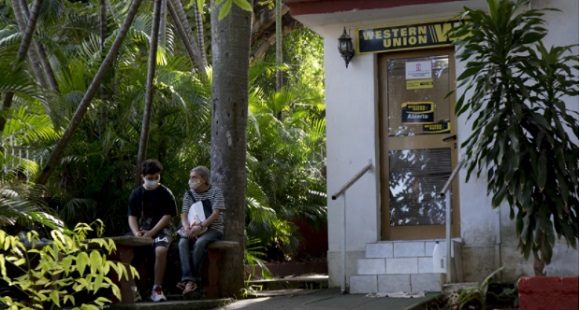
People wait to be served at a Western Union office on its last day of operations in Havana, Cuba, Monday, Nov. 23, 2020. Photo Credit: AP.
The U.S. government said Friday that the ban on sending remittances to Cuba will remain even longer, with which the White House hinders the right of families to help their loved ones living in the Caribbean nation.
A White House official told the media on Tuesday that the administration of President Joe Biden continues to study how to ensure that the money sent to the island does not favor the government of the largest of the Antilles, according to Reuters.
According to the source, the objective is to ensure that the benefits reach the Cuban people directly, although he did not mention how the U.S. economic blockade has been suffocating the inhabitants of the Caribbean country for six decades, even in the midst of the Covid-19 pandemic.
In July, Biden asked the Treasury and State Departments to suggest options for remittances to reach the beneficiaries, under the argument that the Caribbean nation’s executive appropriates between 20 and 40 percent of the remittances.
Last August, the manager of the Cuban commercial company Fincimex, Yamil Hernández, denied that the government of Havana or the armed forces obtained part of the amount sent from U.S. territory.
That theory repeated by politicians of the North American nation put an end to the relations of the Western Union company with the Cuban financial institutions in charge of processing remittances, specifically Fincimex, in October 2020.
The measure – imposed by former President Donald Trump (2017-2021) and maintained by the current administration – unilaterally ended the flow through regular and institutional channels, on the basis of totally unfounded pretexts, Hernandez asserted at the time.
The current U.S. president promised during his election campaign to change the hostile policy of his predecessor against Cuba, however, so far the 243 coercive measures imposed by Trump to reinforce the blockade remain unchanged.
(With information from PL)
Pablo Armando Fernández beloved writer, dies
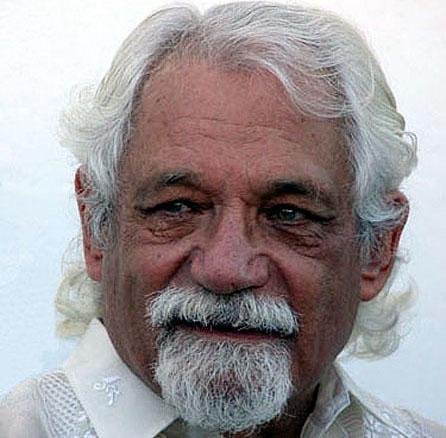
Pablo Armando Fernandez, one of Cuba’s most beloved writers, dies
In 1996, the Cuban Ministry of Culture awarded him the National Literature Prize for the importance of his work.
Translated and edited by Walter Lippmann for CubaNews.
The extraordinary Cuban writer Pablo Armando Fernandez, who not only shone for his literary work in poetry and novels, but also for his patriotic and revolutionary attitude, has died.
The Minister of Culture, Alpidio Alonso, has testified on Twitter of the deep pain caused by the death of the great Cuban poet. “With a poetic and narrative work that led him to win the National Prize for Literature, Pablo Armando is one of our most beloved writers. Our condolences go to his family and friends,” he said.
The author of such important works as Los niños se despiden, Casa de las Américas Prize 1968; Golpe de dados, or the first-born Salterio y lamentaciones, among many of great literary flight and reception of the reader, was born in Central Delicias, in the former province of Oriente, on March 2, 1930. He attended his first education in his hometown and then moved to the United States. He studied at Washington Irving High School in New York until 1947. He also enrolled in some courses at Columbia University in New York.
He lived in the United States between 1943 and 1959. With the triumph of the Revolution he returned to Cuba and developed an intense cultural life that led him, among other things, to be director of the magazine Unión and the Fondo Editorial Casa de las Américas.
He represented Cuba in numerous international events, among them: poetry biennials in Belgium (1963-1965); Meeting of Poets of Spoletto (Italy, 1965); Congress of Poets of Edinburgh (1964-1965) …
He served as a juror for important literary awards such as the Casa de las Américas de Poesía (1966) and Literatura Caribeña en Lengua Inglesa (1982). In 1992 he was a member of the jury for the prestigious Cervantes Prize.
His literary work, which includes numerous books of poetry (20 in total), three novels, a volume of short stories and a volume of essays, has been translated into several languages. In 1996 the Cuban Ministry of Culture awarded him the National Literature Prize for the importance of his work.
The 2003 Book Fair was dedicated to him, to which he reacted with enthusiasm, because in addition to considering it a recognition, he thought it would be another opportunity for his work to be known. “I don’t believe in chance, I believe in writing,” he said at the time.
Related information
Notes on Pablo Armando Fernández (English translation)
You must be logged in to post a comment.