The Wasp Network Stings in Miami


The Wasp Network Stings in Miami
 By Rosa Miriam Elizalde
Cuban journalist. First Vice President of UPEC and Vice President of FELAP. She has a PhD in Communication Sciences and is the author or co-author of the books “Antes de que se me Olvidar”, “Jineteros en La Habana”, “Clic Internet” and “Chávez Nuestro”, among others. She has received the “Juan Gualberto Gómez” National Journalism Award on several occasions. Founder of Cubadebate and its Editor-in-Chief until January 2017. She is a columnist for La Jornada in Mexico.
On twitter: @elizalderosa
July 9, 2020
Translated and edited by Walter Lippmann for CubaNews.
Since Netflix decided to release The Wasp Network on June 19 and reached the captive audience through Covid, the film has become a media success for unconventional reasons.
In Florida, they have threatened to burn down movie theaters if the film is ever shown, and signatures are being collected to force Netflix to withdraw the film, not understanding that the download site is not a television channel. People have the option of watching it or going on, although the scandal must have boosted the rating of a film that had passed through the Venice Film Festival without any sorrow or glory, despite a celebrity cast headed by Penélope Cruz.
But in Miami right now the theme of the film has become a sort of anti-communist conga with the local media dancing the cool step of attacking the French director, Olivier Assayas. They’re accusing him of making pro-Cuba propaganda. The great detail is that The Wasp Network narrates real events that have been documented by the United States authorities themselves, in a trial that is considered the longest in the history of that country’s jurisprudence and in which three generals, an admiral, a former presidential advisor and self-confessed terrorists, who appear on screen as what they are, testified.
The plot of The Wasp Network began in Havana in the early 1990s. René González (Edgar Ramírez in the film), a flight instructor at a military airbase, steals a plane and flees Cuba. He begins a new life in Miami, away from Olguita, his wife (played by Penelope Cruz) and their young daughter. Other Cuban “deserters” soon follow him and set up a network to infiltrate organizations based in that city, responsible for attacks on the island, including a hotel bombing campaign that killed an Italian tourist. Instead of capturing and prosecuting the terrorists, responsible for atrocious crimes, the U.S. government locks up and subjects Cuban agents to blackmail and punishment.
It’s the story of what happened in its pure state, naked in the opinions or interpretations of the screenwriter and director; an intolerable truth for one of the real characters in the film, José Basulto. He presented himself in those years as a good Samaritan, savior of rafters in the Florida Straits, but he supported his excursions with drug trafficking, cheerfully violated Cuban airspace and financed shootings against bathers on the beaches.
Paradoxically, the evidence of his crimes was not provided by the Cuban Ministry of the Interior, but by the FBI, which was aware of everything that was going on, as the film shows. Now Basulto shouted against Netflix and shook his fist in front of the cameras: “I more than agree with Trump that the relationship and agreements with Cuba should be terminated.
There’s a story that seems merely anecdotal of events that occurred over 20 years ago, but it’s current if you look at it correctly. Genuine people like José Basulto or Luis Posada Carriles, who organized the bombing of hotels in Havana and the sabotage of a civil airplane in which 73 passengers and crew members died, are not marginal in American society today.
The Cuban from the island who saw The Wasp Network at the Havana Film Festival last December knows that the hatred that inspired the Mayan attacks in the 1990s permeates today the speeches of President Donald Trump and conquers other radicals who swarm the Facebook forums and YouTube channels linked to white supremacists. Moreover, George W. Bush unleashed his war on terrorism from others while protecting his terrorist friends at home, and now Trump courts Florida’s arsonists and is evasive in condemning the right-wing extremists who have left a trail of death during his administration from Charlottesville to Minneapolis to El Paso.
A study by the U.S. Extremist Crime Database indicates that 74% of the terrorist attacks that occurred on U.S. soil after September 11, 2001, through 2016, were the work of the extreme right. Since Trump became president in 2017, most attacks against defenseless civilians have been carried out by supremacists. The profile of the aggressor does not vary much: a white man, inspired by other violent acts and speeches, and with easy access to assault weapons. He is the archetype of José Basulto, who benefited as the current right-wing extremists from the American law, which only allows the designation of foreign groups or attackers as terrorists.
Virtues and shortcomings of performance apart, The Wasp Network is unusual and courageous. It focuses on explaining what was hidden for decades and still does not want to be looked at head-on: why Cuban agents were sent to the United States. This is the heart of the story that has set the networks on fire, that tries to censor on Netflix and that has the right-wing making common cause against the Spanish vice president, Pablo Iglesias. He accompanied the film’s Twitter feed with three words of unsurpassed precision: “Seen it. Heroes. Great Movie.”
The Wasp Network


The Wasp Network and the Never-Ending Claque
 by Rolando Pérez Betancourt
July 4, 2020
Translated and edited by Walter Lippmann for CubaNews.
The controversy and the pandemic have meant that The Wasp Network continues to be seen far beyond what the most flattering estimates had predicted.
This is despite the fact that some involved in the film plot have vowed to ignore it and continue to call for a boycott, while demanding legal redress “for damages”.
But they betray themselves and, in the loneliness of their homes, sit in front of the Netflix platform, eager to know. Afterwards, they can’t stop themselves and they explode, even though the shouting is evidence of having broken a pact with the Brothers, as happened to Ramón Saúl Sánchez, an old sidekick of the terrorist Posada Carriles and a counter-revolutionary linked to those first groups determined to return Cuba to what it was before 1959.
Sanchez is offended because the film “is more a political project than a cinematographic story”, a statement that invites one to imagine a science fiction plot, with the French director Olivier Assayas, the producers from different countries, technicians, actors, and Netflix itself, involved in an international conspiracy
interested in advocating Cuba’s right to defend itself against the terrorists in Florida, who are being suckled by the United States Government.
What really bothers the explosives expert of the Omega-7 terrorist group is that the film presents him as one of the many who have made counterrevolution a lucrative business, and it is true that many of his lineage are trying to shake off the image of the “patriot” swimming in ugly money that does not dignify the cause.
That’s why the also member of the Alpha 66 group (with a bloody record of service against the Cuban people) is indignant about the uncomfortable position in which the film places him and he claims, with an air of offense, that the money that came out of his pockets to unite the Cuban family was not a small thing. A statement after which -according to statements published on the Internet- he explains what a lavish money-maker he is: “I even had to pay a bill for 800 dollars in calls to Cuba once”.
A reminder of the “who’s who” of the adventure of moving around social networks by watching the reactions to The Wasp Network. This is how Carlos Alberto Montaner emerged, an old terrorist and agent of the cia (with an evidentiary record) who had become a “political analyst” without ceasing to be an ardent counter-revolutionary. He was another one of those who, “without wanting to”, watched The Wasp Network, because – in keeping with the ideals of the high-ranking intellectual who questions everything – he could not believe the argument that the tape “was pure propaganda paid for by Havana”. In other words, supposedly devoid of prejudices and ideological positions, the analyst saw the film, after which he considers it a mistake, because, in effect, “it is propaganda paid for by Havana,” a risky slander – he should have known – since he too could be sued by the film’s producers and, on this occasion, not without reasons to open a court case.
Once again, cinema and art, in their historical implications, are blinded by extreme positions that prefer bonfires to analysis. Hatreds, swearwords, disqualifications, emptiness, savagery of the verb, unhealthy propaganda against those who simply give a frank opinion, as happened to the Spanish vice-president, Pablo Iglesias. “Sight. Heroes. Movie”, wrote the leader with total frankness, and the furious claque, which is never absent, waved torches and went out to set fire to the nets.
I can explain myself!

I can explain myself!
The habit of speaking up for women and belittling what they do or say is a sometimes unconscious form of male violence
Published: Wednesday 08 July 2020 | 12:10:47 am
 By Mileyda Menéndez Dávila
Translated and edited by Walter Lippmann for CubaNews.
Let me shut up about your silence.
–Pablo Neruda
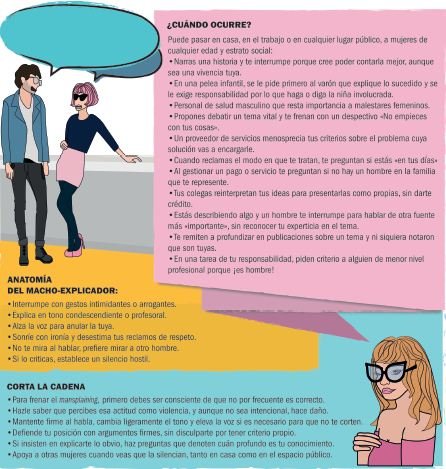
Have you noticed how many times a man explains to a woman or a girl something she already knows, often in an affected tone? That attitude is a type of micro-machismo that since 2008 is identified with the term “mansplaining” (its literal translation would be “macho-explanation”), and it is a typical [form of] gender violence, a patriarchal mechanism that takes away from the value of the female experience in order to silence it.
It can be an unconscious act, transmitted for centuries through diverse cultural channels. When it is brought to their attention, some revise their attitude and try to unlearn it.
CHART (Translation)
WHEN DOES IT HAPPEN?
It can happen at home, at work or in any public place, to women of any age or social status:
You tell a story and he interrupts you because he thinks he can tell it better, even if it’s an experience of your own.
In a children’s fight, the boy is first asked to explain what happened and is held responsible for what the girl involved does or says.
Male health care workers downplaying female ailments
You propose to discuss a vital issue and you are stopped with a derogatory ¨no start with your stuff¨
A service provider disregards your opinion about the problem whose solution you are going to entrust to him
When you complain about the way they treat you, they ask you if you are ¨on your days¨
When arranging a payment or service you are asked if there is not a man in the family to represent you
Your colleagues reinterpret your ideas to present them as their own, without giving you credit
You are describing something and a man interrupts you to talk about another source ¨más importante¨, without acknowledging your expertise on the subject
They refer you to deepen your publications on a subject and they don’t even notice that they are yours
In a task of your responsibility, they ask someone of a lower professional level for his judgment because he is a man!
Anatomy of the macho-explicator:
Interrupts with intimidating or arrogant gestures
Explaina in a condescending or professorial tone
Raises his voice to cancel yours
Smile with irony and dismiss your demands for respect
He doesn’t look at you when he talks, he prefers to look at another man
If you criticize him, he establishes a hostile silence
Cut the chain:
To curb male chauvinism, you must first be aware that not because it’s often right
Let him know that you perceive that attitude as violence, and that even if it’s not intentional, it hurts
Stand firm when speaking, change your tone slightly and raise your voice if necessary so that you are not cut off
Defend your position with firm arguments, without apologizing for having your own viewpoint
If they insist on explaining the obvious to you, ask questions that will show how deep your knowledge is
Support other women when you see them being silenced, both at home and in public spaces
Bill Hackwell’s Photography
Bill Hackwell and Anti-Police Brutality Art
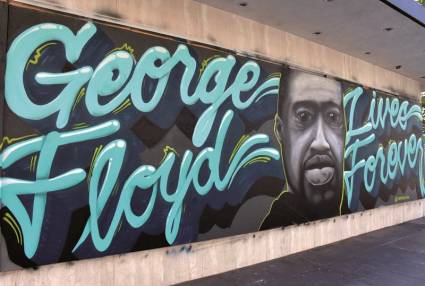
Bill Hackwell records what’s happening on Facebook and Flickr in downtown Oakland, where young artists are portraying on the area’s corporate buildings this creative art that has emerged from violence, oppression and the struggle for a new world with equality, justice and without systematic racism
 Posted: Saturday 04 July 2020 | 08:55:36 pm.
By Juana Carrasco Martin
juana@juventudrebelde.cu
Translated and edited by Walter Lippmann for CubaNews.
Bill Hackwell Mural Author: Bill Hackwell Posted: 04/07/2020 | 08:30 pm
The camera’s trigger documents, once again, a battle for justice. Bill Hackwell is posting on Facebook and Flickr what is happening in downtown Oakland, which he says is “being transformed by art opposed to police brutality..
“These images are just a fraction of the extraordinary uplifting paintings of various young artists along Broadway to Grand and many side streets. Corporate buildings are now adorned with this creative art, which has emerged from violence, oppression and the struggle for a new world with equality, justice and no systematic racism.
He fears, he tells us through the chat, that they will soon fade away, because they are being painted on the panels that cover windows, doors and windows in the California city as an expression of repudiation of a systemic and structural racism in American society. When they reopen those businesses, the owners will probably make them disappear…
An exceptional friend of Cuba, Bill is known for his photos, for the social documentation not only of his country, the United States, but also of Cuba, Venezuela, Argentina, Chiapas, Iraq and other countries. A member of the International Committee for the Freedom of the Five, together with his companion in struggle and life, Alicia Jrapko, he has made a fundamental, arduous, tireless and tenacious contribution to solidarity with our country that has earned him the recognition of the Friendship Medal, and above all, the gratitude of our people.
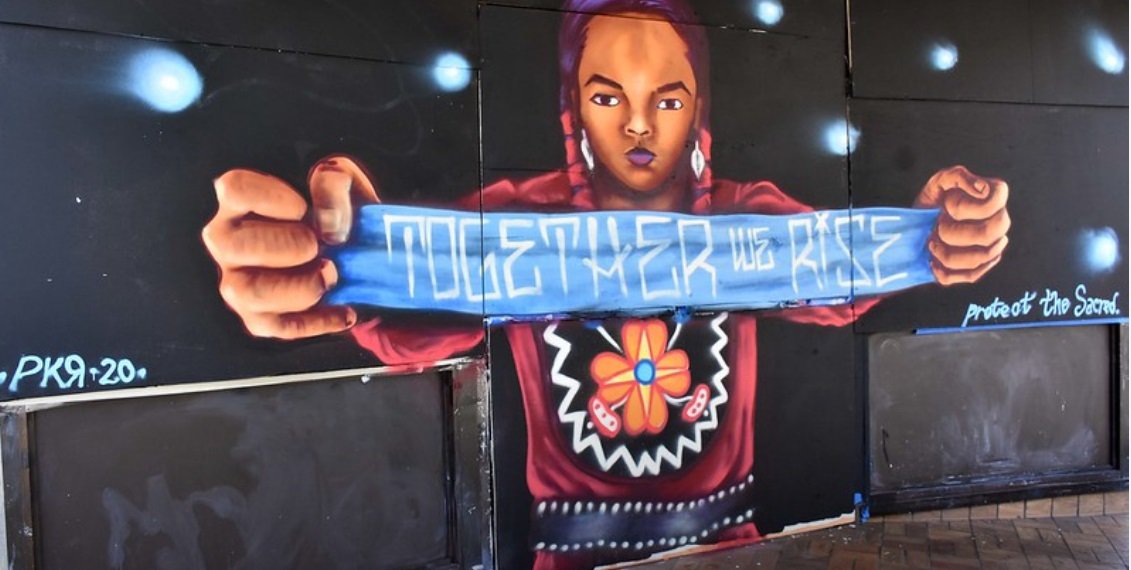
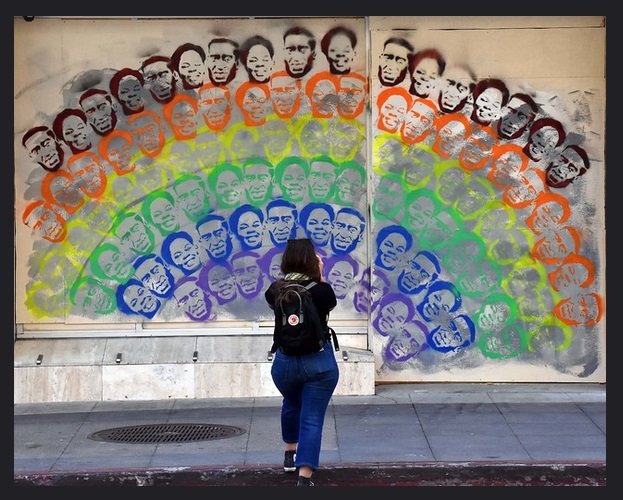
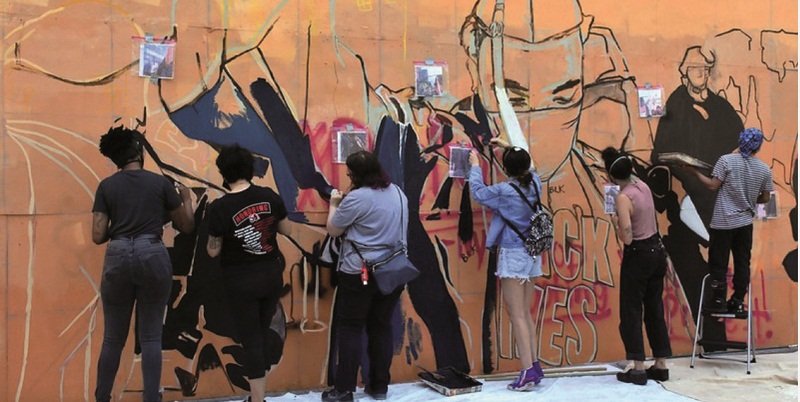
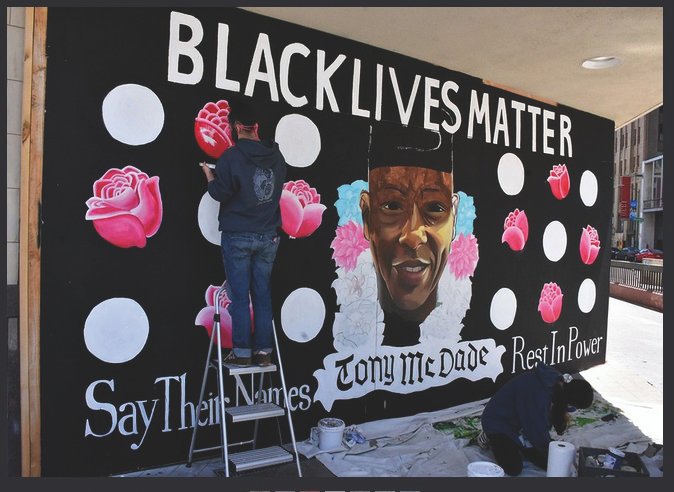
Murals in Oakland, California. Photos: Bill Hackwell
Bullying

MINI-DICTIONARY FOR TODAY’S WORLD
Bullying
Bullying ascribes to its victim negative stereotypes, whether based on gender, sexual identity, religion, family economic capacity, cultural differences, place of birth or residence, among others
Author: Victor Fowler | internet@granma.cu
June 9, 2020 23:06:01
Translated and edited by Walter Lippmann for CubaNews.
Photo: Taken from the Internet
It’s a continuous form of violence that takes place at school – although it usually reaches the residence, entertainment and leisure spaces of the participants. It’s in which one or several aggressors are determined to cause damage (physical, psychological or spiritual) to one or several victims. It can include verbal (direct or indirect), physical (more or less disguised), mockery, continuous devaluation and other degrading practices, isolation and ostracism.
It is based on an abuse of power by the aggressor, the passivity, silence or little reaction of the rest of the group and the weakness of the aggressor. Such a scheme subverts any teaching about values of equality, solidarity and justice, generates dysfunctionality among peers and often makes reveals problems of domestic violence or family isolation, both in aggressors and in victims.
Bullying assigns its victim with negative stereotypes, be it on the basis of gender, sexual identity, religion, family economic capacity, cultural differences, place of birth or residence, among others. In addition to breaking bonds of solidarity, bullying can have destructive effects and cause profound (low self-esteem, depression or other disorders) and long-term damage to those who suffer it and in extreme cases lead to self-harm (including suicide) or physical assault on the abuser.
The contemporary development of communications online and the easy access to these in a widespread way, has given rise to the emergence of a new variety of school bullying, in this case through the Internet, cell phones and social networks.
BIBLIOGRAPHY CONSULTED (MAIN SOURCES):
Sánchez-Castañeda, Alfredo. Bullying. A comparative view. – Mexico, Mexico City : Universidad Nacional Autónoma de México, Defensoría de los Derechos Universitarios, 2018.
Inter-American Institute of Human Rights. Prevention of school bullying : Bullying and cyberbullying San Jose, C.R. SOURCE: IIDH, 2014.
Shane Jimerson, Susan Swearer and Dorothy Espelage. – Handbook of bullying in schools. An international perspective. New York : Routledge, 2009.
The Necessity of Art

The Necessity of Art
By Graziella Pogolotti
digital@juventudrebelde.cu
June 20, 2020
Translated and edited by Walter Lippmann for CubaNews.
For work reasons, there was a time when I traveled with some frequency to the Isle of Youth, then known as the Isle of Pines. On one occasion, I took advantage of the stay to get to Punta del Este and see the mark left there by the first settlers of Cuba. The famous caves of Altamira keep the expression of a representative art. The caves of Punta del Este, on the other hand, seem to announce the appearance of geometric abstractionism.
Weakly built, our first inhabitants arrived from South America, after traveling in fragile canoes through the arch of the Antilles. They planted yucca, lived in huts, produced articles necessary for life, along with some that were not of a utilitarian nature. These words were incorporated into the Spanish language, to which the word allusive to the most feared natural phenomenon, the hurricane, was also added. Its testimonial mark in the cave of Punta del Este raises many questions about the meaning of the work. Perhaps it was a way of averting the threat of an event of mysterious origin that regularly struck men and destroyed their meager possessions.
In any case, in the beginning, art, philosophy and literature were closely intertwined. With the passing of the centuries, as the division of labor was imposed, they gradually became independent. But artistic creation has not ceased to be a specific means of access to knowledge, indissolubly linked to a conception of the world, to the cult of the dead in ancient Egypt, to the rescue of the human dimension of motherhood in the Gothic cathedrals.
The rise of capitalism led to the conversion of art into a commodity. Like a condemned man at hard labor, always persecuted by his creditors, Honoré de Balzac had to submit to the rules established by the publisher. Each chapter of his novels had to close with a question that imposed on the reader the need to acquire the next publication in order to find continuity and an answer.
He turned that experience into LOST ILLUSIONS. As an aspiring writer, the main character Lucien de Rubempré goes on a pilgrimage through publishers reduced to the condition of pure manufacturers of goods. In the 19th century, gallery owners appeared who would buy works that would reach millions of dollars in value for pennies. In modern times, when the value of money is subject to economic crises, investing in art means acquiring a good with a lasting and often growing value.
Adventure of knowledge, artistic creation explores the conflicts and twists and turns of the human condition. In the words of the poet Arthur Rimbaud, we are a drunken boat rocked by storms of all kinds. In the course of history, the works that retain a living presence revealed to us the serene harmony of the mother with the child in her lap.
The baroque fracture showed the tensions generated by power, the image of the Pieta, a painful mother with her son collapsed on her knees, the passing of the ages in the beautiful adolescent body of David and the venerable old age of Moses, brought to light the underground universe of begging and picaresque, the tricks of the Tartuffe climber, sharpened Quevedo’s satirical whip, while the renewal of the codes of architecture showed the precarious balance between illusion and reality. The incision in the depths of our individual and social being has a liberating function, based on the recognition of what we are and is therefore an indispensable springboard for our full emancipation.
Since the conversion of art into merchandise, capitalism castrates the emancipatory function of art. Under the guise of neo-liberalism, with its imposed hegemony over the media, it advances even further in the perverse sterilization of the role of art. An ephemeral fair of show business vanities, which has become a disposable consumer good, produces shows designed to subject and seduce, from a one-way transmitter, a recipient modeled on their whim. It thus undermines the essential nature of artistic creation, its dialogical character open to multiple meanings, a guarantee of transcending from the local to the universal, from yesterday to today and tomorrow. For this reason, despite the millennia that have passed, we are still moved by Oedipus Rex’s tragic confrontation with his destiny. He had to tear out his eyes because he did not know how to recognize the reality that comprised his existence, that of his family, that of the citizens of Thebes.
In this month of June, we have evoked the 90 years since the birth of Armando Hart, a protagonist of the historical vanguard of the Revolution and lucid manager of our cultural thought. It is about to be the anniversary of the [speech] Words to the Intellectuals, given by Fidel in the National Library. This is not the time for routine recounts. The perverse use of culture with the purpose of manipulating consciousnesses, calls for a broad and deep discussion on the role of art in the struggle for human emancipation. [This is] a decisive issue in these days, when the death of art, the disappearance of the species in a process of accelerated climate change and increased poverty threatens us. Taking into account the current panorama and the experience acquired, it is urgent to design integral strategies to offer an adequate response to the great challenges of contemporary life. I will return to this subject in the next issue.
Trump takes his politics to Tulsa
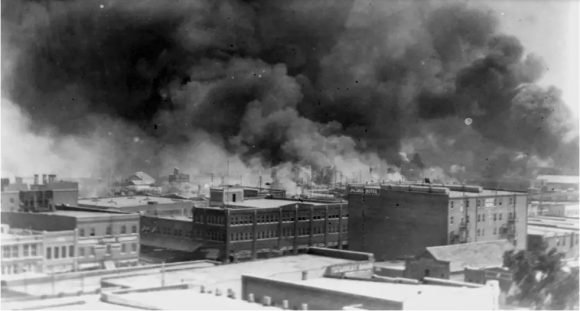
Trump went with his politics to Tulsa, scene of the worst massacre of African Americans in recent U.S. history.
By Natalia Plazas
June 20, 2020
Translated and edited by Walter Lippmann for CubaNews.
In 1921 Tulsa, the city Donald Trump chose to resume his campaign for the presidency, was the scene of one of the most atrocious massacres in U.S. history against the Black community. Nearly a hundred years after the event, the facts remain virtually unknown to society.
Smoke rises from buildings during the 1921 Tulsa, Oklahoma, USA massacre. Photo: Reuters
Donald Trump hit the nail on the head when he decided to resume his campaign for reelection in Tulsa, Oklahoma. Tens of thousands of his supporters await him there, but there is also a growing call for remembrance and justice from activist groups who remember that that city has not healed the wounds of the worst massacre in the country’s recent history against the African-American community.
On the night of May 31 to June 1, 1921, an entire neighborhood was razed to the ground and 300 black citizens were killed. The massacre began when a white crowd came to lynch a black man accused of sexually assaulting a white woman. That, supposedly, was the trigger for the tragedy, but history has revealed a much more perverse situation.
In the 1920s, the Greenwood neighborhood, a black enclave in the city of Tulsa, was noted for its economic prosperity. The distribution of land after the end of the American Civil War had benefited some African-American and Native American communities, and as a result Greenwood had become stronger, despite being segregated, like any black neighborhood at the time.
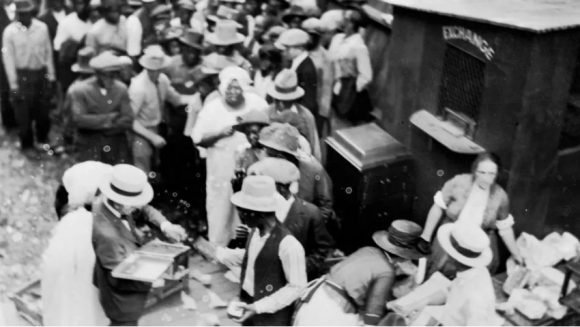
Archive image. A crowd of mostly African Americans lines up at the Exchange booth in Tulsa, Oklahoma, in 1921. © Reuters
From ‘Black Wall Street’ to a neighborhood in the ashes
Such was the commercial and economic success forged in Greenwood that it was commonly called the ‘Black Wall Street’, but soon its good fortune would bring it ruin. Members of the white community began to view their neighbors’ bonanza with suspicion and, interested in occupying their land during the railroad expansion, decided to attack the neighborhood.
On the night of May 31, a crowd of white men, supported by local authorities and even police, arrived in Greenwood and charged at the African-American population and their homes. The mob burned down homes and businesses to the point that when the situation calmed down hours later, at least 35 whole blocks had been left in rubble.
The blow took away the good fortune of the neighborhood forever. In the wake of the event, Greenwood’s recovery has been frustrated by the creation of laws promoting zoning or by building restrictions. Today in Tulsa, the social gap between blacks and whites is notorious. According to a Human Rights Watch report, poverty is almost three times higher among black citizens than among white citizens.
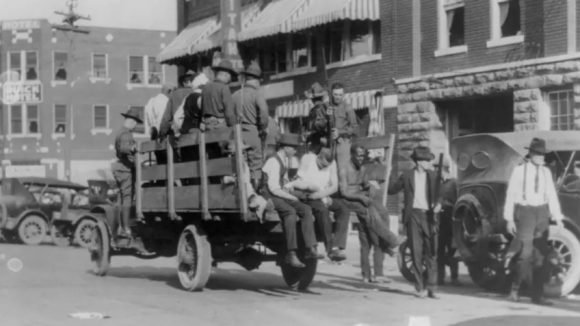
Archive image. A truck carrying soldiers and African Americans near the Litan Hotel during the 1921 Tulsa, Oklahoma race massacre. © Reuters
A Donald Trump rally ignites misgivings in a remote society
With Trump’s visit, originally scheduled to coincide with the celebration of Black Independence Day on June 19 [Juneteenth] and postponed amidst national protests against racism, the call for historical recognition of the victims and economic reparations for their descendants has intensified more than ever.
Less than a year before the 100th anniversary of the Tulsa incident, justice has yet to be established, despite the fact that the case has even been brought before the U.S. Supreme Court. Both lower courts and the high court have dismissed the claims. Currently, only two survivors of the massacre are still alive.
But Trump’s arrival has not only put the spotlight on a forgotten chapter of American history. His desperate attempt to revive in Oklahoma an image that has deteriorated in recent months due to the economic impact of the pandemic has highlighted the differences between his supporters and those who demand changes in the treatment of the African-American community.
“Any protester, anarchist, agitator, looter, or small-time person who goes to Oklahoma, please understand that they will not be treated as they have been in New York, Seattle, or Minneapolis. It will be a very different scene,” the president said before embarking on the trip to Tulsa.
The comment, which his critics call conflictive and divisive, comes at a time when the rejection of racial violence in the United States shows its greatest increase in decades, with weeks of massive demonstrations in multiple cities around the country that have also reached the doors of the White House.
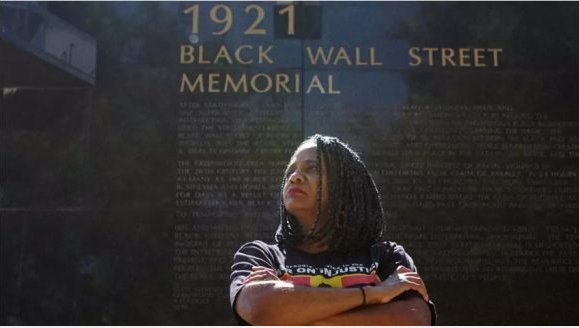
Tulsa Councilwoman Vanessa Hall-Harper poses for a portrait in front of a memorial to the 1921 Greenwood massacre. Tulsa, Oklahoma, USA, June 18, 2020. Lawrence Bryant / Reuters
The gesture that makes Trump uncomfortable
The gesture that makes Trump uncomfortable
The protests against racism, supported in different latitudes of the planet after the assassination of George Floyd, have also gained strength in the field of sport
Author: Alfonso Nacianceno | nacianceno@granma.cu
June 10, 2020 00:06:46
Translated and edited by Walter Lippmann for CubaNews.
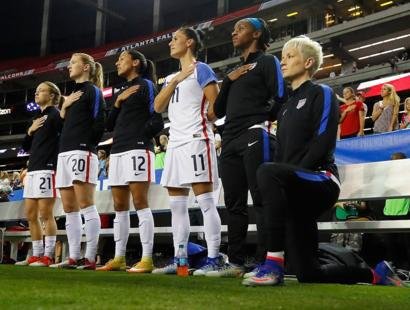
Donald Trump attacked the Black football players, members of the well-known NFL, because a group of them were kneeling on the ground to hear the national anthem, in protest against racial segregation.
U.S. law requires the military to perform its usual salute. All other citizens, including athletes, must remain standing, facing the national flag, with their right hand resting on their heart, while the anthem is played.
By not following this guideline in different facilities, Trump, although there was no clause in the NFL regulations, pressured the organization’s directors to punish all players who expressed themselves in this way against racism and inequality.
In light of the current events in the convulsed American scene, when this Tuesday would be the burial of George Floyd in the middle of the incombustible protests, the United States Soccer Federation (US Soccer) will open a debate to on ending the controversial rule of prohibiting its athletes from taking a knee during the playing of the national anthem, the spokesman of the entity confirmed.
If the rule were to be repealed, it would immediately cease to have any effect. The measure came to life when Megan Rapinoe, four-time U.S. women’s national team champion and Golden Ball winner, knelt on the field in solidarity with American footballer Colin Kaepernick, who in the same gesture in 2016 sparked the anger of Trump, who pushed him out of the NFL
Rapinoe’s solidarity with the expelled player was the reason used by the president to radicalize the ban on kneeling on the ground.
The protests against racism, supported in different latitudes of the planet after the murder of George Floyd, have also gained strength in the field of sport, an important aspect of American national life. This is not only because of the rivalry that exists between the teams of disciplines that are widely followed by the population, but also because athletes are symbols that awaken empathy.
The quality of Black athletes in the United States is internationally recognized; many have been the protagonists of feats remembered throughout the world. Today, even though major competitions have been halted by the pandemic in that country, it is to be hoped that, when they return to action, there will also be a revival of protests in the stadiums, and knees on the grass.
United States at the Crossroads
United States at the Crossroads
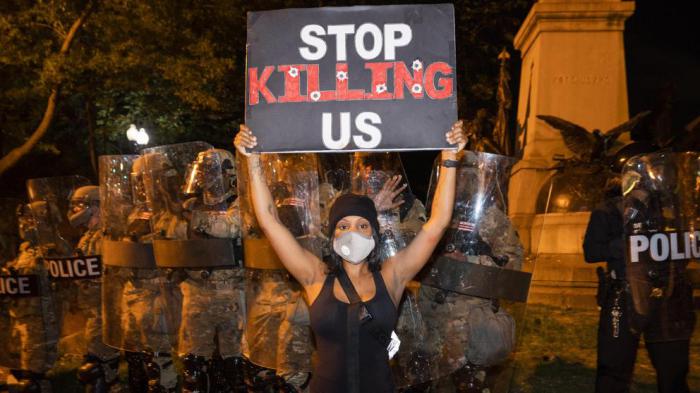
As the crisis in the U.S. deepens and the protests following George Floyd’s assassination take on a broader tone, old and new wounds of a society in need of profound change come to light
—————————————————————————–
Author: Raúl Antonio Capote | internacionales@granma.cu
Translated and edited by Walter Lippmann for CubaNews.
The protests take on a broader tone, bringing out old and new wounds of a society in need of profound change. Photo: La Vanguardia
As the crisis in the U.S. deepens and the protests that have erupted in the wake of George Floyd’s assassination take on a broader tone, old and new wounds of a society in need of profound change come to light.
The makeup that was intended to cover the worn-out face of the US Statue of “Liberty” is slowly fading, and the truth is making its way into the minds and hearts of the people. A protester in New York asks in front of the cameras of a TV network covering the protests: Where is the greatest country in the world, and he answers himself with anger and pain: “It is not here.”
It’s a fact that U.S. Secretary of State Mike Pompeo boasts of being an accomplished liar and recalls during an interview at the University of Texas A&M, the time when he was director of the company, his image as a supposed strongman is not respected either.
The head of U.S. diplomacy is still the same cynic who said, “I was the director of the company. We lied, cheated and stole. We even had training courses” which drew applause from those present, who must have included some of those who, these days, obeying Trump’s “guidance”, gargle with chlorine to combat COVID-19.
You can’t fool everyone all the time. The current government is responsible for more than 112,000 deaths from the pandemic, rampant unemployment, loss of rights, hunger for many (a hunger they can no longer hide), lack of medical care for the majority of the people and racial discrimination.
The man already considered by many the worst president in the history of the United States is covered by a deluge of criticism, with a shower of lies launched through Twitter, a kind of “counter-water” strategy that seems to make no sense, but it does.
Donald Trump speaks to his base, those who voted for him in the previous election, and hopes they will do so in the next one, on November 3. They are secure bases that have remained faithful to their president, despite the defection of a group of the less firm.
Who will vote for whom?
Those who will vote for Trump are those who see him as a “winner” who will achieve success for America, those who admire his showmanship, his misogynistic poses, his image as a rich, powerful man, with a lot of luck with women.
Those who are alienated by conspiracy theories, including those who believe that health care reform and 5G [Internet] seek to control the population.
The U.S. government, which is opposed to vaccination, believes that the left belongs to an alien invading race that wants to dominate the world, and a thousand and one other absurd theories.
Trump gloats over the unconditional love that many ultra-nationalists, religious fanatics, racists, supremacists, and separatists have for him, to whom he presents himself as a political outsider.
Trump and his team calculate that many of the people who oppose his re-election will not vote for Joe Biden either.
They estimate that the most radicals, who want a profound change in the country, would not vote for the neo-liberal group that the former vice president represents. Many millennials and Z-generation supporters do not see Biden as a viable option for solving the country’s problems.
Therefore, faced with possible massive abstentionism, motivated by the lack of valid alternatives and the security of the vote of their bases, the followers of the current president trust that they can win again.
An uncertain future
However, the situation is getting darker for him. Important figures of the Republican Party, prestigious military and hawks with voice and influence, are closing ranks against Trump’s possible re-election.
Colin Powell, former chairman of the U.S. Joint Chiefs of Staff, was the last of a series of retired senior officers to publicly criticize Donald Trump.
“We have a Constitution. And we have to follow that Constitution. And the president is walking away from it,” Powell said in an interview with CNN, in which he accused him of “lying about a lot of things.
Powell, who served as secretary of state during the George W. Bush administration, and according to the Pew Research Center, a Washington, D.C.-based think tank, his statements can influence independent voters, who make up 38 percent of the electorate.
Among others, Trump has been criticized by former Presidents George W. Bush and Barack Obama and former presidential candidate Mitt Romney.
Powell has been joined by the voices of several prominent military figures, including former Secretary of Defense James Mattis, who said that Trump is not “a mature leader” and accused him of “deliberately trying to divide the country.
Former U.S. Chief of Staff John Kelly, a retired general who served in the U.S. government, called on the American people to “look carefully at who you elected.”
Another uniformed man who spoke out against the White House tenant was retired Navy Admiral William McRaven, the commander who led the military operation in which the U.S. killed al-Qaida leader Osama bin Laden.
“It’s time for new leadership in this country, Republican, Democrat or independent,” adding that “the president has shown that he doesn’t have the qualities to be a good commander-in-chief.’
Current Defense Secretary Mark Esper criticized Trump’s actions during the protests: “I do not support the invocation of the Insurrection Act. These measures should only be used as a last resort, and in the most urgent and extreme situations.
Prominent intellectuals, renowned artists and sportsmen, workers, unemployed, Afro-descendants and Latin Americans, businessmen and ex-soldiers, small landowners ruined by the crisis, young people from all walks of life, have joined in the protests across the U.S.
Many are talking about giving their all so that the current administration will not be re-elected. It looks bad for the tycoon-president. Whatever he does, history is bent on sawing the floor to him.
What Trump Would be Capable Of
What Trump Would be Capable Of to Get Re-elected
By Manuel E. Yepe
http://manuelyepe.wordpress.com/
Exclusive for the daily POR ESTO! of Merida, Mexico.
Translated and edited by Walter Lippmann.
Humanity will always remember, with sadness and pain, the tragic way in which the hostilities of the Second World War ended in the theater of operations in Asia and the Pacific.
On August 6, 1945, the United States airlifted and exploded an atomic bomb over the Japanese city of Hiroshima, killing 80,000 people in a treacherous manner. This figure increased to 200,000 by 1950 due to the persistent effects of nuclear radiation.
After that horrendous crime against humanity in Hiroshima, instead of showing their repentance by putting an end to such actions against civilians, the political leaders of the United States continued their efforts to dominate the world with the threat of the use of the atomic bomb for their own interests.
On the second occasion, they did so over an even more populous city, Nagasaki, where President Harry Truman became the murderer of some 300,000 additional human beings.
The message was obvious and clear: The United States possesses a terrible weapon and is willing to use it against any nation that opposes its world domination.
The government of Japan at the time was a military dictatorship nominally headed by an Emperor who had crushed all democratic dissent, outlawed the country’s Communist party, and pursued a very aggressive foreign policy against its neighbors.
In December 1941, the Japanese empire-which had occupied a considerable portion of the coasts of China, Korea, and the French colonies of Indochina (Vietnam, Laos, and Cambodia) by committing atrocities in much of the Dutch East Indies (Indonesia)-attacked Hawaii, an American possession.
But despite those initial victories, by 1945 Japan was already a defeated empire. It had lost its oil reserves and its naval fleet had been destroyed. Nazi Germany, its greatest ally, had surrendered in May 1945.
In June 1945, the government of Japan had communicated to the neutral governments of Sweden and Switzerland, as well as to its strongest opponent, the Soviet Union, its desire for peace. Their sole condition for surrender was that its emperor remain the nominal head of the Japanese state.
Notwithstanding the above, there are many who even today, 75 years after that monstrous fallacy, accept as true the lie with which the then-American President, Harry Truman, justified the use of the atomic weapon after the genocide. “We have used the atomic bomb to shorten the agony of war, in order to save the lives of thousands of young Americans.
That horrendous lie – that Japan’s willingness to end hostilities with an almost unconditional surrender that would have saved humanity tens of thousands of dead, wounded and material resources – was the lethal weapon used by the U.S. government to needlessly prolong the war for a few days in pursuit of its spurious goals of global domination.
Since then, the U.S. has continued to prepare a huge military potential for that purpose. It has adopted a doctrine of pre-emptive war, and planned the militarization of space. After the events of September 11, 2001, they unleashed on its own territory the “war on terror”, which was used to justify attacks around the world and a permanent state of war. Now, the threshold for the use of nuclear weapons is increasingly lowered and their use always seems only a matter of time.
For some decades now, the world has been living in the shadow of the probable nuclear outcomes of the “conflicts” that Washington unleashes anywhere in the world. Their goals are either to impose or prevent any free trade agreement by violent means, to overthrow the governments that it calls “failed” and the popular movements that resist the global corporate empire; to promote the plundering of oil and other resources in the weakest countries, or other unspeakable ends.
With an idiot as characterized by his lies and tricks as Trump that the American population currently suffers as President, Humanity has no choice. It must resign itself to waiting for a phenomenon of popular intelligence among the citizens of that great nation, one that that will prevent the magnate from being able to manipulate his election once again, with whatever ignominious recourse he has to appeal to violate the popular will.
Things are much more dangerous in the highly-charged environment that racism has created these days, with the vicious murder of Black American citizen George Floyd by a white police officer in the city of Minneapolis, Minnesota.
June 1, 2020
This article may be reproduced by citing the newspaper POR ESTO as the source.
You must be logged in to post a comment.