
Hollywood anti-Cuban Mafia Action Movie

 MARTIANOS
Followers of the thought of José Martí Network of Cuban emigres.
Hollywood to Film anti-Cuban Mafia Terrorist Action Movie in Miami
By Arthur González
Posted by Virgilio PONCE on April 4, 2018 at 11:07am
Translated and edited by Walter Lippmann for CubaNews.
The truth always finds a way, even if it takes time, and now Hollywood has agreed to bring to the big screen the story of some of the terrorist actions carried out by the anti-Cuban terrorist mafia of Miami, which the Cuban people have denounced so much.
The totality of the denunciations of these terrorist actions against Cuba will have to wait for Hollywood to decide to count them, since many of its perpetrators still live peacefully in the United States, supported by renowned Congressmen such as Ileana Ros-Lehtinen, Mario Díaz-Balart, Bob Menéndez, Marco Rubio, Ted Cruz and others.
The film, based on the recent book entitled The Corporation, attempts to recount the events of 30 years, carried out by Cuban mafia members. All have the status of “political refugees” granted by the US authorities, although in the book they are classified as “real adventures”, avoiding calling them “terrorist acts” in order not to seek conflict with those most responsible for these plans.
This mafia was formed, trained and financed by the CIA to act in Cuba against the Revolution. Many of its members were part of the mercenary Brigade [2056] that invaded the island in 1961. After being released by the Cuban government, they returned to the United States, training for terrorist acts, where the struggle over money and political power brought a war between them.
The Corporation, tells part of the life of a single group of these Cuban “political refugees”, led by José Miguel Battle, mercenary of the Bay of Pigs invasion. He became the boss of illegal gambling and drugs, from Miami to New York, something that still happens in the underworld of these anti-Cubans, many of whom amass powerful fortunes with which they support politicians of Cuban and American origin.
José Miguel Battle, is one of hundreds of henchmen of the dictator Fulgencio Batista, who managed to escape revolutionary justice and found support and safe haven from the U.S. authorities. They refused to comply with the extradition agreement signed with Cuba and in force until 1961, despite the official demand that Cuban authorities made for years.
Murderers, torturers and former members of the dictator Batista’s repressive bodies, such as Battle, make up this mafia half-described in the book. This is because there are others, not mentioned in the book, despite the volume of crime they committed. These include Rafael Díaz-Balart, former interior minister, also a refugee in Miami; Rolando Masferrer, chief assassin of a paramilitary body known as Los Tigres; Colonel Esteban Ventura, murderer of hundreds of young people; Conrado Carratalá Ugalde, former head of the Department of the Batista Police Department; Luis Alberto del Rio Chaviano, Brigadier General of the Batista army; Colonels Orlando Piedra Negueruela, Mariano Faget Díaz and Rafael M. A. Gutiérrez Martínez; Pilar Danilo García y García, Brigadier General, chief of the tyrant’s police force; Lieutenant Colonel Irenaldo Remigio García Báez, former head of Batista’s Military Intelligence Service.
Nor does the text tell of Operation Condor, carried out by the CIA in Latin America. In it, many of these Cuban mafiosi took charge of murdering and torturing thousands of young people. Others include the terrorist acts suffered by the Cuban people at the hands of CIA agents, such as Carlos Alberto Montaner, who was arrested and punished for placing an incendiary flask in a shopping mall in Havana, escaped from prison and is now a refugee in Havana.
Likewise, they omit to mention the multiple murderer Luis Posada Carriles, a “political refugee” in Miami despite being the confessed author of the bombing of a Cuban civilian plane in mid-flight, where 73 innocent people died.
The terrorist acts planned and carried out by dozens of counterrevolutionary organizations financed by the CIA, such as the Comandos L, Alpha 66 and Omega 7, would need a series with many seasons for the world to know the truth about why Cuba has been denouncing them for 60 years.
Thousands were killed and assassinated by these mafiosi, including Cuban diplomats, the detonation of bombs in Cuban embassies, consulates and commercial offices abroad, dynamited ships, the introduction of pathogenic germs to sicken people, animals and the flora of the island, and many more crimes.
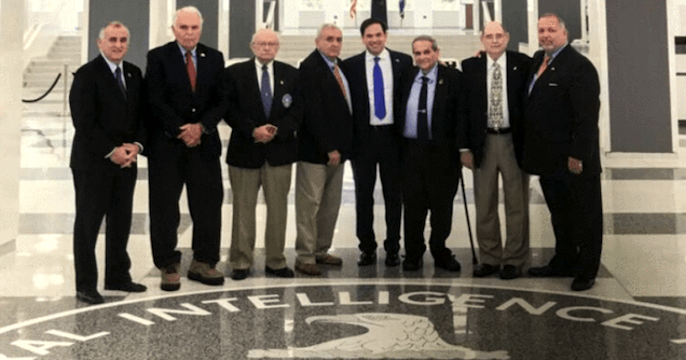
The Corporation is a tiny part of the history of this anti-Cuban mafia, all with the status of “political refugees”, thanks to the subversive manipulation of U.S. immigration policy against Cuba, due to, in the first place, the Cuban Adjustment Act.
The accounts of daylight shootings in the streets of Little Havana and the successful blows celebrated with parties where they gave away bags of cocaine. These are almost child’s play compared to the murky actions of that mafia, such as placing a bomb beneath the seat of former Chilean Foreign Minister Orlando Letelier in Washington, DC, where he, his wife and the driver were blown to pieces.
Its authors, including Guillermo Novo Sampol, live peacefully in Miami as “political refugees”, thanks to the efforts of Representative Ileana Ros-Lehtinen.
The book, although it does not cover all the terrorist actions, is a sample of those who are those murderers whom the United States welcomed as “refugees”, hiding the truth from its citizens who, with part of their taxes, have kept that rascal that forms part of the evil called “Cuban exile”.
That’s why we remember José Martí when he said:
“He smiles at the appearance of truth.”
Arthur González, Cuban, specialist in Cuba-U.S. relations, editor of the El Heraldo Cubano blog.
Of the Dream and the Nightmare

Of the Dream and the Nightmare
Fifty years after Martin Luther King’s momentous visionary speech, African Americans continue to struggle to find the path to true equality.
 By Juana Carrasco Martin
juana@juventudrebelde.cu
Published August 37, 2013 21:39:36 CDT
Updated: Thursday, September 21, 2017 | 10:25:08 PM
A CubaNews translation.
Edited by Walter Lippmann.
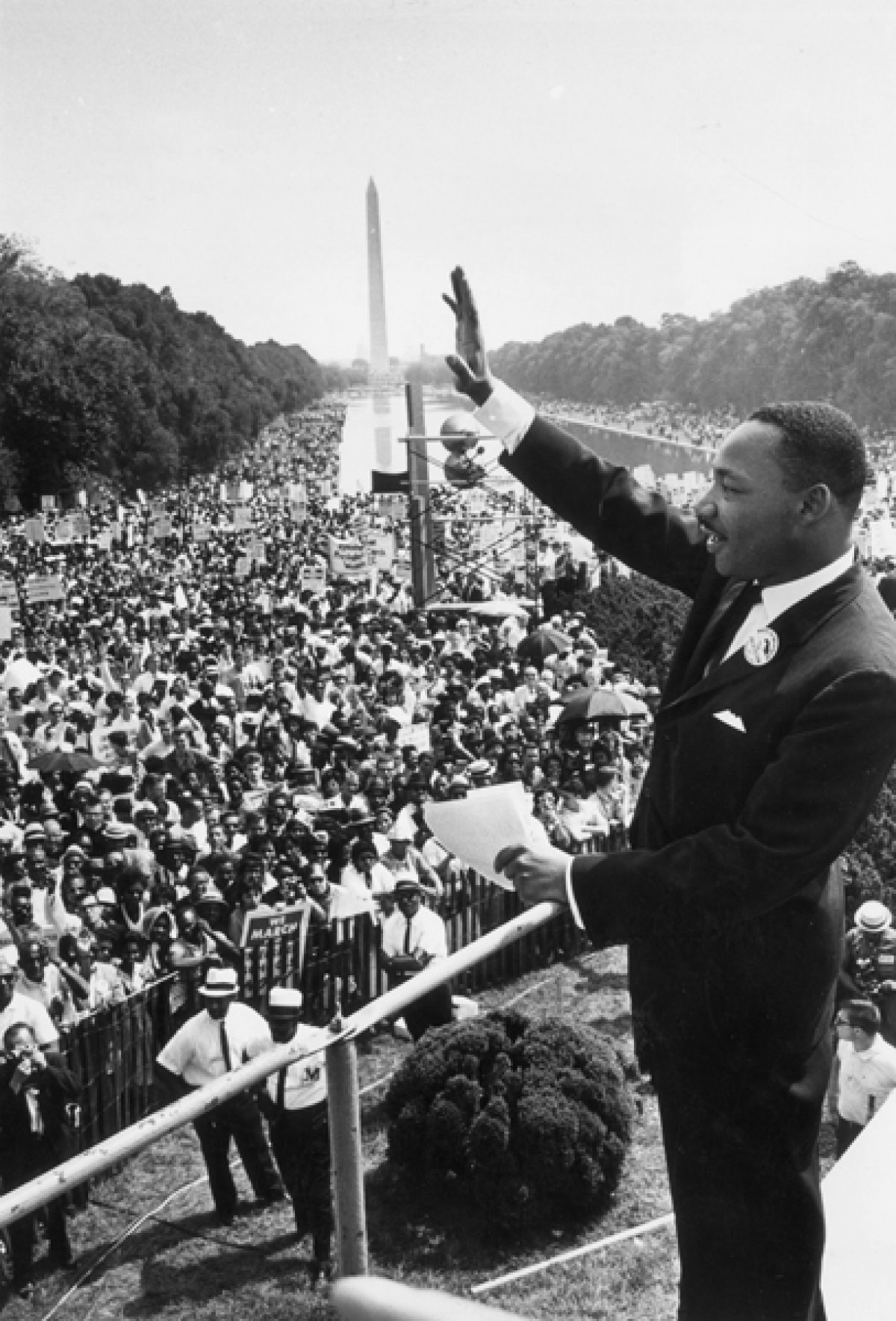
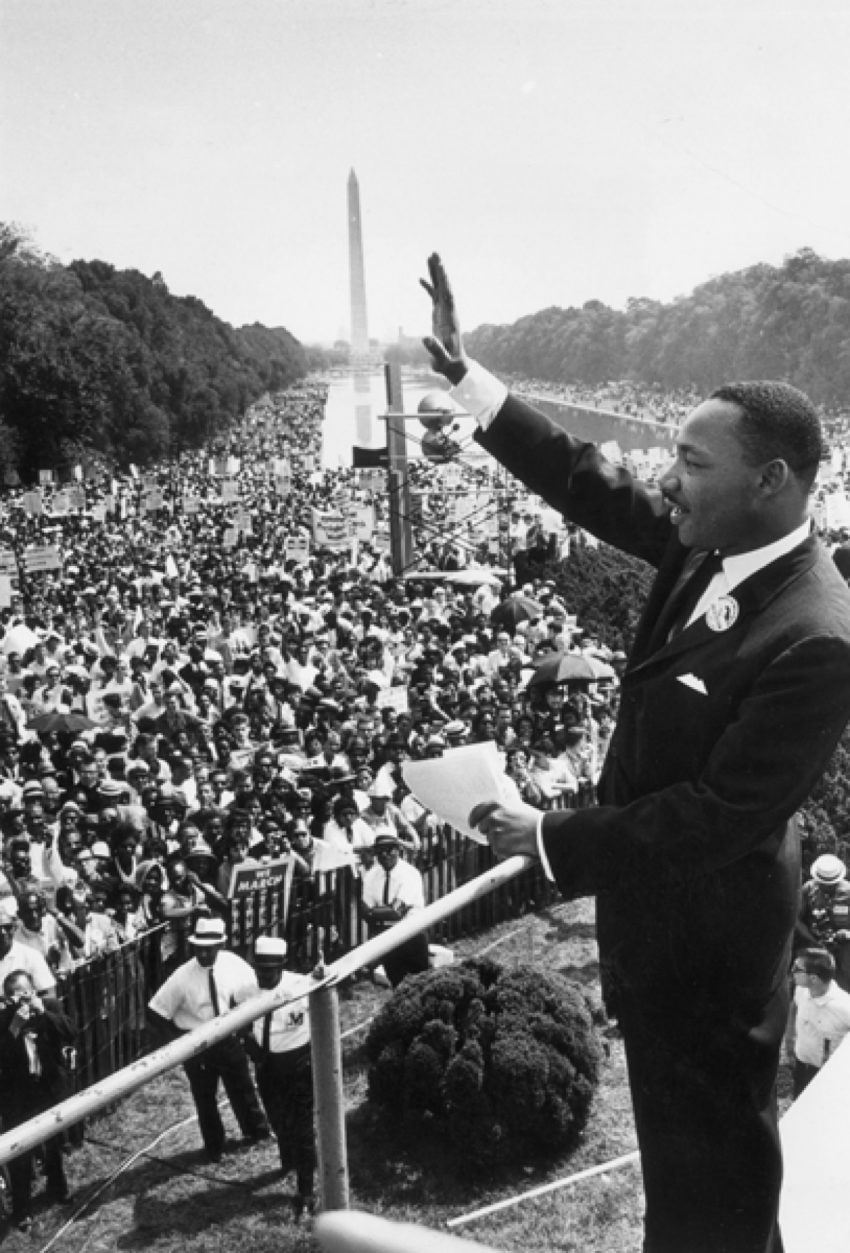
Martin Luther King greets the crowd at the Lincoln Memorial on August 28, 1963. Author: AP Published: 21/09/2017 | 05:38 pm
It was a blast, revalidating the struggle of many, raising the awareness of others and forming ranks in a social movement involving blacks and whites because it was for the civil rights of all. It also awakened those who were still lethargic after hundreds of years of outrage and submission.
On August 28, 1963, the 100th anniversary of the Emancipation Proclamation for black people in the United States, the end of slavery, was observed when a crowd, led by the Rev. Martin Luther King and other leaders of the black people’s struggle and social and labor movements, marched on Washington and gathered at the National Mall at the foot of the imposing statue of Abraham Lincoln.
“I have a dream,” he said in his speech to what he called the greatest demonstration of freedom in the history of the nation, and he called out with utter crudeness that a century later “we must face the tragic fact that the black man is not yet free. He was chained by segregation and discrimination, “living on a lonely island of poverty in the midst of a vast ocean of material prosperity,” he was “an exile in his own land.
The dream? that the words of the Constitution and the Declaration of Independence will apply to each and every American as a guarantee of the inalienable rights to life, liberty and the pursuit of happiness. These were denied to “citizens of color” who had been given a bounced check from a bankrupt justice. But this marginalized, humiliated, separated people, who were denied every opportunity, even the most basic, knew of their right to open the doors of justice, to cast aside racial injustice and to build “the solid rock of brotherhood.”
The time was urgent, warned Martin Luther King, and also alerted his people and the rest of the United States: “1963 is not the end, but the beginning” (…) “There will be no rest or tranquility in America until the black man establishes his citizens’ rights. The winds of revolt will continue to shake the foundations of our nation until the bright day of justice emerges.
Three national television networks, for the first time, covered the march for jobs and freedom in together. The message reached the entire nation that a melting pot was being said, the pot that had mixed all the peoples who had come to its shores and built a powerful country, but that was one of the great lies. The Black ingredient, even the original peoples, the “red skins”, had been taken out of society. That media coverage was proof that it was time for change.
There Joan Baez and Bob Dylan sang, as did the gospel performer, Mahalia Jackson, who carried the feeling of the crowd with I’ve Been ‘Buked and I’ve Been Scorned. Many spoke, including Joachim Prinz, president of the American Jewish Congress, recalling his years as a rabbi in Berlin under Hitler, who said – according to The Guardian – that his great people, who had created a great civilization, had then become a nation of silent spectators to hatred, brutality and mass crimes and cried out: “America cannot become a nation of spectators. America must not remain silent.”
On August 28, 1963, and Martin Luther King’s “I have a dream” speech, a door was opened. It was hardly mentioned in the 64,000 pages of debate and congressional hearings that gave way to the Civil Rights Act of 1964 or the Voting Rights Act of 1965, which put on paper what it should be and yet was not; but it was a touch of the target.
Enemies took it into account. Cointelpro, the program of espionage and infiltration into the social movements of the time, made him its target. William Sullivan, the FBI’s assistant director of domestic intelligence, recommended: “We must mark him now, if we have not done so before, as the most dangerous black man in the future of the nation.”
Hot summers came and their street uprisings, many more marches and actions, unity with the anti-war movement, and rejection of the Vietnam War, which they also used as their favorite cannon fodder for blacks and Latinos. Martin Luther King was in that fight for all.
Little by little there were achievements, even a middle class of “coloured” men and women emerged, their numbers increased in universities, they became professionals, their faces already appeared as leading figures in Hollywood films, they showed, even more, their value in the sports world, where the image of a black fist is vivid as a symbol of Black Power, the power of black people.
Blood flowed – that of Martin Luther King himself in April 1968, that of Malcolm X, that of George Jackson, that of many others – Mumia Abu Jamal is still in prison and those who chose more radical methods of struggle are being persecuted. Other leaders in an ongoing struggle were highlighted, as the Lincoln Memorial speaker said as the summer of 1963 ended: it was only the beginning…
And 50 years later, what?
Present at the rally at the National Mall on Saturday, August 24, 2013, which brought together no less than 100,000 Americans of all colors, generations and ideologies to commemorate the 50th anniversary of Martin Luther King’s oratory piece, were the parents of Trayvon Martin. He was the 17-year-old boy shot dead in the chest by a white vigilante in Florida on February 26, 2012. It took protest marches in many American cities and a lot of work to have the perpetrator arrested and put on trial, and almost now, in July, a jury of five white women and a Latina declared him “Innocent.” Not a few posters in front of Lincoln’s statue again called for justice for what is perceived as a hate crime.
Police in New York and other U.S. cities are accused of practicing stopping and frisking bystanders, most of whom are black or Latino, and preferably young, for no reason. They are stopped because of racial profiling. African-Americans make up seven times more than whites among the prison population, which is already the highest in the world. In the United States, it is known and recognized that they invest more in prisons than in schools….
Only 21 percent of their youth reach high school or college, compared to 37 percent of whites. Budget cuts in major cities declared bankrupt and in federal spending itself, that of the entire nation, affect the public school system and, of course, scholarships or university credits. It goes without saying that communities and neighborhoods where poor or low-income minorities live are among the hardest hit by teacher layoffs. During Barack Obama’s tenure alone, more than 300,000 school jobs have been lost – with a high proportion of these being African-American teachers and staff. Public education will be of even poorer quality, which means that there is no future sown there.
The unemployment rate in 2012 was 13.6 percent for the African-American work force, while the white unemployed made up 8.1 percent. Of the 45 million Americans who receive food aid because they are poor, more than 25 percent are black.
Barack Obama, the first black president of the United States will speak today, August 28, in honor of Martin Luther King. But it is well-known that the president is only an image in a House that is still white and protective of the interests of the powerful 1% against the 99% who – without distinction of race – have declared themselves in struggle and have also begun a path to close the gaps of class inequality, as the Occupy [Wall Street movement] which has been marginalized.
Now, in the southern states, even in other regions, electoral districts are being reconfigured and the black population is once again segregated from the vote, even having to pay to register. It also is the population with the lowest income, thereby discouraging voting. There is only one black senator among the top 100 in Congress, and 43 representatives in the House of Representatives, among 435…
Therefore, the validity of the thought of the civil and pacifist leader: “I have a dream: that one day this nation will rise up and live the true meaning of its creed. We hold this truth to be self-evident: All men are created equal.
Martin Luther King will continue: “Even though we face difficulties today and tomorrow, I still have a dream.”
Ostentation or Petulence?


MESA REDONDA
Ostentation or Petulence?
By Luz Maria Martinez Zelada
March 31, 2018
Translated and edited by Walter Lippmann for CubaNews.
The Cuban people are, par excellence, cultured and simple, but there is a segment who practices ostentation, as a way of attracting attention. In manycases it manages to affect others.
The display of many jewels at the same time is reminiscent of street vendors who used to put them on their bodies for marketing purposes, which does not reflect good taste and is shocking to most people.
But the wearers of so much shininess will say that they like to show off the brilliance of the metals and it is still a childish truth.
There is another example of the financial capacity of the ostentatious, referring to audio equipment: the more powerful, the more expensive.
Owners of powerful devices go out on the street or place them in front of the window, not so much for the purpose of listening to the music but so that everyone [in the neighborhood] knows so much about their property that they cannot sleep, hear the television or talk at home.
Other demonstrations abound, such as the dogs, man’s best friend. Some make the noble animal the object of display, dogs that must be the most expensive to walk wearing a shiny chain too.
Boasting about one’s advantageous financial situation makes one think of the sentences of José Martí, in the letter he wrote to Maria Mantilla, from Cape Haitian on April 8, 1895.
“…Too much shop, not enough soul. He who has much inside needs little outside. Whoever has a lot on the outside has a little on the inside, and wants to hide what little… ” “.
“…it is a human duty to cause pleasure instead of sorrow, and he who knows beauty respects and cares for it in others and in himself. But he will not put a jasmine in a Chinese vase: he will put the jasmine, alone and light, in a crystal of clear water. That’s the real elegance: that the glass is just the flower.
In the face of so much showing off, one might wonder if these ostentatious people lost their ability to admire the flower, influenced by the consumer society, which was alien to the roots and idiosyncrasies of the Cuban people.
(Taken from ACN)
Are Men Stronger Than Women?

Are Men Stronger Than Women?
The machismo superimposed on honesty where health is concerned, puts Latin American men, who believe that they do not need to go to the doctor, at risk of suffering serious illnesses and thus put their lives in danger.
By Juventud Rebelde
digital@juventudrebelde.cu
Posted: Saturday, March 3. 2018 | 06:54:26 PM
A CubaNews translation.
Edited by Walter Lippmann.
The machismo superimposed on honesty in health is concerned, makes Latin American men believe that they do not need to go to the doctor at risk of suffering serious illnesses and that they put their lives in danger.
Compared to other regions of the world, the health of Latin American men is more exposed to male chauvinism, believing that they are stronger than women and that they do not need to go to the doctor, puts them at risk of suffering serious and life-threatening illnesses.
This was recently announced by a study prepared by Panamanian specialists and reviewed by the Xinhua news agency.
The research explains that the decline in men’s health compared to women’s health is a global problem with great impact in our geographical area, although there is also a gap in the matter in Africa and Europe.
According to statistics, men in Latin American countries live between eight and 12 years less than women, mainly because the social stigma that considers them to be the head of the household weighs heavily on the lack of accurate reporting on men’s health.
In this region, the prevalence of certain metabolic, cardiovascular and sexual dysfunction diseases affecting men is increasingly noted.
It is common for men in this area of the planet to live less and less, and not only that, but to arrive much more deteriorated in their old age, because they never go to the doctor or have a follow-up visit.
The opposite is true of women, who, because of their preparation, are closely linked to a doctor, a pediatrician or a gynaecologist. Hence, it is the man who most often goes to the doctor with chronic illnesses.
Teachers Demand Raises and Funding
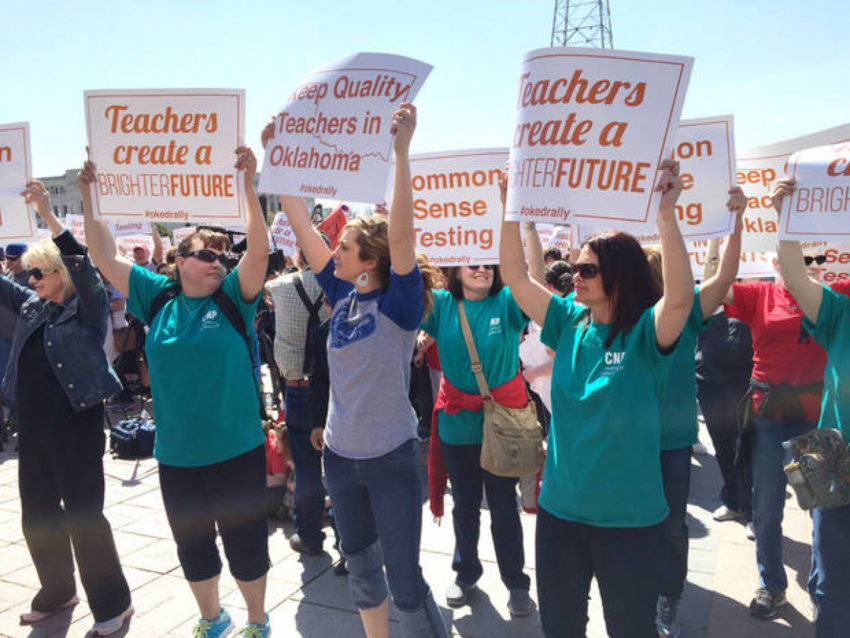
Thousands of teachers in the U.S. demand better salaries and more funding for public schools
Several hundred public schools remained closed this Monday, either because of spring break, or because many teachers decided to leave and their districts allowed them to participate in the mobilization.
Published: Tuesday 03 April 2018 | 09:36:27 AM
 By Juventud Rebelde
A CubaNews translation.
Edited by Walter Lippmann.
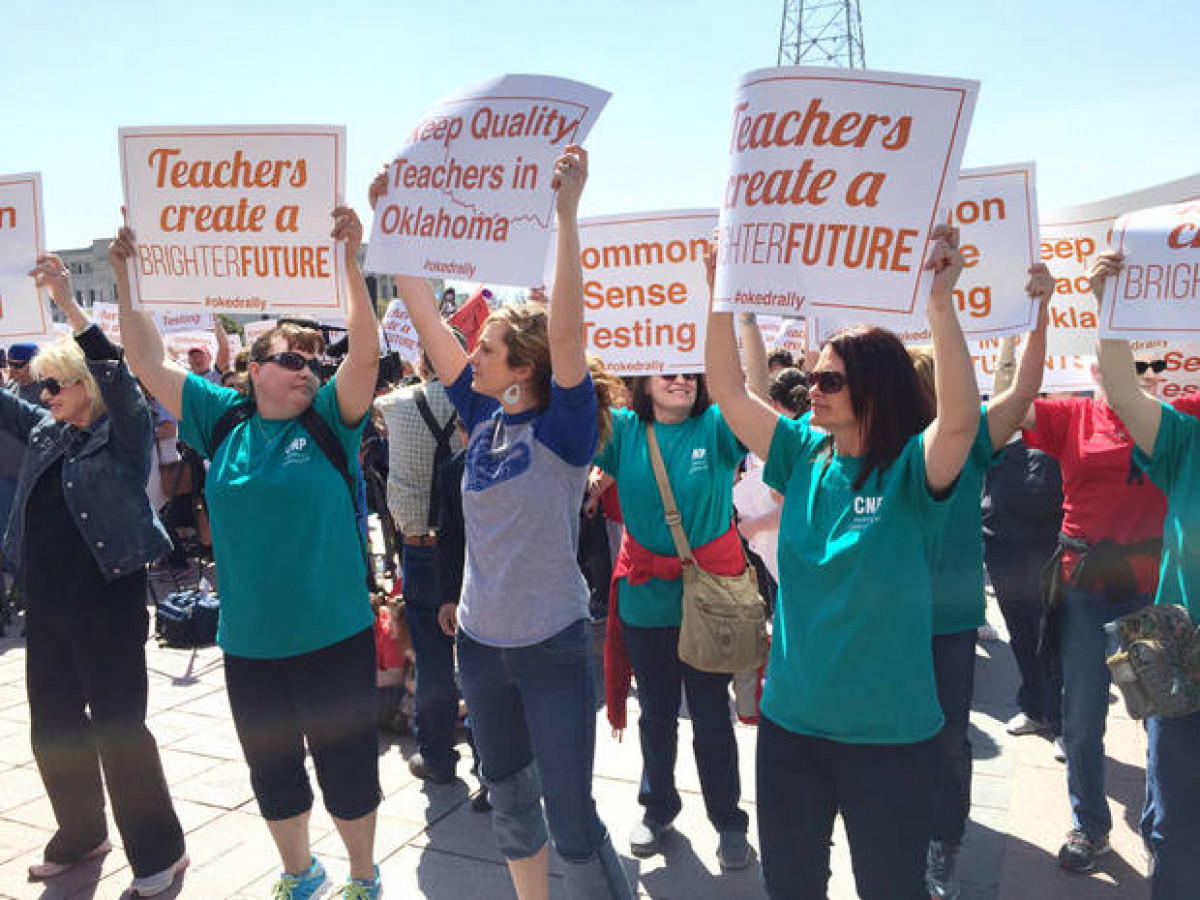
Teachers march in the United States Author: Internet Published: 03/04/2018 | 09:35 am
WASHINGTON, April 3. Tens of thousands of teachers in Kentucky and Oklahoma came together yesterday in their state capitals to demand more funding for education, salary and pension improvements.
According to USA Today, 120 public schools in the first of those territories remained closed on Monday, either because of spring break, because many teachers decided to leave or because their districts allowed them to participate in the mobilization.
“Stop the war on public education!” and “Enough is enough,” the Kentucky teachers shouted outside the state capitol in Frankfort, where they protested against a change to their pension system and cuts to education funding.
Teachers oppose a bill passed by the state legislature last Thursday and demand that Governor Matt Bevin veto it.
If the Republican politician signs the legislation, it will phase out defined benefit teacher pensions and replace them with hybrid retirement plans that combine the characteristics of a traditional pension with the 401(k) accounts used in the private sector.
In addition, retired teachers in Kentucky do not receive Social Security benefits, so any freezing of their pensions affects their total retirement income.
State teachers also demand the necessary funding for the public school system.
“Today we notify you that if you don’t pass a budget that protects Kentucky’s public services, provides adequate funding for schools, then we will vote to remove them from office,” Stephanie Winkler, president of the Kentucky Education Association, told the crowd.
According to ABC News, members of other public employee unions, including those representing firefighters, police, plumbers and pipe fitters, joined the teachers in a show of solidarity.
In Oklahoma, meanwhile, protesters demanded a higher wage increase for teachers and support staff and an increase in funding for education, which plummeted 28 percent in the last decade, according to the state teachers’ union.
The Oklahoma protest comes despite Republican Gov. Mary Fallin signed a law last Thursday that gives educators – currently at $45,000 a year – an average wage increase of $6,100.
Even with that increase, Oklahoma’s teachers would earn below the national average for public school teachers, which is $58,950 a year, and only surpasses those in Mississippi and South Dakota.
“Finance education”, “They are starving our schools” and “Mourning for public schools”, was read on the posters carried by those attending the protest.
Washington Suffers a Credibility Crisis
Washington Suffers a Credibility Crisis
 By Manuel E. Yepe
http://manuelyepe.wordpress.com/
Exclusive for the daily POR ESTO! of Merida, Mexico.
Translated and edited by Walter Lippmann.
Objectively, the credibility of the US government, with either party at the forefront, has always been in question because its foreign policy pronouncements on peace, freedom, democracy and human rights systematically contradict or contrast with its actions.
These days, the Associated Press (AP), a U.S. news agency, lamented in a commentary by its journalists that the conflictive and misleading daily statements of its President, Donald Trump, and the most important members of its team of senior advisors fuel new doubts about the credibility of the White House.
“Some Republican congressmen even wonder if they have a partner in the president of the nation with whom to negotiate in good faith and how much the president’s word is worth.
An AP paper says the former assistant Republican leader in Congress has told the agency that negotiating with White House officials has become impossible for Republicans, given the president’s propensity to undermine the public and private guarantees of his own team. White House officials have been seen in the unusual position of urging legislators to downplay some of the President’s statements.
“Recently, in one of his usual morning tweets, Trump threatened to veto a massive budget bill after the White House itself had assured legislators that the president would sign it.
The White House officials privately insisted, according to the AP journalist, that the president was venting his feelings after hearing reports that the agreement presented a defeat of several of his priorities.
Although, after hours of uncertainty, Trump signed the legislation into law, this situation disturbed some Republicans. “The lack of control over Trump’s outbursts is a concern on both sides of the House,” said a Republican Congressman from Pennsylvania who has sometimes been critical of the leader. “The disorder, chaos, instability, uncertainty and excessive statements are not the virtues of conservatives,” he said.
Members of both parties have expressed concern that the President seems oblivious to the way in which, by assuming certain positions and then relinquishing them without modesty, he undermines his own influence and agenda.
Trump’s hesitancy with the budget bill was just one in a series of recent incidents that put the credibility of the White House’s words in the spotlight. Earlier this month, during a private fundraising event, Trump boasted of inventing trade data in a conversation with Canadian Prime Minister Justin Trudeau.
In recent days, Trump and his team have strongly denied the possible dismissal of General Herbert R. McMaster as National Security Advisor, as well as likely changes in the legal team dealing with Trump’s role in the special prosecutor’s investigation into alleged Russian interference in the presidential election and constitute an obstruction of justice. Beyond public statements, John Kelly, the White House chief of staff, had privately assured his staff that there would be no restructuring.
But by the end of the week, McMaster had been separated and the legal team seemed to be looking for his replacement.
Trump’s problems with the truth are not new, the AP commentary says, often altering the facts, from the number of people who came to his inauguration to the scope of the tax reform he signed last year. And just as he did in boasting of his lie to Trudeau, the president rarely seems ashamed to repeat claims that have proven to be false. Polls show that Americans do not believe Trump is truthful, and in a recent poll conducted by Quinnipiac, 57% of respondents said the president is dishonest. The leader’s supporters say he was elected despite similar polls during his campaign.
Such a bias often puts his advisors in the uncomfortable position of issuing strong public statements that the President immediately denies. Spokeswoman Sarah Huckabee Sanders repeatedly denied reports of McMaster’s departure in the days leading up to Trump’s announcement that he had a new National Security Advisor.
Peter Wehner, who worked in the governments of President Ronald Reagan, George H.W. Bush and George W. Bush said, “Trump has no one to blame but himself. He doesn’t even know his own position.
April 2, 2018.
Parkland Survivors on TIME magazine cover

Parkland Survivors on TIME magazine cover
In a recent issue of Time magazine, five Parkland high school students look at the reader cry of ENOUGH to demand that their legislators take action to make schools and streets safe across the country.
Posted: Monday 02 April 2018 | 10:34:06 PM
Author: juana@juventudrebelde.cu
By Juana Carrasco Martin
juana@juventudrebelde.cu
A CubaNews translation.
Edited by Walter Lippmann.
A recent issue of Time magazine, one of the most important American publications, has a very special cover: five teenagers – students at Parkland High School, where 17 of their classmates were shot dead by another young man who was also a student at Marjory Stoneman Douglas High School – look straight ahead with a word that crosses not only that cover, but also the claim of a majority of the concerned population: Enough, a term that can also be translated as Enough is Enough.
Among the young people are Emma Gonzalez, David Hogg and Cameron Kasky, who have become spokespersons and advocates for control over guns in private hands in the United States. They are activists against armed violence, which is almost an epidemic in the northern nation, and they demand measures from their legislators to make the country’s schools and streets safe.
However, their demand does not have many receptive ears in the political class, where many of its members are tied to the National Rifle Association that thrives on this business. But the young people persist. A month after the shooting, many U.S. schools held 17 minutes of silence in honor of the 17 massacred in Parkland. A march went through Washington, the nation’s capital, with sibling marches in cities and towns across the country. They called for a change in the permissive and enabling rules and laws for these irrational crimes. It was the largest demonstration ever held in the United States for this purpose.
A recent AP-NORC survey emphasizes that national support for arms control is currently at its highest level in five years. About seven out of 10 adults favor stronger laws on the issue, representing 69 percent of respondents, The Hill said.
So, what does the president do? He calls for states in the Union to hand over weapons to teachers and school employees to answer Fire! with Fire!, a simple lesson in insanity….
Rapacious Entities Inhabit the White House
Rapacious Entities Inhabit the White House
By Manuel E. Yepe
http://manuelyepe.wordpress.com/
Exclusive for the daily POR ESTO! of Merida, Mexico.
Translated and edited by Walter Lippmann.
Donald Trump seems to have completed his team of “all-star” hawks that reaffirms the harshness of his power at the head of the only great power on the planet.
John Bolton, a United Nations critic, and advocate of the war against Iraq, Iran, North Korea, Cuba and Venezuela, will be, as of April 9, National Security Advisor. As Under Secretary of State for Arms Control, Bolton was the spokesperson for Bush’s justification for invading Iraq, citing the falsely-alleged possession by its President, Saddam Hussein, of chemical and biological weapons that never appeared, nor did they exist.
Mike Pompeo, whom Trump presented as the most loyal member of his cabinet, has been appointed head of diplomacy in Washington, is a follower of the Tea Party’s ultraconservative philosophy. His political career has been financed by the reactionary brothers Charles and David Koch, one of the most influential extreme right-wing power groups in the United States.
With the backing of the Koch brothers, Pompeo was elected to the House of Representatives in 2010 until Trump appointed him CIA director. In that capacity, he raised fears of a return to the practice of assassinating foreign leaders when he invoked the possible assassination of North Korean communist leader Kim Jong-un.
Pompeo has been in favor of “regime change” in North Korea and of sabotaging the nuclear agreements with Iran.
The Bolton-Pompeo duo will be joined by UN Ambassador Nikki Haley, always remembered for her despotic threat of retaliation against countries whose diplomatic representatives voted against Washington’s decision to recognize Jerusalem as the capital of Israel.
Common to all of Trump’s newly-appointed diplomatic leaders is his interventionist and “Monroeist” stance on Latin America and his affinity with Republican Senator Marco Rubio. The latter is a controversial figure who stands out for his aggressive stance toward Cuba, a country he has never visited, and who is described by the media as an opportunistic Cuban-American.
In recent days, Ambassador Nikki Halley convened a meeting at Florida International University with anti-Cuban members of Congress Ileana Ros-Lehtinen, Marco Rubio, Carlos Curbelo and Mario Díaz-Balart to discuss “how democracy can be strengthened in Latin America and especially in Venezuela and Cuba,” although, according to Senator Marco Rubio, the current state of U.S. business was also discussed.
Rubio has rejoiced in the appointment of the new White House counselor: “I know John Bolton well, he is an excellent choice and he is going to do a great job as a national security adviser,” Rubio wrote on his Twitter account.
In return for the favors that Trump apparently owes him, Senator Rubio has increased his ascendancy in current U.S. foreign policy by appointing former U.S. Ambassador to the OAS Carlos Trujillo, a budding political figure in the Florida State House, akin to the senator.
Keep in mind that the new Secretary of State, Pompeo, has been one of the main supporters Marco Rubio has had in putting together the sinister story of the sonic attacks on accredited officials at the U.S. Embassy in Havana. The design and development of this plan are attributed, by some observers, to CIA plans aimed at hindering and eventually interrupting the process of rapprochement with Cuba initiated by the Barack Obama administration. At the same time, this would place the ambitious Senator Rubio under presidential luminaries who would point to him as a likely Republican party candidate to succeed Donald Trump in the 2020 elections.
Mike Pompeo, now named head of the State Department to replace Rex Tillerson, was considered a hard-line Republican congressman before Trump named him director of the CIA. He is credited with playing an important role as a mediator between the agency and its commander in chief, who has not hesitated to compare the US intelligence services with those of the Nazis.
Hours before Trump announced that he would meet with the North Korean leader, Pompeo was seen in the Oval Office with the President during a White House meeting with a South Korean delegation.
Pompeo had previously played an important role in the investigation into Russia’s alleged attempts to influence last year’s US elections.
March 29, 2018.
Life, Guns and Votes in the U.S.A.

Life, Guns, and Votes in the USA.
Some one million people, mostly students, took to the streets of 800 U.S. locations last Saturday to demand greater control over access to weapons.
————————————————————
Author: International Editor | internacionales@granma.cu
March 27, 2018 22:03:04
A CubaNews translation.
Edited by Walter Lippmann.
Young people in the United States raised their voices this weekend against violence, under the theme March for Our Lives. Some one million people, mostly students, took to the streets of 800 towns across the country last Saturday to demand greater control over access to arms.
The mobilization follows one of the most recent school shootings, in Parkland, Florida, when, in the midst of Valentine’s Day celebrations, a 19-year-old boy killed 14 students and three teachers carrying a legally acquired assault rifle.
The fact once again opened up the debate in a country where there are an estimated 200 to 300 million guns, almost one per capita, and where lobbyists such as the National Rifle Association (NRA) are lobbying hard in Washington to avoid any legislation that would diminish the profits from their lucrative business.
NO TO GUNS
Such was the scope of the demonstrations, that some of the older attendees remembered those of the young people decades before against the intervention of the United States in the Vietnam War.
Mary Riley, a 50-year-old filmmaker who traveled from San Francisco to Washington to support young people, said, “What made a difference in Vietnam was when the students went out on the street and now the students are the ones who were shot and they are also future voters.
In that sense, one of the survivors of the February shooting told the crowd: “We can and will change this world!».
Tired of the killings and school insecurity, young people are asking politicians for more action, not so much their “prayers and thoughts”.
Vietnam, successes, and challenges

Vietnam, successes, and challenges
After 32 years, the country’s outstanding economic indicators show the success of the Renovation Policy (Doi Moi), but also the important challenges it faces in order to ensure the full well-being of the population.
Author: Iramsy Peraza Forte | internet@granma.cu
March 28, 2018 21:03:30
A CubaNews translation.
Edited by Walter Lippmann.
More than four decades after the victory over the American invaders and the beginning of reunification, Vietnam remains an inspiration.
The nation that became an example for all the revolutionaries of the world, stands today as a symbol of self-improvement.
The route taken by the implementation of the Doi Moi policy in 1986 not only enabled the Vietnamese to recover from that bloody war in which the United States, with the exception of nuclear weapons, used the most advanced military technology, but also catapulted them into one of the most dynamic economies of today with remarkable growth rates.
After 32 years, the country’s outstanding economic indicators demonstrate the success of this process, but also the major challenges it faces in ensuring the full well-being of its people.
Today’s Vietnam is not only strong and consolidated, it is also one of the territories with the greatest socio-economic progress in Asia. Over the last decade, the state has experienced sustained growth and last year the Gross Domestic Product (GDP) exceeded US $220 billion, with an expansion rate of 6.81%, the highest since 2011.
The renewal driven by the Vietnamese Party and Government has been focused on the diversification of the economy, as well as its insertion as a competitor in the world market. The country has gone from being a net importer of rice to becoming the world’s second-largest exporter. It is also discussing the top spots in the export of other products such as coffee, rubber, textiles, and footwear. In 2017 alone, exports exceeded US $213.77 billion, up 21.1% year-on-year.
In less than two decades, more than 20 million people have been lifted out of poverty. Primary school enrolment has reached almost 100%. Life expectancy is now around 70 years. These indicators, together with rapid economic progress, have placed it among the fastest-growing emerging countries.
The renewal also established a gradual growth strategy that combined domestic policies with the creation of a network of geopolitical alliances, first in the region and then towards the rest of the world.
The impact of Doi Moi is also notable in the process of industrialization, one of the long-term goals of the Indochinese country. Despite facing more than 20 years of a blockade imposed by the US government, Vietnam opted for the construction of a socialist state that would transform its primary economy from manual agriculture, where 90% of its population was rural.
Some of the routes approved at the 12th Congress of the Vietnamese Communist Party (VCP) to achieve the goal of industrialization, set for 2035, have already been undertaken. They involve renewing the economic structure, raising productivity, strengthening macroeconomic stability and developing human resources to improve competitiveness in a technology-driven world.
But like any strategy, Vietnam’s reform process can also be improved and there are a number of challenges that Vietnam must face.
To continue on the path to success, the country has set out to create a greater investment climate, to free up much more productive forces, to deploy all economic components and to increase competitiveness, a prerequisite for consolidating itself as a middle-income nation and taking the next step.
But economic progress is only one part of the Vietnamese renewal process, and despite progress, the social costs of that transformation are recognized.
The total eradication of poverty, the reduction of inequalities, the reduction of child mortality and environmental sustainability, among others, are essential issues for the nation, aware that only in this way can it emulate the developed countries.
According to their authorities, to achieve the prosperity of all Vietnamese people, it is necessary to fight to narrow the gap between rich and poor, to pay greater attention to mountainous, remote and devastated areas and to generate greater opportunities for the most disadvantaged.
Achieving full access in education and exponentially improving its quality is another of the challenges and priorities of Vietnamese policy, which is committed to increasing resources for the training of its young people, who will have nation-building over their peers in the future.
You must be logged in to post a comment.