Yevgeny Yevtushenko: Poetry Himself

Yevgeny Yevtushenko: Poetry Himself
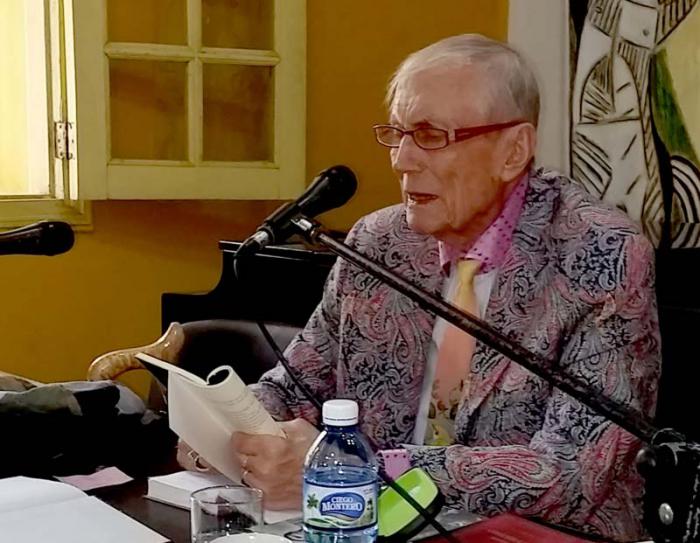
At the International Poetry Festival of Havana, with the presence of this outstanding Russian poet, a reading of his work was made at the Casa del Alba Cultural de La Habana
Author: Madeleine Sautié | madeleine@granma.cu
May 30, 2016 21:05:48
A CubaNews translation. Edited by Walter Lippmann.
Yevgeny Yevtushenko read his poetry at the Casa del Alba Cultural.
Photo: by the author
Much and much deserved is his notoriety. Among the main epithets he was given was that of being, if not the most, at least one of the most famous poets in the world. For this reason, the International Poetry Festival of Havana (FIPH), which now extends its epilogue to the east of the country, reserved among its events a unique reading by Yevgeni Yevtushenko. It was an occasion when the Casa del Alba Cultural Center in the country’s capital city welcomed him with a new audience that –on more than one occasion– applauded him.
Nominated more than once for the Nobel Prize for Literature, the poet, born in Siberia, Russia, in 1933, is familiar with crowds that gather to listen to him. At the age of 22, his love poetry gave him a popularity that grew with his readings in public spaces. In two occasions 6500 people crowded the Kremlin theater to enjoy his poetry.
In the life of this singular being –unique for his authentic poetry and his peculiar way of dressing– reading has been a common exercise. This time it was one more of his typical expressions. Yevtushenko read his poems for more than 90 minutes and between them he gave his audience those sparks that he usually inserts to even more brighten up his astonishing poetry.
After reading excerpts from his book Dora Franco, written in 2011, “with the permission of its heroine, “the Colombian model who accompanied him during his tour of that country where he arrived in his youth as part of a Latin American poetry tour, Yevtushenko chose, among other poems “The Execution of Stenka Razin”; “In the Country Called More or Less”; and “The Key of the Comandante”, dedicated to Che Guevara.
The reading of The Execution … allowed the public to enjoy the 14 different rhythms he mentioned before starting. This is a song to freedom and the evocation of a just leader who defended the peasants. Claiming to have had the illusion of witnessing the facts described in the epic song, the poet read aloud the text in which he describes the public execution of the hero. With remarkable impetus he reached the concluding verses: On the Tsar’s head/chilled by those devilish eyes/the Cap of Monomakh began to tremble/ and, savagely/not hiding anything of his triumph/Stenka’s head burst out laughing at the Tsar!
The key … served to listen to this man, who claims to be a bearer of a poetry that is “a personal confession put into verses,” from his political stance, which allows him to write with exquisite beauty events such as the death of the Heroic Guerrilla and disapproval of converting his sacred image into merchandise. “We do not know, sir, we do not know …” / Where is the key to the future? / The fear of not finding it, panic grabs us. / But the key is in your hands, / I’m sure. / (…) To the left, / boys, / always to the left / but not to the left / of your heart.
In the Country … one can see the poet’s critical and foresightful gaze against evils that corrode the best political purposes, such as bureaucracy, corruption and opportunism, among other human vices that violate the integrity of character, all expressed with great irony. (I would like to stand in front of God, as I am, / not as someone more or less. / Not being more or less happy / in this more or less life … / In this more or less freedom.
But the poet of the great audiences –whose work has been translated into more than 70 languages– and who stirred so many hearts more than six decades ago with his intense love verses, now at 83 years of age, has still much to tell us about the most universal of feelings.
In the presence of his wife Masha, he read –once again for her– and for all: I Love You More than I Love Nature, a poem with which he begins his book Stolen Apples, recently published by the collection Sur of the FIPH (still available at bookstores).
I love you recklessly / as an abyss, not as a small ravine. / I love you more than all possible, / and also more than all the impossible. He read and everyone could see this other side of the poet: earthly and in love. He continued: I love you more than my homeland / because my Homeland is you. Masha is perhaps the inspiration; but the emotion was shared, because we knew we had witnessed poetry itself.
Frank Manitzas (1931-2017)
Frank Manitzas (1931-2017)
By Dr. Néstor García Iturbe
March 19, 2017
A CubaNews translation.
Edited by Walter Lippmann.
On March 12, 2017, the American journalist Frank Manitzas died.
Among the journalistic assignments he covered were the assassination of Robert Kennedy, and the coup d’état against Salvador Allende, during which his house was assaulted by the gendarmerie under the orders of Pinochet and his family was arrested at gunpoint.
In the year 1980 during the Mariel was in Cuba with Peter Jennings, a presenter of the American television. He made articles on Cuba’s advances in medicine and education, and won several threats against his life.
During his travels in Latin America, he frequently denounced the CIA’s activities against governments and leftist movements.
He was a journalist with a high professionalism, ethics and human feelings.
Dr. Néstor García Iturbe
========================
During his tenure with CBS in (1967 to 1974) Frank Manitzas covered the assassination of Robert Kennedy, the lunar landing and Pinochet’s coup in Chile. He’s pictured here with CBS News legend Walter Cronkite. Courtesy JB Diederich
Frank Manitzas, a Dupont-Columbia Award-winning journalist who covered the world’s first heart transplant in 1967, Robert Kennedy’s assassination in 1968, the 1969 moon landing, the Iran hostage crisis in 1979-81, Augusto Pinochet’s coup in Chile in 1973 and the Mariel boatlift in 1980, died Sunday.
Manitzas, who coordinated news coverage for ABC, CBS, NBC and the Associated Press for 40 years, was 85.
“He was my bureau chief at the ABC News bureau in Coral Gables — during the most turbulent times in Latin America,” said ABC News correspondent John Quiñones, host of “What Would You Do?” “I arrived there as a rookie correspondent in 1982 and Frank was my guiding light through all kinds of mayhem in Nicaragua, El Salvador, Panama.
“Frank was a reporter’s reporter,” Quiñones continued. “He was brash and unrelenting in pursuit of the truth — the kind of journalist who never took ‘no’ for an answer. Time and again, ABC beat all the other competing network producers on the story — whatever it was — because Frank would get there first. He seemed to be everywhere, charming everyone from presidents and diplomats to guerrilla leaders, cab drivers and telephone operators — always in his trademark guayabera and with his warm and engaging Texas drawl. If I ever traveled without him he would yell at me on my out the door, ‘Just tell them Frank Manitzas sent you.’ Sure enough, doors would swing open upon my arrival anywhere from Mexico to Cuba, Brazil and points beyond.”
EVERYONE SEEMED TO KNOW FRANK AND EVERYONE LOVED HIM. AT A TIME WHEN DICTATORS, DEATH SQUADS AND THE CIA WERE WREAKING HAVOC IN LATIN AMERICA, HE WAS THERE, FEARLESSLY SOUNDING THE ALARM AND SHINING THE LIGHT OF JOURNALISM ON THE DARKEST CORNERS OF THE CONTINENT. BY DOING SO, HE LITERALLY MADE THE WORLD A BETTER PLACE.
ABC News correspondent John Quiñones.
To daughter Elena, Manitzas was “just my Daddy” — a kind and good-humored man. “Other than being a great journalist and always on top of the story he was just really a good person and caring about other people. That’s what I learned from him.”
Born to Greek immigrants who settled in San Angelo, Texas, the Texas A&M journalism graduate bore witness to some of the 20th century’s biggest stories during a career that stretched from the AP in 1955 through his retirement from ABC News as its bureau chief for Latin America in Coral Gables in 1994. Post-retirement, he continued as an independent journalist covering Cuba and the Americas for various websites.
His work often put him in danger. Manitzas reported live on the streets of Santiago, Chile, when the government of Salvador Allende was overthrown in September 1973. The Manitzas home was raided in an allanamiento (a break in). His wife Nita, an outspoken Latin America expert and supporter of the victims of the new military regime, was held at gunpoint, as were their two children.
“Our house was searched and they were going through these papers from the wire service and all of a sudden all of these Playboy magazines fall to the floor,” Elena recalled. Her mother giggled but was secretly terrified the intruders would search the attic and find her stash of forbidden Allende posters.
Manitzas came home after the raid, Elena said. “Dad says, ‘What’s new?’ Runs upstairs,” then races to his office to file the story. “Later, when he comes back, he says, ‘Are you OK?’”
MANITZAS PENNED UNPOPULAR EDITORIALS WHILE AT TEXAS A&M TO ALLOW WOMEN ENROLLMENT IN THE EARLY 1950S — “A&M GOES COED OR IT GOES TO HELL” —MORE THAN A DECADE BEFORE IT HAPPENED.
Said longtime friend Bernard Diederich, a retired Time bureau chief for Miami and the Caribbean: “He was very good and became persona non grata in those areas where the military took over and very much a hands-on reporter.” Diederich remembered the time he saw Manitzas flying down the road on the back of a motorcycle to cover Pope John Paul II’s historic visit to Mexico in 1979.
During the bloody 1987 schoolhouse massacre in the wake of Haiti’s first free elections in 30 years, Diederich’s son JB and Manitzas, along with members of his ABC News crew, were shot at. Some were injured. “It was Frank who had us evacuated on a Learjet,” JB Diederich said.
In 1980, during the Mariel boatlift, Manitzas did a week-long series with ABC anchorman Peter Jennings from Cuba on advances in medicine and education on the island. His reports led to death threats.
However, not all of his reporting was fraught with danger. In 1967, he traveled to South Africa to cover the first heart transplant done by Dr. Christiaan Barnard, who insisted it was much ado about very little, that he had performed many successful liver transplants. “Have you ever told a woman, ‘I love you with all my liver?’” Manitzas countered.
FRANK WAS AN OLD SCHOOL JOURNALIST. HE WAS LIKE A SECOND FATHER TO ME. HE HAD AN INFECTIOUS SMILE AND LOVED HIS PROFESSION, BUT HIS BIGGEST LOVE WAS ALWAYS RESERVED FOR HIS LATE WIFE NITA AND HIS KIDS NICK AND ELENA.
Miami photojournalist JB Diederich.
As CBS special effects producer, Manitzas was also in charge of the recreation of the lunar landing in 1969, just in case live video reception fizzled. He designed a big, hollowed-out lunar module and had someone pose as an astronaut inside a space suit. Of course, that poor “astronaut” learned quickly that earth’s gravity made that suit so much heavier here than on the moon, his daughter Elena said.
Manitzas sometimes did his work too well. When conspiracy theorists found out about his footage, it gave them ammunition for years that the lunar landing was a hoax concocted by TV.
Manitzas is survived by his son Nikola and daughter Elena Manitzas, siblings Marie Crumly, George, Mary and Demetrios (Jimmy) Manitzas and his six beloved cats. His wife, Nita, died in 2008. The family will be holding a private gathering at their home.
The family requests donations to the Committee to Protect Journalists or similar organizations like Amnesty International, ACLU, Center for Constitutional Rights, Center for Cuban Studies or WOLA.
Howard Cohen: 305-376-3619, @HowardCohen
We are All Ecuadorians
We Are All Ecuadorians
By Ricardo Alarcón de Quesada
A CubaNews translation.
Edited by Walter Lippmann.
“Everything can be bought except the heart,” proclaimed candidate Lenin Moreno in Guayaquil at the close of his campaign that will culminate on April 2 with the ballot to decide who will be the next President of Ecuador. Already the former Vice-President had defeated all the others in the February elections in which he achieved a crushing vote and was a few votes short of obtaining the required majority -40% – to avoid a second round.
Then some spokesmen of the oligarchy threatened to “burn Quito” if Moreno, who got over a million votes more than the banker Guillermo Lasso, was proclaimed victor. Lasso, a character of this ungrateful memory, an ex-Minister directly linked to the disaster that in 1999, among other things, eliminated the sucre as Ecuador’s own currency, forcing the adoption of the dollar as a local monetary unit, and which led to the mass flight of about two and a half million Ecuadorians suddenly thrown into poverty.
Next Sunday, Ecuadorians will have to decide whether to return to that painful stage or continue to advance along the path of the Citizen Revolution initiated by President Rafael Correa ten years ago. It’s record, in terms of a more just redistribution of national income, raising from misery to two million people and shows remarkable progress in education and public health, an admirable work in roads, transport and communications and above all, the rescue of national sovereignty and a clean government dedicated to the benefit of the majority . No one has done so much in such a short time for justice in one of the most unequal countries of the Earth and had to do it in very difficult conditions as a result of the fall of oil prices, a huge earthquake and other natural calamities.
A ferocious and multi-million dollar media campaign is committed to confusing the people, promoting collective amnesia and dragging it to vote against itself. It is now time for the Ecuadorians to decide.
But what is at stake goes beyond the small and beautiful country. Next Sunday, Ecuador will literally be at the center of the world. There will also be decided the future of an emancipated Latin America in front of an Empire that seeks to restore its battered hegemony.
Initially posted to Ajiacomix, March 29, 2017:
https://ajiacomix.wordpress.com/2017/03/29/todos-somos-ecuatorianos/
A necessary and united mobilization
La Opinion
A necessary and united mobilization
This is the time to achieve unity to deal with Trump
By EDITORS
Google translation.
Revised by Walter Lippmann.
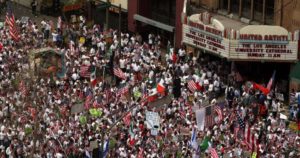
Immigrants Rights mobilization 2006
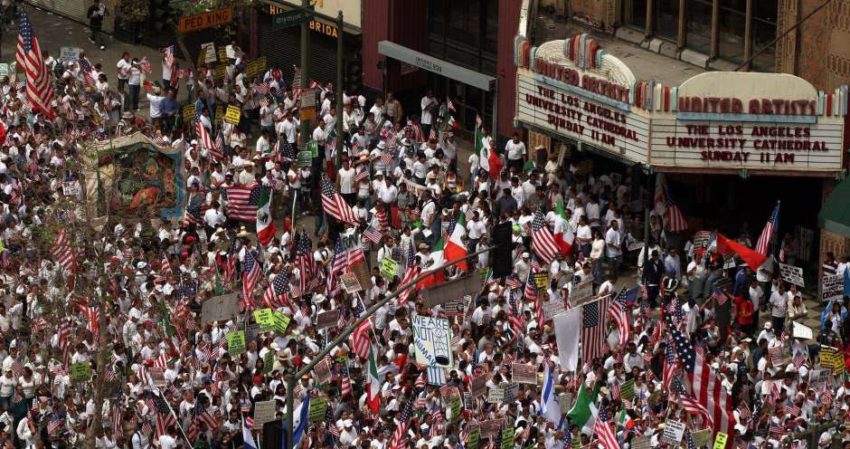
There were hundreds of thousands of people who marched on March 25, 2006 in Los Angeles. / Archive PHOTO: ARCHIVO / JEFF GRACE / IMPREMEDIA
BY: EDITORS
24 MARCH 2017
In 2006 the immigrant community throughout the nation went out massively against the H.R. 4437, the law which was to criminalize all undocumented. Now we live another moment of urgency that requires a similar demonstration of repudiation. The date is 1st. May 1st to denounce and resist against a cruel immigration policy.
Today the situation is much worse than that of 11 years ago.
Before the mobilization was preventive. The purpose was to warn of a threat that appeared to justify the persecution of the undocumented.
Now that threat has become a reality. H.R. 4437 failed, but its designs are being implemented by President Donald Trump more than a decade later.
The president’s campaign rhetoric that relied on anti-immigrant resentment came true with his executive orders. The criteria were extended so that a person could be deported and a freedom of action was given to the agents of the Immigration and Customs Enforcement Agency.
The result is a policy that has terrified the Latino community due to its arbitrariness, its methods and its impact on the family.
In cities and states of our country, it is seen that the fear of ICE ‘s aggressive actions, for example, is reducing the attendance of Latinos at church,. And the drop in the number of reported crimes, such as domestic violence and sexual abuse – for fear of deportation – worries Los Angeles police.
There are arrests they make in the courts, in the vicinity of schools and even the Dreamers. These are outrageous as the accounts of separated families and detainees who are not on the list.
This May 1st is the time to protest against this persecution in a coordinated and effective manner, unlike the disorderly “Day without Immigrants” on 16 February.
International Labor Day represented the migrant worker for a long time in the United States. Now the march has ample support from the labor sector which feels the impact of the Trump administration.
We join this protest. To march without fear, not to buy and to support the immigrants that day even if it is with a sign of support in the window of an automobile.
This is the time to resist with all the legal weapons at our disposal. Let’s use them!
Public Masturbation in Cuba
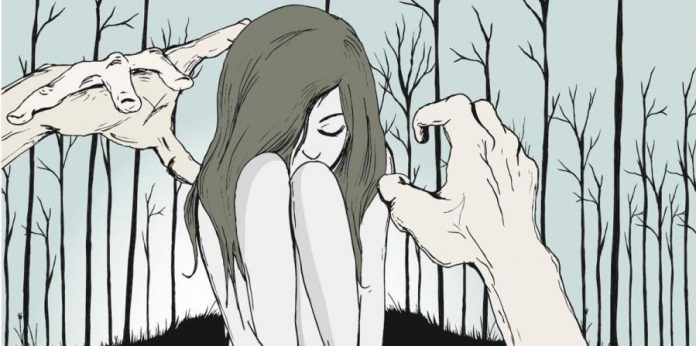

Since when has there been public masturbation in Cuba?
By Roberto Alfonso Lara, February 7, 2017
A CubaNews translation.
Edited by Walter Lippmann.
Elena has a sort of magnet for that. Going home or on her way to work, her eyes seem condemned to stumble upon the same scene. On a park bench, behind the post, hidden in any bush or in some old construction site, she finds the man who masturbates; he looks at her and comes out of his den to tempt her.
She suffers the “fate” of a society where flashers assault public spaces, determined to solve, openly, what they do not achieve on a personal level or in intimacy with their partner. She has knocked on doors several times and presumes that nobody is listening. No one responds when she claims to feel somewhat raped, everyday, on the street.
Women are the main target of this sexual aggression if we consider the common intention of the act or the underlying cultural background: machismo. By showing their genitals and masturbating in public places, men in fact exercise their power against women. But, is this only a gender-related problem?
Despite their sex, there is no choice for those who bump into addicts bent on showing the size of their penises and getting excited in broad daylight. When the person displays toward the stalker an attitude of surprise, panic or simple rejection –almost always going out of their way– it is because the person feels that her or his rights have been invaded and therefore violated.
Although women are the most affected, the problem concerns all citizens and should be addressed from that perspective. This involves a security issue: who can feel safe and protected while sexual flashers are present in the spaces we share?
Movie theaters used to be their favorite site, today they do not waste time in distinctions. Elena finds them everywhere, and sees them approaching her, chasing her, with their dicks in their hands, fully aware of the panic they cause. She is frightened and has come to see me in despair. She doesn’t know what street to take to get home in the evening.
Few people report the crime to the police, it’s true. But… what happens if they do? Do Cuban laws strongly condemn these cases of sexual harassment?
Decree Law 141, on the contravention of public order, sets a fine of 40 pesos to those who “offend modesty or good customs with lewd exhibition”. There is no other provision about it, not even to define the limit or scope of the lewd act. And the small fine, well … it’s almost like paying a cheap license to masturbate out in the street.
Without rigorous measures against those who violate collective coexistence, and go to the extreme of sexually harassing women and disrespecting an elementary norm of civility, every effort to eliminate the problem will suffer the same “fate” as Elena’s when, after knocking on many doors, she feels no one cares about her fear.
Yes, masturbation is a legitimate way of experiencing sexuality, but doing it visibly in open places is detrimental to the human condition. Neither institutions nor society as a whole should remain indifferent to this type of violence.
It is said that the first complaint in Cuba against masturbators in public places was registered in 1881. It is painful to say this: how long will Elena have to wait?
Tribute to the First Women’s Antiaircraft Regiment

- English
- Español
Tribute to the First Women’s Antiaircraft Regiment
March 15, 2009 00:53:09 GMT
A CubaNews translation.
Edited by Walter Lippmann.
At the Museum of the Revolution, the 25 years of existence of this regiment was remembered. The regiment was created by initiative of Vilma Espin, eternal president of the Cuban Women Federation.
The Revolutionary Armed Forces (FAR) in the capital paid tribute to the first anti-aircraft artillery regiment of women, created by initiative of Vilma Espin, eternal president of the Cuban Women Federation (FMC), according to AIN.
During a ceremony at the Museum of the Revolution, the 25 years of existence of this regiment were remembered. Reserve Colonel Mirta Garcia Llorca was in command of this regiment from 1984 to 1991.
After placing a wreath at the eternal flame to the Heroes of the Fatherland at the Granma Memorial, the women shared their experiences and remembered the founding years. The myriad tasks performed on behalf of the FAR and the FMC, particularly during international missions and in Cuba, were also remembered.
The event, chaired by Major General Antonio Enrique Batlle Lusón, Hero of the Republic of Cuba, and by Yolanda Ferrer, secretary general of the women’s organization, was a propitious moment to recount the significance Cuban women have had as part of the Cuban people in uniform.
It also recognized the efforts of the FAR, the UJC, the FMC and the High School Student Federation (FEEM) to comply with the Women’s Voluntary Military Service, a vital link in the incorporation of young girls to the defense of our homeland.
At the end of the ceremony, Brigadier General Ramon Martinez Echevarria, of MINFAR, stressed the merits of these women who stepped forward at a time when the country urgently needed their presence in the Armed Forces and reiterated the altruism and courage with which they faced different missions.
The First Antiaircraft Artillery Regiment of Women was founded on March 8, 1984, and many of its members are still active within the FAR and the MININT, while others are active in different sectors of Cuban society.
Homenaje a Primer Regimiento Antiaéreo Femenino
15 de marzo de 2009 00:53:09 GMT
En el Museo de la Revolución fueron recordados los 25 años de existencia de este órgano armando, que surgió por iniciativa de Vilma Espín, eterna presidenta de la Federación de Mujeres Cubanas
Las Fuerzas Armadas Revolucionarias (FAR) rindieron homenaje en la capital al primer regimiento femenino de artillería antiaérea, una iniciativa impulsada por Vilma Espín, eterna presidenta de la Federación de Mujeres Cubanas (FMC), informó la AIN.
Durante una ceremonia en el Museo de la Revolución fueron recordados los 25 años de existencia de este órgano armando, al frente del cual estuvo desde 1984 hasta 1991 la coronel de la reserva Mirta García Llorca.
Tras colocar una ofrenda floral en la llama eterna a los Héroes de la Patria en el Memorial Granma, las féminas intercambiaron experiencias y rememoraron los años fundacionales y las innumerables tareas cumplidas por encargo de las FAR y la FMC, en particular en misiones internacionalistas y en suelo patrio.
El acto, presidido por el Héroe de la República de Cuba, general de división Antonio Enrique Lusón Batlle, y Yolanda Ferrer, secretaria general de la organización femenina, devino oportuno recuento de lo que ha significado la mujer cubana como parte del pueblo uniformado.
Asimismo, se reconoció el esfuerzo de las FAR, la UJC, la FMC y la Federación de Estudiantes de la Enseñanza Media (FEEM) en el cumplimiento del Servicio Militar Voluntario Femenino, un eslabón imprescindible en la incorporación de las jóvenes a la defensa de la Patria.
Al término de la ceremonia el general de brigada Ramón Martínez Echevarría, del MINFAR, destacó los méritos de estas mujeres que dieron el paso al frente en momentos en que el país urgía de su presencia en las Fuerzas Armadas y reiteró el altruismo y la valentía con que enfrentaron disímiles misiones.
El Primer Regimiento de Artillería Antiaéreo Femenino se fundó el 8 de marzo de 1984, y muchas de sus integrantes se mantienen en activo dentro de las FAR y el MININT y otras en diferentes sectores de la sociedad cubana.
Why does Obama decide 8 days before what he could have decided 8 years ago?
- English
- Español
CUBA-USA: WHY DOES OBAMA DECIDE 8 DAYS BEFORE WHAT HE COULD HAVE DECIDED 8 YEARS AGO?
By Dr. Néstor García Iturbe
January 3, 2017
A CubaNews translation.
Edited by Walter Lippmann.
Each action should carry an analysis. If the action is carried out in the field of foreign policy the analysis should cover different aspects. It is very unlikely that an action in foreign policy has no impact on domestic policy.
Mr. Obama, eight days before finishing his term, modifies the policy of “dry feet” “wet feet,” something he should have done eight years ago, when he undertook the Presidency of the United States. He has really been slow in this matter, as in others.
What are the consequences of maintaining the policy of “dry feet” “wet feet” for eight years?
According to the statistics of the United States Government’s Coast Guard Service, during those eight years about 32,000 people were caught at sea, trying to reach the United States. More than 3,200 people did not reach the US coasts and died at sea. In the fiscal year 2015-2016 the Coast Guard reported having seized at sea 7,358 people from Cuba.
To this figure should be added those who entered illegally by land, mainly along the border with Mexico. This other figure is estimated at about 20,000 people.
In addition to this, a little more than 8,000 health professionals accepted the Plan that allowed them to enter the United States after leaving the mission entrusted to them.
As the policy aimed at stimulating these illegal entrances was that practically all those who could violate immigration controls and become “dry feet” were admitted to the US and were granted under the Cuban Adjustment Act –even if they did not fully qualify under it– the Act cost approximately $680 million dollars annually to US taxpayers. In the eight years that Obama took to eliminate this policy, he spent just over $ 4 billion. Of course, they were not out of his pocket, but they should be added to everything spent on actions against the Cuban Revolution.
Now that Trump is arriving at the White House, this is another of Obama’s maneuvers to leave the scene “hot” and provoke a measure beneficial to Cuba and even the United States, whether maintaining it is considered or not.
The Gestapo Mafia of Miami has already come out against the measure. They consider that it is one of the “favors” that Obama has made to Cuba; a little late, by the way. This removes an important element in their hostile arguments that is precisely to promote the illegal and disorderly emigration of those who “flee from communism”. No matter that some of them die in the attempt: these can also be used for propaganda purposes.
Now the ball is on Trump’s court. Perhaps Obama, unwillingly, solved a problem for him.
Trump has spoken out against illegal immigration: remember the wall, the Muslims, and anyone trying to enter the United States without obtaining the corresponding visa? It does not seem logical that he will complicate something already solved; mainly because it was not his decision, it was Obama’s. This can help him in the analysis that he will make of all the Executive Orders: to leave this one and say that he will only cancel or modify those that harm the United States. This benefits them and is in accordance with the policy that he wishes to follow.
Let’s wait and see what the unpredictable Trump decides.
CUBA.- EU.- ¿PORQUE OBAMA DECIDE 8 DIAS ANTES LO QUE PODÍA HABER DECIDIDO 8 AÑOS ANTES?
Por Dr. Néstor García Iturbe
Cada acción debe llevar un análisis. Si la acción se realiza en el campo de la política exterior el análisis debe cubrir distintos aspectos. Inclusive es poco probable que una acción en política exterior no tenga su repercusión en la política interna.
El señor Obama, ocho días antes de terminar su mandato, modifica la política de “pies secos” “pies mojados”, algo que debía haber realizado hace ocho años, cuando asumió la presidencia de los Estados Unidos. Realmente se ha mostrado lento en este asunto, al igual que en otros.
¿Qué consecuencias ha traído el mantener la política de “pies secos” “pies mojados” durante ocho años?
De acuerdo con las estadísticas del Servicio de Guarda Costas del gobierno de Estados Unidos, durante esos ocho años fueron capturados en el mar, intentando llegar a Estados Unidos, cerca de 32,000 personas, no llegaron a las costas estadounidenses y murieron en el mar un poco más de 3,200 personas. En el año fiscal 2015- 2016 el servicio de Guardacostas informó haber capturado en el mar 7,358 personas procedentes de Cuba.
A esta cifra debe agregarse aquellos que ingresaron ilegalmente por vía terrestre, principalmente por la frontera con México, lo cual se calcula en cerca de 20,000 personas.
Además de esto un poco más de 8,000 profesionales de la salud se acogieron al Plan que les permitió ingresar en Estados Unidos después de haber abandonado la misión que se les había confiado.
Cómo la política seguida para estimular estas entradas ilegales era que prácticamente todos los que podían violar los controles de inmigración y se convertían en “pies secos” se acogían a la Ley de Ajuste Cubano y se les concedía el hacerlo, aunque no calificaran totalmente para eso, la mencionada Ley costaba aproximadamente 680 millones de dólares anuales al contribuyente estadounidense. En los ocho años que Obama se demoró en eliminar esta política, gastó un poco mas de 4,000 millones de dólares. Claro que no eran de su bolsillo, pero que deben sumarse a todo lo gastado en acciones contra la Revolución Cubana.
Cómo Trump está al llegar a la Casa Blanca, esta es otra de las maniobras de Obama para dejarle “caliente” el escenario y provocar que una medida beneficiosa para Cuba y para los propios Estados Unidos, sea analizada si se mantiene o no.
La Mafia Gestapo de Miami ya se pronunció en contra de la medida. Consideran que es uno de los “favores” que Obama le ha hecho a Cuba, un poco tarde, por cierto. Esto les quita un elemento importante en sus argumentaciones hostiles que es precisamente promover la emigración ilegal y desordenada de los que “huyen del comunismo”. No importa que algunos de ellos mueran en el intento, esos también pueden utilizarse para los fines propagandísticos.
Ahora Trump tiene la palabra. Quizás Obama, sin quererlo, le resolvió un problema.
Trump se ha manifestado en contra de la inmigración ilegal, recuerden el muro, los musulmanes y todo aquel que intenta entrar en Estados Unidos sin obtener la visa correspondiente. No parece lógico que algo resuelto lo vuelva a complicar, sobre todo porque no fue su decisión, fue la de Obama y eso puede servirle en el análisis que realizara de todas las Órdenes Ejecutivas, para dejar esta y decir que solamente cancelará o modificará aquellas que perjudican a Estados Unidos. Esta los beneficia y está acorde a la política que él desea seguir.
Esperemos para ver que decide el impredecible Trump.
– Dr. Néstor García Iturbe es editor del boletín electrónico El Heraldo (Cuba) sarahnes@cubarte.cult.cu
“Strange Fruit”, the song that Rebecca Ferguson wants to sing at the Trump ceremony
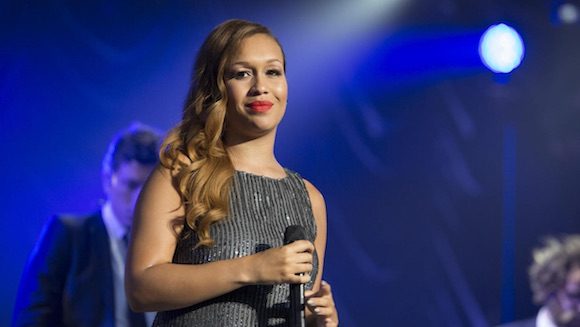
- English
- Español

“Strange Fruit”, the song that Rebecca Ferguson wants to sing at the Trump ceremony
A CubaNews translation.
Edited by Walter Lippmann.

Singing “Strange Fruit” was Rebecca Ferguson’s condition for performing at the inauguration ceremony of Donald Trump, attended by six religious leaders including a Catholic cardinal, a rabbi, a Hispanic clergyman and a woman.
The artist wrote in her Twitter account that she would only accept the invitation of the president-elect “if you allow me to sing” Strange Fruit “a song that has an enormous historical importance, a song that was blacklist of the United States for being too controversial.
A song that speaks to all the black people despised and trampled in the United States. “
This theme was originally performed by Billie Holiday, but the lyrics are a poem by Abel Meeropol inspired by the historical photograph showing the lynching of two African Americans, Thomas Shipp and Abram Smith, in 1930 in downtown Marion, Indiana.

Thomas Shipp and Abram Smith, in 1930 in downtown Marion, Indiana.
Abel Meeropol was a Jewish professor of Russian origin affiliated to the Communist Party of the United States. He saw this photo of the lynchings that, according to his testimony, followed him all day and did not let him sleep. Then he wrote the poem Bitter Fruit, which he published under the pseudonym Lewis Allan in the New York Teacher and the New Masses. Later he wrote music the poem in the song Strange Fruit. Meeropol is also known for having adopted the children of Ethel and Julius Rosenberg, after they were executed in the United States.
The song became famous in the voice of legendary jazz music Billie Holiday in 1939, and then was sung by Nina Simone. Holiday once said that when he first sang “Strange Fruit” at a New York café, she surprised the audience.
“There was not even a clap when I finished,” he wrote later in his autobiography. “Then a lonely person began to applaud nervously. Suddenly everyone applauded.”
Andrea Bocelli, Elton John, Céline Dion, country singer Garth Brooks are among the artists who have turned down the invitation to participate in the January 20 inauguration event. Even Kanye West, who has publicly supported the president-elect, has said no.
In contrast, Beyoncé sang the American anthem four years ago at the reelection ceremony of Barack Obama, Kelly Clarkson and James Taylor acted after the oath. Alicia Keys, Marc Anthony and Brad Paisley were at the official celebration in Washington.
Rebecca Ferguson ends her response to Trump reminding him that “Strange Fruit” is a song that recalls how love is the only thing that will conquer all hatred in this world, so I will gladly accept your invitation and see you in Washington.
The lyrics of Strange fruit has only three deep and mournful stanzas:
Strange Fruit
Southern trees bear a strange fruit,
Blood on the leaves and blood at the root,
Black bodies swinging in the southern breeze,
Strange fruit hanging from the poplar trees.
Pastoral scene of the gallant south,
The bulging eyes and the twisted mouth,
Scent of magnolias, sweet and fresh,
Then the sudden smell of burning flesh.
Here is fruit for the crows to pluck,
For the rain to gather, for the wind to suck,
For the sun to rot, for the trees to drop,
Here is a strange and bitter crop.
Listen to Nina Simone performing “Strange Fruit” with Spanish subtitles
“Fruta extraña”, la canción que quiere cantar Rebecca Ferguson en la ceremonia de Trump
Rebecca Ferguson. Cantar “Strange Fruit” fue la condición de Rebecca Ferguson para actuar en la ceremonia de investidura de Donald Trump, a la que asistirán seis líderes religiosos incluidos un cardenal católico, un rabino, un clérigo hispano y una mujer. La artista escribió en su cuenta de Twitter que solo aceptaría la invitación del presidente electo “si me permites cantar “Strange Fruit” una canción que tiene una enorme importancia histórica, una canción que estuvo en la lista negra de Estados Unidos por ser demasiado polémica. Una canción que habla a todas las personas negras despreciadas y pisoteadas en Estados Unidos”.
https://twitter.com/julianbovis/status/816212016981491712/photo/1
Este tema fue originalmente interpretado por Billie Holiday, pero la letra es un poema de Abel Meeropol inspirado en la histórica fotografía que muestra el linchamiento de dos afroamericanos, Thomas Shipp y Abram Smith, en 1930 en el centro de Marion, Indiana.
Abel Meeropol era un profesor judío de origen ruso afiliado al Partido Comunista de los Estados Unidos. Vio esta foto de los linchamientos que según su testimonio le persiguió durante todo el día y no le dejó dormir. Entonces escribió el poema Bitter Fruit, que publicó bajo el seudónimo de Lewis Allan en la revista New York Teacher y en el diario New Masses. Más tarde musicalizó el poema en la canción Strange Fruit. Meeropol es conocido también por haber sido quien adoptó a los hijos de Ethel y Julius Rosenberg, tras se ejecutados en Estados Unidos.
La canción se hizo famosa en la voz de la legendaria música de jazz Billie Holiday en 1939, y luego cantada por Nina Simone. Holiday dijo una vez que cuando cantó por primera vez “Strange Fruit” en un café de Nueva York, sorprendió al público. “No había ni siquiera un aplauso cuando terminé”, escribió más tarde en su autobiografía. “Entonces una persona solitaria comenzó a aplaudir nerviosamente. De repente todos aplaudieron”. Andrea Bocelli, Elton John, Céline Dion, el cantante country Garth Brooks son algunos de los artistas que han rechazado la invitación de participar en el evento de posesión del próximo 20 de enero. Hasta Kaney West, quien ha apoyado públicamente al presidente electo, dijo que no.
En contraste, Beyoncé cantó el himno de Estados Unidos hace cuatro años en la ceremonia de reelección de Barack Obama, Kelly Clarkson y James Taylor actuaron después del juramento. Alicia Keys, Marc Anthony y Brad Paisley estuvieron durante la celebración oficial en Washington.
Rebecca Ferguson finaliza su respuesta a Trump recordando que “Stranger fruit” “es una canción que recuerda cómo el amor es la única cosa que conquistará todo el odio en este mundo, entonces aceptaré de buena gana su invitación y lo veré en Washington”.
La letra de Strange fruit tiene solo tres estrofas, profundas, dolientes:“De los árboles del sur cuelga una fruta extraña. /Sangre en las hojas, y sangre en la raíz. /Cuerpos negros balanceándose en la brisa sureña. / Extraña fruta cuelga de los álamos./Escena pastoral del valiente sur. / Los ojos saltones y la boca retorcida. / Aroma de las magnolias, dulce y fresco. / Y el repentino olor a carne quemada. Aquí está la fruta para que la arranquen los cuervos. / Para que la lluvia la tome, para que el viento la aspire, para que el sol la pudra, para que los árboles lo dejen caer./ Esta es una extraña y amarga cosecha”.
La letra original en inglés es la siguiente:
Strange Fruit
Southern trees bear a strange fruit,
Blood on the leaves and blood at the root,
Black bodies swinging in the southern breeze,
Strange fruit hanging from the poplar trees.
Pastoral scene of the gallant south,
The bulging eyes and the twisted mouth,
Scent of magnolias, sweet and fresh,
Then the sudden smell of burning flesh.
Here is fruit for the crows to pluck,
For the rain to gather,
for the wind to suck,
For the sun to rot,
for the trees to drop,
Here is a strange and bitter crop.
Time Does Not Devour Redeemers
- English
- Español
Time Does Not Devour Redeemers
Living statue of the strongest metal,
The monsters of gold and silt who could not
Kill you with bullet and poison,
Want time to condemn you to death.
They count your hours, are encouraged by seeing
your beard gone white on your Greek profile;
And on the high summit of serene thinking
The outbreak of your gray hair amuses them.
The peoples, however, give you roses,
poems and songs; more for the dreams
you made come true than for your birthdays.
Because the age of the heroes and geniuses
is not measured by days or years,
But for long centuries and millennia.
Jesús Orta Ruiz, “El Indio Naborí”
(Written in 1996, for Fidel’s 70th Birthday)
A CubaNews translation.
Edited by Walter Lippmann.
El tiempo no devora redentores
Estatua viva del metal más fuerte,
no pudiendo los monstruos de oro y cieno
matarte con la bala y el veneno,
quieren que el tiempo te condene a muerte.
Cuentan tus horas, les anima verte
blanca la barba de perfil heleno;
y en la alta cumbre del pensar sereno
el brote de tus canas les divierte.
Los pueblos, sin embargo, te dan rosas,
poemas y canciones más por cosas
de cumplesueños que de cumpleaños,
pues la edad de los héroes y los genios
no se mide por días ni por años
sino por largos siglos y milenios.
Jesús Orta Ruiz, “El Indio Naborí”
(Escrito en 1996, con motivo de
los 70 años de Fidel)
¨Why I Believe Trump Will Lift the Blockade¨
- English
- Español
Why I Believe Trump Will Lift the Blockade
By Dr. Néstor García Iturbe
A CubaNews translation.
Edited by Walter Lippmann.
November 16, 2016.
A few persons have contacted me regarding the interview that I offered to VOCES DEL MUNDO where I said that, in my view, Donald Trump will lift the commercial, economic and financial blockade that the United States has maintained against Cuba for more than fifty years.
The reasons I put forward for saying this were explained in the interview, but because of a problem, seemingly a time limit in the radio program, they only broadcasted the claim, but not the reasoning behind it, which has created a logical question among all those who read the interview.
CubaNews, edited by Walter Lippmann, was interested in the subject and that is why I write this article. After it is published by CubaNews, I will also publish it in El Heraldo and send it to other recipients, because Walter showed interested in the subject and I consider he should have priority in spreading what I think.
The commercial, economic and financial blockade was imposed hoping it would stifle the Cuban Revolution and at a certain point the Cubans would have to apologize to the United States so they would lift it and we could survive.
None of this has happened; the Cuban Revolution, with difficulties, has continued to live and advance expanding its trade relations with other countries, while the United States has been absent and has therefore lost many commercial and economic opportunities. Had the blockade not existed, they would have participation and now it is other countries that benefit from those opportunities.
The outgoing President Barack Obama has repeatedly raised the futility of the blockade at this point in time and, in addition, has expressed his opinion that it should be lifted. I believe that Obama’s opinion is the reflection of companies and corporations eager to start having commercial relations with Cuba and make profits that the blockade prevents them from obtaining.
In statements made by Obama and the instructions he gave after December 17, 2014 in order to create the best possible conditions for the reestablishment of diplomatic relations with Cuba, he told his team that they should initiate talks with Congress aimed at lifting the blockade on Cuba. Something was done, but with no results.
In recent years, a small number of bills have been presented in the United States Congress aimed at releasing some aspects related to the blockade.
The HR 664 bill, named Freedom to Travel to Cuba Act of 2015, was introduced by representatives Mark Sanford (R-SC 1st.) And James Mc Govern (D-MA 2nd). The bill established the possibility for American citizens to travel freely to Cuba.
This project had 127 co-sponsors: 109 Democrats and 18 Republicans.
The HR 3238 bill, called The Cuba Trade Act of 2015, introduced by representatives Tom Emmer (R-MN 6th) and Cathy Castor (D-Fl 14th), would allow private businesses to trade unrestrictedly with Cuba. This project had 22 co-sponsors: 12 Democrats and 10 Republicans.
Bill HR 3687, titled Cuba Agricultural Export Act, introduced by Representative Eric A. Crawford (R-AR 1st), would allow the use of credits for US agricultural exports to Cuba and also to make investments in private agriculture in Cuba. This project had 38 co-sponsors: 15 Democrats and 23 Republicans.
The interesting thing about these projects was precisely that a number of Democrats and Republicans associated themselves with them, which showed there was a bipartisan interest, although really limited. Notwithstanding all that, it can be said that there are precedents of interest by certain congressmen in the matter.
Now let’s go to Trump. He is a businessman and like many businessmen he recognizes how useful it would be to have the financial, economic and commercial constraints between the two countries disappear, so that all businessmen may establish relationships that will provide profits to their companies. The important thing is not exactly what happened, but what is going to happen.
In his latest statements, he mentioned that he could reverse everything Obama did, because to do so Obama had invoked the powers that the Presidential Order offered him, which now he, as president, has the possibility to overturn. However, Trump also stated that the future of relations between the two countries would be determined by what Raúl Castro and he could agree upon. Perhaps he is planing to travel to Cuba, or to invite Raul to travel to Washington.
I remember my interview several years ago with the president of the American Leaf Tobbaco Company, owner of the Partagas patent in the United States. The Cuban Revolution had nationalized the lands where they planted tobacco, the warehouses and the factory.
This man’s proposal was as follows. Cuba would give them the exclusive distribution of the Partagas cigars in the United States for five years and they would not make any claim for the nationalized goods. At the end of the five years, the patent became the property of Cuba. If Cuba considered it convenient, they would continue to distribute Partagas in the United States, or Cuba would take charge of the matter.
According to the executive, in those five years they would earn far more money than the worth of what had been nationalized, and they would also recover a good part of the losses caused by all the time that, because of the blockade, they had not been able to sell a single Partagas cigar in the U.S.
That’s the way a business man thinks. Something similar was offered to me by other companies that had been nationalized in Cuba, whose interest was to start trading as soon as possible and stop losing profits, or seeing how opportunities were taken up by different countries such as Russia, China, France, Spain and others. “Time is Money” and if they continued to waste time, they would continue to lose money.
There are companies that are really eager to be able to trade with Cuba and the blockade is the only thing that prevents it.
The trade of cigars of different brands could reach about 900 million dollars.
The Havana Club Rum trade could represent about 500 million dollars.
Tourism would also be an important source of business. One million Americans could travel to Cuba annually. They would spend an average of 400 dollars in air fares, according to the place of provenance; that would mean 400 million dollars for the transport companies. If each traveller stays one week in Cuba, they would have to pay a tourist package of approximately 550 dollars, which would represent 550 million dollars for the US tourist agencies.
On the aspect of golf courses, as we know, Trump companies had been exploring possibilities. Since the companies are now operated by his sons, it would come as no surprise that among some of the groups of businessmen who quite frequently visit Cuba, an executive of his sons’ companies might be present.
The trade of medicines and vaccines can also be an important area to consider. The price fixed for medicines in Cuba is relatively low, especially lower than the ones set for the same drugs when produced in the United States, where labor is much more expensive. The treatments in the United States are exorbitant, and the difference between the purchase price in Cuba and what the patient has to pay in the United States for using those medicines can represent an income of hundreds of millions of dollars for US clinics and laboratories.
Cuban nickel, important for US industry, is being traded in the month of November at $ 11,000 a ton. If out of our production, quite committed to other countries that are standard buyers, we would be kind enough to sell 1,000 tons to the United States, this operation would total 11 million dollars.
The lifting of the blockade could lead to joint exploration and exploitation between US and Cuban companies in the maritime economic zone of Cuba, where there are oil deposits and where the US presence could guarantee the application of techniques that allow exploitation with high standards of security. How many millions of dollars would this operation involve? It is a little risky to calculate, but it would run in the hundreds.
The free zone of the port of Mariel could also be of great interest for American companies. This port is conveniently located for ships departing from Florida, Louisiana, Texas and other cities with coasts to the Gulf of Mexico. It is a modern port, equipped for the reception of containers and ample facilities, in whose free zone, besides having the possibility to establish industries, the American companies could count on warehouses whose operation and maintenance would be much cheaper than what they could get in their country. These warehouses would not only serve to supply to Cuba the articles that it needs to buy, but also to distribute from those warehouses to clients in Central America and the Caribbean.
There are other products that American companies have shown interest in; as there are many products made in the United States that Cuba is interested in, including agricultural products and equipment, medicines, equipment of different types, tools and machine tools, maritime, land and air transport equipment, supplies for the tourism industry, computer systems and software and others.
The commercial exchange between the two countries can reach a high level, benefitting from the proximity between both. It does not require high costs of transportation or storage in large quantities, since the source of supply is only a few hours by plane and two or three days by sea, if the warehouses are not placed in Cuba.
The US economic situation, with a high commercial and financial deficit, the 94 million people that are outside the labor force and the official –under calculated–unemployment rate of 4.9 percent, Trump’s alleged policy of canceling Free Trade Agreements, and the return to the United States of jobs that were sent to other countries requires liberalized trade and a market that will help to improve to some extent the internal situation in the US. Trade, economic and financial relations with Cuba could be of assistance in that regard.
Some have tried to argue that Donald Trump is indebted to the Cuban community for having won Florida. Those who say that have not bothered to analyze how the Cuban American vote went in those elections. There Hillary Clinton received the majority of the votes of that community, so there is no debt whatsoever, and Trump can feel free to make the decisions on Cuba that he deems more convenient. Besides that, according to surveys, about 65 percent of Cubans living in Florida favor an improvement of relations with Cuba.
The lifting of the blockade will favor the international image of the United States, show the world that a more rational policy is being developed and also eliminate the possibility that next year, at the United Nations General Assembly, Cuba will again submit the resolution on the blockade. Trump could even argue that this action responds to compliance with a resolution taken at the last meeting of the body. In addition, the action would benefit US relations with Latin America and other countries, which feel limited in some way to carry out operations with Cuba for fear of being fined by OFAC.
This action on the part of the United States requires not only the wishes of Trump, but also that Congress approves what he proposes. A Congress such as the one that will work with Trump, where both chambers will have a Republican majority, offers very favorable conditions for an agreement on the lifting of the blockade against Cuba, regardless of some opposing voices that will be heard in the congressional floor.
The lifting of the blockade may be one more among the surprises that Trump has already given us.
CUBA – EU
PORQUÉ CONSIDERO QUE TRUMP LEVANTARÁ EL BLOQUEO
Por Dr. Néstor García Iturbe
CUBA.- EU.- PORQUÉ CONSIDERO QUE TRUMP LEVANTARÁ EL BLOQUEO.
GRUPO EL HERALDO sarahnes@cubarte.cult.cu
“LA SENSACIÓN DE CUMPLIR CON EL MÁS SAGRADO DE LOS DEBERES,
LUCHAR CONTRA EL IMPERIALISMO DONDEQUIERA QUE ESTÉ”
CHE
Dr. Néstor García Iturbe
16 de noviembre de 2016.
Algunas personas se han comunicado conmigo por la entrevista que ofrecía a VOCES DEL MUNDO donde expresé, que de acuerdo con mi criterio. Donald Trump levantará el Bloqueo comercial, económico y financiero que Estados Unidos hace más de cincuenta años mantiene contra Cuba.
Las razones que yo expuse para decir esto se explicaron en la entrevista, pero por un problema, al parecer de tiempo en el programa de radio, solamente difundieron la afirmación, pero no el razonamiento para hacerla, lo cual ha creado una lógica interrogante entre todos los que leyeron la entrevista.
CubaNews, editado por Walter Lippman, se interesó en el asunto y es por eso que hago este artículo, el cual después de ser publicado en CubaNews, lo publicaré en El Heraldo y lo enviaré a otros destinatarios, pues Walter se interesó por el asunto y considero debe tener prioridad en divulgar lo que pienso.
El Bloqueo comercial, económico y financiero fue impuesto con la esperanza de que el mismo ahogara la Revolución Cubana y en un momento determinado los cubanos tuvieran que pedir perdón a Estados Unidos para que lo quitaran y pudiéramos subsistir.
Nada de eso ha sucedido , la Revolución Cubana, con dificultades, ha continuado avanzando y viviendo, ampliando sus relaciones comerciales con otros países, en las que Estados Unidos ha estado ausente y por lo tanto, ha perdido muchas oportunidades comerciales y económicas, que de no existir el bloqueo, tendrían participación en las mismas y ahora son otros países los que sacan provecho de estas.
En repetidas oportunidades, el presidente saliente, Barack Obama ha planteado lo inútil que en estos momento resulta el bloqueo, además de expresar que en su opinión, el mismo debía levantarse. Considero que esta opinión de Obama es el reflejo de empresas y corporaciones deseosas de comenzar a tener relaciones comerciales con Cuba y recibir utilidades que el bloqueo le impide obtener.
En las declaraciones realizadas por Obama y las instrucciones que impartió después del 17 de diciembre del 2014 con el fin de crear las mejores condiciones posibles para el restablecimiento de relaciones diplomáticas con Cuba, planteó a su equipo, que debía iniciar conversaciones con el Congreso encaminadas al levantamiento del bloqueo a Cuba. Algo se hizo, pero sin resultados.
En los últimos años, se han presentado en el Congreso de Estados Unidos un reducido número de proyectos de ley encaminados a liberar algunos aspectos relacionados con el bloqueo.
El proyecto de ley HR 664, nombrado Freedom to Travel to Cuba Act of 2015, fue introducido por los representantes Mark Sanford (R-SC 1st.) y James Mc Govern (D-MA 2nd). El mismo establecía la posibilidad de que los ciudadanos estadounidenses pudieran viajar libremente a Cuba.
Este proyecto tenía 127 co-patrocinadores, 109 demócratas y 18 republicanos.
El proyecto de ley HR 3238, denominado The Cuba Trade Act of 2015, introducido por los representantes Tom Emmer (R-MN 6th) y el representante Cathy Castor (D-Fl 14th), permitiría a los negocios privados comerciar sin restricciones con Cuba. Este proyecto tenía 22 co-patrocinadores, 12 demócratas y 10 republicanos.
El proyecto de ley HR 3687, titulado Cuba Agricultural Export Act, introducido por el representante Eric A. Crawford (R-AR 1st), permitiría el utilizar créditos en las exportaciones agrícolas de Estados Unidos a Cuba y además el realizar inversiones en la agricultura privada en Cuba. Este proyecto tenía 38 co-patrocinadores, de ellos 15 demócratas y 23 republicanos.
Lo interesante de estos proyectos, era precisamente, que un número de demócratas y republicanos se vincularon a los mismos, por lo que existió un interés bipartidista en ellos, aunque realmente limitado. No obstante todo eso, puede decirse que existen antecedentes de interés de ciertos congresistas por el asunto.
Ahora vamos a Trump. El es un hombre de negocio y como muchos hombres de negocio reconoce el beneficio de que las limitaciones financieras, económicas y comerciales entre los dos países desaparezcan, para que todos los negociantes puedan establecer relaciones que le brinde utilidades a sus empresas. Lo importante no es exactamente lo que sucedió, sino lo que va a suceder.
En sus últimas declaraciones hizo referencia a que podría revertir todo lo realizado por Obama, pues este, para hacerlo, se había amparado en las potestades que le ofrecía la Orden Presidencial, lo cual él, como presidente, tiene la posibilidad de anular. Sin embargo, planteó también que el futuro de las relaciones entre ambos países estaría determinado en que Raúl Castro y él pudiera ponerse de acuerdo. Quizás es que piensa viajar a Cuba, o invitar a Raúl para que viaje a Washington.
Recuerdo mi entrevista, hace varios años, con el presidente de la American Leaf Tobbaco Company, propietaria de la patente Partagas en Estados Unidos. La Revolución Cubana le había nacionalizado las tierras donde sembraban el tabaco, los almacenes y la fábrica.
La propuesta de este señor era la siguiente. Cuba le daba la exclusiva de la distribución de los puros Partagas en Estados Unidos por cinco años y ellos no harían reclamación alguna por los bienes nacionalizados. Al final de los cinco años, la patente pasaba a ser propiedad de Cuba. Si Cuba lo consideraba conveniente ellos continuaban distribuyendo Partagas en Estados Unidos o Cuba se hacía cargo del asunto.
Según el ejecutivo , en esos cinco años ganarían mucho más dinero que lo que valía lo nacionalizado y además, recuperaría una buena parte de las pérdidas, que les había representado, todo el tiempo que debido al bloqueo no habían podido vender ni un puro Partagas en Estados Unidos.
Esa es la forma de pensar de un hombre de negocio. Algo parecido me fue ofrecido por otras empresas que habían sido nacionalizadas en Cuba, cuyo interés era iniciar cuanto antes el intercambio comercial y no continuar perdiendo utilidades, ni que las oportunidades fueran aprovechadas por distintos países, como los rusos, chinos, francés, españoles y otros. “Time is Money” y si continuaban perdiendo tiempo, iban a seguir perdiendo dinero.
Existen empresas que están realmente deseosas de poder comerciar con Cuba y el bloqueo es lo único que se lo impide.
El comercio de puros, de distintas marcas, pudiera llegar a cerca de 900 millones de dólares.
El comercio del Ron Havana Club pudiera representar cerca de 500 millones de dólares.
El turismo sería también una fuente importante de negocio. Pudieran viajar a Cuba anualmente 1 millón de estadounidenses, que gastarían en pasaje internacional un promedio de 400 dólares, según el lugar de procedencia, eso serían 400 millones de dólares para las empresas transportadoras. Si cada uno de ellos realiza una estancia de una semana en Cuba, tendrían que pagar un paquete turístico de aproximadamente 550 dólares, lo cual importa 550 millones de dólares que recibirán las agencias turísticas estadounidenses.
Sobre este aspecto y según conocemos, relacionado con los campos de Golf, ya las empresas de Trump estuvieron explorando posibilidades. Como ahora las empresas las operan sus hijos, no debe sorprendernos que en algún grupo de hombres de negocio que visite Cuba, de los que viajan con bastante frecuencia, se incluya un ejecutivo de las empresas de sus hijos.
El comercio de medicinas y vacunas puede ser también un aspecto importante a considerar. El precio que se le fija a la medicina en Cuba es relativamente bajo, sobre todo más bajo que el que se obtiene cuando se produce el mismo medicamento en Estados Unidos, donde la mano de obra es mucho más cara. Los tratamientos que se realizan en Estados Unidos tienen precios exorbitantes y la diferencia entre el precio de compra en Cuba y lo que tenga que pagar el paciente en Estados Unidos por la utilización de estas medicinas, puede representar un ingreso de cientos de millones de dólares para las clínicas y laboratorios estadounidenses.
El níquel cubano, importante para la industria estadounidense, se está cotizando en el mes de noviembre a 11,000 dólares la tonelada. Si de nuestra producción, bastante comprometida con otros países que son compradores habituales, hiciéramos el favor de vender a Estados Unidos 1,000 toneladas, serían 11 millones de dólares.
El levantamiento del bloqueo pudiera originar la exploración y explotación conjunta entre empresas estadounidenses y empresas cubanas de la zona económica marítima de Cuba, donde se plantea existen yacimientos de petróleo y donde la presencia estadounidense pudiera garantizar la aplicación de técnicas que permitan la explotación con altas medidas de seguridad. ¿Cuántos millones de dólares implicaría esta operación? Es un poco aventurado calcularlo, pero serían cientos.
La zona franca del puerto de Mariel pudiera ser también de gran interés para empresas estadounidense. Este puerto esta convenientemente situado para barcos que salgan de la Florida, Luisiana, Texas y otras ciudades cuyas costas se encuentran en el Gofo de México. Es un puerto moderno, habilitado para la recepción de contenedores y de amplias facilidades, en cuya zona franca, además de tener la posibilidad de establecer industrias, las empresas estadounidenses pudieran contar con almacenes cuya operación y mantenimiento sería mucho más barata que los que pudieran tener en su país. Estos almacenes no solo servirían para suministrar a Cuba los artículos que requiera comprar, sino también para desde esos almacenes distribuir hacia clientes de Centro América y el Caribe.
Existen otros productos sobre los que empresas estadounidenses han mostrado interés, al igual que existen infinidad de productos fabricados en Estados Unidos sobre los que Cuba está interesada, dentro de ellos productos y equipos agrícolas, medicinas, equipos de distintos tipos, herramientas y máquinas herramientas, equipos de transporte marítimo, terrestre y aéreo, suministros para la industria turística, sistemas y programas de computación y otros.
El intercambio comercial entre los dos países puede alcanzar un alto nivel, beneficiado por la cercanía existente entre ambos, que no requiere altos costos de transportación ni almacenaje en grandes cantidades, pues la fuente de suministro se encuentra a pocas horas en avión y dos o tres días en barco, si es que los almacenes no se sitúan en Cuba.
La situación económica de Estados Unidos, con un alto déficit Comercial y Financiero, los 94 millones de personas que se encuentran fuera de la fuerza laboral y por lo que oficialmente se dice que el desempleo es de un 4.9 por ciento, lo cual no es cierto, la política planteada por Trump de cancelar los Acuerdos de Libre Comercio y el regreso a Estados Unidos de puestos de trabajo que se enviaron a otros países, requiere un comercio liberado y un mercado que ayude en cierta medida al mejoramiento de la situación interna de Estados Unidos. Las relaciones comerciales, económicas y financieras con Cuba pudieran ayudar en algo a ese propósito.
Algunos han tratado de plantear que Donald Trump está en deuda con la comunidad cubana por haber ganado La Florida. Los que dicen eso no se han molestado en analizar cómo se manifestó el voto cubano americano en dichas elecciones, donde Hillary Clinton recibió la mayoría de los votos de dicha comunidad, por lo que no hay deuda alguna y Trump puede sentirse libre de tomar las decisiones sobre Cuba que considere más conveniente, además de que, según encuestas realizada, cerca del 65 por ciento de los cubanos residentes en La Florida favorecen un mejoramiento de las relaciones con Cuba.
El levantamiento del bloqueo favorecerá la imagen internacional de Estados Unidos, mostrará al mundo que se está desarrollando una política más racional y además eliminará las posibilidades de que el próximo año, en la Asamblea General de las Naciones Unidas, Cuba presente nuevamente la resolución sobre el bloqueo. Pudiera Trump inclusive plantear que esa acción responde al cumplimiento de una resolución tomada en la última asamblea del organismo. Además de eso, la acción beneficiaria las relaciones de Estados Unidos con América Latina y otro países, que se sienten limitados en cierta manera para realizar operaciones con Cuba por temor a ser multados por la OFAC.
Esta acción , por parte de Estados Unidos, requiere no solamente el deseo de Trump, sino además que el Congreso apruebe lo que el mismo proponga. Un Congreso como el que trabajará con Trump, donde ambas cámaras tendrán mayoría republicana, presenta condiciones muy favorables para acordar el levantamiento del bloqueo a Cuba, independientemente de que algunas voces de oponentes se escuchen en el emiciclo congresional.
El levantamiento del bloqueo, puede ser otra, dentro de las sorpresas que nos ha dado Trump.
You must be logged in to post a comment.