
The paparazzi and their share of the blame


The paparazzi and their share of the blame
By Rolando Perez Betancourt
2009
A CubaNews translation.
Edited by Walter Lippmann.
For several days now, the international press that covers show business and their scandals was making a lot of fuss over millionaire Paris Hilton going to Europe to “meet” soccer star Cristiano Ronaldo, best man in the courts today.
FARRAH FAWCETT
Would they begin an affair? Can the Portuguese escape the seduction of this romance collector? These were some of the expectations around the young star, who was recently acquired by the Real Madrid at an unpronounceable price, and the so called blond of gold. Her merits list is larger, more because she comes from a rich family and for the scandals she never stops creating, than for her performances as actress, model and singer.
Everything seems to indicate that the boy saw her for some minutes, smiled courteously and continued on his way to training. The tall queen of the media, slighted, declared that he had looked “somewhat feminine.”
Soon after, Cristiano Ronaldo was again in the spotlight, not because he is a sports star, but for kicking the car of a paparazzo that was following him on the streets of Lisbon. The soccer star explained in a press release that up to that moment, he had put up with weeks of harassment by sheer self control. But, the image hunter had not taken into consideration that his victim was traveling with his mother. And, one doesn’t disrespect someone’s mother! Therefore, if such a situation repeated itself, he would probably react in the same way.
The almost coincidental deaths of Michael Jackson and actress Farrah Fawcett have put the topic of the paparazzi again on the table. And in passing, the fatal accident of princess Diana of Wales while escaping from a group of them in Paris is also remembered.
Jackson was constantly harassed in his intimacy and Farah Fawcett, who was a cancer victim, left a bitter testimony, days before her demise, accusing the press and the paparazzi of being decisive in the deterioration of her health. They took photographs of her in a wheelchair showing her fragile and haggard. “I asked them to please leave me to fight my illness alone, but they never heard me, they harassed me, they wanted to be beside me every step till the end and it is already known that cancer feeds on stress.”
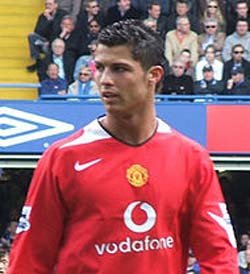 CHRISTIANO RONALDO
Technological development –digital cameras and Internet for quick transmission—have made paparazzi proliferate and the competition is ferocious. Some of them are employed and some are independent. And, sometimes they are the ones who pay the so called “stars brokers”, who detect what public figures are doing and locate them. Then the paparazzi speed off by motorcycle, car or airplane to wherever they are. Their objectives are very specific following a unique and unalterable concept: all embarrassing situations are profitable! It doesn’t matter if they are infidelities, evident or imagined, accidents, carelessness of a physical nature (poor Britney Spears and others), being nude in the high seas or in restricted areas, and, most of all, sexual scenes.
In extreme situations, when the intrusion is of such proportion that it defies human understanding, almost all reproaches are usually made to the paparazzi and people forget that –although guilty– they are part of a mechanism that starts higher up. It begins where the owners of big businesses, generally printed media competing with each other, print just about anything “weird” about show business stars.
These are stars that they frequently help manufacture and then go after them and destroy them. All this on behalf of a reader –equally manufactured–that, without realizing he is being manipulated, pays to see what lies behind the curtains of the famous.
And of from there, the paparazzi take their share (of the blame).
The tax that is not always paid
The tax that is not always paid
An approach to a reality that some ignore and others infringe
Author: Pastor Batista Valdes
A CubaNews translation.
Edited by Walter Lippmann.
LAS TUNAS. – If everybody knew that for each peso of salary that a company pays a worker, it has to pay the wtate 25 cents tax for the use of the work force (besides the 12,5 cents for social security) maybe more people would be more conscious of the need to use every minute of their labor day correctly.
BESIDES AIMING AT TRIBUTARY DISCIPLINE, THIS TAX SHOULD ENDOURAGE A MORE EFFICIENT USE OF THE WORK FORCE.
But, for many years there has been little knowledge of ta law and an absence of a tax culture. This is true not only for the general population but also of managers of productive and service companies; so much so that many people ask themselves, taxes? What is that?
Specialists from the provincial branch of the Finances and Prices Ministry and from the National Office of Tributary Administration (ONAT) explain that this obligation, which is instituted not only in Cuba, applies to all natural and juridical persons, Cuban or foreign, that have employees, and is calculated from the wages, salaries, bonuses and other payments given to those workers (Law No. 73 of the tributary system, 4-8-1994, chapter X).
Modifications introduced in 2006 to Resolution 240/2002 included budget units in the list of tax payers (they had been excluded until then). Credit and Service Cooperatives (CCS) and state agricultural units were temporarily excluded if the personnel they hire are working directly in agricultural production or in woodlands.
Stated in these terms, there should be no problems in its enforcement. On the other hand, reality doesn’t always live up to expectations.
Audits carried out in the county last year by ONAT supervisors revealed irregularities amounting to 2,170,400 pesos, for the most part concentrated on 12 entities of the sugar industry, 23 entities subordinated to local government and ten to the agriculture ministry. From January to May (2009) irregularities amounted to more than 900 000 pesos.
One wonders: If those audits reviewed only part of the possible universe, how much money is not being paid in the territory and what are the consequences for national economy? Possibly, nobody can say.
WHO’S PAYING FOR THIS?
Supervisor Pedro Quesada thinks one thing is clear: if the tax is not paid the law stipulates a fine. But, where will the money come from to pay that fine?
The budget does not include these types of expenses, therefore the situation is “solved” by diminishing the entity’s efficiency or its budget, and this causes serious damage to our country.
“We lack culture – says Milaida Aerie, sub-director of Finances and Prices -, maybe we need more knowledge, more popularization, and more seminars. But, we also need to be stricter. If whoever is responsible for the irregularity had to pay the fine from his/her own pocket, the situation would be different. But in the end it is Liborio (the State) who pays for the broken china.”
Not all managers act like the one in the Milk Basin Company.
Fe Esperanza Álvarez, of that company says, “When we finish calculating the payrolls, we calculate the tax, prepare it quickly and deposit it in the Bank. This happens month after month. I won’t deny that at some point we had difficulties with some of our units, but they are already solved. This year we only have two CCS and a Cooperative of Agricultural Production (CPA) in trouble, not for unpaid taxes, but for old debts.”
SHORT RECKONINGS
A timely word can solve future problems. “We are not inflexible – said Velia Proll Gamboa, ONAT sub-director in the municipality -; if a taxpayer is in a difficult situation and requests a postponement, we study the case, verify with the bank, see the bank statements and if the conditions are justified, authorize the postponement.”
In fact, entities like those of the agriculture (CCS, CPA, Basic Units of Cooperative Production) have received credit and special treatment since 2005, because of the havoc caused by many years of drought (first) and then the lashing of hurricanes later. This doesn’t mean that they have been relieved from responsibilities or obligations with the revenue.
What is unacceptable is that, due to negligence, the taxes go unpaid or units are late in making bank deposits. For example, if the deposit the CCS have to make are late, this is not the responsibility of those who work directly in the fields, but of those who are part of the managing board. Although here, this is not a serious problem, it can have repercussions in other territories.
Many, as Alberto González, of the provincial delegation of the agricultural ministry, recognize that the information and conferences the Tributary Administration Office gives to the economic personnel [of the units] is very valuable. They also value the installation of the program Sentry, designed to remind personnel that the tax needs to be paid; several days before the due date a reminder pops up every time the computer is activated.
Regrettably, some do not value these alternatives, others wait until they are ‘caught napping’” and there are still others who “pull faces” if the press points them out for not paying or for being morose. But, who “pulls faces” for the millions of pesos that don’t come in, for the loss it represents for the nation and all its inhabitants?
One needs to ponder about this, especially when a company is about to violate its tributary obligations, or when managers decide to hire more workers that will increase the work force tax, without having efficiently used the capabilities of those who have conformed its payroll until that instant.
Moviemaking not spared by economic crisis

Moviemaking not spared by economic crisis
By José Luis Estrada Betancourt
E-mail: joselestrada@jrebelde.cip.cu
May 26, 2009 – 00:45:44 GMT
A CubaNews translation.
Edited by Walter Lippmann.
 Even Hollywood shoots with caution given the undeniable problems to get loans, the fear of recession and the little confidence in Wall Street.
Such a highly topical matter as the world economic and financial crisis, whose effects we feel in life’s every sphere, has not gone unnoticed by the seekers of ideas for possible plots that might become box-office hits. In fact, the sexagenarian Michael Douglas will once again be directed by the renowned Oliver Stone to deliver a sequel to Wall Street (1987), where he made an Oscar-winning portrayal of Gordon Gekko, a powerful, roguish tycoon who became filthily rich as a stock market speculator.
Wall Street 2 unfolds against the ideal backdrop of today’s disturbing crisis, which will provide the context to throw light on the same world of greed and corruption behind the upcoming The international, starring Clive Owen (as Louis Salinger) and Naomi Watts (as Eleanor Whitman).
Based on screenwriter Eric Warren Singer’s script, the film follows an Interpol agent and an assistant district attorney determined to disclose the shady deals of a very powerful bank turned expert on illegal activities to fund terrorism and war.
Director Tom Tykwer speaks:”If the story seems to be ripped from the headlines, it’s because the headlines have shown that the banks control all aspects of our lives. The mess we’re in now started when the banks took advantage of people and encouraged them to live beyond their means ‘.
 A similar concern has led the controversial and always unerring director of Farenheit 9/11 and Sicko to revisit a subject he had already brought to the fore in 1989 with Roger and Me, when he dug for the reasons why General Motors closed several auto plants in Michigan. A decade later, Michael Moore strikes again, but unlike his fellow filmmakers, with a documentary film, his favorite genre.
As usual, Moore decided to make inquiries into the root cause of the economic chaos lashing against our planet. To that end, he used his webpage to urge a few brave people who work on Wall Street or in the financial industry to come forward and share with me what they know», and adding: «Be a hero and help me expose the biggest swindle in American history”.
To the author of Oscar-winning Bowling for Columbine (2003) it is plain that “the wealthy, at some point, decided they didn’t have enough wealth. They wanted more… a lot more. So they systematically set about to fleece the American people out of their hard-earned money. Now, why would they do this? That’s what I seek to discover in this movie”, he explains.
As we wait for the famous filmmaker to delve into this issue, the economic and financial crisis keeps lashing at the entertainment industry, and of course, cinema is not an exception.
No getting out of this one
A most noticeable effect of this crisis, at least to those who are all gung-ho on whatever celebrity walks down the red carpet, is the lack of glamour in the world’s greatest movie festivals, an extravaganza the average mortal won’t give two hoots about but certainly a sign of how drastic the limitations have got to be, even in Cannes, one of the industry’s two biggest markets. Credit lines have decreased so much worldwide that smaller industries are no longer able to attract a sizeable audience –as it happens to Cuba and most independent film companies– to these contests, also affected by a reduction in the number of sales contract signed for the movies, TV, DVD and their by-products. Since the to-ing and fro-ing of 35-mm film has become so expensive, from now on it will be harder for filmmakers and actors to attend the premieres of their motion pictures, and more DVD releases are likely to hit the stalls.
Things have reached the point that corporate Hollywood, with plenty of stakes in various companies, have turned more conservative and are even having second thoughts about paying the hair-raising salaries their stars pocket –like the 20 million dollars Jim Carrey made for The Cable Guy, in the end a real turnoff– or keeping the affluent lifestyle they demand while on set, say, private jets close at hand.
Now the studios are “walking a tightrope”, what with the undeniable difficulties to get credits, the fear of recession, and the little confidence they have in Wall Street, which explains why more than a few finished movies ended up on ice until the thunderclouds get away –including eagerly awaited titles like the latest Harry Potter installment– often because of a budget too low to cover the hundreds of millions of dollars needed for marketing and advertising campaigns alone.
A trump card?
The DVD divisions seem to be the only ones expected to “gain” something from this mess, because people choose to watch films at home rather than pay for a theater ticket –as an average, 3.50 dollars in Mexico, and over 4.50 in Brazil and Chile. Facts: audience ratings fell 10% in Asia, 14% in the United States, and 1% in the European Union (figures for the end of 2008 have it that more than 9 million people stopped going to the movies compared with the previous year, which meant the closure of 39 theaters).
Nonetheless, filmmakers such as the Argentinean Luis Puenzo (The Official Story, Old Gringo) believe the economic crisis “may blaze a trail that the less powerful countries can use to disseminate their motion pictures more. Despite the hard times worldwide cinema is going through, shaking the system a little bit always leaves gaps through which we can slip, used as we are to dealing with lower costs of production than the big Hollywood companies. My generation was born in mid-crisis and is trained to make films regardless of the financial ups and downs”.
Life has proved Puenzo right up to a point, but the crux of the matter remains that the «peripheral» industries can truly make movies, taking into account that the studios have been compelled to make budget cuts and put off some productions for next year, as they have less money for distribution.
For instance, that’s the case of the Cuban Film Institute (ICAIC), which was forced to postpone the shooting of feature films that were almost ready to begin after two years of a steady pace that gave us movies like Los dioses rotos, El cuerno de la abundancia, Omertá, Ciudad en rojo and La anunciación.
Some documentary and full-length films are almost ready to hit the big screen, namely Esteban Insausti’s Larga distancia; El ojo del canario, Fernando Pérez’s movie about our Apostle José Martí; Juan Carlos Cremata’s El premio flaco; and Daniel Díaz’s Lisanka. Yet, we’ll have to slow down.
For the time being, the moviegoers’ greatest hope is that only those films supported by good scripts will get the go-ahead and the budget they need, at least while the crisis still goes on.
Auto-eroticism in both directions
Autoeroticism in both directions
Masturbation is born from a longing to know one’s own body. This practice
can begin at any age, but not doing it is also normal.
By digital@jrebelde.cip.cu
A CubaNews translation.
Edited by Walter Lippmann.
From early childhood we all explore our genitals to try to understand how they are, why they are there and why they are different in size and shape from those of others, whether they are close adults or other boys and girls.
Likewise, we examined the rest of our bodies, but to nobody does it seem odd that a baby touches its face or bites the arms of another child, whereas a tiny hand lowering with insistence toward the vulva or penis –their own or another’s– always generates a certain preoccupation.
Like most animals, human beings exhibit an obvious sexual di–morphism, the name given to the unequal appearance (external and internal) among individuals of the same species according to their biological sex.
Among humans that difference is just 15 per cent, and during childhood it is mostly perceptible in the genital area. Inasmuch as those parts are “coincidentally” the ones that the family most insists on covering, it is natural that children associate that minimal difference with the entire accumulation of roles and exclusions that signifies being reared as a boy or a girl in all past and present societies.
The typical curiosity of that age leads them to focus their attention on such attributes and not miss any opportunity to tune into differences between females and males, and in passing, to find out if they respond equally to touch, which in itself is pleasant.
Over the years, they understand that adults do not like such exploratory practices, and since there is so much to learn and master in this world, those doubts are left for later, until they awaken in an alluvium of hormones that makes it urgent to comprehend what is happening to them, why those “little touches” are so enjoyable and if they have some relation to the intimate secrets of mom and dad.
That is one of the challenges for which many families never believe they are well–prepared. Clearly, we all passed through that stage, but in confronting the masturbation practices of adolescence, sometimes culture weighs more understanding one’s prejudices, myths and inherited fears– than the memory of one’s own experience.
Incredibly, parental reactions range from the man who tries to teach his son to “launch” fortune afar, to the mother who knocks insistently on the bathroom door if the boy lingers a lot. There’s also those humiliating smiles of mischief at any attempt for pubescent privacy, so it is left clear that he only wants to rest, to read or to listen to music.
When it comes to girls, the subject is much more harsh. Still, there are few families which assimilate female masturbation as a path to self–recognition, a useful activity to delay the onset of coital relations –and therefore the risks of any sexually transmitted diseases (STDs) or an unplanned pregnancy– in addition to a valuable exercise to prevent anorgasmia and to learn to give more value to individual pleasure.
Autoeroticism is born from the longing to know one’s own body and its reactions, explains the Spanish neurologist Nolasc Acarín in his book, El Cerebro del Rey…, edited by the Scientific–Technical seal for the current Book Fair.
Although in both sexes explicit masturbation arrives with adolescence, in boys, it is more precocious and sometimes takes somewhat of a “sport” direction, while in girls, it requires a higher degree of fantasy and often appears after several endeavors of sexual exchange with other people.
In both cases, this habit can persist, even after the initiation of coital activity, as a way for releasing tensions, satisfying cravings and increasing self–confidence, or as a substitute for a complacent sexual partner.
An inhibition eminently cultural
Years ago it was considered the worst bad taste for a man to confess those masturbation habits to his stable partner, and of course, it was almost unthinkable the other way around. Not even among friends was the topic talked about a lot, as if it were a sin to say it and much more to do it.
This inhibition is a phenomenon more cultural than biological, says Doctor Acarín. In some way, he has sought to understand female auto-eroticism as an exponent of women’s freedom, which does not need a man to obtain pleasure.
In an obsession to prevent this “dangerous” ability to exercise the right to one’s own body, several countries turn to an ancient gender violence consisting of the mutilation of the clitoris of millions of girls each year, this organ being a type of palpable symbol of that independence of pleasure, an attribute exclusively female which many still consider unnecessary or aberrant since in her they do not encounter in her a reasonable participation in the reproductive process of the human species.
In contrast, male masturbation alone or in a group, with the purpose of “fertilizing” the earth, was common in several ancient cultures. In these times, there are few arguments against it –almost always arguments of a religious order, more than medical or moral– unless the he practices it in public places or has a compulsive behavior that affects other areas of his life, such as couple relationships, children or his performance in society.
In this matter, as in many others, gender equity still has a lot of ground to conquer. Girls as well as boys can begin to masturbate at any age and it is normal. But they can not to do it, because it does not interest them or because they prefer other forms of channeling their energy, and that too is normal.
What is abnormal is to believe that there is a single path to reach maturity, that that path has its limitations when it comes to women or men and that the road is only one way, as if beginning to give ourselves to others would imply stopping to belong to our own selves.
Ask up front
D.A.: I have been married for four years. I believe that my relationship is dying and I want to be able to act, but I cannot find the right way. Sometimes I do not feel anything for him. However, when I decide to end it, something very powerful stops me. Always there was enough confidence and communication on both sides. That does not prevent me from now seeing everything as routine, without anything new, without passion. Our sexual relations are once a month. Is that normal? On the other hand, I desire to be with an ex who I have not seen for a long time. I am 21 years old.
RESPONSE: By what you say, the relationship appears to be in a time of crisis. This does not have to lead to its extinction. In fact, it could be an opportunity to revitalize it. Everything will depend on what you both are able to undertake.
You say that you do not know how to act, but you only emphasize the separation attempts, fortunately unsuccessful. That is, your relationship still matters to you. The ties stay well–knotted despite the boredom and distancing.
On the other hand, you have in your favor a history of good communication. It is going to be time to activate it after elucidating what is happening, such as its possible causes and alternative solutions. Only the two of you will be able to gradually find your own solution.
We often grieve the positive of past loves when the current one is in crisis. This is a signal in the present situation. A call rather to recuperate the vitality of the marriage, still very young.
There are many challenges that a stable couple encounters along their path. There are multiple high and low points on any amorous trajectory. One is not happy because of the absence of conflicts, but rather by knowing how to overcome them. It is essential to define them, to understand them, to find
alternative solutions or alleviations and if necessary to accept certain realities non gratis.
On that “something powerful” that stops your impulse to break up, it is the kindling to revive the fire, still burning. Do not stop trying.
Mariela Rodríguez Méndez, Masters in Clinical Psychology, Counselor in STDs and HIV/AIDS and Psychoanalyst.
The war of lies against Cuba
- English
- Español
The war of lies against Cuba

By Manuel E. Yepe
http://manuelyepe.wordpress.com/
June 2009
A CubaNews translation.
Edited by Walter Lippmann.
The mere fact that the U.S. blockade on Cuba has remained in place even when almost all U.N. member states vote against such policy every year is a sure sign of its impudence. However, the obscene nature of the economic war that the world’s sole superpower wages on its small, poor neighboring country lies first of all in a long string of lies that violate the foremost rule of international coexistence: interference by one state in another state’s internal affairs.
Never mind that over 300 million Americans are ashamed of being taken for accessories to a siege designed to bring suffering, hunger and hardship to a nearby population thirty times smaller who defend their independence at all costs: the falseness of the arguments employed by various U.S. Administrations –using a vast media machinery financed by the taxpayers– is an affront to common sense and irrefutable proof of their contempt for the American people, whom they fooled from the outset into thinking that the “embargo” was justified as a means to put pressure on a Cuban Revolution that had seized property owned by, and paid no compensation to, major U.S. companies. Truth is, Cuba observed all international standards on the legitimate nationalization of foreign assets, whereas the U.S. government was the only one who had banned its nationals from negotiating the terms of expropriation, like investors from other nations were doing with whom a satisfactory indemnity was soon after agreed.
Then they came up with the excuse of the threat the Cuban Revolution posed to the hemispheric system, on whose behalf the U.S. masterminded a collective severing of ties with Cuba embraced by all the then-members of the OAS, with the exception of Mexico. As Latin America has been able to advance steadily toward sovereignty, all its countries have reestablished relations with the island.
Cuba’s support for the armed struggle led by national liberation movements across the continent also served to justify the blockade, but the excuse grew obsolete as insofar as the said forces managed to make themselves heard at the polls and other democratic forums, and so our links with them translated into open, plain solidarity.
Cuba’s alignment with the USSR and China was still another reason to accuse the island of violating the principles of Pan-Americanism when, in all fairness, what worried the U.S. above all else was Cuba’s status as a fully independent socialist country, its central role within the nonaligned movement and, ultimately, its great prestige and clout among the peoples and nations of the South.
Totally unconcerned for the truth, the U.S. has used its remarkable financial power to orchestrate media campaigns accusing Cuba of alleged human rights violations, trying to conceal the fact that, not counting the outrages committed in the prison that the U.S. keeps in the illegally occupied territory of Guantanamo bay, the island boasts the cleanest record of respect for such rights in the last half century.
Washington has tried all along to make people believe that the pressure exerted by the Miami-based right-wing Cuban American extremists is the reason why it has not voided its embarrassing policy of condemning a free nation to hunger and privation in order to pave the way for a popular uprising against the socialist revolutionary project. What’s certain is that these groups were created by the CIA, and they’re still filling their coffers with money from the federal budget to “promote democracy in Cuba”.
Everybody knows that when the U.S. decides to normalize relations with a ‘hostile’ country they get rid in a jiffy of the “powerful” lobby run by those opposed to the said nation. Like Rome did, Washington has hired traitors, but it despises them.
Given the undeniable evidence of the blockade’s failure, it’s the U.S.’s place to admit so and proceed to repair the offense in compliance with the principles of international law. Obviously, it has chosen instead to devise a face-saving tactics without changing its strategy. Now its discourse reads as follows: “After 47 years, the unilateral embargo on Cuba has failed to reach the goal of taking democracy to the Cuban people. The international community demands more refined and specific sanctions against unruly governments that are not so detrimental to the civilian population, because a general measure unite people around their leaders and become therefore counterproductive”.
There’s every indication that the new standpoint lays the foundations for other plans and more subtle lies –with exactly the same purposes of neo-annexation– in detriment of Cuban independence and the Cubans’ right to carry on the Revolution they have been called to achieve, since 1868 to the present day, by Carlos Manuel de Céspedes, José Martí and Fidel Castro.
LA GUERRA DE LAS MENTIRAS CONTRA CUBA
Por Manuel E. Yepe
http://manuelyepe.wordpress.com/
El solo hecho de que la política de bloqueo de Estados Unidos contra Cuba se haya mantenido a despecho de que casi la totalidad de los Estados que integran la Organización de Naciones Unidas la condenan cada año, bastaría para demostrar su condición impúdica.
Pero el carácter obsceno de esa guerra económica que libra hace medio siglo la superpotencia global única contra la pequeña y pobre nación vecina radica, sobre todo, en que se ha fundamentado siempre en mentiras para quebrantar la primera de las normas de la coexistencia internacional: la condena de la intromisión de cualquier Estado en los asuntos internos de otro.
Más allá de la ignominia que representa para los más de 300 millones de estadounidenses aparecer como cómplices de un asedio llamado a provocar sufrimientos, hambre y miserias a un pueblo vecino treinta veces menor en número que defiende su independencia al costo de cualquier sacrificio, la falsedad de los argumentos que han utilizado las administraciones estadounidenses -con apoyo de una inconmensurable maquinaria mediática que paga la ciudadanía con sus impuestos- constituye un atentado a la razón y un grave menosprecio de la inteligencia del pueblo norteamericano.
De inicio, se le mintió a los estadounidenses alegando que el “embargo”, como instrumento de presión, se justificaba porque la revolución cubana había expropiado sin compensación propiedades de grandes corporaciones estadounidenses, cuando el hecho cierto era que Cuba cumplía todas las normas internacionales para actos de legítima nacionalización y el gobierno de EEUU era el único que prohibía a sus nacionales negociar los términos de compensación como lo estaban haciendo los inversionistas de otras naciones con quienes en poco tiempo se acordaron indemnizaciones satisfactorias.
Pasó después el bloqueo a justificarse por la amenaza que la revolución cubana constituía para el sistema hemisférico, en cuyo nombre Estados Unidos impuso un rompimiento colectivo de relaciones con Cuba que acataron todos los entonces miembros de la Organización de Estados Americanos, menos México. A medida que las naciones latinoamericanas han podido avanzar hacia la afirmación de sus soberanías, todas han restablecido sus vínculos con Cuba.
El apoyo de Cuba a la lucha armada de los movimientos de liberación nacional en Latinoamérica sirvió también de justificación para el bloqueo, pero ésta se fue haciendo obsoleta en la medida en que esas fuerzas iban logrado la posibilidad de manifestarse en las urnas y de otras maneras democráticas, traduciéndose así los nexos de Cuba con ellos en una solidaridad abierta y transparente.
El alineamiento de Cuba con la URSS y China fue otra razón para acusar a la Isla de violar los principios del panamericanismo, cuando en verdad lo que preocupaba era su condición de país socialista absolutamente independiente, su papel protagónico en el movimiento de países no alineados y, en última instancia, su gran prestigio y autoridad entre los pueblos y naciones del Sur.
Sin preocuparse en lo absoluto por la verdad, Estados Unidos ha manejado contra Cuba el argumento de supuestas violaciones de los derechos humanos, usando su formidable poder financiero como propulsor
mediático, pretendiendo ocultar que Cuba ha sido el país del hemisferio donde más fielmente se han respetado los derechos humanos en el último medio siglo, si se excluyen los desmanes en la cárcel que EEUU mantiene en la base militar de Guantánamo, en territorio ilegalmente ocupado a la Isla.
Y, en todo momento, se ha pretendido hacer ver que la presión ejercida por los grupos extremistas cubano-americanos de Miami ha sido responsable de que Washington no cancele esa política bochornosa que condena al hambre y grandes privaciones a una nación soberana, pretendiendo forzar a su pueblo a alzarse contra el proyecto socialista de la revolución popular. Lo cierto es que estos grupos fueron creados por la CIA y son aún financiados por el presupuesto federal con partidas dedicadas a la “promoción de la democracia en Cuba” que nutren arcas en Miami.
Cualquiera sabe de qué manera tan expedita es capaz EEUU de deshacerse del “poder” de los lobbies de los adversarios de sus enemigos cuando decide normalizar relaciones con un país “hostil”. Como Roma, Washington paga a los traidores, pero los desprecia.
Ante la evidencia del fracaso del bloqueo, correspondería al gobierno de Estados Unidos reconocerlo y proceder a reparar la ofensa dentro de los principios del derecho internacional, pero es evidente que se ha modelado una táctica que pretende limpiar la cara sin variar la estrategia. Su discurso hoy reza así:
“Después de 47 años, el embargo unilateral a Cuba ha fracasado en lograr el objetivo de llevar la democracia al pueblo cubano. La comunidad internacional exige que las sanciones sean más refinadas y específicas contra los gobiernos rebeldes y que afecten menos a la población civil porque las medidas generales aglutinan al pueblo en torno a sus dirigentes y por ello se hacen contraproducentes”.
Todo parece indicar que, con esta nueva óptica, prosperan en Estados Unidos -con idénticos fines neo anexionistas- nuevos planes y mentiras más sutiles contra la independencia y el derecho de los cubanos a continuar una revolución a la que, desde 1868 hasta hoy, han estado convocados por Carlos Manuel de Céspedes, José Martí y Fidel Castro.
The UJC prepares wide program for Cuban women
The UJC prepares wide program for Cuban women
By Kaloi Santos Cabrera
March 04, 2009 00:42:57 GMT
A CubaNews translation.
Edited by Walter Lippmann.
The festival “For you, Woman” will be held from the 6th -8th March concurring with the Cuban Women Federation 8th Congress.
The Young Communists League is giving the finishing touches to an extensive program called “For you, Woman”, to be held from the 6th – 8th of March, to entertain Cuban women in every corner of the country.
This festival, concurring with the sessions of the 8th Congress of the Cuban Women’s Federation that will take place Saturday and Sunday, will hold its main events at the Cuba Pavilion [in Havana]. It will start with a meeting of female soldiers. Participants will be young students from several military schools and the founders of the Feminine Anti-aircraft Artillery Regiment formed by Vilma Espin.
Similar meetings will take place this day with women of other fields, like education and science. An exhibition of famous Cuban heroines painted by Antonio Guerrero will also be shown. Similarly, the [Computer] Youth Clubs will present several multimedia, like “Celia, Butterfly of the Sierra”. Singer Ivette Cepeda and her group Reflection will close the day.
On Saturday, the meetings will be held with women from the cultural sector. Therefore, music, literature and art will seize the pavilion. Children from “Bebe Compañia” and from the “Cascabelito” choir will be two of the outstanding performances that day. The presentation of the literary anthology “Spaces in the Island, 50 years of women’s stories in Cuba” and the opening of a collective exhibition of paintings from 17 artists are also included. The vocal group “Zamba” has been announced for the evening concert,
On Sunday, it’s the International Woman’s Day and the debut of our baseball team in the II Baseball World Classic. So, the main event will be a meeting with great national sporting figures. Other important events will be the performances of the Ballet of the L y 19 school, of the “Nene Traviesa” Children’s Company, and of the project “JADE” of the “Hemanos Saiz” Association.
During these three days, Pavilion Cuba will also provide food and hairdressing services and CDs, books, and craft sales in local currency.
Cuban government gives out land

Cuban government gives out land to over fifty thousand peasants
Agricultural production hindered by lack of consumables
By DPA and AFP, March 22, 2009
A CubaNews translation.
Edited by Walter Lippmann.
Around 56,000 peasants received plots of idle land thanks to a measure adopted by Cuban president Raúl Castro, though his government’s efforts to increase food production through this and other decrees might be doomed to failure as a result of inexperience and lack of consumables, local daily Juventud Rebelde (JR), organ of the Young Communist League in the island, reported today
To date, according to a lengthy report by National Center for Land Management director Pedro Olivares Gutiérrez and published in JR, around 56,000 people have got the land they requested and intend to make productive, a difficult endeavor if we take into account that over 80% of the beneficiaries had no land before now and only 16.7% went to experienced farmers, he said.
“If these new producers go at it untrained, there will be great obstacles to achieve any significant food production,” remarked Félix Palau, an agronomy professor with the University of Ciego de Avila, a province of central Cuba. “Land is being given to many people who have no idea how to deal with it and therefore need to start by learning the nuts and bolts of agriculture, let alone a proper qualification.”
JR pointed out that because of difficulties in handing over the plots and a number of problems facing the brand-new landowners, most of these lands are still unready for farming today.
Giving out idle land comes high on the Cuban government’s list of priorities to boost food production, a matter of national security especially after the island was hit by three hurricanes at the end of 2008 that caused 10 billion dollars’ worth of losses.
President Raúl Castro’s initiative was announced on April 2 last year, but it was in late September that the required formalities started to entitle private farmers, peasants associations and cooperatives to own 13.4 hectares of land, and up to 40.3 if they are already growing any crop.
Would you say we have “womanism”?
Would you say we have “womanism”?
Years of fighting for and gaining woman rights by Cuban women has not exorcised the patriarchal ghost that still rears its head
By Alina Perera and Yailin Orta
March 8, 2009 00:39 GMT
A CubaNews translation.
Edited by Walter Lippmann.
To be a woman with spread wings; to be One and not to lose the charm and tenderness inherent in one, in this island…it’s a tough job. Don’t be frightened, reader: the authors of this article are no hard-core stubborn upholders of women’s liberation excluding indispensable male companionship. We do not uphold the statement: “foolish men who accuse women without reason…”
If we look at things more profoundly, more justly, we have to admit that despite everything, Cuban women have gained, in the maelstrom of a revolution that has never stopped thinking about them, there are still bonds that tie them down. From these bonds, as old as the human species, a patriarchal vision stems forth, silent as a ghost.
“To run on a par with the wolves, they have to pay the price”, confessed an anthropologist who studies the history of feminism in Cuba. And now, in light of the Congress of the Cuban Women Federation (FMC), we wondered about how women in our society, where discrimination against women is not legitimate, face a cultural challenge. Granted women and men are different, But, why do they have to assume life’s responsibilities so inequitably?
This is a fascinating issue that concerns us all. Hence, we went in search of voices to help us think about the reality of women in Cuba today. And, on the path walked by the Federation; born in 1960 when huge gaps between men and their partners had to be closed.
The cost of advancement
“Living in these times is difficult, both for women and men,” said Ivette Vega Hernández, editor of the magazine “Muchacha”, published by “Editorial de la Mujer”.
She could not ignore the impact of the distressing blockade that gravitates over our daily life: “The FMC has denounced it in international forums. It has done so, thinking about the great toll it is for women to assume roles historically assigned to them. When a woman occupies minutes from her working time worrying about the food she needs to cook, it is time taken from her work. Besides being good professionals, they feel they must also be good at home”.
And, this is not wrong. What’s wrong is that only women are concerned with such issues. The pattern seems cloned in the younger generations, said Ivette Vega: “It is common in high schools that girls, to meet the expectations of their partners, take on the responsibility of managing and taking care of the weekly groceries, or washing clothes. Disparities are not changed by a stroke of a pen; they pass through the individual conscience of each human being. Change is costly because it means getting rid of more than five or six hundred years of patriarchal culture.”
In the eyes of specialists, women continue to function compelled by very old triggers. It is obvious that in many households, the times when the “weaker sex” requested permission to work “outside the home“ are over. But, Ivette Vega reflects, “now, there’s a deep silence when we get home, or there’s a disapproving expression on their faces when we open the door.”
There are other, more blatant, discriminatory signals, such as we find in “popular songs” that brand women as heartless thieves or greedy. As long as there are people that see us in this way, equal opportunity and social justice will not be achieved“, said the director of the magazine “Muchacha”.
And she gave us other examples to ponder: “If I have a brother and he works less than me at home simply because he’s male, justice has not been achieved. If I’m the one who has to be careful about having sex, and not him, the point of view is still lopsided. Because, becoming a father is something as serious and responsible as becoming a mother. “
There is a trend Ivette did not overlook: ‘When you move up the social pyramid, the number of women in leadership positions diminishes. Is it because they are no longer bold, decisive, and intelligent? No. Life changed them, and those that “get there” … What have they lost, what have they gained, what makes them suffer? And, if apparently they have not lost anything, what do they feel guilty of? What is the cost to pay if they fail to conform to the mother or wife cultural pattern expected of them? A truly revolutionary change is needed, because it is not enough for me to be present: we must be really there, without it being considered a heresy. “
To run or to flirt, with the wolves?
Without including the male point of view, this journalistic expedition would be incomplete. That is why we invited Julio Cesar Pages, Ph. D. in Historical Science and anthropologist, to contribute his point of view on this complex and sensitive issue. It’s an issue that triggers the most diverse views, and there’s always the risk of not being able to balance them.
“We are a country with high expectations, we have a large population of women with university and pre-university studies, we have achieved a great professional level, but ‘machismo’ survives as a cultural and educational label.
“Whereas our women have grown in their spiritual universe and in the professional world, our men have not done the same. We remain a gallant, but discriminatory society. I’d like to make clear that the ‘machismo’ discourse includes everyone. It is not just superficial, it’s a set of ideas profoundly embedded [in our consciousness].
“The challenge to overcome it can not be left solely to the FMC. It seems to me it lacks responsibility, if only those who are most vulnerable face it. It needs a social synergy in which all the institutions must work. The Federation must be the generator, but not the custodian of all the problems. “
Julio Cesar wanted to remind us that absent mothers and fathers are judged differently. Mothers who turn away from their children are downright disqualified. On the other hand, [absent] fathers are seen as wayward or judged simply as abiding by tradition.
“If a woman decides to run at a par with the wolves, it will be very difficult for her. She will probably be disqualified. Similarly, if a man isn’t dominant, he will definitively be disqualified and even run over by the competition,” stated the anthropologist. For him, it’s not easy to make educational talks coincide with day by day reality, among other reasons, because “we keep sticking to women without involving men.”
The mirage of equity
There are many traps, sometimes subtle snares, set on the road to equity. To sustain this idea, Julio Cesar Gonzalez suggested we examine how, when some women occupy positions in which they have to make important decisions, they tend to use certain communication codes used by men.
In this reflection, the Doctor of Historical Sciences says that “we cannot bring about equity without working on men’s perception of their masculinity. When we talk to some men about changing, they associate change with being weak.”
When referring to the history of women struggles for liberation, the interviewee noted that, due to their public success in the nineteenth century, men made progress. But, women went further because they questioned their essence. “For me as a social activist, the great challenge of the twenty-first century is to work with men and get them to influence others [men].”
– How do you feel people see you for studying issues such as masculinity?
-Sometimes I provoke skepticism. Some doubt me. “This man is missing something,” they sometimes think. But later, during the debate, people become passionate [with the subject]. So, I get a lot of solidarity. And many people come to me to tell me their most intimate conflicts.
Significance and dreams of a federation
To get to know the intricacies of the Federation, to get to be part of its National Directorate, was for Ivette Vega an opportunity to discover the transformative dimension of the Revolution on women. It’s a change that has been “much more inclusive than what might be dealt with in books. We speak of a job that has been difficult, systematic, and not always well understood.”
– What do you consider are the most immediate tasks the organization has to perform?
– I think the first challenge facing the FMC is to make the girls of the new generations understand fully, that conquered goals do not last per se, and if we fail to defend them, they can be lost.
“In the ’60s, most women had to the community as their sole political and social participation space.
Fifty years later, many young girls study in boarding schools; others work and have different responsibilities in other organizations. So, I think the biggest challenge for the FMC lies in getting the [Federation] to vibrate and to be felt strongly at the lower echelons. “
According to Ivette Vega, one of the weaknesses of the Federation is that few of the lower echelon delegations are headed by young women, who, incidentally, must be called upon attractively. They tend to have a greater presence at middle or higher echelons.
But despite all challenges, the objectives of the FMC are still valid because the primary purpose is to keep up the work of the Revolution. “
To make the organization look increasingly similar to the new generations is one of the cardinal horizons outlined by Lisa García Gayoso, legal adviser to the national FMC Community Work field and executive coordinator of the National Group for the Prevention and Treatment of Domestic Violence.
“We are privileged to have close to us women who were in the Federation since its inception. We have learned from them. There are objectives, laid down when the Federation was found, that are still valid, and that need to be transmitted to young women today in the language of 2009.
“We must make sure that young people see the organization as theirs, not only as the one born in 1960; that they see it as one that is fighting for what must be conquered now. Some equity has been achieved, but there are still dilemmas. We still have, for example, violence in some homes. And, I dare say that after the special period, with the intensification of economical difficulties in Cuban families, tensions have not diminished. ”
Moreover, according to Lisa, the organization has to divulge more and in a better way what it does, and work in specific ways with young women. The way it’s run is another key factor: “We have delegations that work very well, others not so much, and others that do not work at all. The latter ones are those in which people say, “The Federation [representatives] only comes here to collect fees “.
It is a weakness that must be corrected, because good performance guarantees our being able to attract the younger generation, especially in the communities where all kinds of women live: housewives, workers, students, and retired women.”
– What is the most exciting thing the organization offers to young women?
– There are things that have interested me a lot and that I first heard of when I arrived at FMC: they include humanity, simplicity and sensitivity. The Federation has been involved in many beautiful endeavors in this country. Few people know, for example, the great impulse given by the Federation to the current Family Code. It was created, partly because of the impetus given it by Vilma and the FMC, to restructure the concept of motherhood and fatherhood. And so that men could share all family roles equally with their wives.
”The FMC participates in programs that help those who neither study nor work. It helps in schools, day care centers, and homes for children without parental care. There are many social endeavors unknown to the young people. There are the Counseling Houses for Women and Families where we can ask for counsel in any kind of situation. “
Julio Cesar Gonzalez has no doubt that the Federation is “an important organization, which needs and deserves the solidarity of other social organizations. It is badly needed, because until we have equity between women and men, many federations will be needed.
“The FMC reaches the most distant and difficult places; it travels into the family, and it does so by activism. Women are the ones who mobilize for any public good campaign. “
Norma Vasallo Barrueta, president of the Women’s Chair at the University of Havana, Ph. D. in Pedagogical Sciences and Senior Professor of the Psychology Faculty, said that the Federation needs to diversify the work it carries out today. It should be diverse corresponding to the different interests of its addressees. “If it were more active and rewarding, it would achieve plenty of results.”
Maité López Peña, a promotion and media official of the FMC in Havana, is confident that the organization must “work more with young women at the lowest echelon, and also be more operational. We must do more to reach housewives who have no other links. The work must be individualized, because all young women do not have the same interests. We must find areas where they feel motivated. “
The difficult art of existence
”No one can doubt,” Norma Vasallo said, “the rising significant presence women have in the public world of Cuban reality. But, parallel to the evolution of their social involvement, a partial stagnation of their private and domestic life has resulted. And this not only happens in Cuba.
“The feminist movement has had significant achievements in the twentieth century, meaningfully expressed in labor market participation and different levels of education. But, women are still the ones mainly responsible for household tasks and in Cuba these tasks require more time, more dedication. “
This specialist said Cuban women, because they work in the social and domestic fields, have a double shift. Because of everyday shortages, it often turns into two and a half shifts, which means a 20 hour work day.
“The other thing that is a reality in Cuba is the need to care for the elderly at home. This is another task that tradition has assigned to women. In our country, we already know, population is aging. Therefore, it’s peremptory to think about creating institutions that help women. So they don’t have to give up their professions, when they are still in full possession of their faculties, to care for their loved ones full time. “
The Ph. D. in Psychological Sciences touched yet another abrasive issue, that of gender violence; the one, women suffer in social spaces. She recalled how some institutions prefer to hire young and beautiful women; and that harassment on the street is such, those of the “weaker sex” will wind up needing space suits to go out.
“Violence against women is also emotional, -she added- psychological, and even economic. Economic violence can be enforced when women are dependent on the man’s salary, or when it’s his house, and he uses this as blackmail. These are realities that are with us, which we must be disassemble and denounce, because if they are seen as natural, we are at risk of making them almost legitimate.
There are women who, as a result of years of patriarchal culture, can be more ‘macho’ than men, said Lisa Garcia Gayoso. The social authority we have gained sometimes cracks when we cross our front doors inwards, and we limit our partner’s help with domestic chores. For example, were we born with a sign in our foreheads saying ‘I’m the one who cooks’? How many times do we come home at night to find our husband watching TV and our son hasn’t taken a bath yet?”
Thinking of the future, we can not expect our society to be better tomorrow, if at home the son is seeing that Dad is doing nothing and Mom is the orchestra- woman. When that child grows up, he will repeat the pattern he has learned.
Let’s meditate together on this. Without having to experience arguments like the following, this is a true story:
– There is a lot of ‘machismo’- says the female subordinate to the male boss. And he says: “What we have is a lot of ‘womanism’.” She is struck dumb at the new word. And he continues: “Yes, a plague of women who want to boss us around.” And so, in this case, it’s a dialogue between two deaf persons, biting its tail, without hope for solutions that would provide wise balance.
The Robbers Were After Pouch With $300,000
EL PAIS
The Robbers Were After Pouch With $300,000 That An Official Withdrew In Fuerte Tiuna
By El País
Final Edition | Sunday, March 8, 2009
A CubaNews translation.
Edited by Walter Lippmann.
Attack on Cuban mission in Anauco
They took the sum of 26,000 Strong Bolivars that was going to pay the Cultural Mission
Caracas. A group of Cuban officials who were working for the government of Venezuela were assaulted on Friday morning in the Anauco Hilton Hotel in Central Park by a gang seeking a sum of 300,000 dollars, which had been withdrawn hours earlier to pay the wages of the employees of the Cultural Mission.
The attack took place at 11 am, when the Cuban officials arrived from the Banco Industrial de Venezuela, located in Fuerte Tiuna. The members of the mission withdrew $300,000 in cash and went to the third floor of the Anauco Hilton, where their operational center is located, but, according to the police report, several armed men were waiting for them there.
The officials offered no resistance, but the robbers had no way of dealing with the pouch containing the dollars and therefore they took 26,000 Strong Bolivars in cash, which was in the offices [in 2008 a new Bolivar Fuerte, with three zeros removed, was introduced to take the place of the old Bolivar].
According to off-the-record comments by a source in the CICPC (Scientific, Penal, and Criminal Investigations Corps), the dollars and bolivars are part of the funds used to pay those working at the Cultural Mission and to cover operational expenses.
Officials from the CICPC were notified and arrived at the hotel to carry out the required investigation. The Cubans were questioned and a forensic examination of the site was carried out.
According to the unofficial version, the police do not rule out the collaboration of some employee of the mission or the bank who could have supplied details about the withdrawal of the money.
Did we fail the mark or overdo it?
PALABRA NUEVA
Did we fail the mark or overdo it?
By Orlando Marquez
A CubaNews translation.
Edited by Walter Lippmann.
(The US film BROKEBACK MOUNTAIN was played on Cuban TV last year. I’m told it was extremely widely watched and so, it will come as no surprise to read that, BROKEBACK evoked a long comment – two full pages in the printed journal of the Roman Catholic Archdiocese of Havana as you can see here. We plan to translate this for readers of CubaNews in the near future.)
Hilda Mejias writes me, on behalf of other people in her community, who were very surprised on the evening of Friday May 16, when the television show “The Seventh Gate” played the film “Brokeback Mountain”. The film showed quite erotic scenes between two men, two cowboys. “Such loathsome behavior and lack of respect for the viewers”, Hilda writes,” who, in this country, include young men, teenagers and others who have never even seen or participated in a sexual act. I felt nauseated and switched off the TV. “
Is she too prudish? Is she a woman constrained to the “macho” standard of our culture? Is she intolerant because she’s Catholic? The truth is that Hilda’s reaction was not restricted to Catholics or other Christians, who from the viewpoint of their faith, reacted similarly. Many Cubans were surprised that this film was shown at a relatively early hour, because children and young people do not wake up early on Saturdays to go to school, [and therefore stay up late].
The surprise continued on Saturday, Sunday, Monday and subsequent days when the television, radio and the printed media echoed the great social event sponsored by the National Center for Sex Education (CENESEX): the celebration, on May 17th, of the Day against Homophobia. There was no more talk of the Peasant’s Day, but of the day of gays, bisexuals, transsexuals and transvestites. With such bombardment and promotion Cuba had achieved, some think, its social maturity. In fact someone even said this was a real “revolution”: “Revolution (is) … a group of transvestites on a stage.”
On June 6 CENESEX announced the promulgation of the resolution 126 of the Public Health Ministry that establishes “all disciplinary proceedings involving the care of transsexual people”, that is, meet the demands of the Cuban men and women who want to change their sex. It is possible that the next plenary meeting of the National Assembly in July, approves some amendments to laws that have to do with this subject. Although, Mariela Castro Espin, CENESEX Director, said that on the subject of legalizing marriage between same-sex couples there is nothing yet.
The correspondent in Havana for the newspaper “La Jornada” reported on June 5 that “up to now CENESEX has diagnosed 27 people as transsexuals and is studying 57 more. Of the 27 diagnosed, 13 have changed their official identity card and seven more have applied for new ones. One of those diagnosed was operated in1988, by special permit, and lives as a woman. “
Is it too much fuss for a few hundred people in a country of eleven million inhabitants? It is not so simple. If the percent of homosexuals in Cuba is similar to that of other countries, approximately one or two percent, it is possible that the total figure is closer to 200 thousand people. To promote respect and not discriminate someone because of their homosexuality is a gesture worthy of recognition. The Church agrees (see segment in this issue), precisely because a person is not just his status and sexual potential. As a creature of God, made in His image and likeness, the person is spirit, will, consciousness, effort, love, sacrifice, service, renunciation, self-mastery, freedom, desire for justice, transcendence …
Despite our Hispanic and African heritage, one can not say ours is a macho-style society as others around us. Suffice to see the reaction of the majority of Cuban women to the unbridled aggression of a husband. It can not be said either that prior to 1959 homosexuals were significantly discriminated against. Maybe because of the traditional cosmopolitanism, tolerance and relaxation of “traditions” that has marked the history of Cuba, even in colonial times. And, at the beginning of the twentieth century, the hordes of Americans who came as discoverers of all kinds of new opportunities designated and repeated ad nauseam that Havana was a gay city, a happy city, tolerant and open to the excesses that Puritanism did not allow there. \So even before, for some, this was a joyous and tolerant city. There were many famous Cuban persons, and there still are, many painters, writers, actors, academics, scientists and politicians who were not frustrated in their professional and social status for being homosexuals. Some hid the fact, others didn’t, but neither one nor the other was marked by scandal, nor were they sanctioned by law for their homosexual condition. Did they suffer the scorn and incomprehension of certain individuals? It’s possible. But, many of them achieved their purpose in life and left their mark in history because of their human talent, not their sexual preferences.
The current government campaign led from the higher echelons seems rather like a redress of wrongs. It was after 1959, with the purpose of creating a “new man”, that homophobia was imposed. They used jail cars, imprisonment, farm labor and the “invitation” to emigrate. The redress of wrongs and respect is great. But, there is danger that the campaign for respect moves towards promotion of homosexuality. There is danger that it can present homosexuality as “normal”, especially, if this campaign is launched so as to include young children and adolescents.
The television program “Open Dialogue”, broadcasted 48 hours after [the celebration of] the Day against Homophobia, is an example of the danger we face. This subject was treated superficially. It was not a debate, not a proper dialogue, because everyone had the same viewpoint. Besides, from time to time, one of the cameras focused on a poster with the phrase “The norm of sexuality is diversity.” Then, we can ask ourselves: When will we approve polygamy, or incest, or provide premises for swingers and other “sexual diversities”? And, maybe the most incomprehensible of all was the statement by a Baptist pastor, who was there precisely because she is Christian. “In the Gospels,” she said, and I’m quoting her more or less freely, “there is no word of Jesus against homosexuality.” Thus, it seemed she had blessed the event and banished all religious opinion to the contrary. It is true that Jesus never spoke of homosexuality, nor did he talk about ecology or the right to work. Nor is it said in the Ten Commandments, which the Pastor must know, that “you shall not covet your female neighbor’s wife or your male neighbor’s husband.” Doesn’t she realize that when Jesus speaks of marriage in the Gospels, when He speaks of adultery, or of cohabitation with the Samaritan woman, He speaks only of men and women because God incarnate could not conceive marriage, adultery and cohabitation between homosexuals?
But, there is a particular danger in this entire campaign if it insists in reaffirming this condition and no space or opportunity is given to those who wish to leave it behind. There are many who would like to change their attitude, and many in the world have done so.
When in 1973 the American Society of Psychiatry removed homosexuality from its list of diseases, it did so by a vote of its members at a rate of 58 percent in favor of the removal. So, that leaves 42 percent of psychiatrists who believe that homosexuals can be helped to overcome this condition. In fact, there are many psychiatrists, including Cubans, who continue to consider homosexuality as a disorder that arises, in many cases, because of damaged emotional relationships between parents and children’s early years.
We say yes to respecting a homosexual person, and no to the promotion of homosexuality. We walk on a razor’s edge when, from the very governmental institutions, programs are promoted that can undermine the basis of society. Homosexual behavior is not new, but the international agenda promoting homosexuality at all levels, is. Not even the Greeks and Romans, who were so devoted to homosexual practices they considered them as “distinguished” acts during their centuries of dominance, dared to equate homosexual with heterosexual unions. They were convinced that the latter ones were the ones that guaranteed and supported the existence of society.
Respect for the homosexual person, for being a person, yes; to make the program into a State priority when there are other needs, no. If CENESEX’s purpose is education, it does not suffice to show respect for homosexuals. Why not promote, with a greater and more evident force, the value of the family as the main social institution? The family today is corrupted and divided because of many social ills. Why not strengthen the family and help them to have more children and raise them in a country that is rapidly aging? Why not develop programs that demonstrate the social benefits of a strong family and of married couples that stay together until death? Why not push for stronger laws forcing many irresponsible fathers to provide sustenance for their children, who they abandon to the fate of the mothers when they divorce, or when they do not want to acknowledge them? Why not promote with real strength an education in decency, responsibility and true love? Why not put an end to so much opportunity for sexual promiscuity and vice, where young people have been driven to homosexual behavior that they never thought to have? (An action in this direction should include educational centers) Why not publicize current studies made by experts from countries that started on this journey almost twenty years ago, such as Norway? Why not talk about homosexuals who have ceased to be so of their own free will, and who declare themselves released from a sad tether?
Perhaps we have already touched bottom with the approval of sex and identity change. In fact, when the Director of CENESEX says in an interview to Bohemia magazine (May 23, year 100, No. 11) that “homosexual marriage” is not necessary; she is setting a limit to what she advocates. But, when state institutions send messages that shake social foundations, family values, and jeopardize the innocence of the youngest and most vulnerable of its citizens in a country already shaken by the uncertainty of the present and the future, the result of these messages can be counterproductive. Then it won’t be enough to turn off the TV to avoid seeing the erotic flirting of two cowboys in Brokeback Mountain.
You must be logged in to post a comment.