They don’t feel sorry, should they?


They don’t feel sorry, should they?
 Roberto Alfonso Lara Licenciado en Periodismo.
Graduado en la Universidad Central “Marta Abreu”
de Las Villas en 2013.
A CubaNews translation. Edited by Walter Lippmann.
Two women walk together, holding hands, appropriating the same space and right that society allows heterosexual couples. Two women love each other and do not hesitate to share their affection, under the warm sun of these days. Two women kiss in public –an innocent touch of lips– and around them the looks of contempt, the feeling of disgust, the scandalized common shame.
-I don’t know, wow, I would be sorry, warns another woman.
Prejudices persist and reality is responsible for challenging them. Every day it is more frequent to see the amorous self-assurance of two women (or men) in the street. They try to lead their lives in this way, naturally, like the rest of the people, without feeling discrimination and offense towards one or another relationship. But the more habitual the scene is, the more settled the phobia of the different. There are still many people who conceive and accept, in public, only one type of affection.
To love and show it openly through any caress, goes through a strongly patriarchal culture, which still recognizes as legitimate and obligatory the value system linked to heterosexuality. Censure the candid kiss between two females with the same arrogance that should admonish the kissing, almost pornographic, of two young people of the same or opposite sex in a park or corner of the city. What’s reprehensible, given the case, does not lie in the sexual condition of those who kiss, but in the impudent manner in which something so intimate is exhibited. However, the morality shared today is sometimes more condescending in the face of obscenity and less in the face of what differs from their beliefs.
The prevailing macho and homophobic tradition repudiates the expressions of affection between two lesbians, for many, the most hidden and marginalized population within homosexuality. The reactions and terms used to define them (“disgusting”, “filthy”, “repulsive”) are truly offensive and show how little literacy continues Cuban society on issues related to sexual and civic education.
For the psychologist and activist Norma Guillard, a decades-long defender of the rights of lesbian women in Cuba, the situations of discrimination and rejection that involve them represent another example of gender-based violence in the country. This makes it difficult to face “lesbophobia” in the family and social spheres; more when there is not even a systematic observation about their conflicts, nor is sexuality promoted from an early age that allows people to face, with the necessary self-esteem, the condition in which they wish to live and be happy.
However, the matter goes beyond the institutional and legal efforts in favor of the rights of Lesbians, Gays, Bisexuals, Transsexuals and Intersex people (LGBTI), even in the nations where they have been recognized. Very recently, last October in Buenos Aires, Argentina –considered one of the most “gayfriendly” capitals in Latin America– Mariana Gómez, married to Rocío Girat, was arrested for kissing in public with her wife, in a clear attack on her sexual orientation The fact gave rise to protests against the obvious episode of lesbophobia.
If kissing is, as we know, a liberating and exciting act, its enjoyment in public, in a measured and tender way, should be assumed without sexist and discriminatory questions. Nobody is given the power to decide who should do it or not, but the possibility of being more tolerant, sensitive and respectful of the difference.
Roberto Alfonso Lara Licenciado en Periodismo.
Graduado en la Universidad Central “Marta Abreu”
de Las Villas en 2013.
Why is Insecurity Growing in the USA?
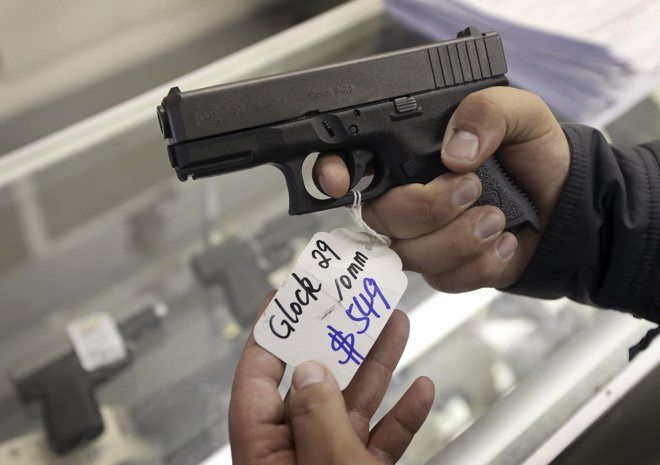

Why is Insecurity Growing in the USA?
Photo taken from El Mundo
By Abel González Santamaría
The main world economic power is going through a complex social situation, which causes levels of insecurity in the whole nation to increase year by year. Children’s gardens, schools, universities, churches, shopping centers, offices and recreational places have been the scene of bloody events.
It is estimated that, in the United States, 93 people die every day from gunshots, while another 222 survive after being shot, equivalent to 33,880 deaths per year. For every ten inhabitants there are nine firearms, being the highest proportion in the world.
These statistics are carefully recorded by the Brady Campaign, which is named after James Brady, who served as press secretary to President Ronald Reagan, when both of them were wounded in 1981 during an attack in Washington DC. Reagan recovered but Brady was left in a wheelchair. For the next three decades, he became a standard-bearer of arms control in the United States.
Only one month ago, the bloodiest shooting in the modern history of the United States occurred. On October 1, an American retiree killed 58 people and wounded 500 others during a country music concert in Las Vegas. Last Sunday, November 5, a new massacre occurred. An American ex-military man killed 26 people, including several children, and wounded 20 others during a Mass at a Texas Baptist church.
The worst killings, before beginning this year, occurred, in 2016, at a nightclub in Orlando, Florida, in which 49 people died and 53 were injured; in 2007, at Virginia Tech University, Virginia, where 32 people lost their lives, and the one that took place in 2012 at a primary school in Newtown, Connecticut, in which a total of 20 children and six adults died.
In spite of this harsh reality, the second amendment of the Constitution of the United States approved in 1791, which declares that “the right of the people to own and bear arms will not be violated, remains in force.” Since then, having guns is a right of American citizens and has become a big deal for the National Rifle Association (NRA).
There is no shortage of violent acts or massacres, nor the mobilization of public opinion to promote a real shift to the unsustainable regime of control of American arms. However, regrettably, the deliberate action of the NRA and other associated special interest groups, which “work” with generous contributions and threats of reprisals against each decision-making official on the issue within the Government and Congress, continues to be much more powerful.
The largest organization defending the possession of weapons of the United States, founded in 1871, is one of the most faithful donors of congressmen and presidential hopefuls, especially of the Republican Party. During the 2016 election campaign, that lobby allocated more than 30 million dollars in favor of the Republican candidate Donald Trump.
Once in the presidency, on April 28, 2017, Donald Trump participated in the convention of the National Rifle Association. He was the first US president to participate in this meeting since Ronald Reagan and grateful for their contributions, he said: “You have a true friend in the White House.”
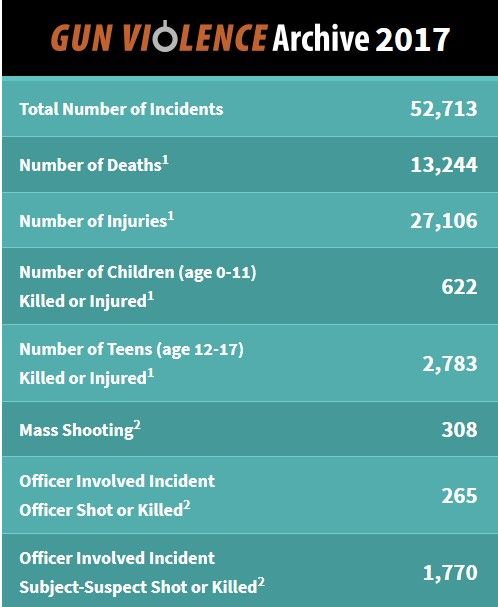
http://www.gunviolencearchive.org/
(Taken from Granma)
 He is a Cuban lawyer, Doctor in Political Science and Master in International Relations. Researcher of Inter-American Relations and National Security.
Translated and edited by Walter Lippmann for CubaNews.
One Mass shooting per day
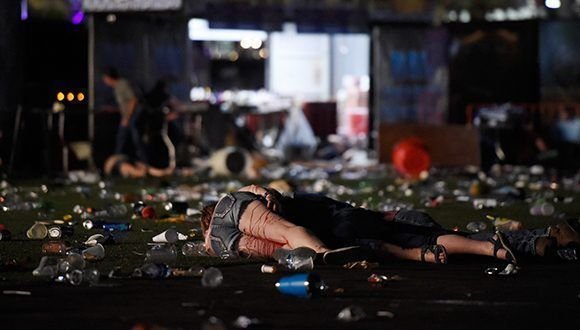
One Mass Shooting per day: Welcome to the USA
By David Brooks
At least 50 people have been killed and more than 200 injured in the Las Vegas shooting. Photo: David Becker / AFP.
The massacre in Las Vegas was characterized as the worst case of a multiple mass shooting in the modern history of the United States, but it is a type of tragedy that has become increasingly common in recent years in this country.
According to a case count of mass shootings (defined in this calculation as one in which 4 or more people are injured or killed by an aggressor), this was number 273 of the year. It happened on the 273rd day of this year. As the policy journalist Matt Taibbi of Rolling Stone summed it up in a tweet: “a mass shooting per day: welcome to the United States of America”.
Only 16 months ago, until what happened yesterday the deadliest mass shooting in the country’s modern history, was when Omar Mateen killed 49 people at the Pulse nightclub in Orlando. Before that, the blood title and death of a mass shooting had been recorded at Virginia Tech University in 2007, where 32 were killed.
The cases of mass murder multiply with alarming frequency. Among the most remembered, in addition to the three “worst”, include the hate crime of the young Dylan Roof in an Afro-American church in Charleston, South Carolina, killing 9, in 2015, the same year in which there was a massive shooting in San Bernardino California, where 14 died; the movie theater in Aurora, Colorado where a man killed 12 in 2012, the same year that a man shot 20 primary school children and their teachers at Sandy Hook School in Newtown, Connecticut and the 13 students killed at Columbine High School in Littleton, Colorado (subject of the famous documentary “Bowling for Columbine” by Michael Moore), among others in an increasingly long list.
Since 1970, more Americans have died from guns (including suicides, accidents and homicides) than the total of all Americans who lost their lives in all the wars in the country’s history, since Independence (1776). Every day, about 92 lose their lives by firearms, recalled Nicholas Kristof, New York Times columnist.
The incident in Las Vegas already triggered another cycle of debate over the control of private weapons in this country. But this, just as it is so often, already has a familiar script and nothing indicates that this time it will be very different. Trump and the Republicans expressed their condolences Monday and cited biblical phrases, while some – not all – Democrats insist again that more control of arms has to be promoted. The National Rifle Association and its allies will be silent for a while, while as always after these tragedies, the stocks of the gun makers rose on Wall Street.
The president, his team and a good part of the Republican Party, defend the “constitutional right” to arms, and argue that with more armed citizens there will be less violence and greater security.
But in an evaluation of diverse investigations published by Scientific American shows the opposite – that more weapons in private hands lead to more crimes, and comparisons with other developed countries indicate that this is, by far, the one that suffers most from gun violence, with more than 36 thousand fatalities in 2015.
According to the Gun Violence Archive, so far in 2017, there have been 46,595 incidents of violence with firearms, resulting in 11,652 deaths and 23,516 injured (this does not include the approximately 22,000 suicides per year).
In this country, there are approximately 300 million firearms in private hands – almost enough to give one to every adult and child in this country, and a little more than a third of the households in the country report having a gun at home.
But the tragedy in Las Vegas has already generated unexpected changes: the guitarist of one of the bands at the festival declared that the experience has changed his opinion. By declaring that he had been a promoter of the right of citizens to have arms all their lives, “until the events of last night. I can not express how wrong I was, “wrote Caleb Keeter of the country band Josh Abbott Band on his Twitter account “Enough is enough … We need gun control right now. “
But the White House spokeswoman said Monday was not the time to have a political discussion on gun control. “There is a time and place for a political debate. But this is a time to unite as a country,” said Sarah Sanders.
 David Brooks is the US correspondent for the Mexican daily LA JORNADA.
Translated and edited by Walter Lippmann for CubaNews.
Neo-McCarthyism and the New Cold War
- English
- Español
Neo-McCarthyism and the New Cold War
 By Manuel E. Yepe
http://manuelyepe.wordpress.com/
Exclusive for the daily POR ESTO! of Merida, Mexico
Translated and edited by Walter Lippmann.
Every American not anesthetized by anti-Russian hysteria should read Robert Parry’s essay “The Rise of the New McCarthyism” that highlights the similarities between the current overheated political pranks of Trumpism and the earlier manifestation of the shameful phenomenon in US history that is identified with the name of Senator Joseph McCarthy.
Parry recalls in that, during and after the First World War, the Bolshevik revolution terrorized the American ruling class. It, in turn, reacted with its first “red scare,” an orgy of patriotism induced by war and fear, infused by frantic means inflamed by the mythical red barbarism that led to a feast of deportations and mass arrests.
The victory of the Soviet Union, the expansion of socialism, the intensification of struggles for national liberation and a challenge to the hegemony of the two parties stimulated the occurrence of a second “red scare” in the US ruling class.
With such a base of support, a critical mass of consensus was achieved that persisted throughout the cold war. It was driven by the Republicans and the right against a large part of the left and other sectors and individuals (democrats, liberals and progressives) attacked by Senator McCarthy as “anti-American” or “fellow travelers” of the communists.
The true beneficiaries of the new McCarthyism today seem to be the neocons. They take advantage of Trump’s rejection of liberals and democrats to attract a part of the left to the hysteria unleashed by the controversy over the supposed “political interference” by Russia in the US presidential election.
The neocons and their allies have already exploited the frenzy against Russia to extract tens of millions of additional dollars from taxpayers for programs to “combat Russian propaganda,” that is, to fund non-governmental organizations and dissident US “scholars” for this new cold war.
The Washington Post (WP), which for years has served as the flagship of neocon propaganda, is charting the new political course of the United States. It had done the same to build the public support for the invasion of Iraq in 2003 and to promote support for Washington’s pressure to achieve “regime change” in Syria and Iran.
US taxpayers are bearing the cost of wars or military actions in the Middle East, South America, Africa, the Caribbean and Asia. Any country that does not show obedience to the global leadership of the United States becomes the target of In its attacks. the WP is leading a global campaign aimed at blaming Russia for everything that displeases Washington.
Putin has become the great black beast for the neocons, because he has frustrated Washington by a large variety of schemes. He helped to avoid a major US military attack against Syria in 2013; helped President Obama achieve the nuclear agreement with Iran in 2014-15; opposed the frustrated neocon support for the coup in Ukraine in 2014; and the support of the Russian air force that ultimately decided the recent defeat of the “rebels” supported by the US in Syria, at the hands of the local army, in 2017.
In an article, the WP reminds its readers that Moscow, historically, has relied on social inequalities in the United States to attack Washington, “which,” says Parry, “brings us back to the comparisons between old and new McCarthyism” .
Yes, it is true that the Soviet Union denounced the racial segregation of the United States. They cited that ugly characteristic of American society when expressing solidarity with the American civil rights movement and the national liberation struggles in Africa. It is also true that the communists of the United States collaborated with the national civil rights movement to promote racial integration, Parry explains.
That was a key reason why J. Edgar Hoover FBI had Dr. Martin Luther King, Jr. watched and persecuted Dr. Martin Luther King, Jr. and other African-American leaders, because of his association with people known or suspected of being communists. Ronald Reagan’s administration, in the same way, was reluctant to support the global campaign for the release of Nelson Mandela because his party African National Congress accepted communist support for its struggle against the regime of white supremacy (apartheid) in South Africa.
Robert Parry warns that perhaps “new McCarthyism” is not the appropriate way to describe the situation that seems to be approaching in the United States, but that it should be a “new cold war.”
November 7, 2017.
Spanish
By Manuel E. Yepe
http://manuelyepe.wordpress.com/
Todo estadounidense no anestesiado por la histeria anti rusa debería leer el libro de Robert Parry “Auge del nuevo macartismo” que destaca las similitudes entre las recalentadas travesuras políticas actuales del trumpismo y la anterior manifestación del tan vergonzoso fenómeno en la historia de Estados Unidos que se identifica con el nombre del senador Joseph McCarthy.
Parry recuerda en su libro que, durante y luego de la Primera Guerra Mundial, la revolución bolchevique aterrorizó a la clase gobernante estadounidense que, a su vez, reaccionó con su primer “susto rojo”, orgía de patriotismo inducida por la guerra y el miedo infundido por frenéticos medios enardecidos por la mítica barbarie roja que llevó a un festín de deportaciones y detenciones en masa.
La victoria de la Unión Soviética, la expansión del socialismo, la intensificación de las luchas por la liberación nacional y un desafío a la hegemonía de los dos partidos estimularon la ocurrencia de un segundo “susto rojo” en la clase dominante estadounidense.
Con tal base de sustentación, se logró una masa crítica de consenso que persistió a todo lo largo de la guerra fría, impulsada por los republicanos y la derecha contra gran parte de la izquierda y otros sectores e individuos (demócratas, liberales y progresistas) afrentados por el senador McCarthy como “antiamericanos” o “fellow travelers” (compañeros de viaje) de los comunistas.
Los verdaderos beneficiarios del nuevo macartismo actual parecen ser los neoconservadores (neocon), que aprovechan el rechazo a Trump de liberales y demócratas para atraer a una parte de la izquierda a la histeria desatada por la polémica sobre la supuesta “intromisión política” rusa en las elecciones presidenciales estadounidenses.
Ya los neocon y sus aliados han explotado el frenesí contra Rusia para extraer decenas de millones de dólares adicionales de los contribuyentes para los programas de “combate a la propaganda rusa,” es decir, a financiar organizaciones no gubernamentales y “eruditos” disidentes estadounidenses para esta nueva guerra fría.
El periódico Washington Post (WP), que por años ha servido como buque insignia de la propaganda neocon, está trazando el nuevo curso político de Estados Unidos, como lo hizo en los mítines de respaldo público a la invasión de Iraq en 2003 y para promover apoyo a las presiones de Washington por lograr el “cambio de régimen” en Siria y en Irán.
Mientras a costa de los contribuyentes Estados Unidos lleva a cabo guerras o acciones de guerra en el Medio Oriente, América del Sur, África, el Caribe y Asia, y cualquier país que no demuestre aceptar el liderazgo global de Estados Unidos se convierte en blanco de sus agresiones, el WP encabeza una campaña mundial encaminada a culpar a Rusia por cuanta cosa desagrade al público de EEUU.
Putin se ha convertido en la gran bestia negra para los neocon, porque les ha frustrado una gran variedad de esquemas. Ayudó a evitar un gran ataque militar de Estados Unidos contra Siria en 2013; ayudó al Presidente Obama a lograr el acuerdo nuclear con Irán en 2014-15; se opuso al frustrado apoyo neocon al golpe de estado en Ucrania en 2014; y el apoyo de la fuerza aérea rusa que en última instancia fue lo que decidió la reciente derrota de los “rebeldes” apoyados por EEUU en Siria, a manos del ejército local en 2017.
En un artículo, el WP recuerda a sus lectores que Moscú, históricamente, se ha basado en las desigualdades sociales en Estados Unidos para atacar a Washington, “lo que –dice Parry- nos retrotrae a las comparaciones entre el macartismo viejo y el nuevo”.
Sí, es cierto que la Unión Soviética denunció la segregación racial de Estados Unidos y citó esa fea característica de la sociedad norteamericana al expresar su solidaridad con el movimiento de los derechos civiles estadounidense y las luchas de liberación nacional en África. También es cierto que los comunistas de Estados Unidos colaboraron con el movimiento de derechos civiles nacional para promover la integración racial, admite Parry.
Fue esa una razón clave por la que el FBI de J. Edgar Hoover había vigilado y perseguido a Martin Luther King Jr. y otros líderes afroamericanos debido a su asociación con personas conocidas o sospechosas de ser comunistas, del mismo modo que el gobierno de Ronald Reagan se resistió a apoyar la campaña mundial por la liberación de Nelson Mandela porque su partido Congreso Nacional Africano aceptaba el apoyo comunista a su lucha contra el régimen de supremacía blanca (apartheid) en Sudáfrica.
Robert Parry advierte que quizás “nuevo macartismo” no sea la forma apropiada para calificar la situación que parece avecinarse en Estados Unidos sino que debía hablarse de una “nueva guerra fría”.
Noviembre 7 de 2017.
We Keep Being Put on New Lists
We Keep Being Put on New Lists
By: Dr. Néstor García Iturbe
Translated and edited by Walter Lippmann for CubaNews.
The Trump administration, at the head of the United States government, has just included Cuba on three new lists.
That is part of the policy change, which Trump announced when he met in the city of Miami, with a group of “rank Batistianos, annexationists and terrorists” as our Minister of Foreign Affairs, Bruno Rodríguez, described them in his recent speech before the General Assembly of the United Nations.
One of the lists, from the State Department, refers to different Cuban entities with which the US citizens will not be able to carry out financial transactions. This list is headed by the MINISTRY OF THE ARMED FORCES, THE MINISTRY OF THE INTERIOR, THE POLICE AND OTHERS ORGANS OF STATE SECURITY. They also include a series of hotels and other entities that supposedly belong to the security forces of the Cuban government.
This measure has been shaped by the main interest of trying to affect the trips of US citizens to Cuba. But what it establishes is unconstitutional, within the so-called freedoms that American citizens have proclaimed, as well as being irrational.
For example, if a US citizen commits a traffic infraction, he has to pay a fine to the police, in doing so he is violating a regulation of the US government and could be incriminated for this.
It is irrational and ridiculous to include in the ban two brands of soft drinks made in Cuba. The so-called “individual freedoms” of the American are torn up again when the government regulates them up to the brand of soda pop that can be drunk.
To continue issuing regulations, the Trump administration will establish the type of toilet paper that Americans should use in Cuba. It is possible that even THAT will have to be regulated for people from the US. That is the so-called “democracy”, and a sample of the “freedom” that prevails in capitalist society.
The other lists, also regulating what the US citizen can do or not do, have the same goal, try to affect the relations between the Cuban people and the American people, the contacts that are established between visitor and visited, in order, to the greatest extent possible, to avoid these contacts.
In general, people from the US who have traveled to Cuba are kind, respectful and interested in knowing the truth of what is happening on the Island. That is the danger that the enemies of our country are considering.
Those who return from Cuba, speak with honesty of our people, of the advances of the revolution and of the situation in which we live, which is always much better than the image disclosed by the enemies and the Miami mafia.
What kind of regime is Trump creating?
It is not only trying to reverse the progress in relations with Cuba that was achieved during the Obama administration. The violations of the US Constitution and to the liberties proclaimed in that same document, are directed at creating a repressive, discriminatory, terror regime, comparable to the existing one at the time of peak of the McCarthyism.
Perhaps that is the true meaning of his motto “Make America great again”.
Fidel Castro on 1983 Coup in Grenada
The Bells Tolling Today for Grenada May Toll Tomorrow for the Whole World.
Intro to Leon Trotsky mini-bio
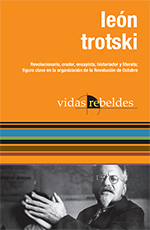
New
Leon Trotsky
Compiled by ARIEL DACAL DÍAZ
2015 | Rebel Lives Collection |
“The name of Leon Trotsky is among the most controversial and irreplaceable figures in the history of the revolutionary movement.” -Ariel Dacal Díaz
Leon Trotsky has not lost, after death, the ability to arouse conflicting passions. His life and work attest to the tireless fighting spirit that always encouraged him, as well as his dedication to the revolutionary cause, founded on a sentiment that would never be able to abandon him: hope in the triumph of the oppressed.
Little more than seventy years have elapsed since his assassination, and yet the thought of Trotsky and the example of tenacity that constitutes his life still have much to say.
ABOUT THE AUTHOR
Ariel Dacal Díaz
REBEL LIVES COLLECTION
Vidas Rebeldes, a new series of books at affordable prices that rediscover relevant figures in the history of the world’s workers, socialist and feminist movements. It publishes essay selections about women and men whose thought and action acquire renewed validity in our days. Vidas Rebeldes does not pretend to ennoble its protagonists as perfect political models, but to make them known in their different ways to the new generations.
168 pages | ISBN 978-1-925019-72-8
Intro to Ocean Sur Trotsky anthology
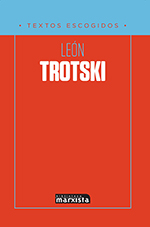
Introduction to Selected Texts by Leon Trotsky
New Leon Trotsky
Selected texts
Compiled by
2015 | Marxist Library Collection |
The present selection has the first purpose of spreading the political ideology of Leon Trotsky, author of a considerably vast work and unavoidable personality of the history of the 20th century. Gathered in this volume, you can find some of his most significant and lucid writings.
An examination of the strategic and controversial debates originated in the heart of the revolutionary movement in the last century has to consider, by force, the figure of Trotsky. The chosen exts that Ocean Sur offers to the readers provide a valuable opportunity to revisit, or discover for the first time, the thought of this tireless theoretician and revolutionary, at the same time that they constitute an invitation to deepen, question and reflect.
This collection brings together publications that address the origins, history and validity of Marxist thought.
472 pages | ISBN 978-1-921438-89-9
Translation by Walter Lippmann for CubaNews.
Havana Dresses in Style
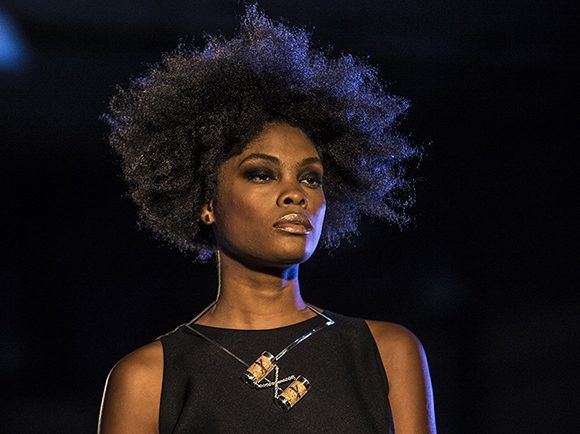
Havana Dresses in Style
By: Ismael Francisco
October 27, 2017
 Photojournalist at Cubadebate. He has worked at Granma, Prensa Latina and AIN. He has made graphic coverage of important political, sports and social events in Cuba and other parts of the world. He has won several awards and journalistic recognitions.
A CubaNews translation by Walter Lippmann.
Fashion Week in Havana, collection of ROX 950. Photo: Ismael Francisco / Cubadebate.
The Fashion Week in Havana: Crafts and Identity, serves as a stimulus to creativity based on Cubans’ know-how, in accordance with the aesthetic and functional values of our idiosyncrasies.
Until Saturday the 28th, the event will offer parades in the old Warehouse of Wood and Tobacco, in the Alameda de Paula.
More than 70 creators, including designers and artisans who work in events such as textiles, jewelry, leather and costume jewelery, participate in this event sponsored by the Cuban Association of Craft Artists and the Cuban Fund of Cultural Assets.

Fashion Week in Havana, collection by designer Mario Freixas. Photo: Ismael Francisco / Cubadebate.
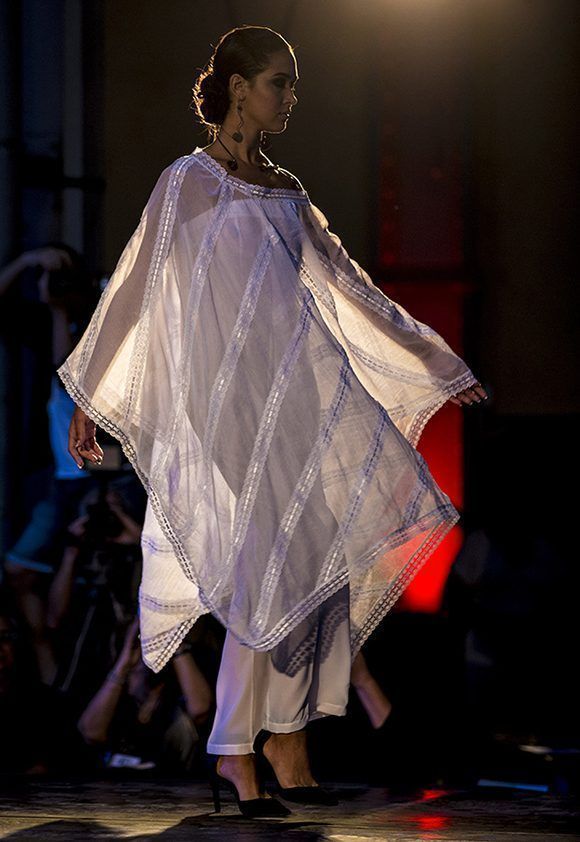
Fashion Week in Havana, collection of the designer Mario Freixas. Photo: Ismael Francisco / Cubadebate.
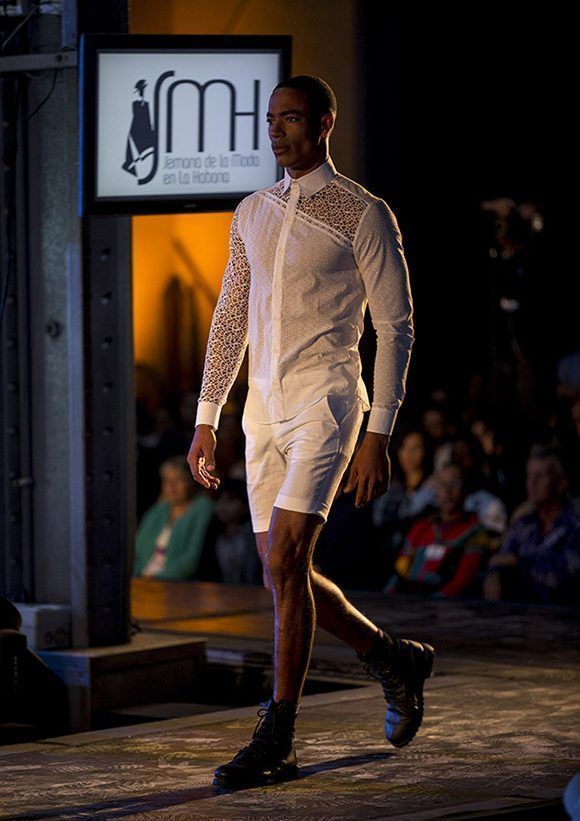
Fashion Week in Havana, collection by designer Mario Freixas. Photo: Ismael Francisco / Cubadebate.

Fashion Week in Havana, collection by designer Mario Freixas. Photo: Ismael Francisco / Cubadebate.
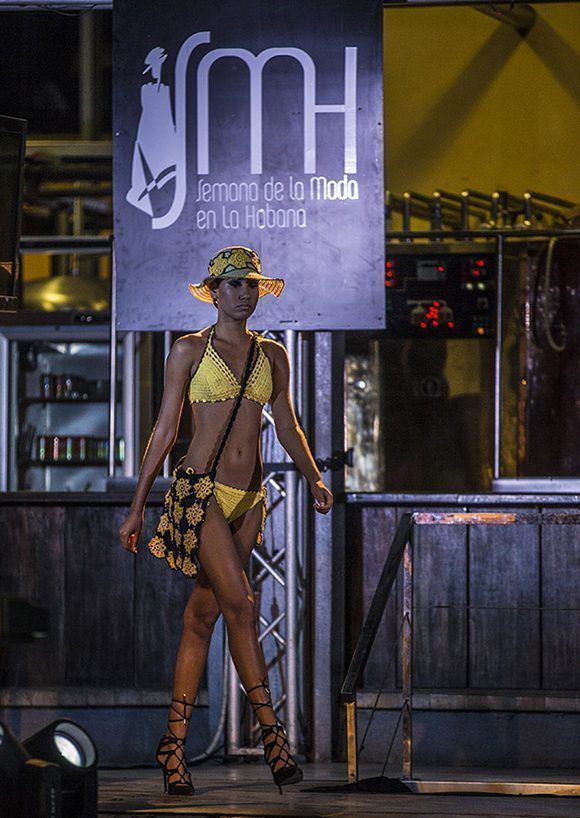
Fashion Week in Havana, collection of designer Rosa Xiomara Valdés. Photo: Ismael Francisco / Cubadebate.

Fashion Week in Havana, collection of designer Rosa Xiomara Valdés. Photo: Ismael Francisco / Cubadebate.

Fashion Week in Havana, collection of designer Rosa Xiomara Valdés. Photo: Ismael Francisco / Cubadebate.
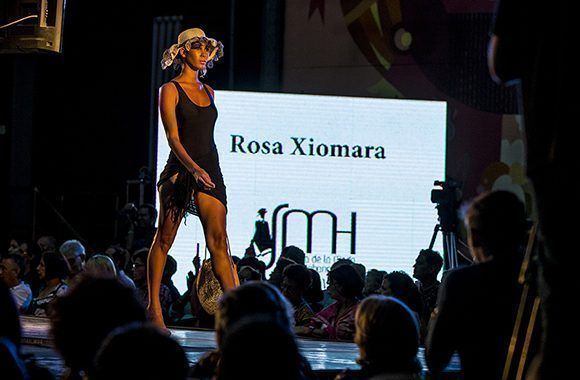
Fashion Week in Havana, collection of designer Rosa Xiomara Valdés. Photo: Ismael Francisco / Cubadebate.
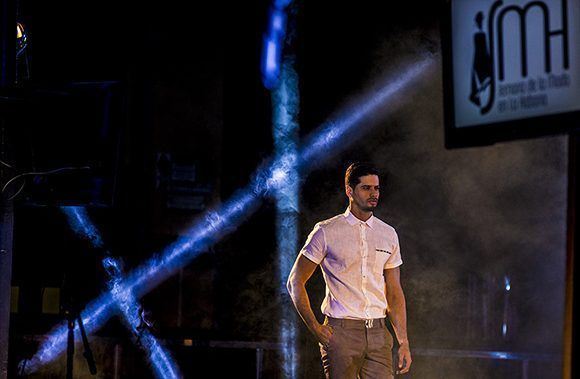
Fashion Week in Havana, designer Yunior Hierro Leyva’s collection. Photo: Ismael Francisco / Cubadebate.
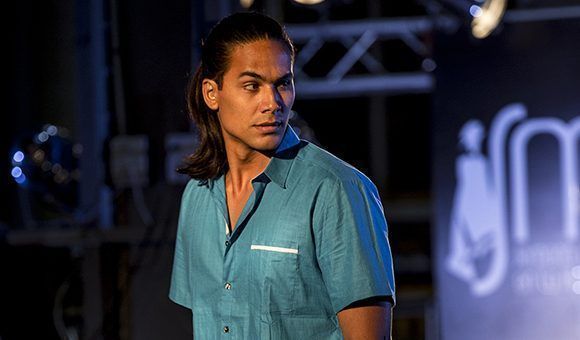
Fashion Week in Havana, designer Yunior Hierro Leyva’s collection. Photo: Ismael Francisco / Cubadebate.
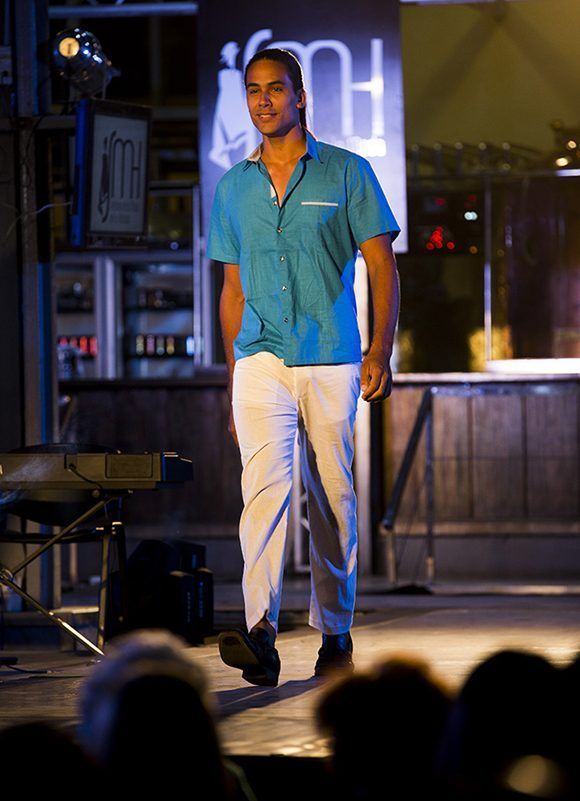
Fashion Week in Havana, designer Yunior Hierro Leyva’s collection. Photo: Ismael Francisco / Cubadebate.
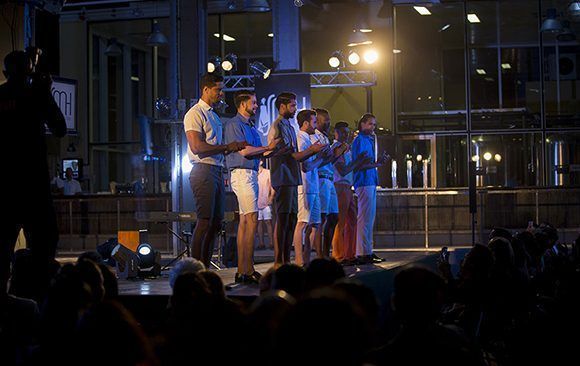
Fashion Week in Havana, designer Yunior Hierro Leyva’s collection. Photo: Ismael Francisco / Cubadebate.
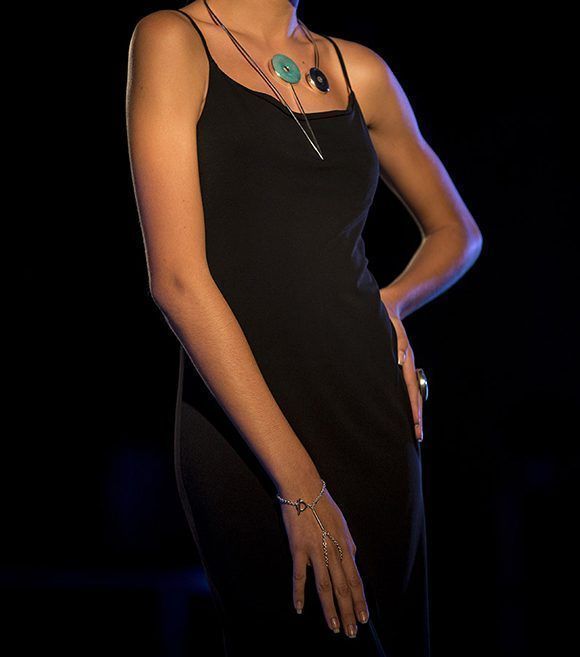
Semana de la Moda en la Habana, colección de ROX 950. Foto: Ismael Francisco/ Cubadebate.
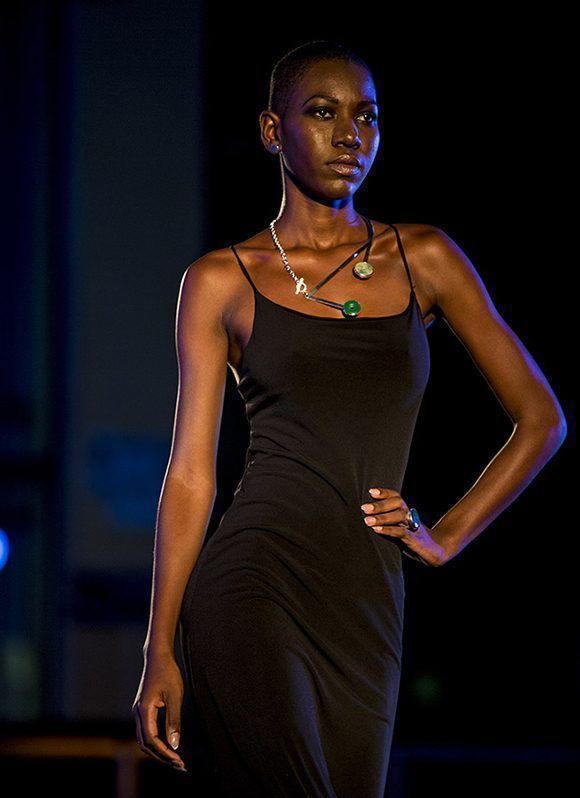
Semana de la Moda en la Habana, colección de ROX 950. Foto: Ismael Francisco/ Cubadebate.

Fashion Week in Havana, ROX 950 collection. Photo: Ismael Francisco / Cubadebate.

Fashion Week in Havana, ROX 950 collection. Photo: Ismael Francisco / Cubadebate.
Using Fear to Strike at Cuban Tourism
Using Fear to Strike at Cuban Tourism
By Manuel E. Yepe
http://manuelyepe.wordpress.com/
Exclusive for the daily POR ESTO! of Merida, Mexico.
Translated and edited by Walter Lippmann.
The mysterious case of the alleged “acoustic attacks” against US diplomatic personnel in Cuba turns out to have been a media maneuver aimed at damaging tourism in terms of as part of the blockade against the island.
One of Cuba’s greatest attractions for foreign tourism is the guarantee of security offered by the island to visitors from any part of the world. Another is the high level of public health in Cuba, one of the highest in the Western Hemisphere with health indicators comparable to those of the most developed nations.
In addition to the exceptional conditions with which the island has been endowed by nature, the popular revolution of 1959 has incorporated the dsocial conditions of peace and harmony that the visitor appreciates from the first moment of their stay in Cuba.
More than half a century of possessive paranoia, aggravated by the economic, commercial and financial blockade, have not been able to counteract the enormous achievements of socialism, even if they have postponed or limited many revolutionary economic and social advances in the country.
Basque journalist José Manzaneda, coordinator of the Cubainformación website, a channel that broadcasts news, reports and commentaries on the island from Spain, has denounced the media’s objective against Cuba over the campaign of alleged sonic attacks.
Manzaneda remembers that it was the Argentine newspaper “Clarín”, among many other media, who published a report two years ago from the Associated Press. Its focus was on an American traveler who felt “a sudden loss of feeling in his four extremities, in the same hotel where some affected diplomats were staying.”
Then there’s the growing interest among students, the sector of American visitors that has grown the most in Cuba –118% in the first half of the year– given that conventional tourism is still prohibited by the US blockade, Diario de Cuba, half-financed by the governments of the United States and Spain, wrote: “There are signs that students and retirees (from the U.S.) plan to cancel their trips to the island”, since neither “Washington nor Havana have been able to prevent the attacks, which could generate an uncontrollable crisis”.
El Nuevo Herald, a mouthpiece for the extreme right-wing Cubans in Miami, assured its readers that Raúl Castro is turning a diplomatic crisis into an economic, potentially destabilizing one.
Agencies and media collaborated in this way with the objective of the White House that came to life on September 29. That was when, recognizing that ti was “not aware” of the origin of the supposed acoustic attacks, it officially recommended not traveling to the island.
“Coming from the government of a country where every year 30,000 people die by firearms, more than a thousand by police, and 31% of the world’s mass shootings are recorded, this alarm seems like a joke in bad taste,” says Manzaneda.
The extreme-right of Cuban origin of the Republican party, which, in exchange for its vote on other matters, already manages Donald Trump’a Cuba policy. It seeks to reverse the growth experienced through the trips of Americans to the island and damage the income from them which it brings to the Cuban economy.
In line with this campaign, the conservative Washington Examiner asked the House of Representatives to demand that Cuba “evaluate security at its ten international airports.” This is an inadmissible interference that seeks to reduce the number of visitors from the US, in this case by canceling the regular flights authorized by the Obama administration.
However, RESPECT, the largest US association of travel promoters in Cuba, rejected –as unnecessary and counterproductive– the “security warning” issued by the State Department, arguing that Cuba is a “safe destination.”
The Spanish newspaper El País followed with an interview with Thomas Shannon, US Undersecretary of State. He held Cuba responsible for everything that had happened, but without clarifying what he was referring to, and without contributing any element to such an unusual story. Republican Senator Marco Rubio, Donald Trump’s current spoiled scion, seems to be, according to analysts, the one who is behind the nefarious campaign about “sonic attacks” in Cuba.
Everything indicates that, now, the tactic chosen by the right, at the service of imperialism, is to generate fear more than to legislate against Cuba. This is because, since for the former they have the concurrence –conscious or unconscious– of powerful international agencies and media, so much so that, for the second, they run the risk of increasing the division in the Republican ranks in Congress.
Let it be known then that all this diabolical mischief of sonic attacks is nothing more than another element of the blockade against Cuba that this past November 1, was condemned almost unanimously by the world community in the UN for the 26th consecutive year.
November 2 of 2017.
You must be logged in to post a comment.