
Happy Confirmation of Democracy in Cuba
Happy Confirmation of Democracy in Cuba
 By Manuel E. Yepe
http://manuelyepe.wordpress.com/
Exclusive for the daily POR ESTO! of Merida, Mexico.
Translated and edited by Walter Lippmann.
The Cuban electoral system confirmed its democratic character through the exercise of the popular consultative procedure that elected Miguel Díaz-Canel Bermúdez as head of state and government. Cubans will now place their hopes in him to continue the island’s revolutionary process, a paradigm of ideas and struggles for socialism and the independence of the nations of Latin America.
“I’m not here to promise anything, like the Revolution never did. I have come to fulfill the program that we have imposed on ourselves with the guidelines of Socialism and the Revolution”, the new President emphasized about his main work objectives.
Díaz-Canel had been First Vice President of the Councils of State and Ministers. Together with him, engineer Salvador Garcia Mesa was proclaimed 1st Vice-President. Before that, Esteban Lazo had been re-elected President of the Mational Assembly.
On April 18, the National Assembly of People’s Power in Cuba (ANPP) was constituted in its nineth term session. It elected, from among its 605 newly-elected deputies, the members of its highest body, the Council of State. The latter, in turn, chose the new president of the Republic of Cuba at its first session, succeeding Army General Raúl Castro Ruz, who had been in charge of the nation’s government since 2008.
Initially, Raúl took up the position through normal succession when President Fidel Castro Ruz fell ill. It was his responsibility to replace Fidel in accordance with his duty as First Vice-President, a position that had been legally assigned to him by the National Assembly of People’s Power in the past.
During those two consecutive presidential terms, Raúl was elected and re-elected President of the Council of State and the Council of Ministers by the will of the citizens expressed at the polls. However, on the second occasion, the Cuban revolutionary leader announced his decision not to run for re-election.
Raúl Castro had been, since the beginning of the insurrection against the Batista tyranny, the second figure in the leadership of the revolution. His performance at the head of the government earned him an increase in prestige as a leader, which was already great due to his brilliant performance at the head of the country’s defense.
No one questions that Raúl’s enormous authority and popularity would have enabled him to continue in the presidency for a third term, but Raúl Castro himself had advocated the need to renew the leadership of the revolution and the government, which, in the eyes of the people, turned compliance with his decision not to continue in office into something like paying a debt of gratitude to its President.
On the morning of April 19, marking the anniversary of the first defeat of U.S. imperialism in America at Playa Girón, Miguel Díaz-Canel delivered his first speech as President of the Council of State and Council of Ministers,
“With this legislature,” he stressed, “the culmination of the election process of the last few months, which the people have carried out conscious of its historical importance, and without any campaigning, corruption or demagoguery. Citizens have distinguished humble, hard-working and modest people as their genuine representatives. They will participate in the approval and implementation of approved policies.
He added that anyone who wants to see Cuba in all its diversity can observe it in its National Assembly.
He stressed that he assumes responsibility with the conviction that all revolutionaries, from any trench, “will be faithful to Fidel and to Raúl, the current leader of the revolutionary process.
He then stressed, as another inherited achievement, that “unity has become invulnerable within our party, which was not born of the divisions of others, but out of the unification of those who sought to achieve a better country”.
“Raul remains at the forefront of the political vanguard. He continues to be First Secretary of the Party as a reference point for the revolutionary cause, teaching and always ready to confront imperialism, like the first, with the rifle at the time of combat.
He highlighted Raúl’s revolutionary and political work, his legacy of resistance and in the quest for the nation’s improvement, his statesmanship, building consensus and leading the process of implementing the Party’s guidelines. He also mentioned how Raúl had supported the efforts to bring about the return of the Five Heroes that Fidel had predicted.
This session of the Ninth Session of the National Assembly was closed by Raúl with a vibrant and historic speech outlining many of the most urgent tasks facing the new Cuban President.
April 19, 2018.
A Crazy President, But Not So Much
A Crazy President…But Not So Much
By Manuel E. Yepe
http://manuelyepe.wordpress.com/
Exclusive for the daily POR ESTO! of Merida, Mexico.
Translated and edited by Walter Lippmann.
The madman was advised and suspended his visit to Lima where he would have attended the VIII Summit of the Americas as head of the U.S. delegation. Nor will Donald Trump travel to Colombia, as officially announced. The reason given for this was that the president had to deal with the situation in Syria, a country over which a threat of war hangs as a result of the president’s own outbursts. These are based on the worn-out, paradoxical and proven-false accusations against the government of Bashar Al Assad of having used chemical weapons in its internal war against terrorism.
Sarah Sanders, White House spokeswoman, announced that Vice President Mike Pence will be in charge of Washington’s delegation, both in Lima to conduct bilateral talks with Latin American leaders who will be present at the hemispheric meeting and in Bogotá for the meetings Trump had scheduled with Colombian authorities.
There is no doubt that the pretext of the situation in Syria will serve to prevent the United States from having a resounding catastrophe in its relations with the governments of the nations of Latin America.
History shows that when the countries south of Rio Grande act together they are able to shock the empire at its deepest roots. But hardly anyone expected that, as a result of the right-wing movement that has emerged as a result of various US coups d’état on the continent, such unity would be able to achieve such encouraging results.
The planned Summit of the Americas was announced as a likely trigger for the fury of the peoples of the continent against Washington’s most recent impositions and manipulations. But the arrogance and irresponsible actions of President Donald Trump have reached such an extreme that even the rulers of Latin America, who have shown themselves to be more servile in their ties with Washington, have jumped with unprecedented firmness.
An extreme case was produced by the president of Mexico, Enrique Peña Nieto, who suggested that the New York magnate review the origin of his anger. “If your recent statements stem from frustration over domestic policy issues, your laws or your Congress, you should address them, not the Mexicans. We are not going to let negative rhetoric define our actions,” Peña Nieto said, when it was announced that President Trump had ordered the deployment of between 2,000 and 4,000 military personnel to support the Border Patrol agents on the southern border of the United States.
The Mexican president’s message also responded to a series of tweets and comments by the magnate-president, motivated by a caravan of Honduran migrants who sought to reach Mexico’s northern border with the United States.
Trump warned that he would cancel the North American Free Trade Agreement (NAFTA) negotiations if the Mexican government did not detain Central American migrants.
“It is better that the great caravan of people from Honduras, coming through Mexico to our border of weak laws, stop. NAFTA is at stake, as are foreign aid for Honduras and the countries that will allow this to happen. Congress must act now!“the president tweets threateningly.
To general surprise on the continent, Peña Nieto declared that Mexico will not be afraid to negotiate with the United States, but he demands respect. “We will never negotiate in fear.”
The Mexican Senate also demanded respect from the president of the United States and demanded that the Peña Nieto government suspend binational collaboration on immigration matters.
The four candidates for the presidency of the nation: Margarita Zavala, Ricardo Anaya, Andrés Manuel López Obrador and José Antonio Meade immediately joined in the rejection of the deployment of U.S. troops on the Mexican border. “When it comes to defending national dignity, we all speak with one voice and demand respect,” independent Congresswoman Margarita Zabala wrote to Donald Trump in her tweeter.
Peña Nieto mentioned these statements in his message to the nation while underscoring the negotiating tone with which his government has addressed the U.S. president. “The Mexican government’s efforts have been aimed at building an institutional relationship of mutual respect and benefit for both nations.
The relationship between the two countries “is intense and dynamic but that does not justify threatening attitudes or lack of respect between our countries,” insisted Peña Nieto. “If you want to reach agreements with Mexico, we’re ready. As we have shown so far, we have always been ready to engage in serious, good faith and constructive dialogue.
April 12, 2018.
World Bids Farewell to Winnie Mandela


World bids farewell to Winnie Mandela, Mother of the South African Nation
Leaders from around the world expressed their condolences after the death of the anti-apartheid fighter on Monday.
——————————————————————————–
Author: International Editor | internacionales@granma.cu
April 3, 2018 20:04:36
A CubaNews translation.
Edited by Walter Lippmann.
The anti-apartheid fighter, Winnie Mandela, died at the age of 81. Photo: Prensa Latina
PRETORIA: Leaders from around the world expressed their condolences after the death on Monday of Winnie Mandela, a woman whom the current South African president described as “the voice of challenge and resistance in the face of exploitation and repression by the apartheid regime”.
In a message released yesterday in Pretoria, the head of state and government, Cyril Ramaphosas, further noted that “Winnie was a champion of justice and equality and that throughout her life she contributed to the struggle through sacrifice and persistent determination”.
The news of the death of Winnie Madikizela-Mandela, 81, on Monday, April 2, at the Netcare Milpark Hospital in Johannesburg, South Africa, was reported by family spokesman Victor Dlamini. He said that “we want to communicate with deep sadness that she has passed away,” he said.
The African Union (AU), in the words of its Commission Chairman, Moussa Faki Mahamat, also expressed shock and sadness at the death of Nelson Mandela’s second wife, reported Prensa Latina.
Also joining in the condolences was Iran’s Foreign Minister, Mohammad Yavad Zarif, who addressed his condolences to the South African people in general and to the supporters and all those who follow the thought and beliefs of the anti-apartheid icon Nelson Mandela.
Alluding to the four long decades of struggle against apartheid alongside Mandela, he noted that Winnie’s death had caused South Africa and the world pain.
From a closer latitude, Evo Morales, president of the Plurinational State of Bolivia, expressed his solidarity with the South Africans for the loss of the one considered by many “mother of the nation” of South Africa.
Morales’ message on Twitter states that the second wife of South African leader Nelson Mandela “was and will be a symbol of the struggle for freedom and equality.
In 1994, after the first democratic elections, Madikizela-Mandela was appointed deputy and vice-minister of Art and Culture. Since then, she had been a member of parliament and remained a leading figure in the African National Congress (ANC), the governing body in South Africa since the first democratic elections after the end of apartheid, in which she won together with Mandela’s victory in 1994.
The South African government announced yesterday that on April 14 Winnie Mandela will be sent off by her people with state funerals, after President Cyril Ramaphosa visited her family in Soweto to express his condolences and support directly to them.
Winnie Mandela Passes On
Winnie Mandela, A Symbol of the Anti-Imperialist Struggle in South Africa, Passes On
South African activist and politician Winnie Madizikela Mandela passed away on Monday at the age of 81, her personal assistant said on Monday.
——————————————————————-
Author: Digital Editor | internet@granma.cu
April 2, 2018 11:04:04:04
A CubaNews translation. Edited by Walter Lippmann.
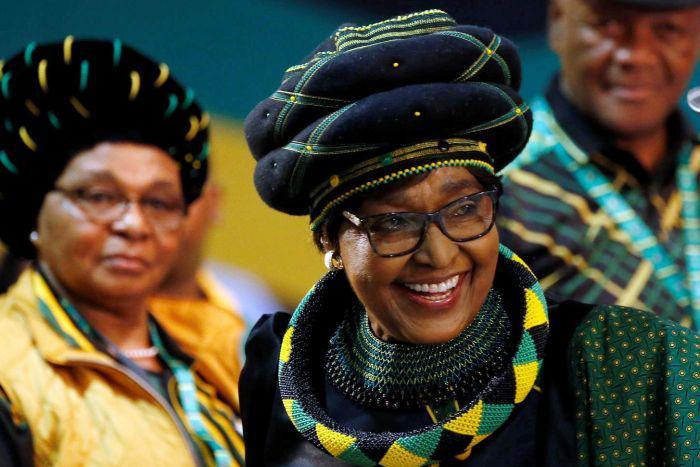
Foto: abc.es
Veteran anti-apartheid fighter Winnie Mandela, who became a reflection of South African women during the years of repression against the majority black population, died Monday at 81, Prensa Latina reported.
Spokeswoman Zodwa Zwane confirmed that Winnie passed away this afternoon and that the family will issue a statement within a few hours.
Nomzamo Winifred Madikizela was born in 1936 in Bizana, Eastern Cape Province, and moved to Johannesburg in 1957 to study Social Work, when he met the legendary leader Nelson Mandela, whom he married the following year and had two daughters. The marriage ended in 1996.

Nelson and Winnie Mandela after the release of the first in February 1990. Photo: AFP
An icon of women’s struggle and resistance in this southern African country, Winnie is remembered for her confrontation with the racial segregation authorities in South Africa, her political harangues and her participation in black workers’ strikes when her then-husband was imprisoned with other leaders of the African National Congress (ANC) on Robben Island.
In 1993, she was elected president of the ANC Women’s League, Minister of Art, Culture, Science and Technology in the first government after the end of apartheid, and left her official position in 1996.
Until her death she was involved in community work at his residence in Soweto.
Cuba Mourns Winnie Mandela’s death
Cuba Mourns Winnie Mandela’s death
In the afternoon of Wednesday, the Vice President of the Council of State, Mercedes López Acea, signed the book of condolences at the South African Embassy on the island due to the death of the South African leader Winnie Mandela.
Author: Darcy Borrero Batista | darcy@granma.cu
April 11, 2018 15:04:35
A CubaNews translation. Edited by Walter Lippmann.
In the afternoon of Wednesday afternoon, Mercedes López Acea, Vice President of the Council of State, signed the book of condolences at the South African Embassy on the island due to the death of the South African leader Winnie Mandela.
In front of Winnie’s image, surrounded by a vase of flowers, Acea, who is also the first secretary of the Party in Havana, wrote that “in view of the death of Winnie Mandela, a prominent defender of the rights of her people and an activist against the apartheid regime, we convey to the government and people of South Africa our deepest condolences on behalf of the people and the Government of Cuba, which we extend to them”.
Along with her words also appear the signatures of Vice-Chancellor Abelardo Moreno and Gisela García Rivera, Director for Sub-Saharan Africa of the Ministry of Foreign Affairs (Minrex).
The veteran anti-apartheid fighter who was the second wife of leader Nelson Mandela, became a reflection of South African women during the years of repression against the majority black population.
She died on Monday of the week before, at the age of 81.
Five Million Cell Phone Lines


Five million cell phone lines already active in Cuba
This figure confirms the growing evolution of mobile telephony on the island in recent years
By Juventud Rebelde digital@juventudrebelde.cu
Published: Thursday 12 April 2018 | 02:08:31 AM
A CubaNews translation. Edited by Walter Lippmann.

Five Million mobile lines Already active in Cuba Author: Internet Published: 12/04/2018 | 01:50 am
At press time, it was announced that a customer had signed a contract with a commercial unit of the Cuban Telecommunications Company (Etecsa) in Guanabacoa, in the eastern part of Havana, with whom the country has five million active mobile line services. According to information provided by Etecsa’s Institutional Communication Department, this figure confirms the growing evolution of mobile telephony on the island in recent years. Keep in mind that in December 2003 there were only 43,000 active mobile lines, by April 2008 the number of these had risen to 223 000, by March 2014 it had reached 2 million, by December 2016 it had reached 4 million, and 2017 closed with 4.22 million of these services.
Lizette Vila’s documentary
Paquito el de Cuba

Lizette Vila’s documentary or Padres en plural
By Francisco Rodriguez Cruz
November 19, 2017.
Translated and edited by Walter Lippmann for CubaNews.
I’m not going to try to do a review or evaluation of Lizette Vila and Ingrid León’s documentary, because I’d be a judge and a party, and that would be very ugly. Even more so when I’m still under the impression of the apotheosis of the premiere that Soy papá had this Saturday, November 18th… anyway, in a Yara cinema at full capacity, which forced me to offer a double performance.
 I just wanted to thank you for the gift, which was great, for my son, my partner and me, that we were able to enjoy it also among so many good and friendly people. I barely recover, though, from the shock of seeing my face – what a horror! – on the big screen.
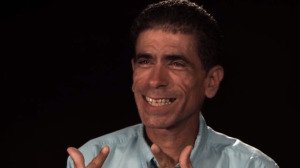
I also self-critically admit that I underestimated the impact of this bringing to life of the Palomas Project.
A little more than 30 minutes with the biographical shreds of a dozen or so men, I never thought they would attract so much kind and even overwhelming attention from a wide and diverse audience.
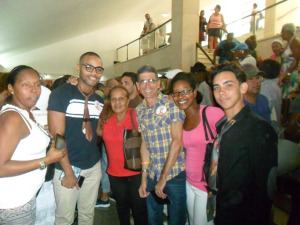
In the lobby of the Yara, on leaving, witnesses and relatives receive many signs of affection.
Personally, what I liked the most was to know the other stories of this choral interview – moving at times, sometimes hilarious, always authentic, by what they show, and even more, by what one can guess behind each testimony.
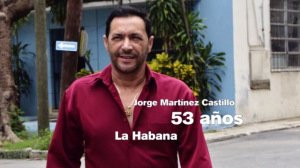 It was nice, but undeserved to be able to share the stage with such great parents at the end of the screening, and to receive with them, their families and my son Javier, the solidarity and affection that the audience lavished on us with an applause that I interpret as a recognition, not individual, but collective, for all the parents.
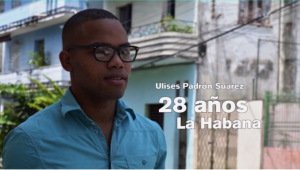
Because beyond the explicit purposes that link it with international campaigns and just social causes, this audiovisual is ultimately a claim to paternity, the best balance of which is not melodrama -which there is, there was no lack of it, we speak of Lizette Vila – but the natural force of a joy, accomplishment or pride that is difficult to explain, but easy to perceive even in her saddest or most heartbreaking stories.
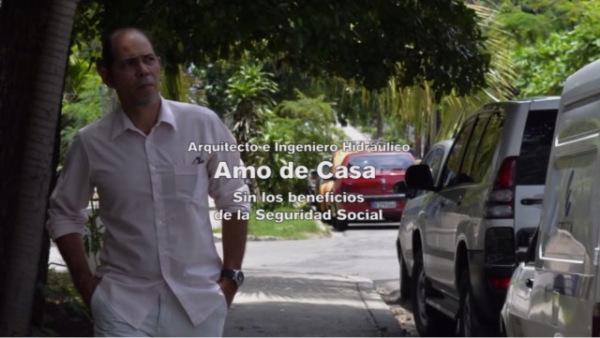
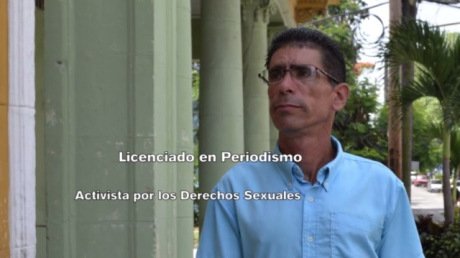
Pedro Enrique Galiano Rego
Because, beyond the explicit purposes that link it with international campaigns and just social causes, this audiovisual is ultimately a claim to paternity. The best balance of this is not melodrama -which there is, there was no lack of it, we speak of Lizette Vila – but the natural force of a joy, accomplishment or pride that is difficult to explain, but easy to perceive even in her saddest or most heartbreaking stories.lk;
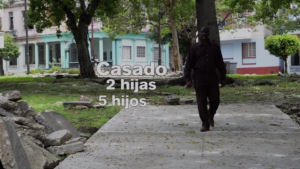
Omar Montalvo Chirino
Another great success was its projection on the eve of November 19, 2017, International Men’s Day, a celebration that has existed since the 1990s, but we rarely remember it.
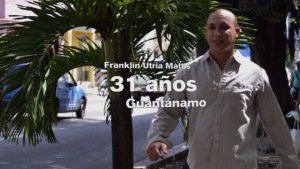
This makes it all the more valuable and timely to look at these Cuban parents – parents or biographers – who share different experiences from different ages, marital status, professions, territories; 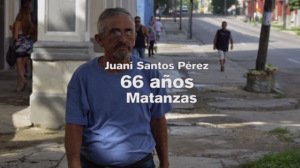
without forgetting variables such as sexual orientation and gender identity, as they include other male perspectives that the traditional notion of manhood usually tries to ignore, silence or at least diminish, disguise.
Another great success was its projection on the eve of 19 November 2017, International Men’s Day, a celebration that has existed since the 1990s, but we rarely remember it.
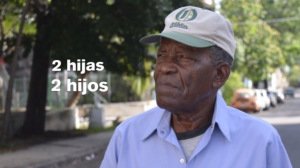
I am therefore pleased to be part of this thoughtful, disturbing and problematic tribute to the most intense and enriching human experience I know: being a father.Juan Nodarse Ramos
Thank you, Ingrid; thank you, Lizette.
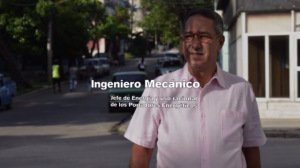
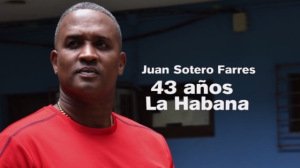
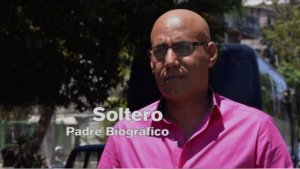
Truly Human Rights
Truly Human Rights
By Manuel E. Yepe
http://manuelyepe.wordpress.com/
Exclusive for the daily POR ESTO! of Merida, Mexico.
Translated and edited by Walter Lippmann.
Among the many unique qualities of the Cuban political process, and the organization of politics that has emerged from the revolutionary changes on the island, is the achievement of social peace in Cuba. It’s a phenomenon unthinkable in most other nations of the continent including, of course, the United States.
Surprised by this tranquility and security, many of the visitors from the United States who have been able to travel to Cuba with the exceptional authorization of Washington wonder if there are any organizations in Cuba that oppose the government. The answer, which is surprising to many, is that the only effective organizer and leader of the opposition in Cuba is the United States government. This is because Cuba’s citizens enjoy the daily right to participate in the construction of the new socialist order, but they also have the right to dissent. This is exercised in multiple instances of the vast and intense Cuban participatory system.
But another very important reason, one less spoken about, is that U.S. foreign policy has always been obsessive in maintaining a very direct and rigorous control over this dissidence. Very few Cubans agree to align themselves, to make use of their right to disagree, under the directions of a foreign government that openly proclaims itself to be an enemy of the independence, identity and social justice objectives of Cubans, and even less so with let alone do it in exchange for material benefits.
Washington’s instinctive imperialist voracity has never resigned itself to accepting a neighbor which does not blindly submit to U.S. hegemony. If not, they will learn from their own historical-practical experience, as have Puerto Rico, Mexico, Canada, the Dominican Republic and Haiti!
All these countries have suffered, in addition to Cuba, the extreme violence with which Washington is able to impose its neighbors’ submission to US designs.
The methods used by U.S. foreign policy to keep or return its neighbors to the fold have not always been identical. For example, from the dangers of absorption and subtle threats that have advised Canada to stay within the British Commonwealth. Why? To prevent its absorption by its American neighbors to the south. Then, the extension of borders by force with which Washington took half of its territory from Mexico. And, of course, the longest economic blockade in world history that still persists against Cuba. And we’re not even detailing the multiple invasion operations, coups and interventions sponsored by the OAS (Washington’s ministry of colonies), our America has experienced in recent centuries.
In the specific case of Cuba, a fierce campaign for the demonization of the purposes and actions of the Fidelista revolution began to develop before the triumph and seizure of power by the people in January 1959. It has been a sustained and relentless campaign, initially by the powerful US secret services of subversion and later publicly and notoriously, with multi-million dollar programs and plans aimed without discretion or shame at subverting order on the island.
This policy has been complemented, most of the time, by a ban on US citizens visiting the island in search of their own individual assessments.
With William Clinton in the presidency, the “people-to-people” policy was briefly put into effect. It authorized visiting Cuba by a certain category of individuals from academia and universities in general. It was designed with the purpose that the visitors would influence the Cubans by making them see the advantages of capitalism more, as was logical, the opposite was what happened.
President George W. Bush felt compelled to cancel the program, realizing its boomerang effect. By clashing with the truth of Cuba, the visitors became the best spokespersons for the Cuban reality.
In March 2016, then-President Barack Obama used his presidential powers to enact several measures that allowed certain categories of Americans to travel to Cuba with fewer restrictions. Nevertheless, the unconstitutional ban on tourist travel remained in place.
Donald Trump’s autocratic regime has preferred to apply measures of terror and threats in his speeches to counter the interest of U.S. citizens in approaching Cuba.
Cuba’s socialist revolutionary project does not impose anti-capitalist conditions on other countries. All it demands is respect for its experiments, essays, and studies. Cuba’s project is to create an alternative social and economic order to failed capitalism, one that is more just and better for the Cuban people and its independence.
April 9, 2018.
Between rebellion and brazenness

Between rebellion and brazenness
Posted: Saturday 17th March 2018 | 10:52:43 PM
Author: Alina Perera Robbio
This reflection begins with a true story: in a certain pharmacy in the capital, a patient asks for the medicine that will take him out of the crisis in which his digestive system has fallen and out of an almost unbearable pain that has caused him to go out into the street despite the fact that the doctor has ordered absolute rest.
The needy person, who has to update his or her home address papers, carries a certificate with him or her where the word “transit”, written by the doctor, can be read, but the pharmacy technique explains that the term is only applicable to transfers between provinces.
The dialogue between the needy and those who can help becomes a dead end. At some point the technique says vaguely: “Let’s see if we understand each other, let’s see if we can “solve…”. The patient gets confused and just asks, “Will they give me the medicine or not? Suddenly someone remembers that there is only one box left with the pills that they are urging and that are destined for a very critical case in the community. The patient feels almost guilty, and without having solved his problem he leaves with a bitter and surprising memory of the phrase in which he had hinted at the possibility of a solution.
Among Cubans there are terms that allude to our incessant effort to make our way through multiple difficulties: the “battle” or “struggle”, for example, serves to remind us of the enterprising eagerness, often positive, of the children of this island. But there are words that speak to us of less clean attitudes – such as the “search” – or of invitations to “solve”, to mediate in circumstances that, so humanly delicate, do not allow the inclusion of intentions of sale and purchase.
This last word is often disconcerting to the listener, who does not know the language of “help me, I will help you”: No one who has in his soul an ethical protocol in which cheating and pillaging add to the list of anti-values will be able to comfortably assume that complicity in which “aid” has a price and in the end the feeling remains that, to the right, solutions either arrive late or never arrive, unless there is a commercial option.
To tell the truth, the desire to “seek” (i.e. to find monetary or material advantages where there are resources), or this desire to “solve” – whether from the person who charges or from the one who pays – could find multiple explanations in reality: In three decades of increased economic and social difficulties, we have seen a lot of weeds grow in the shadow of emergencies and needs; life, like water seeking to run its course, has become for many a long-distance race in which almost everything is done against the clock, desperately, in a context marked by a lack of resources, bureaucracy and inefficiency in providing services, in a country that for much more than three decades has suffered the handshake of the empire through a commercial and financial blockade.
To these known and accumulated problems we must add the new challenges arising from the reconfiguration of the country in the economic and social spheres – a stage that, as a friend told me, is reminiscent of the movement of the bowels of the Earth, that rearrangement in which many customs and moral compasses seem to be dislocated while the scenarios, like the flakes of the planet, are being rearranged.
The fact that “resolving” lives among us as a style places us as a society, since it reminds us of the importance of the right-wing paths – that is, the entities that are responsible for the well-being of all – working together and doing so with agility. The other thing is that everything we design in terms of the necessary control must implicitly bring about the natural flexibility of life: rigidity and excessive restrictions are overwhelming and lead many to wonder what to do to “resolve” problems, and how to do it.
There is another inescapable aspect to this: even the ugliest attitudes can find an explanation, which does not mean that they deserve to be justified. Therefore, even if the most diverse distortions fuel the search for shortcuts, it would not be good for the dream country to wait for everything to go well in the target world to start looking inside. To rebel against brazenness and unscrupulousness at this moment seems to me to be an act of responsibility insofar as it limits the denial of virtue; it even seems to me to be an act of faith in the best possibilities for our fellow beings.
How to Protect the Cuban Consumer?
How to Protect the Cuban Consumer?
Although clients in our country can claim and assert their rights against any violation, it is worth asking what mechanisms and norms exist today to protect them.
——————————————————————————-
Author: yadidelsol@granma.cu
A CubaNews translation.
Edited by Walter Lippmann.
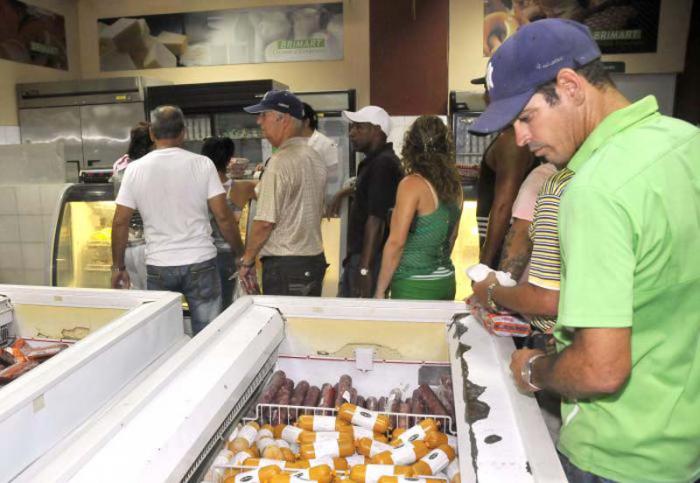
The consumer has the right to choose, which gives him the possibility to satisfy his needs. Photo: Alberto Borrego

Consumer protection is strongly linked to quality of service. Photo: Miguel Febles Hernández
Of course, these evils are compounded by others that affect trade in our country. These include irregularity in supplies, price-quality balance, insufficient information provided to buyers on the terms of product guarantees, few strategies and promotional initiatives, or the symptoms of apathy and mistreatment sometimes shown by staff working in stores and other establishments.
One thing is clear: to leave it to spontaneity or good faith to solve this problem would be to be naïve. The country is aware that, more than a glance, the most important thing is to take precise action, without delay, to eliminate the culture of abuse. It is not a favor to attend to the people and provide them with the service they request.
SOME OF THE COMPLAINT MECHANISMS AND CHANNELS THAT EXIST IN THE COUNTRY:
The Assemblies of Accountability of the delegate of the People’s Power of the district or private attention by this delegate.
The Attorney General’s Office and the Legal Consultations, which deal with complaints and issue consultations to citizens.
In the Councils of the Municipal and Provincial Administration, and in the companies located in the different territories where the Departments of Attention to the Population operate.
The Offices of Attention to the Population of the Communist Party of Cuba, in all its instances.
The mass media is another way for the population to lodge complaints.
SOME CONSUMER RIGHTS ESTABLISHED IN RETAIL ENTITIES.
To the satisfaction of their basic needs, through access to essential basic goods and services through the different modalities established in the country and according to their income.
The protection of the life, health, and safety of the consumer against risks caused in the supply of products and services considered dangerous, harmful and against poor quality and false or misleading advertising.
To the protection of their economic income, through fair, just and respectful treatment in the purchase and sale and contractual transactions and against coercive commercial methods or methods involving misinformation about products and services.
To the information, that is, to receive all the truthful and timely information on the different goods and services, with correct specification of quantity, characteristics, composition, quality, and price, as well as on the risks they represent.
To education and dissemination on the appropriate consumption of goods or services that ensure freedom of choice, fairness in the conduct of exchange and the preparation of the consumer to engage in responsible consumption.
To choose, which gives the possibility to satisfy the needs of consumers according to their expectations, tastes, preferences, all within a national framework and in accordance with the specific possibilities and conditions of the national economy.
To ensure that the conservation and preservation of the environment is not undermined.
To full, timely and adequate compensation for damages resulting from the purchase of the goods or services offered on the market and to effective compensation, whenever feasible, as regulated in the event of the supplier’s default.
To have access to the corresponding bodies for the protection of their rights with a view to presenting their opinions and complaints in the different instances, creating the conditions for their analysis, through agile and efficient procedures.
You must be logged in to post a comment.