The Vietnam War and the People of the U.S.
The Vietnam War and the People of the United States
By Manuel E. Yepe
Exclusive for daily POR ESTO! of Mérida, México.
http://manuelyepe.wordpress.com/
A CubaNews translation.
Edited by Walter Lippmann.
“Two of the world’s greatest revolutionaries –Jose Marti and Ho Chi Minh– lived for some time in the United States.
Both had deep knowledge of US history and culture. Both saw the dark side of that nation, but also acknowledged great revolutionary potential in the democratic ideals of the United States. The Vietnamese Ho Chi Minh wrote about the Ku Klux Klan and lynching, while, in the 19th Century, Cuban Jose Martí warned against the evidence of the coming advent of imperialism in North America.”
The quotation is from “Vietnam and Other American Fantasies,” a book by Bruce H. Franklin (b.1934), the multiple award-winning scholar and writer on historical cultural topics.
Franklin’s book attempts to demolish the fantasies, myths, and lies that most people in the United States believe about the relatively recent Vietnam War. It uncovers the truth about what was really an imperialist war against the people of Vietnam, Laos and Cambodia.
That war was rejected by the heroic struggle of tens of millions of people in the US. The dominant narrative today in the United States claim there was a democratic nation called South Vietnam, and another evil one called North Vietnam that was part of a communist imperial dictatorship. North Vietnam wished to invade South Vietnam.
The United States, being the leader of the free world and the defender of democracy on Earth, had to go to South Vietnam in 1965 to defend it and got bogged down in a quagmire. “We could not win the war because we fought with one hand tied behind our back, because of some university students mobilized by veteran left-leaning professors and the actress Jane Fonda.”
In his book, Franklin explains that Vietnam was a single country, not two countries. The US war against Vietnam began in 1945, not in 1965. The anti-war movement was initiated by US soldiers and sailors who were its vanguard, and in the endydct k made it impossible for Washington to continue the war in 1945.
Between 1945 and 1975 the Vietnamese revolution led the global struggle against colonialism that brought independence to half the world’s population. During those three decades, the US struggled to preserve colonialism and became the leader of neo-colonialism, the ultimate form of imperialism in the world.
Franklin recalls the true story of the day when Japan surrendered: August 14, 1945, recalling his experiences that day, when he was eleven years old. He was riding in a van full of children in joyful celebration in the streets of the Brooklyn neighborhood where he then lived. “We believed in a future of peace and prosperity, quite different from that of a nation always at war, as we live in now.”
That day in August was the beginning of the revolution in Vietnam, when the Vietnamese people rose and, in less than three weeks, defeated the Japanese and the French and established the Democratic Republic of Vietnam.
On September 2, Ho Chi Minh read out the declaration of independence to half a million Vietnamese in Hanoi, the former capital of a new nation that had been fighting for independence for over 2,000 years.
Suddenly, two fighter planes appeared above the crowd. When the Vietnamese recognized US insignia on the planes, they shouted for joy. They believed that the Americans were their friends and allies, and that they were the champions of freedom and independence from colonialism.
Washington, however, conspired with Paris to launch an invasion against the Democratic Republic of Vietnam whose goal was to restore French colonial rule. The United States would provide arms and financing. This, Franklin points out, was the true beginning of the war against Vietnam and marks the beginning of the US people’s movement against that war.
The British troops who had been sent to Saigon to disarm the remaining Japanese forces, instead gave weapons to the Japanese who had been recently disarmed by the Vietnamese. Soon the Japanese joined the British together with the remnants of the French colonial forces to wage war against the newly-declared independent nation of Vietnam.
When Washington later decided to replace France in the war against Vietnam, fierce opposition from US citizens prevented it, and for that reason, direct US military involvement had to be initially disguised.
Bruce H. Franklin recalls that, although it was the struggle of the Vietnamese which defeated the United States, the anti-war movement, especially in the armed forces, ultimately forced Washington to sign a peace treaty that included, word by word, each demand of the victorious Vietnamese liberation forces.
Mississippi Governor on Working Visit to Cuba

Mississippi Governor on Working Visit to Cuba
A CubaNews translation by Walter Lippmann.
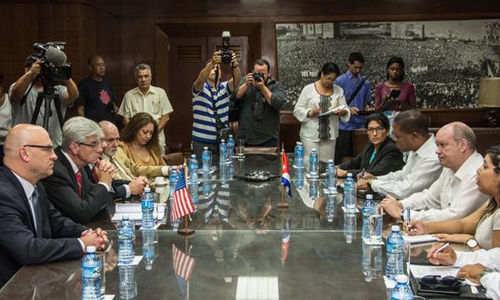
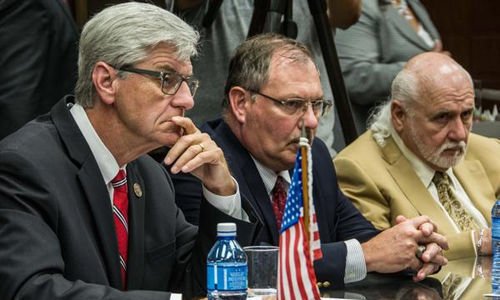
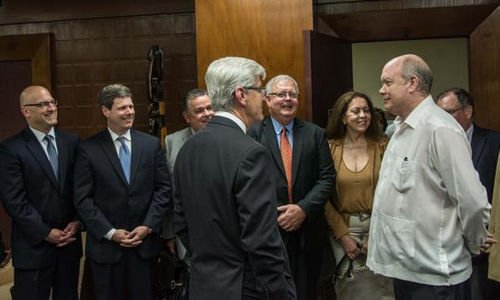
Mississippi Governor Phil Bryant began an official visit to Cuba Wednesday, where he met with Foreign Trade and Foreign Investment Minister Rodrigo Malmierca to stimulate bilateral ties.
Bryant is the second governor of a US state to travel to Cuba since New York magnate Donald Trump took office, following the visit of Colorado Gov. John Hickenlooper, a Democrat, last February.
In the meeting with Malmierca, the governor of Mississippi was accompanied by a delegation of business executives and officials from that state, who also held meetings with officials from the ministries of Tourism, Agriculture and Food Industry.
The North American delegation includes representatives from sectors such as agriculture, tourism, renewable energy, food production and marketing, and port activity.
Minister Malmierca said that since the beginning of the process of normalization of relations between Cuba and the United States in December 2014, “much has been progressed since”, but remains “the most important”: elimination of trade, economic and financial blockade.”
“The blockade’s measure is the main obstacle to us having normal ties. It not only creates serious difficulties for the Cuban people, but also damages economic operations between the two countries and with third parties,” said the Cuban minister on the policy Washington has applied to the island since 1962
According to him, Bryant and his entourage also spoke with authorities of the Cuban ministries of Tourism, Agriculture and Food Industry
Governor Bryant and his delegation are planning a tour of the Mariel Special Development Zone (ZEDM), a business and commercial enclave about 40 kilometers from Havana, which is the star project of the Cuban government to attract foreign investment .
The governor is scheduled to meet during his visit with authorities of the Ministry of Transportation and with the director general for the United States of the Cuban Foreign Ministry, Josefina Vidal.
Last February, Havana, Republican Senator William Thad Cochran, who presided over the signing of agreements between maritime-port authorities in Cuba and the ports of Pascagoula and Gulfport in that southern state, was the result of a business forum to explore Joint business opportunities.
(Infromation of Prensa Latina and EFE)
Child Sexual Abuse: Without Faces or Ages
Child Sexual Abuse:
Without Faces or Ages
A CubaNews translation.
Edited by Walter Lippmann.
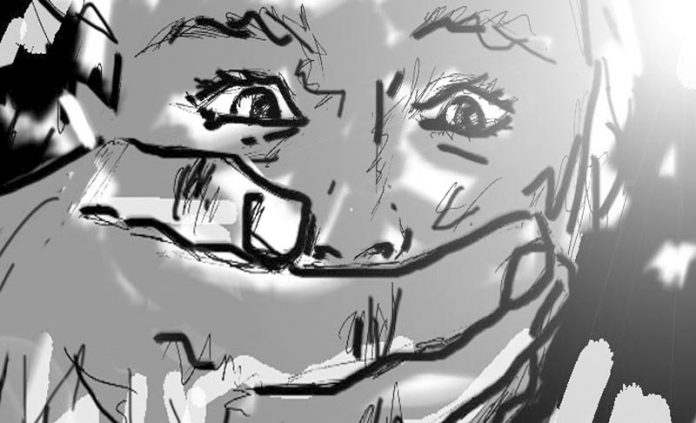
She was the girl in the house, nice and affectionate. He was the “uncle”, Dad and Mom’s best friends since they were little children, like her. She always ran to greet him. He visited the house on every birthday, on weekends, in the afternoons … Her parents would leave her in the care of the “uncle” so they could run errands. He brought her dolls, candy, cookies. She never understood why he kissed her in the mouth, took off her robe and touched her everywhere when they were alone. He told her it was a secret, as in the tales of princesses. She did not like it; but it was a princess’s secret … He left her half-naked and crying one afternoon when Mom and Dad had not yet returned … She’s barely four years old.
Contrary to the widespread belief of an “unknown stranger,” “distant from our home or affective environment,” events such as the one narrated above are very much our own, close, historical … Social taboos or stigmas –even institutional ones– manage to silence them, but never avoid them, much less eradicate them.
“I worked with cases that came to the Court in 2015 and the first months of 2016,” explains Lisandra León Borrero, whose Master’s Degree thesis in Criminology discussed the “Victim Factors that Promoted Sexual Abuse of Children Under 16 in The Municipality of Cienfuegos in 2015-16: Actions for prevention.” However, the author mentions the existence of other cases still being processed and says there are cases that are never reported.
Researchers say that in our country the most common crimes related to child sexual abuse are lascivious abuses, and the most vulnerable are children between three and ten years of age.
According to the 2013 Cuban Report on “Legal-penal actions against human trafficking and other forms of sexual abuse”, protection was granted to 2,321 girls and boys who had been victims of these acts (1036 of lascivious abuse, 553 of corruption, 365 of rape, 191 of sexual outrage, 57 of pederasty and 29 of rape under 16 years of age). From then to date, the figure has been rising.
“I do not think it has increased,” explains Dr. Diana María Stuart Duarte, child psychiatrist at the Centro de Evaluación, Análisis y Orientación del Menor (CEAOM) [Center for Evaluation, Analysis and Guidance of Minors] in the province. From the very beginning of the history of humankind, abuse has been present. But people have gained confidence, knowledge, and are less afraid. Thus the number of accusations has increased. In fact, many families had their children being victims of sexual abuse and did not disclose it. We are already more open in that regard.”
Other studies reveal that, even with such progress, the reported cases are usually only 10 to 20 percent of the real number .
PREVENTING…
The victimizers, like the victims, have no face, no age, no sex, but “they are almost always close to the family and study their victims, identifying problems of any kind: children who lack affection. And many times the child is mentioning the abuse to the elders and they do not believe it; they take him or her to be a liar. Imagine being in a situation like that,” says Lic. Sara Rey Hernández, a psychologist at CEAOM.
As part of her research, Lisandra León Borrero identified some risk factors that increase the vulnerability of children to this type of abuse. The absence of risk perception on the part of the family is at the top of the list and reveals certain shortcomings of present-day Cuban society.
“Most of the cases under study were dysfunctional families; they did not pay attention to their children; they did not know who they related to; they were not prepared to provide them with adequate sex education; and they were permissive.”
“Another element was the economic factor. In juvenile corruption, for example, when we analyze how the crime is committed –the age, the crime itself—material factors are almost always present. Predators take advantage of those teenagers who wish to have cell phones or tablets, and whose parents cannot give them those goods.”
Master Lisandra Leon Borrero also discusses the social factor with the presence of alcoholism in our communities, and the lack of adequate recreation spaces for the children. “The mother lives on a fifth floor and lets the child play in the street, in a dark place, without supervision,” she added.
Whether in the short or medium term, the aftermath is usually manifested in the child victim. Among the most serious consequences, Dr. Stuart Duarte includes: affective disorders, psycho-somatic problems (physical symptoms such as fatigue, loss of appetite or gastrointestinal, perception, function or behavioral disorders) or personality disorders, deriving even from substance abuse.
The law, for its part, falls more heavily on those responsible depending on the age, the circumstances of the event, or the significance of the damage. Punishments range from 12 months for lascivious abuse, to 30 years or death for rape, violent pedophilia or corruption of minors when the victim is under twelve years of age.
“In 1991 Cuba ratified the Convention on the Rights of the Child. However, our Penal Code shows a certain lack of protection when it comes to considering aggravating factors,” Leon Borrero explains. In civil law here, a person is a minor until he or she is 18; but for punishment in criminal law we speak of a minor until he or she is 16, and in the end, aggravation is only considered when the victim is 14 or younger”.
WHEN THERE IS CONFIRMATION
Although each child may react in different ways to this type of aggression, there are symptoms that would help relatives or friends to detect them.
“Isolation is one of the most common,” says psychiatrist Diana Maria Stuart. Also school rejection, hostility, rebellion, fluctuations in appetite, difficulties in personal relationships … Depression in children and adolescents is not as in us adults: in children, it responds to a manifestation of behavior, rather than to emotional causes…
Behavioral alterations take precedence over emotional ones. The school plays an important role: when a child is being abused his or her academic performance almost always decreases. The child reacts differently: some are not aggressive and at a certain moment they become so; they reject physical contact …”
“It is paramount to maintain close observation of such changes,” stresses psychologist-pedagogue of CEAOM, Lic. Arianna González Fernández. “Sometimes we get cases in which the parents cannot tell us if there is an emotional alteration or not: the child is in school until 5:00 pm, comes home, takes a bath, does homework, eats and goes to bed. In such circumstances, it is the teacher who helps us with a more complete characterization.”
It is difficult to react serenely to the chance of possible abuse of some of the smallest of the house. However, it is essential to take into account some procedural steps for the safety and welfare of the child.
“When the family learns of the abuse, it should address the PNR unit [Policia Nacional Revolucionaria/ National Police] and file a complaint without the presence of the child. The child should not be taken to the unit of the PNR, emphasizes psychologist Sara Rey Hernandez. The child has already told the story to a cousin, an aunt, then to the mother, and then goes to the police station and repeats the story to whoever is there. They may not be the person prepared to explore the child. To work with them is our group of specialists. We must not re-victimize the victim.”
“Nor should parents insist on getting more details. That is our job,” comments González Fernández. “We keep repeating this because that insistence only creates more problems. By the time we get the information, it will already be tainted and the child will give us a narration of what he heard, guessed, imagined… altering the concrete fact.
The specialists interviewed agreed on the fact that, in general, delays in the detection and reporting of abuse persist.
“Speaking in terms of crime, we should not cause alarm either,” suggests Lisandra León Borrero. We should be careful with the subject, because perhaps the child’s symptoms respond to something else and misunderstandings can generate family conflicts.”
“We know that everyday life is difficult, but we must devote time to our children,” emphasizes Stuart Duarte. “Talk to them, play with them. Draw with them. The idea is not to be permissive, but to devote time to them. And have control: boys and girls should have schedules according to their age; parents should know who they play with, where they play … All this is important in the family’s actions to prevent their children from being victims of sexual abuse.”
Stories like that of the girl in our opening paragraph are very close to home, they are our own, historical … And silence does not manage to silence the pain, much less avoid it.
Crimes involving sexual abuse
Violent pederasty: sexual intercourse with men
using violence or intimidation.
Sexual outrage: harassment with sexual demands,
exhibitionism or obscene acts; producing or circulating pornographic materials.
Lewd abuse: to lasciviously abuse a person
of either sex, without the aim of carnal access,
using force or intimidation.
Rape: to have sex with a single woman
older than 12 years and under 16,
using abuse of authority or deception.
Corruption of minors: using minors under 16
in the practice of prostitution or in the practice
of acts of corruption, pornography, or other
dishonest behavior.
Cuban-American gets life sentence for terrorism in USA
Cuban-American gets life sentence for terrorism in USA
April 18, 2017
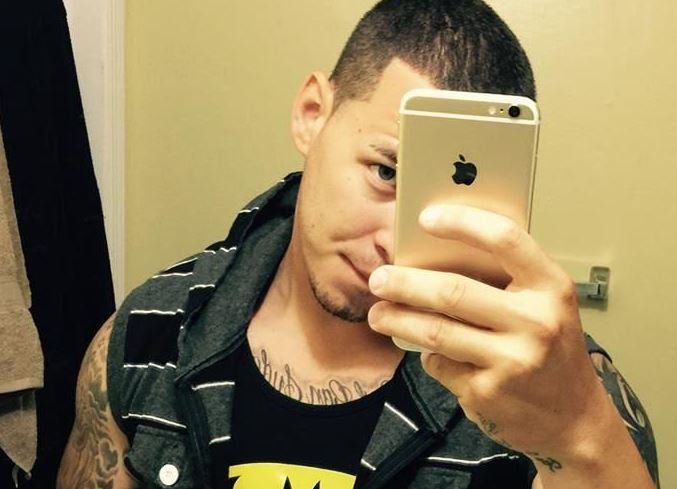
Harlem Suárez. Photo taken from Facebook.
Translation by Walter Lippmann.
Harlem Suarez, Cuban-born citizen, was sentenced to life in prison after being found guilty of attempting to blow up a bomb on a Florida beach and providing material support to the Islamic State group, the US Public Prosecutor’s Office reported today.
Judge José Martínez Suárez stated today that Suárez, 25, must spend the rest of his life in prison, as requested by the prosecution, who had considered Monday that this would be a “totally fair and reasonable” punishment for his crimes.
Suarez was sentenced to life in prison for attempting to use a weapon of mass destruction, and to an additional 20 years in prison for trying to provide support to a terrorist group, the prosecutor said.
The prosecution presented the recordings of the defendant’s conversations with the FBI undercover officers, in which they spoke of the explosive device.
Suarez, found guilty last January in a Florida Keys court, said during the trial that he had no real intention of blowing up a bomb, that he felt scared and intimidated by the police and that his interest was only to know, out of curiosity, the way in which the EI operates.
From the outset, defense lawyers tried to evade terrorism charges by arguing that their client has mental problems.
Suarez was arrested in mid-2015 by the FBI after being monitored by this entity since April of that year, when they detected that he had made comments of support to the Islamic State on his Facebook account.
According to the complaint, the Cuban met with an undercover FBI informant on multiple occasions with the intention of carrying out an attack in the country on behalf of the IS after publishing a series of violent messages in favor of the terrorist group on Facebook, under the name “Almlak Benítez”
(With information from EFE)
Miguel Barnet on US-Cuba Normalization
Miguel Barnet at Cuba normalization conference
New York City, March 2017
Transcribed by Carla Riehle. Edited by Walter Lippmann.
Gail Walker:
I’d like to now ask our brother Miguel Barnet to please come forward and to offer a few words. Distinguished member, leader of UNEAC, the union of writers and artists in Cuba.
Miguel Barnet:
Yes, dear friends and colleagues.
We are very, very happy, first of all to to have you here, and then to hear this message from Gerardo. You know of the five heroes, Gerardo is something very special. You know that. He’s a very talented young man and now very happy with three children, and that means a lot.
It comes to my mind the day that Fidel, in one of his speeches, said, “they will come back” and they are in Cuba now, so that’s something that we have to really recognize, and this is, in a way, something that belongs to you also, because you worked very hard for that occasion.
We Cubans are deeply proud of the solidarity expressed by people around the world to Cuba and particularly to the Cuban revolutionary process. Solidarity is one of the basic principles of the revolution led by Fidel and Raúl. The word solidarity carries the most sensitive feeling of Cubans who live in the island.
We were raised under this concept and it has been a daily practice for all of us. How can we analyze or discuss issues of revolutionary life if we do not take into account what we have done all over the world, not to mention medical aid to poor people, education or political support to countries that have suffered criminal and illegal wars.
Now, I would like to say Latin America has been a priority to us, but also, we have expressed our solidarity in international multi-lateral organizations like the African Union, the UN, UNESCO, the July 26 Coalition, Venceremos Brigade, Pastors for Peace and the recently-created CELAC. Fidel has been the icon of that struggle and he never gave up his principles, regardless of foreign pressure and blackmail. We all learn from him that solidarity is a keyword and a banner of socialism and humanism.
This is the reason why we admire all those people like you who have strengthened ties of friendship and support to our cause. I want to mention here just one name of a person who passed away last year and is definitely a symbol of that solidarity and also a symbol of friendship.
Saul Landau. He never had to say to [inaudible] hold hands together with all Cubans. He is, to me, one of the best examples of what a concrete action of solidarity represents.
I could also mention others: workers, students, intellectuals and ordinary people who massively backed us after the kidnapping of the boy Elián González.
I want to mention also others who always wrote serious articles analyzing the Cuban Revolution, such as Noam Chomsky, James Petras, Arnold August, just to say outstanding examples.
The struggle to free the Five Heroes was likewise a heroic feat where many took risks of persecution and harassment. What fair words can I use for such cooperation and embracing of Cuba and its population. You are anonymous heroes of this huge battle to achieve the goal of a new world that has to wipe up the poison seeds of capitalism and imperialism.
Not all of you, and I know that, are members of any party, maybe social organizations or labor unions, you’re mainly or basically honest people, well-meaning and decent, who have faced risky situations and then in dangerous fields You represent the good Americans, the land of Abraham Lincoln, Martin Luther King, Malcolm X, Lucius Walker, the land of truth and justice. We are conscious that you wish a participative democracy and not one that justifies crimes, corruption and lies.
How can we normalize relations if the embargo is not lifted right away, and the whole world demonstrates this with its vote in the United Nations? That is our biggest aim and I’m sure it is also yours. How can I be happy in this wonderful place, in this wonderful country, in this city, where I have lived and learned so many good things from your cultural heritage, if the embargo is not lifted?
If we can not make sometimes, at least in my case, make calls from my cell phone, I still don’t have roaming [service] to call my friends and especially my grandson in Cuba. I have to ask my colleague who comes with me, the deputy of the writers and artists union. The university’s telephone has roaming, not mine. I don’t know why. It’s a mystery. I think probably I have to buy a new one soon, anyway.
Okay. Why cannot we use dollars in our financial negotiations with Cuban and American banks? Why cannot I receive royalties of my books published in the United States? One of them has eight editions in the United States and I haven’t received a cent. Not one thing. Okay. That’s not important.
Because of the stupid and criminal embargo that we of course mentioned, with the very pointed definition of blockade, which is expressive of our feelings towards this country and ourselves. We’re neighbors, as President Obama declared and John Kerry repeated, upon the raising of the American flag in the new American Embassy in Havana. A neighbor is part of our family and I think we also belong to that family, the family that José Martí in New York called “Our America,” “nuestra America.”
We are also Americans with rumba that, by the way, was recently declared an international, tangible heritage and that’s a great feat also, thanks.
Latin jazz, cigars that still cannot be found in any airport of this country. Why? Isn’t that absurd? Absurdity, as the French philosopher and leader of the French Revolution, Talleyrand, said, is worse than a crime.
Let us shake hands and hugs for heaven’s sake. It’s enough. We need a new and common energy. We are people of peace and friendship.
Dear friends, on behalf of the Cuban writers and artists, and also of the Cuban people that I represent, thank you very, very much for your sincere solidarity that, believe me, has been more important to us than any prayer.
Cuba never will betray the ideas that our leader Fidel taught to us. Those ideas are ready to face all challenges and risks that we come across. This is a battle that we will win to honor his memory and follow his principles. Our national poet and hero, José Martí, who lived in this country for 15 years in the nineteenth century, wrote, “trenches of ideas are stronger than trenches of stone.”
Let us make that statement true always.
Thank you.
Venceremos.
The Limits of Trump’s Bravado
The Limits of Trump’s Bravado
By Manuel E. Yepe
Exclusive for daily POR ESTO! of Mérida, México.
http://manuelyepe.wordpress.com/
A CubaNews translation. Edited by Walter Lippmann.
“The use of Russian anti-aircraft defense systems by the Syrian army in retaliation to the US missile strike would have provoked a nuclear conflict. That did not come only thanks to the self-control that Vladimir Putin showed as Supreme Commander of Russia”, daily Izvestia daily reported, quoting Sergei Sudakov, member of the Academy of Military Sciences of the Russian Federation.
“Many Russian citizens believe Russia should have repelled the aggression. But those who think that way ignore that, had this been so, the shoot-down of US missiles would have provoked a scenario of conflict between two nuclear powers in the territory of a third country.” According to Sudakov, Trump placed humanity at the doors of a true “hot war”.
Military analyst Vladislav Shuryguin clarified in Pravda that the Russian air defense systems deployed in Syria defend the interests of Russia, and are under the military command of Russia. Thus, “when Israel or Turkey periodically bomb Syria, we can protect our air base and its facilities.” Shuryguin believes the Russians made a political decision, because the shooting-down of US missiles would have undoubtedly led to a conflict between Russia and the United States.
Meanwhile, the Russian Defense Ministry denounced the absence of evidence to support the US accusation about the existence of chemical weapons in the Syrian base of Al Shairat which the US used as the pretext to attack that facility.
Press media, firefighters, police and Syrian authorities who went to the base after the US airborne-Tomahawk missile aggression did not find the presence of deposits or bombs with chemical weapons. “People who work there are going about their tasks with total normality; no one is wearing special suits to handle toxic substances,” said Major General Igor Konashenkov, one of the Russian chiefs of the base.
Obviously, observers’ attention was drawn to the similarity between this situation and the white powder shown by Gen. Colin Powell to justify US aggression against Iraq in 2003, or the report to the Parliament of then-British Prime Minister, Anthony Blair, on alleged chemical weapons in that Arab country that same year.
Impartial observers say the United States used the events as a pretext to punish Syria. At the same time, the US attack would delay the defeat of the Islamic State which would consolidate the position of Bashar al-Assad, Syria’s legitimate leader.
The Syrian government is calling for the creation of an international committee of professional and independent professional experts to investigate the circumstances which led to the Washington’s attack on Syria. This would be the only legal body capable of verifying whether from that air base chemical weapons could have been used.
The Organization for the Prohibition of Chemical Weapons [OPCW] has pointed out that any manipulation or use of toxic substances leaves a trace that can be detected weeks and even months later.
Three years ago, the United Nations verified the total disarmament of chemical weapons in Syria. Therefore, specialized agencies of the world organization would now have to investigate just how the alleged return of this type of weapons to the country took place, and through which border.
All these justifications for the cruise-missile attack on Syria are inconsistent with Donald Trump’s statements during his election campaign. Trump announced that, if elected President, he would oppose the involvement of the nation in international conflicts, something undoubtedly in conflict with the agenda of the real power that governs the empire.
Trump had said he would prioritize the defeat of global terrorism, an objective that also contradicts this attack –which in fact prolongs the existence of the main enemy which he had said the United States should focus on– because, with this attack, he saved the Islamic State from imminent defeat at the hands of the Syrian army.
It has become clear, once again, that the underlying policy of the United States, whoever is President and whichever party is in government, is to prolong wars as much as possible in the interest of profit for the industrial military complex.
Donald Trump clearly is not as absurd as it appears in the performance of his presidency. The thing is that the goals he proclaims are almost never real goals. Sometimes they only express a part of his true objectives, to which he intends to arrive by sleight-of-hand.
Trump’s bravado as president no doubt has its limit there where it surpasses the guidelines fixed by the real power that is not achieved in democratic facade elections.
April 11, 2017.
The Market Forgot About the Elderly

The Market Forgot About the Elderly
By Roberto Alfonso Lara
April 5, 2017
A CubaNews translation. Edited by Walter Lippmann.
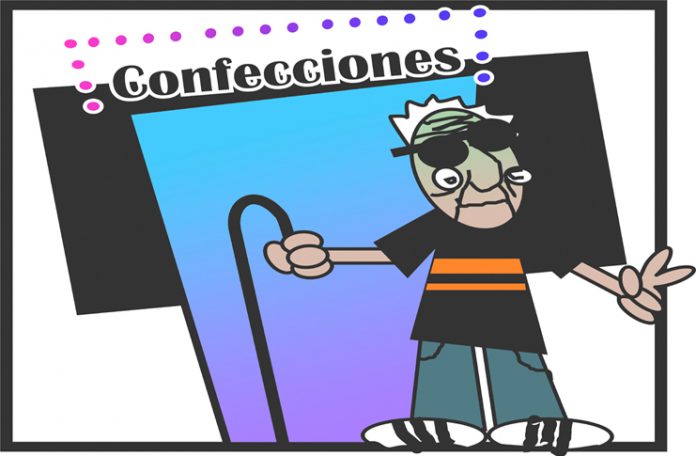
In terms of marketing, older people are little valued in the country as an economically attractive group. Illustration by Ari
Living a comfortable old age can be the aspiration of anyone in the world. Some even set it as a goal and work hard to achieve it. But this effort at the individual or family level requires socio-economic support. This implies changes in health-care services, transportation, the stores…
For several years, Cuba has given emphasis to policies to protect senior citizens. The irreversible aging of its population has led to a number of transformations, essentially in public health. Other sectors remain oblivious to the challenge. Marketwise, for example, old people are forgotten.
The country´s stores disregard the needs and preferences of the elderly. The sale of clothing, footwear and food without adjustment to their demands, is proof of the low visibility of this age group in commercial matters. When it comes to selling, gray hair is usually not taken into account.
Somehow, I think there is an incomplete perception about the elderly, which doesn’t realize their true potential. A degree of conformism is attributed to them. The limited satisfaction of their urgent needs often follows that premise. It is usually thought that, due to their age, they lack tastes and interests, and that anything will be good for them.
Neither slippers nor pajamas nor “home scrubs” at reasonable prices are to be found in stores. Neither are light fabric clothing, nor shoes with the proper design to cope with corns and bunions, or anything that gratifies or pleases them. They do stumble upon sneakers and high heels, shiny blouses and tight pants.
Domestically-made garments hardly fill the vacuum. The use of textiles inadequate for Cuba’s hot climate (polyester instead of cotton), make the articles on sale of little use. Industry needs, first, to know in detail the type of customer to whom its products are intended. The same happens with prices, which bear no relationship with the very little money pensioners receive.
In terms of marketing, older people are scarcely valued in the country as an economically attractive group. Nevertheless, nations with similar demographic characteristics find in seniors numerous possibilities as consumers. Several specialists have even argued that the future of the market lies in the grandparents.
If in 2025 one in four Cubans will be over 60, wouldn’t it be appropriate to take another look at the issue? The care of the elderly –a strategic issue in the development of the nation– requires the implementation of comprehensive action in pursuit of greater comfort and quality of life.
The construction and repair of nursing homes and grandparents’ homes, along with new geriatrics clinics, anticipate the way forward. The other lap corresponds to the spheres of production and services. These are still permeated with the stereotype that the elderly do not buy enough.
Because of the size of the changes required, it may be difficult to deal with the needs of old age. For Cuba’s weak economy it is, in fact, a problem. However, all the elements should be thought of instead of continuing to postpone possible options. Not only in terms of clothing or food, also in the constant supply of wheelchairs, canes, hearing aids, mattresses, beds…
The government’s own interest in promoting the active participation of senior adults in the socio-economic life of the country clearly speaks of the need for reorienting the compass towards the current demographic process. Consequently, it is a task for the market to review its current situation and expand what’s available. The elderly, like other generations, need to see their reflection own in the mirror.
Trump, President of the United States
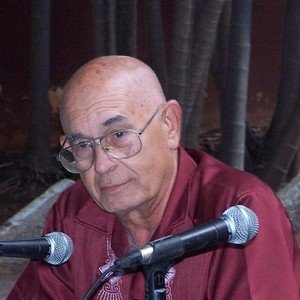
Trump, President of the United States
By Dr. Néstor García Iturbe
April 7, 2017
CubaNews translation by Walter Lippmann.
Recently Donald Trump has begun to show that he is already learning to behave as a true president of the United States. This was shown yesterday, when he ordered that more than fifty Tomahawk missiles be launched against a Syrian air base, under the pretext that the Syrians had used chemical weapons against civilians and opposition troops.
Bashar al-Assad, who was accused of ordering the attack, which was actually launched by the opposition forces themselves, who have been handed over by Turkey. This action in no way benefited the United States’ position in the Syrian conflict, when it was argued that it was no longer a priority of its foreign policy to overthrow Assad.
The true beneficiary of what happened is Israel. It was quick to endorse the attack and encourage an appropriate response from the United States. Trump’s positions have also been strengthened, as he justifies the requested increase in the Pentagon’s budget and allows him to show a strongman image to his Chinese guest, Xi Jimping, with whom he must analyze, among other things, the situation of North Korea’s atomic development.
Among those demanding this type of action is Hillary Clinton, who came out of her lethargy last Tuesday, stating that “the United States ought to bomb Syrian military air bases in response to the apparent chemical attack.” The big American press has commented on the fact, but it has not condemned it. So far, as far as I know, no major popular demonstrations against Trump are being organized for the bombing of the Syrian base.
Of course, we will always find those who want to magnify this situation as another sign of their aversion to Trump and that they are still suffering from Hillary’s defeat. Expressing himself thus was a sign of his ignorance in relation to what the United States represents in the world, what his foreign policy is and how a president of that nation acts. By the way, in Trump’s case, although he deserves to be criticized for bombing the Syrian base, we can say that by comparing this with what was done by Obama, Winner of the Nobel Prize for War, he still reveals himself to be a beginner.
In Afghanistan, where US troops are still found, bombings and other military actions have cost the American taxpayer more than $3 billion, the death of about 2400 military and hundreds of thousands of civilians.
In Iraq, the ongoing military adventure has cost more than $6 billion, 4500 military personnel killed, 33,000 wounded and more than one million Iraqi civilians killed.
In Libya, daily bombings ordered by the binomial Obama-Hillary cost $1.1 billion, in addition to the Libyan military, and killed more than 80,000 civilians. Still, war continues and civilians continue to die.
In Syria, where the Obama administration began its participation in the war on September 10, 2014, activities began precisely by bombing different facilities in the capital and other cities as part of supporting anti-government forces. It is estimated that the bombings have cost about $800 million dollars, in training and logistical support to the rebels $600 million. As a result of the bombings and actions carried out by the rebels, more than 100,000 civilians have died and a large part of the country has been destroyed.
We could say that Trump is still warming up, he started pitching in this inning and he may give a good performance, but to beat pitchers like Obama he needs a lot more experience.
I hope this will help some of our compañeros gain a true understanding of a US president’s way of acting and not be surprised when he orders a bombing of a military base or a coup in Venezuela. That is part of his job.
Jodie Foster meets the Acosta Dance Company
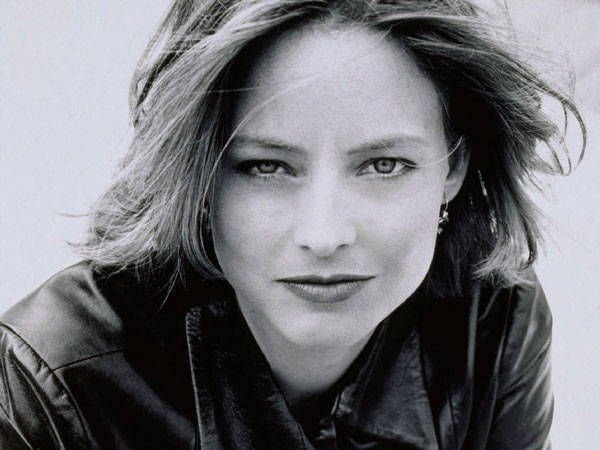
Jodie Foster meets the Acosta Dance Company
American actress and film director Jodie Foster is visiting Havana, where she attended an “Acosta Danza” rehearsal this Thursday and held a dialogue with the members of the company founded and directed by Cuban dancer Carlos Acosta.
From the presence of Foster, winner of two Oscars for best actress in 1989 and 1992, at the headquarters of “Acosta Danza” the photos talem posted on the page of the set on Facebook, which she appears with the dancers.
Foster witnessed the rehearsals of “Belles Lettres,” a piece by New York City Ballet’s resident choreographer, Justin Peck. It will be premiered in the upcoming spring season of “Acosta Danza,” scheduled for April 21-23 at the “Alicia Alonso” Gran Theater of Havana.
Peck created Belles-Lettres in 2004 for the NYCB. It became became one of the trump cards of the American choreographer right away.
He was also able to appreciate the preparation for the work “Fauno” by the Belgian choreographer Sidi Larbi and the duet “Nosotros” by Cubans Beatriz García and Rafael Reinoso, according to Lester Vila, a spokesman for Cuban dance company .
Jodie Foster, internationally recognized for her roles in films such as “Taxi Driver”, “Silence of the Lambs” and “Panic Room”, now joins a list of US artists. Who have visited Cuba following the approach initiated by Havana and Washington in December 2014 and the diplomatic thaw that took place months later.
Since then, Cuba has become a tourism destination, and has been visited by American film actors such as Robert de Niro, Ethan Hawke and Tim Robbins, and music figures such as Madonna, Katy Perry and Rihanna and the rocker Jon Bon Jovi.
A CubaNews translation. Edited by Walter Lippmann.
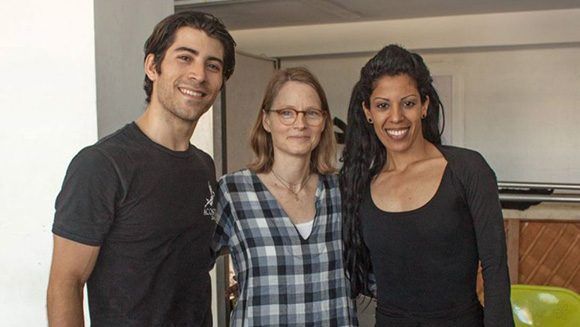
Josie Foster visits the studio of the Acosta Dance Company. Photo: Facebook/Acosta Danza
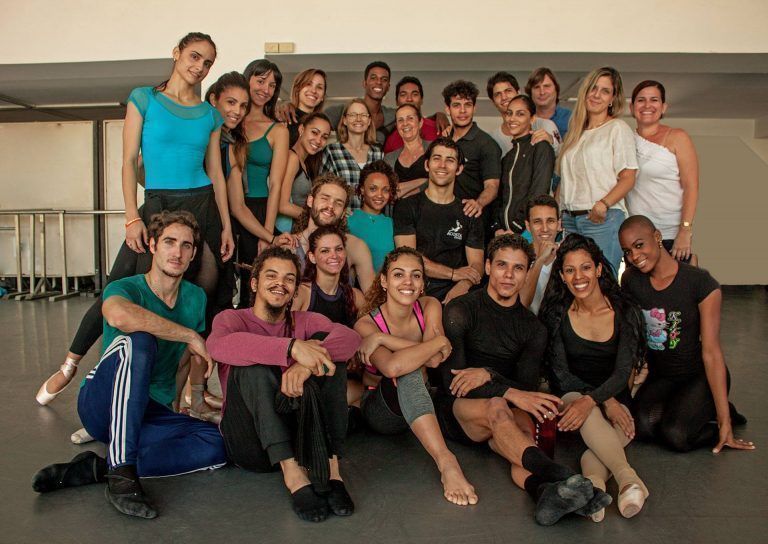
Josie Foster visits the studio of the Acosta Dance Company. Photo: Facebook/Acosta Danza
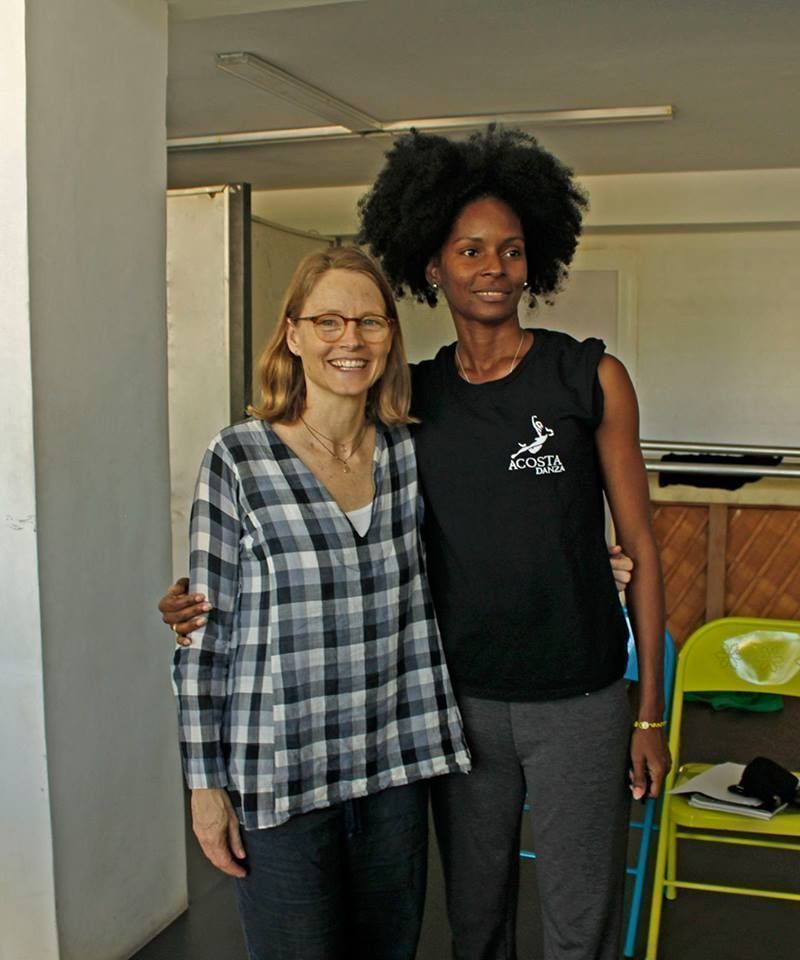
Josie Foster visits the studio of the Acosta Dance Company. Photo: Facebook/Acosta Danza
Jodie Foster shares with CENESEX specialists
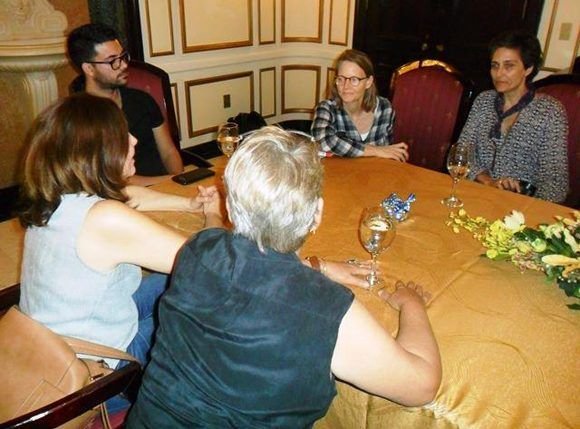
Jodie Foster shares with CENESEX specialists
Jodie Foster discusses the work of the National Center for Sex Education (Cenesex) with Dr. Mariela Castro. Photo: Taken from the Facebook of Mariela Castro.
A CubaNews translation by Walter Lippmann.
Recently, actress and American film director Jodie Foster was in Cuba. During her visit to Havana, the winner of two Oscars for Best Actress in 1989 and 1992 shared with specialists from the National Center for Sex Education (CENESEX).
Dr. Mariela Castro Espín shared her impressions about the meeting with Jodie on Facebook today:
“It was a pleasant surprise that the American actress Jodie Foster showed interest in knowing about our work at Cenesex Cuba, during her recent private visit to the Island with her wife, Alexandra Hedison, and her sons Charles and Kit, with whom we had a beautiful family evening” .
Open to scientific search, exchange of experiences and dialogue of knowledge, CENESEX counts on professionals of recognized prestige from different scientific disciplines who use a comprehensive approach in the study of sexuality.
Foster, whose performances in Taxi Driver, The Silence of the Lambs and Panic Room have always been in the memory of her followers, has now been added to the list of artists of the United States who have visited the Island after the approach initiated by Havana and Washington in December 2014.
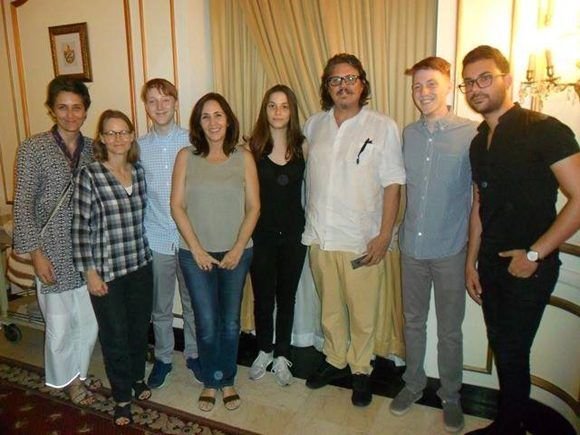
Jodie Foster took a family photo with Cenesex specialists. Photo: Taken from the Facebook page of Mariela Castro
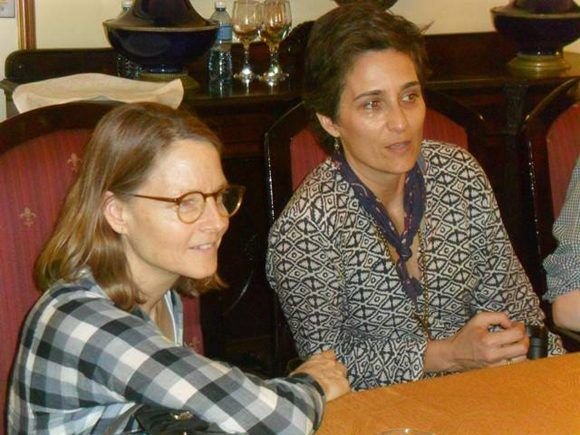
Jodie Foster together with her wife Alexandra Hedison. Taken from the Facebook page of Mariela Castro.
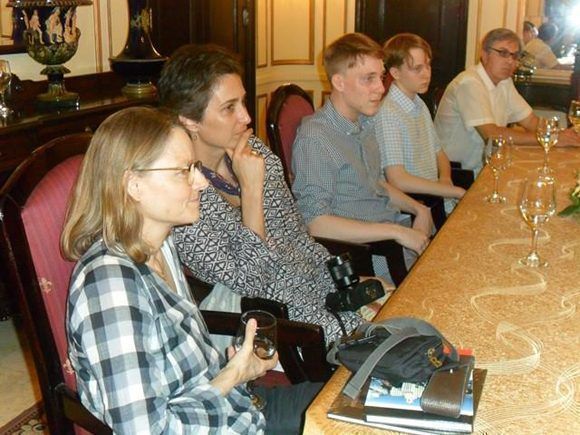
During her visit to Havana, the winner of two Oscars for Best Actress in 1989 and 1992 shared with Cenesex specialists. Photo: Taken from of the Facebook page of Mariela Castro.
You must be logged in to post a comment.