The Cuba Embargo Needs To Go
Hillary Clinton: The Cuba Embargo
Needs To Go, Once And For All
July 31, 2015
In Miami today, Hillary Clinton forcefully expressed her support for normalization of U.S. relations with Cuba and formally called on Congress to lift the Cuba embargo. Hillary emphasized that she believes we need to increase American influence in Cuba, not reduce it — a strong contrast with Republican candidates who are stuck in the past, trying to return to the same failed Cold War-era isolationism that has only strengthened the Castro regime.
To those Republicans, her message was clear: “They have it backwards: Engagement is not a gift to the Castros – it’s a threat to the Castros. An American embassy in Havana isn’t a concession – it’s a beacon. Lifting the embargo doesn’t set back the advance of freedom – it advances freedom where it is most desperately needed.”
A full transcript of the remarks is included below:
“Thank you. Thank you very much. Thank you. I want to thank Dr. Frank Mora, director of the Kimberly Latin American and Caribbean Center and a professor here at FIU, and before that served with distinction at the Department of Defense. I want to recognize former Congressman Joe Garcia. Thank you Joe for being here – a long time friend and an exemplary educator. The President of Miami-Dade College, Eduardo Padrón and the President of FIU, Mark Rosenberg – I thank you all for being here. And for me it’s a delight to be here at Florida International University. You can feel the energy here. It’s a place where people of all backgrounds and walks of life work hard, do their part, and get ahead. That’s the promise of America that has drawn generations of immigrants to our shores, and it’s a reality right here at FIU.
“Today, as Frank said, I want to talk with you about a subject that has stirred passionate debate in this city and beyond for decades, but is now entering a crucial new phase. America’s approach to Cuba is at a crossroads, and the upcoming presidential election will determine whether we chart a new path forward or turn back to the old ways of the past. We must decide between engagement and embargo, between embracing fresh thinking and returning to Cold War deadlock. And the choices we make will have lasting consequences not just for more than 11 million Cubans, but also for American leadership across our hemisphere and around the world.
“I know that for many in this room and throughout the Cuban-American community, this debate is not an intellectual exercise – it is deeply personal.
“I teared up as Frank was talking about his mother—not able to mourn with her family, say goodbye to her brother. I’m so privileged to have a sister-in-law who is Cuban-American, who came to this country, like so many others as a child and has chartered her way with a spirit of determination and success.
“I think about all those who were sent as children to live with strangers during the Peter Pan airlift, for families who arrived here during the Mariel boatlift with only the clothes on their backs, for sons and daughters who could not bury their parents back home, for all who have suffered and waited and longed for change to come to the land, “where palm trees grow.” And, yes, for a rising generation eager to build a new and better future.
“Many of you have your own stories and memories that shape your feelings about the way forward. Like Miriam Leiva, one of the founders of the Ladies in White, who is with us today – brave Cuban women who have defied the Castro regime and demanded dignity and reform. We are honored to have her here today and I’d like to ask her, please raise your hand. Thank you.
“I wish every Cuban back in Cuba could spend a day walking around Miami and see what you have built here, how you have turned this city into a dynamic global city. How you have succeeded as entrepreneurs and civic leaders. It would not take them long to start demanding similar opportunities and achieving similar success back in Cuba.
“I understand the skepticism in this community about any policy of engagement toward Cuba. As many of you know, I’ve been skeptical too. But you’ve been promised progress for fifty years. And we can’t wait any longer for a failed policy to bear fruit. We have to seize this moment. We have to now support change on an island where it is desperately needed.
“I did not come to this position lightly. I well remember what happened to previous attempts at engagement. In the 1990s, Castro responded to quiet diplomacy by shooting down the unarmed Brothers to the Rescue plane out of the sky. And with their deaths in mind, I supported the Helms-Burton Act to tighten the embargo.
“Twenty years later, the regime’s human rights abuses continue: imprisoning dissidents, cracking down on free expression and the Internet, beating and harassing the courageous Ladies in White, refusing a credible investigation into the death of Oswaldo Paya. Anyone who thinks we can trust this regime hasn’t learned the lessons of history.
“But as Secretary of State, it became clear to me that our policy of isolating Cuba was strengthening the Castros’ grip on power rather than weakening it – and harming our broader efforts to restore American leadership across the hemisphere. The Castros were able to blame all of the island’s woes on the U.S. embargo, distracting from the regime’s failures and delaying their day of reckoning with the Cuban people. We were unintentionally helping the regime keep Cuba a closed and controlled society rather than working to open it up to positive outside influences the way we did so effectively with the old Soviet bloc and elsewhere.
“So in 2009, we tried something new. The Obama administration made it easier for Cuban Americans to visit and send money to family on the island. No one expected miracles, but it was a first step toward exposing the Cuban people to new ideas, values, and perspectives.
“I remember seeing a CNN report that summer about a Cuban father living and working in the United States who hadn’t seen his baby boy back home for a year-and-a-half because of travel restrictions. Our reforms made it possible for that father and son finally to reunite. It was just one story, just one family, but it felt like the start of something important.
“In 2011, we further loosened restrictions on cash remittances sent back to Cuba and we opened the way for more Americans – clergy, students and teachers, community leaders – to visit and engage directly with the Cuban people. They brought with them new hope and support for struggling families, aspiring entrepreneurs, and brave civil society activists. Small businesses started opening. Cell phones proliferated. Slowly, Cubans were getting a taste of a different future.
“I then became convinced that building stronger ties between Cubans and Americans could be the best way to promote political and economic change on the island. So by the end of my term as Secretary, I recommended to the President that we end the failed embargo and double down on a strategy of engagement that would strip the Castro regime of its excuses and force it to grapple with the demands and aspirations of the Cuban people. Instead of keeping change out, as it has for decades, the regime would have to figure out how to adapt to a rapidly transforming society.
“What’s more, it would open exciting new business opportunities for American companies, farmers, and entrepreneurs – especially for the Cuban-American community. That’s my definition of a win-win.
“Now I know some critics of this approach point to other countries that remain authoritarian despite decades of diplomatic and economic engagement. And yes it’s true that political change will not come quickly or easily to Cuba. But look around the world at many of the countries that have made the transition from autocracy to democracy – from Eastern Europe to East Asia to Latin America. Engagement is not a silver bullet, but again and again we see that it is more likely to hasten change, not hold it back.
“The future for Cuba is not foreordained. But there is good reason to believe that once it gets going, this dynamic will be especially powerful on an island just 90 miles from the largest economy in the world. Just 90 miles away from one and a half million Cuban-Americans whose success provides a compelling advertisement for the benefits of democracy and an open society.
“So I have supported President Obama and Secretary Kerry as they’ve advanced this strategy. They’ve taken historic steps forward – re-establishing diplomatic relations, reopening our embassy in Havana, expanding opportunities further for travel and commerce, calling on Congress to finally drop the embargo.
“That last step about the embargo is crucial, because without dropping it, this progress could falter.
“We have arrived at a decisive moment. The Cuban people have waited long enough for progress to come. Even many Republicans on Capitol Hill are starting to recognize the urgency of moving forward. It’s time for their leaders to either get on board or get out of the way. The Cuba embargo needs to go, once and for all. We should replace it with a smarter approach that empowers Cuban businesses, Cuban civil society, and the Cuban-American community to spur progress and keep pressure on the regime.
“Today I am calling on Speaker Boehner and Senator McConnell to step up and answer the pleas of the Cuban people. By large majorities, they want a closer relationship with America.
“They want to buy our goods, read our books, surf our web, and learn from our people. They want to bring their country into the 21st century. That is the road toward democracy and dignity and we should walk it together.
“We can’t go back to a failed policy that limits Cuban-Americans’ ability to travel and support family and friends. We can’t block American businesses that could help free enterprise take root in Cuban soil – or stop American religious groups and academics and activists from establishing contacts and partnerships on the ground.
“If we go backward, no one will benefit more than the hardliners in Havana. In fact, there may be no stronger argument for engagement than the fact that Cuba’s hardliners are so opposed to it. They don’t want strong connections with the United States. They don’t want Cuban-Americans traveling to the island. They don’t want American students and clergy and NGO activists interacting with the Cuban people. That is the last thing they want. So that’s precisely why we need to do it.
“Unfortunately, most of the Republican candidates for President would play right into the hard-liners’ hands. They would reverse the progress we have made and cut the Cuban people off from direct contact with the Cuban-American community and the free-market capitalism and democracy that you embody. That would be a strategic error for the United States and a tragedy for the millions of Cubans who yearn for closer ties.
“They have it backwards: Engagement is not a gift to the Castros – it’s a threat to the Castros. An American embassy in Havana isn’t a concession – it’s a beacon. Lifting the embargo doesn’t set back the advance of freedom – it advances freedom where it is most desperately needed.
“Fundamentally, most Republican candidates still view Cuba – and Latin America more broadly – through an outdated Cold War lens. Instead of opportunities to be seized, they see only threats to be feared. They refuse to learn the lessons of the past or pay attention to what’s worked and what hasn’t. For them, ideology trumps evidence. And so they remain incapable of moving us forward.
“As President, I would increase American influence in Cuba, rather than reduce it. I would work with Congress to lift the embargo and I would also pursue additional steps.
“First, we should help more Americans go to Cuba. If Congress won’t act to do this, I would use executive authority to make it easier for more Americans to visit the island to support private business and engage with the Cuban people.
“Second, I would use our new presence and connections to more effectively support human rights and civil society in Cuba. I believe that as our influence expands among the Cuban people, our diplomacy can help carve out political space on the island in a way we never could before.
“We will follow the lead of Pope Francis, who will carry a powerful message of empowerment when he visits Cuba in September. I would direct U.S. diplomats to make it a priority to build relationships with more Cubans, especially those starting businesses and pushing boundaries. Advocates for women’s rights and workers’ rights. Environmental activists. Artists. Bloggers. The more relationships we build, the better.
“We should be under no illusions that the regime will end its repressive ways any time soon, as its continued use of short-term detentions demonstrates. So we have to redouble our efforts to stand up for the rights of reformers and political prisoners, including maintaining sanctions on specific human-rights violators. We should maintain restrictions on the flow of arms to the regime – and work to restrict access to the tools of repression while expanding access to tools of dissent and free expression.
“We should make it clear, as I did as Secretary of State, that the “freedom to connect” is a basic human right, and therefore do more to extend that freedom to more and more Cubans – particularly young people.
“Third, and this is directly related, we should focus on expanding communications and commercial links to and among the Cuban people. Just five percent of Cubans have access to the open Internet today. We want more American companies pursuing joint ventures to build networks that will open the free flow of information – and empower everyday Cubans to make their voices heard. We want Cubans to have access to more phones, more computers, more satellite televisions. We want more American airplanes and ferries and cargo ships arriving every day. I’m told that Airbnb is already getting started. Companies like Google and Twitter are exploring opportunities as well.
“It will be essential that American and international companies entering the Cuban market act responsibly, hold themselves to high standards, use their influence to push for reforms. I would convene and connect U.S. business leaders from many fields to advance this strategy, and I will look to the Cuban-American community to continue leading the way. No one is better positioned to bring expertise, resources, and vision to this effort – and no one understands better how transformative this can be.
“We will also keep pressing for a just settlement on expropriated property. And we will let Raul explain to his people why he wants to prevent American investment in bicycle repair shops, in restaurants, in barbershops, and Internet cafes. Let him try to put up barriers to American technology and innovation that his people crave.
“Finally, we need to use our leadership across the Americas to mobilize more support for Cubans and their aspirations. Just as the United States needed a new approach to Cuba, the region does as well.
“Latin American countries and leaders have run out of excuses for not standing up for the fundamental freedoms of the Cuban people. No more brushing things under the rug. No more apologizing. It is time for them to step up. Not insignificantly, new regional cooperation on Cuba will also open other opportunities for the United States across Latin America.
“For years, our unpopular policy towards Cuba held back our influence and leadership. Frankly, it was an albatross around our necks. We were isolated in our opposition to opening up the island. Summit meetings were consumed by the same old debates. Regional spoilers like Venezuela took advantage of the disagreements to advance their own agendas and undermine the United States. Now we have the chance for a fresh start in the Americas.
“Strategically, this is a big deal. Too often, we look east, we look west, but we don’t look south. And no region in the world is more important to our long-term prosperity and security than Latin America. And no region in the world is better positioned to emerge as a new force for global peace and progress.
“Many Republicans seem to think of Latin America still as a land of crime and coups rather than a place where free markets and free people are thriving. They’ve got it wrong. Latin America is now home to vibrant democracies, expanding middle classes, abundant energy supplies, and a combined GDP of more than $4 trillion.
“Our economies, communities, and even our families are deeply entwined. And I see our increasing interdependence as a comparative advantage to be embraced. The United States needs to build on what I call the “power of proximity.” It’s not just geography – it’s common values, common culture, common heritage. It’s shared interests that could power a new era of partnership and prosperity. Closer ties across Latin America will help our economy at home and strengthen our hand around the world, especially in the Asia-Pacific. There is enormous potential for cooperation on clean energy and combatting climate change.
“And much work to be done together to take on the persistent challenges in our hemisphere, from crime to drugs to poverty, and to stand in defense of our shared values against regimes like that in Venezuela. So the United States needs to lead in the Latin America. And if we don’t, make no mistake, others will. China is eager to extend its influence. Strong, principled American leadership is the only answer. That was my approach as Secretary of State and will be my priority as President.
“Now it is often said that every election is about the future. But this time, I feel it even more powerfully. Americans have worked so hard to climb out of the hole we found ourselves in with the worst financial crisis since the Great Depression in 2008. Families took second jobs and second shifts. They found a way to make it work. And now, thankfully, our economy is growing again.
“Slowly but surely we also repaired America’s tarnished reputation. We strengthened old alliances and started new partnerships. We got back to the time-tested values that made our country a beacon of hope and opportunity and freedom for the entire world. We learned to lead in new ways for a complex and changing age. And America is safer and stronger as a result.
“We cannot afford to let out-of-touch, out-of-date partisan ideas and candidates rip away all the progress we’ve made. We can’t go back to cowboy diplomacy and reckless war-mongering. We can’t go back to a go-it-alone foreign policy that views American boots on the ground as a first choice rather than as a last resort. We have paid too high a price in lives, power, and prestige to make those same mistakes again. Instead we need a foreign policy for the future with creative, confident leadership that harnesses all of America’s strength, smarts, and values. I believe the future holds far more opportunities than threats if we shape global events rather than reacting to them and being shaped by them. That is what I will do as President, starting right here in our own hemisphere.
“I’m running to build an America for tomorrow, not yesterday. For the struggling, the striving, and the successful. For the young entrepreneur in Little Havana who dreams of expanding to Old Havana. For the grandmother who never lost hope of seeing freedom come to the homeland she left so long ago. For the families who are separated. For all those who have built new lives in a new land. I’m running for everyone who’s ever been knocked down, but refused to be knocked out. I am running for you and I want to work with you to be your partner to build the kind of future that will once again not only make Cuban-Americas successful here in our country, but give Cubans in Cuba the same chance to live up to their own potential.
Thank you all very, very much.”
###
For Immediate Release, July 31, 2015
Contact: press@hillaryclinton.com
PAID FOR BY HILLARY FOR AMERICA
Contributions or gifts to Hillary for America are not tax deductible.
Hillary for America, PO Box 5256, New York
Cuban media coverage, an example:
Hillary Clinton Calls in Miami for Lifting of U.S. blockade on Cuba
HAVANA, Cuba, Aug 1 (acn) Democrat pre-candidate to the 2016 presidential elections in the United States, Hillary Clinton, asked Congress on Friday, from Miami, Florida, to lift the economic, commercial and financial blockade imposed on Cuba since 1962, the Prensa Latina news agency reported.
In a speech at the International University of Florida, the former Secretary of State asked lawmakers to take advantage of this decisive moment, after the resumption of diplomatic relations between the two countries and the reopening of embassies in the respective capitals on July 20.
The U.S. policy towards Cuba is at a crossroads and next year’s elections by the White House will determine whether we will carry on with a new course in this regard or return to the old ways of the past, she added.
We must decide between commitment and sanctions, between adopting new thinking and returning to the deadlock we were during the Cold War, she pointed out.
She added that even many Republicans on Capitol Hill are beginning to recognize the urgency of continuing onward to dismantle the sanctions and this is the moment when their leaders must join this task or get out of the way of those who carry on.
Clinton added that the blockade must end once and for all; we must replace it with “more intelligent measures that manage to consolidate the interests of the United States,” and called the red party leadership on Capitol Hill to join this policy.
The former Secretary of State reiterated her support for the policy of rapprochement with the island that began after December 17, when Cuban President Raul Castro and his U.S. counterpart, Barack Obama, announced the decision of reestablishing diplomatic relations.
For years, the state of Florida was the base of a strong opposition to bonds with Havana, which made the blockade an untouchable issue among those who aspired to be elected for posts in that territory, especially for Republicans.
On several occasions, the former first lady has defended the lifting of the blockade against the Caribbean nation, particularly in her book Hard Choices, in which she assures that while she was Secretary of State (2009-2013) she recommended Obama to review the policy towards Cuba.
A survey conducted last week by the Pew Research Center showed that 72 percent of U.S. citizens are in favor of lifting the blockade against Cuba and 73 percent approve Obama’s decision of reestablishing diplomatic relations with the Caribbean island.
A survey by the McClatchy newspaper chain and the Marist Institute for Public Opinion released on Friday showed that 44 percent of likely voters prefer Clinton; 29 percent Republican Jeb Bush; and 20 percent controversial aspirant Donald Trump, for the November 2016 elections.
Socialist Democracy in Practice
Socialist Democracy in Practice
 By Manuel E. Yepe
http://manuelyepe.wordpress.com/
Exclusive for the daily POR ESTO! of Merida, Mexico.
Translated and edited by Walter Lippmann.
Cubans are going to the polls on Sunday, March 11th to elect members of the Provincial Assemblies of People’s Power and deputies to the National Assembly of Cuba.
From this democratic exercise will emerge the new Cuban parliament and its superior body, the new Council of State, which in turn will elect the new president of the Republic of Cuba, the successor to General Raúl Castro Ruz who has been in charge of the government of the nation since 2008.
Raúl initially occupied the position by a statutory substitution, as President Fidel Castro Ruz became ill and it was incumbent upon him to replace him in accordance with his duties as First Vice-President. During the two consecutive presidential terms that followed, he was elected by the will of the citizens expressed at the ballot box, President of the State Councils and Ministers.
But this time Raul has announced his decision not to run for re-election.
Raúl Castro has been, since the beginning of the armed struggle against Batista’s tyranny, the second figure in the leadership of the revolution. His performance at the head of the government has earned him an increase in the prestige he already had for his performance at the head of the country’s defense.
No one questions his authority and the enormous popularity among the people that would enable him to continue in the presidential office in a new period. But Raul Castro himself has advocated the need to work for the renewal of the leaders of the revolution and the government, which, in the eyes of the people, has made it necessary to abide by his decision not to continue in office in the payment of a debt of gratitude to his President.
For more than six decades, Cuba has been engaged in a permanent war of resistance with the American superpower, in which an extraordinary trust of the island’s population in its historical leaders has been forged.
Neither Raul nor any other figure of great revolutionary authority in the population has indicated his preference for any individual for the highest state office, abiding by principles that the historical leadership of the revolution has defended and practiced of preferring the progressive renewal of leaders and cadres from the roots.
The design of the Cuban electoral system was based on contributions from constitutional lawyers and other specialists committed to the independence and respect for the will of the Cuban people. It is not a copy of other systems, although it is based on the results of the analysis of texts prepared by the founding independentistas of the Cuban nation. It’s also based on a study by Cuban experts of electoral systems of many countries in Latin America and other nations of the world. All this was systematically enriched by the practice of a population with an incomparably higher level of education and culture than before the revolutionary triumph of 1959.
In Cuba there exists, by constitutional requirement, a single party that, however, is not an electoral party nor does it participate at all in the electoral processes. Rather, it acts as the binding authority of all the people in order to defend the independence of the nation and prevent its absorption by the neighboring imperialist superpower. This is a latent danger since Cuba ceased to be a Spanish colony after bloody liberating wars from 1868 to the ending of the 19th century, based on many heroes and great sacrifices.
Election advertising is prohibited on the island today. Neighbors of the communities elect their delegates from among themselves, who are members of the municipal assemblies, an exercise that is the essential basis of the system’s total democracy.
In the municipal assemblies made up of delegates from the base, candidates are elected to be members of the provincial assemblies and deputies to the National Assembly of People’s Power.
The latter elects the Council of State, composed of some twenty members, and the latter elects its President, the Head of State, who is also the head of the Government.
All elected representatives, from the base delegates to the President of the Republic, are required to report on their performance several times during the year to those who elected them.
The initial inspiration has been Greek democratic assemblies. However, unlike those, from which slaves were excluded, the voters are men and women; white, black and mestizo; civil and military: the whole range of Cuban society. There are no no limits other than those that restrict the rights of some whose legal sanction, determines it, and which is imposed by the corresponding judicial authorities.
The system is still perfectible. But its statutes require that any modification must always be aimed at bringing the country’s political leadership closer to the people, bearing in mind the essential fact that the hegemonic power in Cuba is always and only in the hands of the Cuban people.
March 8, 2018
Translated with www.DeepL.com/Translator
“Los adultos se están comportando como niños.”
HARPER’S BAZAAR
“Los adultos se están comportando como niños.”
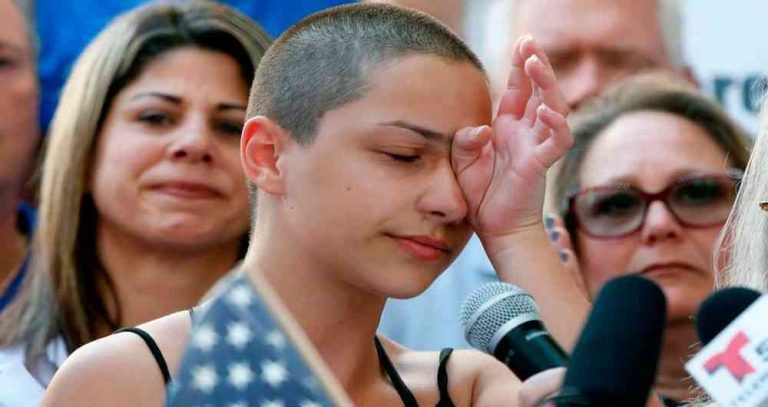
Emma González, estudiante de Parkland, se sincera sobre su lucha por el control de armas
By Emma González
26 de febrero 2018
Una traducción de CubaNews. Editado por Walter Lippmann.
Mi nombre es Emma González. Tengo 18 años, soy cubana y bisexual. Me siento tan indecisa que no logro decidir cuál es mi color favorito, y soy alérgica a 12 cosas. Sé dibujar, pintar, hacer croché, coser, bordar—cualquier cosa productiva que pueda hacer con mis manos mientras veo Netflix.
Pero ya nada de esto importa.
Lo que importa es que la mayoría de los estadounidenses se han vuelto autocomplacientes frente a toda la injusticia sin sentido que ocurre a su alrededor. Lo que importa es que la mayoría de los políticos estadounidenses se han dejado dominar más por el dinero que por las personas que votaron por ellos. Lo que importa es que mis amigos están muertos, al igual que cientos y cientos que también han muerto en todo Estados Unidos.
Mi nombre es Emma González. Tengo 18 años, soy cubana y bisexual. Me siento tan indecisa que no logro decidir cuál es mi color favorito, y soy alérgica a 12 cosas. Sé dibujar, pintar, hacer croché, coser, bordar—cualquier cosa productiva que pueda hacer con mis manos mientras veo Netflix.
Pero ya nada de esto importa.
Lo que importa es que la mayoría de los estadounidenses se han vuelto autocomplacientes frente a toda la injusticia sin sentido que ocurre a su alrededor. Lo que importa es que la mayoría de los políticos estadounidenses se han dejado dominar más por el dinero que por las personas que votaron por ellos. Lo que importa es que mis amigos están muertos, al igual que cientos y cientos que también han muerto en todo Estados Unidos.
En resumidas cuentas, no queremos que a las personas les quiten sus armas. Sólo queremos que las personas sean más responsables. Queremos que los civiles tengan que hacer muchos más trámites para obtener lo que quieren, porque si esos trámites pueden impedirle tener un arma a quienes no deberían tenerla, entonces nuestro gobierno habrá hecho algo bien. Todo cuanto queremos es regresar a la escuela. Pero queremos saber que cuando entremos allí no tendremos que preocuparnos por la posibilidad de vernos frente al cañón de un arma. Queremos arreglar este problema para que no vuelva a ocurrir, pero sobre todo queremos que la gente se olvide de nosotros cuando todo esto acabe. Queremos regresar a nuestras vidas y vivirlas al máximo por respeto a los muertos.
Los maestros no necesitan tener armas para proteger a sus alumnos, lo que necesitan es una sólida educación para enseñar a sus alumnos. Eso es lo único que debería aparecer en la descripción de su trabajo. La gente dice que los detectores de metales ayudarían. Que le digan eso a los niños que ya tienen detectores de metales en su escuela y siguen siendo víctimas de la violencia armada. Si quieren ayudar, armen las escuelas con material escolar, libros, terapeutas, cosas que realmente necesitan y pueden utilizar.
Una cosa más. Queremos más atención psicológica para quienes la necesitan—incluyendo a los hombres furiosos y frustrados que casi siempre cometen estos crímenes. Las enfermedades mentales y la violencia armada no guardan relación directa, pero cuando marchan juntas, hay estadounidenses—a menudo niños—que pierden la vida. No necesitamos las excusas de la ANR, necesitamos que la ANR finalmente se ponga de pie y utilice su poder para darle al pueblo de Estados Unidos algo que merezcan. (Y por favor, fíjense que cuando los miembros del movimiento Marcha por Nuestras Vidas hablan de la ANR, nos referimos a la organización como tal, no a sus miembros. Muchos de esos miembros comprenden y apoyan nuestra lucha por una posesión de armas responsable, a pesar de que la organización impide que se aprueben leyes sobre armas que tengan sentido en nombre de la protección de la segunda enmienda—en vez de proteger al pueblo de Estados Unidos.)
Así que marche con nosotros el 24 de marzo. Regístrese para votar. Acuda de verdad a las urnas. Porque necesitamos, de una vez y por todas, despojar a la ANR de sus argumentos.
Emma Gonzalez dice, “¡Mentira!”
CNN
Emma Gonzalez, estudiante de la Florida, le dice a los legisladores y defensores de las armas: “¡Mentira!”
26 de febrero 2018. Traducido por CubaNews. Editado por Walter Lippmann.
(CNN) Emma Gonzalez, estudiante de último año en la Secundaria Marjory Stoneman Douglas, habló en una concentración pro-control de armas el sábado en Fort Lauderdale, Florida, días después de que un hombre armado entró en su escuela en la cercana Parkland y mató a 17 personas.
Lea a continuación la transcripción completa de su discurso:
Ya tuvimos un momento de silencio en la Cámara de Representantes, así que me gustaría que tuviéramos otro. Gracias.
Cada una de las personas reunidas aquí hoy, todas estas personas, deberían estar en casa guardando luto. Pero en vez de eso, estamos juntos aquí, porque si lo único que nuestro gobierno y nuestro Presidente pueden hacer es transmitirnos sus pensamientos y plegarias, entonces es hora de que las víctimas sean el cambio que necesitamos ver. Desde los tiempos de nuestros Próceres y desde que agregaron la 2da Enmienda a la Constitución, nuestras armas se han desarrollado a una velocidad que me da vértigo. Las armas han cambiado, pero nuestras leyes no.
Claro que no entendemos por qué debería ser más difícil planificar un fin de semana con los amigos que comprar un arma automática o semi-automática. Para comprar un arma en la Florida no se requiere un permiso ni una licencia de armas, y una vez que se compra no es necesario registrarla. No se necesita un permiso para portar un rifle o una escopeta ocultos. Usted puede comprar tantas armas como desee de una vez.
Hoy leí algo que me resultó muy impactante. Y lo fue desde el punto de vista de un maestro. Cito: ‘Cuando los adultos me dicen que tengo derecho a poseer un arma, todo lo que escucho es que mi derecho a poseer un arma tiene más peso que el derecho de sus alumnos a vivir. Todo lo que escucho es mi, mi, mi…’.
En vez de preocuparnos por nuestro examen del capítulo 16 de AP Gov, tenemos que estudiar nuestras notas para garantizar que nuestros argumentos basados en política e historia política sean irrebatibles. Los estudiantes de esta escuela sentimos que hemos estados debatiendo sobre armas durante toda nuestra vida. Sobre AP Gov ha habido unos tres debates este año. Incluso algunos análisis sobre este tema tuvieron lugar durante el tiroteo, mientras los estudiantes se escondían en los armarios. Sentimos que los que ahora estamos involucrados, los que estaban allí, los que envían mensajes, los que escriben en Twitter, los que hacen entrevistas y hablan con la gente, están siendo escuchados por primera vez sobre esta tema, que sólo en los últimos cuatro años ha surgido más de 1,000 veces.
Hoy descubrí un sitio web llamado shootingtracker.com. Nada en el título sugiere que está rastreando solamente los tiroteos en Estados Unidos, pero, ¿necesita abordar eso? Porque Australia tuvo un tiroteo masivo en 1999 in Port Arthur (y después de la) masacre introdujo mecanismos de seguridad contra las armas, y desde entonces no ha tenido ni un tiroteo más. Japón nunca ha tenido un tiroteo masivo. Canadá ha tenido tres y el Reino Unido tuvo uno, y ambos países decretaron leyes para el control de armas, y sin embargo aquí estamos, con sitios web dedicados a informar estas tragedias para que se puedan registrar en estadísticas para su conveniencia.
Esta mañana vi una entrevista y noté que una de las preguntas fue, ‘¿Cree usted que sus hijos tendrán que participar en otros ejercicios de preparación contra tiroteos en la escuela?’ Y nuestra respuesta es que nuestros vecinos no tendrán que hacerlo más. Cuando le hayamos dado nuestra opinión al gobierno – y quizás los adultos se han acostumbrado a decir ‘Así son las cosas,’ pero si nosotros los estudiantes hemos aprendido algo, es que, si no estudiamos, suspendemos. Y en este caso, si uno no hace nada activamente, otras personas terminarán muertas, así que es hora de empezar a hacer algo.
Nosotros seremos los niños sobre los que usted leerá en los libros de texto. No porque vayamos a ser otro dato estadístico sobre tiroteos masivos en Estados Unidos, sino porque, como dijo David, vamos a ser el último tiroteo masivo. Al igual que en [el caso] Tinker v. Des Moines, vamos a cambiar las leyes. Eso va a ser Marjory Stoneman Douglas en ese libro de texto, y va a deberse a la acción incansable de los directores, los maestros, los familiares y la mayoría de los estudiantes. Los estudiantes que murieron, los que todavía están en el hospital, los que ahora sufren de TEPT, los que tuvieron ataques de pánico durante la vigilia porque los helicópteros no nos dejaban tranquilos, volando sobre la escuela las 24 horas del día.
Hay un tweet sobre el que quisiera llamar la atención. Tantas señales de que el tirador de la Florida tenía problemas mentales, incluso había sido expulsado por su conducta indebida e imprevisible. Sus vecinos y compañeros de clase sabían que tenía grandes problemas. Siempre hay que informar estos casos a las autoridades una y otra vez. Y lo hicimos, una y otra vez. Nadie que lo conoció desde que empezó la secundaria se sorprendió al escuchar que él fue quien disparó. A quienes dicen que no debimos haberlo aislado, ustedes no conocieron a este niño. Está bien, lo hicimos. Sabemos que ahora están alegando problemas de salud mental, y yo no soy psicóloga, pero tenemos que prestar atención al hecho de que esto no fue sólo una cuestión de salud mental. Él no hubiera dañado a tantos estudiantes con un cuchillo.
¿Y si dejamos de culpar a las víctimas por algo que fue culpa del estudiante, culpa de quienes para empezar lo dejaron comprar las armas, quienes organizan festivales de armas, quienes lo alentaron a comprar accesorios para sus armas para hacerlas totalmente automáticas, quienes no se las quitaron cuando supieron que él manifestó tendencias homicidas? Y no estoy hablando del FBI, sino de las personas que vivían con él. Estoy hablando de los vecinos que lo veían con armas fuera de la casa.
Si el Presidente quiere venir y decirme en mi cara que fue una terrible tragedia que nunca debió haber sucedido y sigue diciéndonos que no se va a hacer nada al respecto, voy a preguntarle alegremente cuánto dinero recibió de la Asociación Nacional del Rifle.
¿Quieren saber una cosa? No importa, porque ya yo lo sé. Treinta millones de dólares. Divididos por el número de víctimas de armas de fuego en Estados Unidos sólo en el primer mes o mes y medio de 2018, la cifra da $5,800. ¿Eso es lo que estas personas valen para ti, Trump? Si no haces algo para que esto no vuelva a ocurrir, aumentará el número de víctimas de armas de fuego y se reducirá la cantidad de lo que valen. Y no tendremos ningún valor para ti.
Le decimos a cada político que acepta donaciones de la ANR, vergüenza debía darte.
A los cánticos de multitudes, vergüenza debía darles.
Si su dinero estaba tan amenazado como nosotros, ¿su primer pensamiento sería ‘cómo esto se va a reflejar en mi campaña?, ¿a cuál debo escoger?’ ¿O nos escogerían a nosotros, y si respondieron que a nosotros, ¿lo demostrarán de una vez? ¿Saben cuál sería una buena manera de demostrarlo? Tengo un ejemplo de cómo no demostrarlo. Hace un año, en febrero de 2017, el Presidente Trump revocó una regulación de la era de Obama que hubiera facilitado impedir la venta de armas de fuego a personas con ciertas enfermedades mentales.
A partir de mis interacciones con el tirador antes del tiroteo y de lo que ahora sé sobre él, realmente no creo que era un enfermo mental. Esto lo escribí antes de saber lo que dijo Delaney. Delaney dijo que se le había diagnosticado [una enfermedad mental]. Yo no necesito a un psicólogo ni necesito ser psicóloga para saber que revocar aquella regulación fue una idea realmente estúpida.
El Senador republicano Chuck Grassley de Iowa fue el único patrocinador del proyecto de ley que le impide al FBI verificar los antecedentes de personas declaradas como enfermos mentales, y ahora está diciendo oficialmente, ‘Bueno, es una pena que el FBI no verifique los antecedentes de estos enfermos mentales.’ ¡No me digas! Esa oportunidad la eliminaste el año pasado.
La gente del gobierno por quienes votamos para estar en el poder nos está mintiendo. Y parece que nosotros los niños somos los únicos que nos damos cuenta, y nuestros padres […unintelligible…]. A las compañías que hoy tratan de caricaturizar a los adolescentes diciendo que todos somos egocéntricos y tenemos obsesión con la moda, que nos someten mandándonos a callar cuando nuestro mensaje no llega a los oídos de la nación, estamos preparados para decirles, ¡mentira! A los políticos del Congreso y el Senado que se sientan en sus butacas doradas financiadas por la ANR y nos dicen que no se pudo haber hecho nada para evitar esto, les decimos ¡mentira! A quienes dicen que tener leyes más rígidas sobre control de armas no reduce la violencia de las armas, le decimos ¡mentira! A quienes dicen que una persona buena con un arma impide detiene a una persona mala con un arma, le decimos ¡mentira! A quienes dicen que las armas son sólo herramientas como cuchillos y tan peligrosas como los automóviles, le decimos ¡mentira! A quienes dicen que ninguna ley pudo haber evitado los centenares de tragedias sin sentido que han ocurrido, le decimos ¡mentira! A quienes dicen que nosotros los niños no sabemos de qué estamos hablando, que somos demasiado jóvenes para entender cómo funciona el gobierno, le decimos ¡mentira!
Si están de acuerdo, regístrense para votar. Contacten a sus congresistas locales. Díganle cuatro verdades.
(Cánticos de multitud) Sáquenlos de aquí.
Video:
https://www.cnn.com/2018/02/17/us/florida-student-emma-gonzalez-speech/index.html
The Arms Race is At its Peak
The Arms Race is At its Peak
By Manuel E. Yepe
http://manuelyepe.wordpress.com/
Exclusive for the daily POR ESTO! of Merida, Mexico.
Translated and edited by Walter Lippmann.
If we could return in time, Vladimir Putin would try to prevent the collapse of the Soviet Union in 1991. That is what the President of Russia said at a forum in Kaliningrad last week, in response to a question from the public about what historic event in that country he would have wanted to prevent. In 2005, Putin had said in his annual speech on the country’s situation that the Soviet collapse had been “the greatest geopolitical catastrophe of the century.
At the Kaliningrad forum Putin announced that Russian scientists had developed novel weapon systems thanks to the achievement of new materials that no other country possesses. “Others have tried, but as far as we know, they haven’t succeeded.”
The Russian leader explained that the unmanned submarine armed with nuclear missiles achieved by his country reaches a combat power 200 times greater than that of other current submarines and is faster than many surface ships.
He also described as “science fiction” the carrier system of intercontinental Avangard missiles that, according to the Russian leader, “flies like a meteorite while the temperature at its surface reaches 2,000 degrees, deviates up and down, right-left and everything works properly.
Putin reported that Russia has several systems capable of circumventing the U. S. missile shield and can cope with any attack from outside. It brought to light weapons that had hitherto been kept secret, such as a heavy intercontinental missile and a hypersonic cruise missile, submarine drones armed with nuclear rockets and laser weapons.
“Before we had the new weapons systems, no one would listen to us. Listen to us now!”, exclaimed Putin during his fiery speech on the state of the nation before both houses of the Russian Parliament.
The leader of the Kremlin said that “for now no one in the world has anything like it” and warned that, by the time they have it, the Russians “will invent something else”.
The rivalry between great powers to develop their armed forces and make them more effective as a strategic interaction mechanism for the elevation of their own military’s morale and the weakening of the adversary’s, began to develop in recent times since Washington, foreseeing the end of the Second World War with the defeat of Germany and the triumph of several allies extremely battered by the effects of the war, designed a policy in that direction with the objective
Russia, which had carried the main burden of the struggle against Nazi Germany, was in a vast minority among the allied powers. Not only because of the material and economic destruction it suffered after its enormous military effort, but also because of the political and ideological affinity that united the United States with the rest of the allies.
Practically determined since World War II, and with only a few details to be agreed upon for the unconditional surrender of Japan, the United States exploded atomic bombs on two densely populated cities of the Asian nation with the obvious purpose, with that monstrosity of showing the world its unique possession of the terrifying nuclear weapon.
From then on, Russia made every effort to achieve parity and the world became bipolar, marked by two major centers of power in Washington and Moscow. The arms race known as the Cold War was born.
Bipolarity changed into a U. S. monopoly, with the dissolution of the USSR. Nevertheless, as a single great power, the United States was not able to evade the paradoxes inherent in capitalism. This is because its essential ambitions of domination that demand wars, inequalities, exploitation and misery to stay ahead of the imperialist pack.
Putin has repeated many times that Russia will not be pushed into an arms race that will deplete its resources as was done to the Soviet Union when U. S. President Ronald Reagan launched the so-called “Star Wars. But in recent years, Washington’s imperialist aggressiveness has caused the Kremlin to invest enormous resources in modernizing its nuclear triad: intercontinental missiles, atomic submarines and strategic aviation.
In Syria, by curbing the impunity with which the United States had been acting for a number of years, the Russian Army not only saved the regime from Bashar al-Assad, but demonstrated that “Russia has returned as a military superpower.”
I hope it will be an arms race in which sensible minds are able to counter the serious threat that comes from one of the contenders being led by a maniac.
March 5, 2018.
Translated with www.DeepL.com/Translator
Monica Lewinsky on Clinton
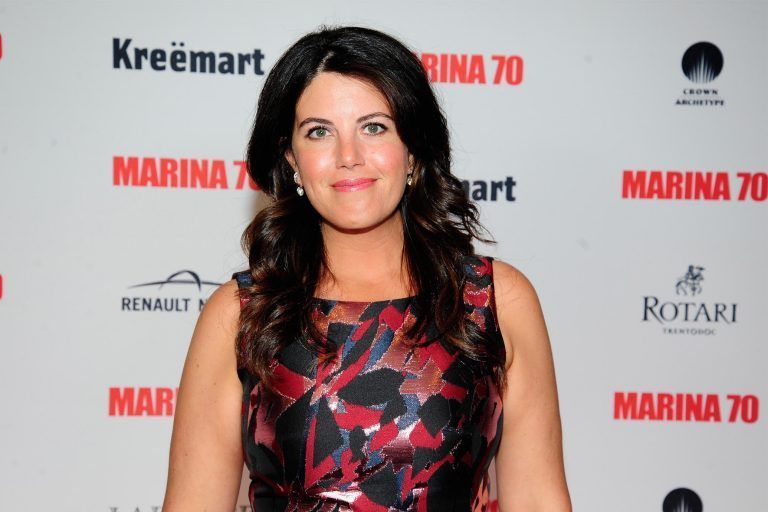

Monica Lewinsky tells her version of the scandal with Clinton
February 26, 2018
Translated and edited by Walter Lippmann for CubaNews.
Monica Lewinsky. Photo taken from TV Guide.
Twenty years ago, Bill Clinton was shaky: the then-president had to go through in impeachment process based solely on his extra-marital relationship with Monica Lewinsky, a 27-year-old scholarship recipient. Clinton survived the trial, led by special prosecutor Kenneth Starr. Lewinsky almost didn’t make it. In 1998, she was used as a weapon by the prosecutor and the media. At the age of 24, an unpaid scholarship holder saw every facet of her life dissected or reinvented. How, Lewinsky recalls in Vanity Fair,”in the Washington Post alone 125 articles appeared on the subject, only in the first 10 days.”
Two decades later, after a fortuitous encounter with Starr, Lewinsky has decided to contribute her vision. She has done so, in the first person, for Vanity Fair, by recalling those days in 1998, when the Internet first became the seed of fake news, a viral propagator and source of harassment. In a steamroller that crushed the line “between facts and opinions, news and gossip, private lives and public moral judgments. The Internet was already such a driving force behind the information flow that, when the House Judiciary Committee decided to publish Ken Starr’s findings online -two days after I had received them- it meant to me that every adult with a modem could read my private conversations, my personal thoughts (taken from my computer) and, worse, my sex life.”
Lewinsky talks about the infamous Starr Report, achieved among other things when “a group of FBI agents – Starr was not present – cornered a 24-year-old girl in a Pentagon room and told her she faced 27 years in prison if she didn’t cooperate. That “they threatened to impute my mother (if I didn’t tell them about the private confidences I had given her), that they let it slip that they would investigate my father’s medical career, and even interrogated my aunt, with whom I was having dinner [the night the FBI went after Lewinsky],”.
The media, fed by “anonymous sources and online rumors that arose daily, all false or irrelevant”, dragged through public opinion the figure of a young woman who, at the age of 22, entered into a “consensual” relationship with a 49-year-old married man. Or all the spoilage that can be the relationship with someone who “was my boss. He was the most powerful man on the planet. He was 27 years older than me, with enough life experience to know that it wasn’t right. That he was at the top of his career while I was in my first position after college. Lewinsky says that even if the relationship was consensual, it is now that she begins to realize the “incredible abuse of authority and power” that Clinton exercised.
But there was something worse, something that has changed for the better. During the whole Lewinsky case, those rumors appeared in the media, either Starr’s point of view, or Clinton’s, or that of hundreds of talk shows, but not Lewinsky’s, who “was not allowed to speak legally. She had no support, no way to tell her story or defend herself “as any woman today can do by sharing her story by tagging it with #MeToo and immediately welcoming her into the tribe. (…) Support networks on the Internet were something that did not exist at the time. Power, in that case, was still in the hands of the president, Congress, prosecutors and the press.
Lewinsky was alone. “Publicly alone. Abandoned. Without support, much less the main figure [Clinton]”. She has even been recognized as “one of the founders of the #MeToo movement”. And that marks the change of an era: Lewinsky was by no means a victim of sexual abuse (something that Lewinsky herself has defended from the beginning). But she did suffer multiple abuses of power, both before and during and after her relationship with Clinton. Responsibility. Of a game between two men, Starr and Clinton, with their media choirs. Subjected to an infinite “gas lighting” by all those who had placed a 24-year-old girl at the center of a public narrative. Lewinsky had no public voice. Lewinsky was what others said she was,”until I couldn’t question my narrative internally or internally.
And that’s what has changed today: “We owe a huge debt of gratitude to the heroines of #MeToo and Time’s Up. Because their movements speak volumes about the pernicious conspiracies of silence that for so long have protected powerful men when it comes to abuse of power, harassment and sexual abuse. Lewinsky concludes by recalling a Mexican proverb she’s been told quite a few times during these months:”They tried to bury us, but they didn’t know we were seeds. And for Lewinsky, Time’s Up and #MeToo is proof that spring has arrived.
(Taken from Vanity Fair)
Israel’s Image in the US
Israel’s Image in the US Becomes More Complicated
By Manuel E. Yepe
http://manuelyepe.wordpress.com/
Exclusive for the daily POR ESTO! of Merida, Mexico.
Translated and edited by Walter Lippmann.
Everyone knows about Israel’s close relationship with the United States. It is enough to observe that in all the votes in the UN General Assembly, no matter how committed it is to Washington, Israel seconds the superpower no matter how far removed they both are from the general consensus.
That’s why the phenomenon is so interesting that it was reflected in a report by Ramzy Baroud, a writer and journalist specializing in Middle Eastern issues, in a work published in the Palestine Chronicle entitled “The Boomerang Effect”.
Baroud points out that, despite the massive sums invested by Israel to maintain public opinion in its favor in the U. S., there are currently unmistakable trends in the polls that show a change. The dynamics of support for Israel by the average American citizen is changing, even among those who are Jewish, which is of great concern to the Israeli government.
Following the terrorist attacks of 11 September 2001, Israel’s affinity with the EEAU grew to unprecedented levels. The attacks, media discourse and subsequent wars evoked the support of many evangelical Protestant Christians. They see the widening of the conflict in the Middle East as part of the long-awaited biblical prophecy that, according to them, was fulfilled with the establishment of the State of Israel.
Prime Minister Benjamin Netanyahu’s government exploited every opportunity it had to maximize support for the goals deemed important by the right. Meanwhile, to the ultra-right and religious parties in Israel, Netanyahu’s vain and confrontational style has alienated the support of many Democrats. Netanyahu’s policies of strengthening the occupation, blocking any peace efforts and expanding illegal Jewish settlements also began to undermine the support that Israel has always taken for granted from American Jews.
But in January 2018, statistics among American Jews have plummeted even further.
According to the Israeli newspaper Haaretz, a recent study by the Brand Israel Group “support for Israel among Jewish students in the US fell by 32% between 2010 and 2016.
The perception that Jewish Americans constitute an isolated group that supports Israel regardless of their political tendencies is no longer sustained. Jewish communities in the United States are changing, as is the entire nation.
The number of those who identified themselves as “liberal” in the US has risen from 27% to 41% between 2000 and 2015.
This change has been accompanied by growing sympathy for the Palestinians, as indicated by a May 2016 Pew survey. More liberal Democrats said they were more sympathetic to the Palestinians (40%) than to Israel (33%). Analysts then concluded that disenchantment with Israel stemmed from differences between Netanyahu and Barack Obama over issues such as Israel’s illegal settlement expansion and the nuclear agreement with Iran.
The trend continued, because, when an issue becomes part of partisan politics, it becomes polarized, explains Baraud. For decades, Israel had been considered the only issue on which all Americans agreed, but this is no longer the case and Netanyahu has played an important role in this change.
The tendency among liberal Democrats was counterbalanced by another tendency among Republicans who adopted the cause of Israel as their own. While Christian evangelicals were able to make unconditional support for Israel an indispensable requirement for any candidate seeking their support, the Israeli cause has ceased to be an issue demanded by Democrats.
A Pew survey indicates that “the Democratic liberals who support Palestinians more than Israel have almost doubled since 2014 (from 21% to 40%) and are higher than at any other time since 2001. Of all Democrats, only 33% sympathized with Israel, according to the 2017 Pew poll.
This was the “first time in history” that has divided “almost half the number of those who support Israel and those who support the Palestinians.”
And, just as support for the Palestinians grew among Democrats, so did the gap between the two major parties. According to the most recent Pew 2018 poll, while Republican support for Israel remains high, a troubled 79% of Democrats’ support for Israel sank to just 27%.
Certainly, Netanyahu has embedded Israel in the heart of polarized US policy. Although he has achieved short-term successes (such as US recognition of Jerusalem as Israel’s capital city) it has damaged the American consensus on Israel “and this raises hopes,” Baraud concludes.
March 1 st, 2018.
Never Again?
Never Again?
 by David Brooks. Mexican journalist. Correspondent for the newspaper LA JORNADA in the United States.
Translated and edited by Walter Lippmann for CubaNews.
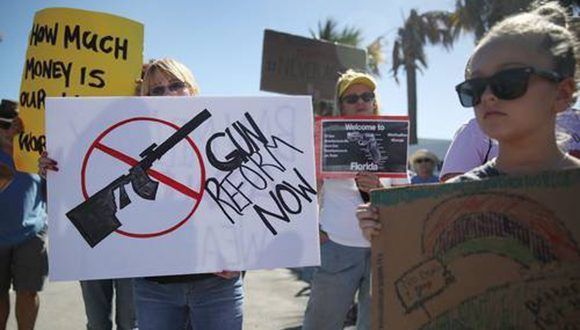
Activists and students protested outside an AK-47 rifle factory in Pompano Beach, Florida yesterday. Photo: AFP.
“I knew that I could never raise my voice against the violence of the oppressed in the ghettos without first speaking out clearly about the greatest provider of violence in the world today: my own government,” Martin Luther King Jr. stated in his famous speech against the Vietnam War in 1967, where he linked injustice and oppression within this country to its world-wide warlike and imperial policies.
The United States is an extraordinarily violent country, the most violent of all the first world within its borders and, perhaps, if you count the victims of its violence outside, the most violent country on the planet. Violence is an integral part of its history, starting with the genocidal campaign against the first inhabitants of this country, slavery and wars of all sizes (some with millions of dead) against dozens of nations to date. This country is the only one that has used a weapon of mass destruction. Moreover, its economy has depended to a large extent on the production of arms, wars, civil control; it gives the largest public subsidy to the private sector.
And institutional and official violence has always been bipartisan and justified in the name of peace and to defend the country and sometimes even to save the world. Official violence inside and outside the country is no exception, it is the rule.
The massacre at Marjory Stoneman Douglas Public High School in Parkland, Florida, last Valentine’s Day occurred in a country flooded by more than 300 million firearms that, each year, claim more than 32,000 lives (and tens of thousands of wounded) and that since 1968 to date have killed more Americans than those who perished in all their wars since the founding of this country. But this internal violence cannot be separated from the external violence, wars and almost incessant interventions of this country throughout its history. The official message is that violence is a legitimate, justifiable and necessary response. And the weapons, therefore, are sacred.
What Trump wants most today is a military parade with many planes flying over and presided over by him, a commander in chief who evaded -like so many children of the rich- military service during the Vietnam War. And their solution for resolving gun violence is: more guns, including arming teachers.
Never Again is the name of the new movement launched by those Florida students who survived the most recent massacre, a fierce response against politicians and the National Rifle Association (NRA) who are complicit in the country’s official violent culture. For now, high school students are making them tremble like never before.
Emma Gonzalez, 18, a survivor whose speech at the first demonstration after the killing became viral, today has more followers of her Twitter account, @emma4change, than @NRA, one of the most powerful organizations in this country. She, along with her classmates such as Alfonso Calderon, Cameron Kasky, Jaclyn Corin and David Hogg, among others, launched Nunca Más and in the first hours after the tragedy called for a national march for March 24, declaring that this would be the last massacre in a school. Suddenly they lead what could be, if sustained, a movement of a new generation that, in essence, refuses to be complicit in the violence.
The movement, whose objectives are very specific -to ban the sale of weapons of war, to verify the mental health of those who buy weapons- is thus questioning the political essence of this democracy. It’s clear, they say, when, in the most recent polls, the vast majority of the country favors controls on the sale and use of firearms (in the two most recent: CNN: 70 percent in favor; USA Today, 63 percent), but politicians continue to hold back further controls by serving the NRA.
National companies, understanding the potential power of this movement, are fleeing their relationship with the NRA; the list is growing every day: Delta, United, Hertz, Avis, Enterprise, Symantec, Chubb and First National Bank.
The NRA accuses these companies of cowardice, and one of its national spokeswomen dared to declare that the media is guilty of manipulating all this, as they love killing because it raises ratings. David Simon, creator of The Wire and Treme, among others of the best TV series, and who was a Baltimore Sun journalist, replied: “As a reporter, I covered more than a thousand deaths from handguns and spent a full year following stage homicide detectives onstage. I covered a massive shooting. Did I love it? Fuck you, you stupid, meaningless, sociopathic spokeswoman… for this American hell.”
Michael Moore, whose documentary Bowling for Columbine researched the issue of gun violence in the United States from another massacre in a high school, sent a tweet: The NRA is a terrorist organization, remembering: we have had 1.2 million Americans killed by guns since John Lennon was shot in New York.
But what scares the leaders most is that these young people are able to create alliances with other movements, something that is already beginning to happen. Camila Duarte, a high school student and leader of United We Dream (the largest national immigrant youth organization) in Florida, said: As youth of color and immigrants, we have gone through so much hate, emotional abuse and violence over the past year, from Muslim prohibition to the end of DACA, through school budget cuts, and announced that United We Dream’s immigrant youth “will follow the lead of the brave students at Marjory Stoneman Douglas High School (…) in the March for Our Lives. We will take to the streets together because we believe in a future where everyone can feel safe in their schools and homes. It is hoped that other young people from other movements will also join in.
Maybe the students can teach everyone here how to never again tell teachers about violence.
(taken from La Jornada)
Young People to the Rescue
Young People to the Rescue
 By David Brooks, Mexican journalist. Correspondent for the Mexican daily La Jornada in the United States.
23 February 2018
Translated and edited by Walter Lippmann for CubaNews.
On Saturday, Emma Gonzalez demanded that political leaders take effective action against arms sales. Photo taken from Semana Magazine.
Emma Gonzalez demanded Saturday that political leaders take effective action against arms sales. Photo was taken from Semana Magazine.
“We’re here together because if all our government and the president can do is send their condolences and prayers, then it’s time for the victims to be the change we need to see,” Emma Gonzalez said during a rally against guns Saturday in Fort Lauderdale, four days after surviving the massacre in her high school in the town of Parkland, Florida, a few miles from where she spoke with a firm voice and in tears.
Gonzalez, 18, said everyone already knows about the statistics on mass shootings and how these tragedies are happening across the country. In fact, she and her classmates have joined the more than 150,000 students in more than 170 elementary, middle and high schools who have witnessed gunfire on her premises since the Columbine High School massacre in 1999, according to a Washington Post analysis.
“We are going to be the young people from whom you will then read in your textbooks. Not because we are going to be another statistic about massive shootings in the United States, but because we are going to be the last massive shootings (…) we are going to change the laws,” she promised the more than a thousand students, parents and others who came together to say enough is enough.
If the president wants to stand in front of me and tell me that this was a terrible tragedy and that it should never have happened, and if he wants to keep saying that nothing can be done about it, I will happily ask him how much money he has received from the National Rifle Association. And you want to know something? It doesn’t matter, because I already know: 30 million dollars (…) To every politician who receives donations from the NRA (National Rifle Association): shame, and at that moment hundreds of his colleagues and parents chanted: shame, shame.
“The elected rulers are lying to us. And it looks like we young people are the only ones who realize it, and we’re here to say that’s BS [bullshit]. Companies that make cartoons of young people these days, saying that we only care about what is ours and that we are obsessed with trends… we are prepared to say BS. Politicians who are sitting in their golden seats funded by the NRA saying that nothing could have been done to prevent this, we say BS… They say no law could have prevented hundreds of tragedies that have occurred. We say BS, that we don’t know what we are talking about, that we are too young to understand how government works. We call them BS. And a chorus responded: no more BS.
Gonzalez is not alone. A new group of ferocious leaders has just been born from the violent deaths of 17 of their compañera/os in the most recent massive shooting in this country. Any politician accepting NRA funding is responsible, Cameron Kasky, another high school student in Parkland, told ABC News. And speaking directly to his state’s Senator, Marco Rubio, he added:”It’s not our job to tell you how to protect ourselves. Our task is to attend school, learn and not be shot… Their task is to protect us and our blood is on their hands.
It is worth noting that Rubio is among those most benefited by the generosity of the National Rifle Association, the most powerful entity against control over guns in private hands.
Another surviving student, David Hogg, in an interview with CBS News, addressed Trump directly this Sunday denouncing: we have seen the government close down, we have seen tax reform, but nothing to save children’s lives. You make me sick.
Responding to a Trump’s tweet accusing the FBI of not following alerts about the suspect because they were too busy investigating the collusion that does not exist between the Russians and their election campaign, Aly Sheehy, another survivor, responded: 17 of my compañeros are no longer there. That’s 17 futures, 17 young people and 17 stolen friends. But you’re right, it always has to be about you. How silly of me, I forgot.
The students, some of whom have already carried out local actions, announced that they are organizing mobilizations on a national scale, something that is worrying politicians who, until now, have felt very comfortable, who have managed to stop previous initiatives to impose controls on the more than 300 million weapons that are in private hands in this country.
In the call to the March for our Lives, a student-driven action across the country and set for Washington on March 24, it is stated: Not one more. We can’t let one more child get shot at school. We cannot allow one more teacher to have to decide whether to stand in front of an assault rifle to save the lives of her students. We cannot allow one more family to be waiting for a call or text that never arrives. Our schools aren’t safe. Our children and teachers are dying. We have to make it our top priority to save these lives.
On March 14, a 17-minute student strike is being called for the 17 victims, and others on April 20, Columbine’s anniversary, calling for everyone to wear orange clothes to demand change, among others.
In another interview with CNN, Kasky summed up: my message to those who are in elected office is: are they with us or against us. We’re losing our lives while the adults are playing games.
Or as Wired’s editor-in-chief Nicholas Thompson summed it up in a tweet: United States: where high school students act as leaders, and leaders act as if they were in high school.
In a country where more people have died from gun violence since 1968 until today than the total number of Americans killed in all their wars since independence, where the world’s most armed people commit massacres and where on average there are five bullets in academic venues each month, it will be the young people who may be able to rescue their country from this barbarity.
(taken from La Jornada)
The Hackneyed Imperialist Tool of Demonization
The Hackneyed Imperialist Tool of Demonization
By Manuel E. Yepe
http://manuelyepe.wordpress.com/
Exclusive for the daily POR ESTO! of Merida, Mexico.
Translated and edited by Walter Lippmann.
“The systematic dehumanization of the leaders of other countries; the routine exaggeration of their military capabilities; the monotonous falsification of the nature and attitudes of other peoples; the reckless application of double standards in comparing the conduct of others with our own, as well as the inability to recognize the common character of many problems of others with our own, and the consequent tendency to see all aspects of the relationship with others in terms of a total and irreconcilable conflict of concerns and purposes. These, I believe, are not signs of the maturity and discernment that can be expected in the diplomacy of a great power…”.
Although the above description may seem applicable to Washington’s current foreign policy, it is a warning that George Frost Kennan (1904-2005), a long-serving diplomat and American historian, reminds us of the fact that it was Kennan who formulated and advocated a “policy of containment” against alleged Soviet expansionism, but later changed his theory.
Kennan enunciated his “containment policy” in February 1946 in a text that is remembered as the long message (“the Long Telegram”) he sent from Moscow in 1946 against so-called Soviet expansionism at the end of World War II. The text, signed with just one “X”, appeared in the July 1947 issue of Foreign Affairs magazine, intended to analyze the structure and psychology of Soviet diplomacy at that time. It was widely disseminated by Washington and brought Kennan a lot of popularity in the academic world.
Shortly after that same year, he was appointed director of policy planning at the State Department and, in 1949, advisor to that department. He returned to Moscow in 1952 as his country’s ambassador and in the following year, he had to return to the United States after being declared persona non grata by the Soviet government.
In the late 1950s, Kennan revised his views on “containment” and began advocating a program of “disengagement” from areas of conflict with the Soviet Union. He later emphatically denied that containment was applicable tp situations in other areas of the world, such as Vietnam.
Kennan is identified as one of the architects of the Cold War. His postwar writings about the supposed Soviet threat nurtured the U. S. policy of containment that led to the devastating arms race that still threatens the world with utter destruction.
But the development of events and variables in Washington’s foreign policy led Kennan to reconsider his initial views and to formulate those with which he begins this article.
Kennan then suggests that, although the Russians were still fundamentally opposed to peaceful coexistence with the West and inclined to achieve the extension of the Soviet socialist system around the world, they were particularly sensitive to the logic of military force and will respond or retreat in the face of skillful and determined resistance to their wishes for expansion.
Thus, Kennan goes on to advocate a policy of “counter-pressure” where the Soviets threatened or it could be predicted that such counter-pressure could lead to the Soviets being willing to cooperate with the US or, eventually, be seen to lead to an internal collapse of the Soviet government. This point of view would eventually become the focus of US policy towards Russia.
It is remarkable how much the imprint of Kennan’s policy of containment has influenced U. S. imperial policy, despite its belated retraction. It is something that can be noticed in the current stage of Washington’s hegemonic decline with an almost identical performance in the manner of demonizing its enemies or those who do not agree with its designs.
It is as if the complacent media and the two political parties that govern alternatively could only agree to attack their opponents when they have fabricated an image that fits into certain diabolical and perverse preconceived patterns.
In Latin America, the current U. S. offensive against dissident governments in its hegemonic area goes through a period of great intensity in which Bolivarian leader Nicolás Maduro Moro, president of Venezuela, occupies the prominent place that for half a century had Cuba sitting in the chair of the accused. The head of the Caracas government has reached, if not surpassed, the level of gossip that Fidel and Raúl Castro used to have, although the latter do not escape today from the diarrhea of lies and dehumanizing insults of Donald Trump.
February 27, 2018.
You must be logged in to post a comment.