WAR AGAINST THE CHINESE ECONOMIC MODEL
WAR AGAINST THE CHINESE ECONOMIC MODEL
By Manuel E. Yepe
http://manuelyepe.wordpress.com/
Exclusive for the daily POR ESTO! of Merida, Mexico.
Translated and edited by Walter Lippmann.
The growing hostility of Western governments towards China has more to do with the interests of Western investors than with legitimate security fears, according to Stephen Gowans, a Canadian political analyst, who regularly publishes in the Voltaire Network, Global Research and other progressive media.
The U.S. National Defense Strategy for 2018 ranks China at the top of the world’s external threats to the United States, even above Russia, North Korea, Iran, and “various terrorist groups with global reach”.
Secretary of State Mike Pompeo describes China as the “great long-term threat to the United States” and the Trump administration, according to the Washington Post, considers China to be “the real enemy.”
What has China done to deserve so many “distinctions”? The answer –according to Gowans– is that China has developed a state-led economic model that limits the profit opportunities of the U.S. investors and defies their control over high-tech economic sectors that include artificial intelligence and robotics, which are essential to U.S. military supremacy.
“Washington is immersed in a multi-faceted war to prevent Beijing from going ahead with plans to become world leader in10 broad areas of technology, including information technology, aerospace and electric vehicles”. Washington seeks to “curtail China’s plans to develop advanced technology ” and “force China to allow US companies to sell their products and operate freely” in China, in conditions that will allow the United States to maintain its economic and military supremacy.
For its part, “China seeks to alter a global economic system that only allows them to manufacture t-shirts while the US is in charge of high-tech productions,” according to Yang Weimin, senior economic advisor to Chinese President Xi Jinping. But now Xi is “determined to have China dominate its own microchips, systems, and other basic technologies” in order to become “technologically self-sufficient.”
But self-sufficiency in industries such as aerospace, telecommunications, robotics and artificial intelligence means taking China –a huge market– out of the scope of US high-tech companies.
In addition, given that the supremacy of the West has always depended on technological superiority, China’s efforts to challenge the monopoly of high technology directly generate a renewed challenge to Washington’s capacity to utilize the Pentagon as an instrument to obtain advantages in trade and investment opportunities for U.S. entrepreneurs.
China’s economic model is called state capitalism or “market socialism.”
Both terms refer to the two defining factors of the Chinese model: the presence of markets, for materials, products and labor force, and the role of the State, in charge of the industrial planning and corporate ownership.
The “pillar of the economy” is made up by the more than 100,000 state-owned enterprises of China. The State has a strong presence in the higher echelons of the economy.
“Key sectors, such as banking, are dominated by companies controlled by the State”. State-owned enterprises “represent about 96% of the telecommunications industry, 92% of energy and 74% of automobiles”.
Beijing is the largest shareholder of the country’s 150 largest companies.
The state National Commission of Development and Reform is in charge of industrial planning. The Commission uses a variety of means to foster Chinese industry in key sectors, and develops plans to give preferential treatment to Chinese companies in strategic areas.
Beijing is counting on state-owned companies to become leaders in semiconductors, electric vehicles, robotics and other high technology sectors and finances them by means of subsidies and funding by state-owned banks.
The Planning Commission also guides the development of steel, photovoltaic energy, high-speed trains and other critical industries.
Beijing has closed the door to foreign ownership in sectors it considers strategic or vital to national security. These include “finance, defense, energy, telecommunications, railways and ports”, as well as steel.
All the steel companies are state owned and are all financed by state owned banks.
In total, China has restricted or closed foreign investment in 63 sectors of its own economy, such as stem cell research, education and training, satellites, prospection and exploitation of numerous minerals, the media, as well as research institutes in the humanities and social sciences.
January 24, 2019.
A FORECAST OF DONALD TRUMP’S FIASCO IN VENEZUELA
A FORECAST OF DONALD TRUMP’S FIASCO IN VENEZUELA
By Manuel E. Yepe
http://manuelyepe.wordpress.com/
Exclusive for the daily POR ESTO! of Merida, Mexico.
Translated and edited by Walter Lippmann.
In late November, President Donald Trump announced that Washington had withdrawn its recognition of Nicolas Maduro as the President of Venezuela, and has now given it to the Head of the National Assembly in contempt, José Guaido.
In this way, the United States will openly support the regime change in Caracas This has been the dream of the Neo-cons for a long time and can become a nightmare for Trump.
“Why does the American President act like this?” Ronald “Ron” Paul wonders on his blog. Paul, a political scientist at the University of Georgia, member of the Republican Party and former representative to the House in the U.S. Congress, who holds the largest record of conservative votes for a representative in Congress since 1937.
He has been called the “intellectual godfather” of the Tea Party. He has achieved notoriety for his libertarian positions on many political issues, often clashing with the leaders of the Democratic and Republican parties. Paul has run for the Presidency three times: in 1988 as candidate of the Libertarian Party, and in 2008 and 2012 as a Republican.
“According to the U.S. State Department, the Administration is acting to help enforce the Venezuelan Constitution… As if the Administration were so anxious to enforce its own Constitution!” Paul ironically wrote on January 29.
It’s also ironic that Trump — a president who has spent his first two years in office fighting accusations that a foreign country interfered in U.S. elections– not only meddles in a foreign election, but also grants himself the right to appoint the president of a foreign country.
“How would we react if the Chinese and the Russians decided that President Trump is not upholding the U.S. Constitution and recognized Nancy Pelosi as President of the United States?” asks Paul.
Even those who would like to see a change of government in Venezuela should reject any notion that such change must be “helped” by the United States. According to news reports, Vice President Mike Pence was so involved in Venezuelan internal affairs that in fact he urged Guaido to name himself president and pledged America’s support. This is not just foolish but also very dangerous. A Venezuelan civil war would result in massive death and even more economic misery.
Regime change has long been the U.S. policy for Venezuela. The United States has been waging an economic war against it practically since Maduro’s predecessor, Hugo Chávez, was first elected in 1998. The objective of the U.S. sanctions and other measures against Venezuela and other countries targeted by Washington’s is to make life so miserable for the average citizen that it would make them stand up and throw out their leaders. But, of course, once they do, they must replace those leaders with someone approved by Washington.
“Remember,” writes Paul,” after the “Arab Spring” in Egypt, when the people rose up and overthrew their leader, the “wrong” candidate was then elected. The army moved and deposed the elected president and replaced it with one approved by Washington. The then Secretary of State, John Kerry, called that “restoring democracy.”
“It’s tragicomic,” says Ron Paul, “that Trump appointed the convicted criminal Elliot Abrams, as his key person to “restore democracy” in Venezuela. Abrams played a key role in the Iran-Contras scandal and became one of the main architects of the disastrous U.S. invasion of Iraq in 2003. His role in the promotion of the horrible violence in Latin America in the decade of the 1980’s should disqualify him from returning to any public office.
“Instead of this coup d’état, a better policy of ours to relate to Venezuela in the last 20 years should have been one of commitment and trade. If we really believe in the superiority of a free market system, we must also believe that we can only preach by example, not by forcing our system on others,” stresses Paul.
Just four months ago, President Trump said at the UN that he respected “the right of every nation to practice its own customs, beliefs and traditions. The United States cannot tell others how to live, work or worship. In return, we should only ask respect for our sovereignty.”
“Unfortunately, it seems that these were just empty words. We know from what happened in Iraq, Libya, Syria, etc. that this will not end well for Trump… or for the United States. We must leave Venezuela in peace!” concludes Ron Paul whom no one can accuse of being a defender of Socialism.
January 31, 2019.
U.S. PLANS AGAINST CARACAS ARE WORSE
U.S. PLANS AGAINST CARACAS ARE WORSE
By Manuel E. Yepe
http://manuelyepe.wordpress.com/
Exclusive for the daily POR ESTO! of Merida, Mexico.
Translated and edited by Walter Lippmann.
“Contrary to what Venezuelans believe, the objective of the United States is not to overthrow President Maduro but to apply in the “Caribbean Basin” the Rumsfeld-Cebrowski doctrine, and to destroy the state structures in the countries of the region. This requires the elimination of Nicolas Maduro, but also of Juan Guaidó”.
That’s how Thierry Meyssan, founding president of the Damascus-based Voltaire Network, and a brilliant specialist on Middle East topics, sees it.
This scheme was already used in 2011 to make the internal issues that took place in Syria appear as an external aggression perpetrated by an army of mercenaries.
In the case of Venezuela, the Organization of American States (OAS) — known around the world as the Yankee Ministry of Colonies, and whose Secretary General immediately recognized Guaidó as President – undertook the role that the Arab League had in the case of Syria. The role of the so-called Friends of Syria’s (which in fact were of Washington’s) was played by the Lima Group, also under U.S. control.
Burhan Ghalioun, an old collaborator of the American National Endowment for Democracy ( NED), played the part of leader of the opposition in Syria. He was soon replaced by another little character, who, in turn, was replaced by another, then by another, and again for yet another; so many times that no one remembers their names anymore. You can assume that Juan Guaidó will be quickly discarded in the same way.
But the Syrian scheme of the United States worked only in part because: in the first place, Russia and China opposed it in the UN Security Council repeatedly; secondly, because the Syrian people supported their government and gave evidence of exceptional resistance; and, finally, because Russia managed to support and equip the Syrian Arab Army in time for its confrontation with NATO and the foreign mercenaries.
It is known that Washington, knowing that the Pentagon will not be able to continue using the jihadists to weaken the Syrian state, is now proposing to place the Syrian case in the hands of the U.S. Treasury Department who, in turn, will do everything possible to prevent the reconstruction of the Syrian country and state.
The idea is for the self-proclaimed Interim President Guaidó to head a parallel administration that focuses its objective on: obtaining oil money in various lawsuits; “settles” the territorial dispute with Guyana; “satisfactorily” negotiates the question of refugees; “agrees” with Washington on all the foreign policy issues, and manages to imprison in the United States the Venezuelan Chavista leaders under various pretexts.
Based on the experience of the last eight years in the Middle East, what is happening in Venezuela cannot be compared with what happened in Chile in 1973. The United States was then trying to control the Americas and close the way to all forms of Soviet Union influence. They wanted to exploit the natural riches of that part of the world, leaving the least possible control in the hands the national governments… at the lowest attainable cost.
Today, on the contrary, the United States persists in considering the world as uni-polar. It has no friends or enemies. According to its vision, every population integrated into the globalized economy or living in a territory that has natural resources that the United States wants to control (not necessarily exploit immediately), these must be under the shared control of the Pentagon in the nations where they are located.
Therefore, Washington is trying to prevent the proper functioning of the state structures of those countries.
“It is possible that Juan Guaidó believes he is really capable of solving the crisis and serving his country by proclaiming himself interim president. But in fact it would actually have the opposite effect, because it would create a situation similar to a civil war. He, or his successors, will ask for help from Brazil, Guyana and Colombia, which will deploy “peace keepers” with support of Israel, the United Kingdom and the United States. And the violence would continue until entire cities are in ruins.
It doesn’t matter if the Venezuelan government is Bolivarian or liberal, whether their relations with Washington are good or not. The goal is not to achieve a “regime change” as in Syria, but to weaken the Venezuelan state as much as possible. That process would begin in Venezuela and immediately extend to other countries in the region –such as Nicaragua– until there remains no real political power in the region as a whole”, predicts Thierry Meyssen.
“This situation is very clear for many Arabs whose countries already fell into that trap. But now, it does not seem to be seen with enough clarity in Latin America”, warns the expert.
“Of course, it is also possible that Venezuelans may become aware of the manipulation, put aside their divisions and save their country,” concludes Meyssen.
January 28, 2019.
Vertigo in its place

Vertigo in its place
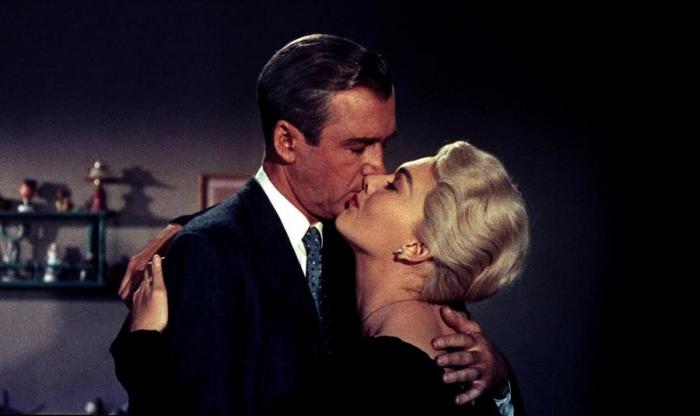
Among the list of artistic works that at the time were misunderstood and even ignored, Vertigo, the film by Hitchcock, classifies as a case worthy of study.
Kim Novak and James Stewart in Vertigo. Photo: Movie still
Author: Rolando Pérez Betancourt | internet@granma.cu
January 25, 2019 21:01:41
A CubaNews translation.
Edited by Walter Lippmann.
Among the list of artistic works that at the time were misunderstood and even ignored, Vertigo, the film by Hitchcock, classifies as a case worthy of study.
Last December, the film’s 60th anniversary was celebrated with great fanfare, and Kim Novak, the leading actress, she retired from a ranch in Oregon in her retirement ranch in Oregon.. From there she didn’t go out even to look for gold nuggets in a cinematographic world that, in the 50s and 60s of the last century, had kissed her feet. She was, however invited to participate in the 2014 Oscar ceremony, a sort of tribute, she believed, like the one offered at the Cannes Film Festival.
Just a few minutes on the stage of the so-called Mecca of cinema that cost her the most bloody jokes and mockery in various media, because of the plastic surgery that made the two characters she played in Vertigo, at 25 years of age, look very remote.
Television and social networks were filled with images of the actress and comments, such as those leaked by Donald Trump, who was not president at the time, although he had already given signs of what Twitter unleashed would become in his hands: “Kim should sue her cosmetic surgeon,” wrote the magnate.
Before returning to her ranch, Novak defended herself on Facebook: “…I’m not going to shut up in front of tyrants. You can’t let people destroy your life. You have to stand up against them.¨
Known for not giving interviews, the actress agreed a month ago to a request from an AP journalist. The pretext was impossible to ignore. Vertigo, the film that launched her career, was 60 years old and in 2012 had moved from first place in the preference of critics and historians over the mythical Citizen Kane, after 50 years of the film of Orson Welles reigning in the polls conducted by the prestigious British magazine Sight and Sound.
An ascent in which the indisputable quality of the film mediated, unusual for the Hollywood of the 50s, the love story marked by the obsession of a man (James Stewart) who intends to resurrect the woman who fascinated him, and the unparalleled performance of Kim Novak (beautiful and sensual, but nothing outstanding until then in the field of acting).
It´s producers weren´t enthusiastic, and so it competed without pain or glory at the 1958 San Sebastian Festival, it was considered below Psycho and other Hitchcock films. However, step by step it opened the way to the reign of myths thanks to its values, and also to the music of Bernard Herrmann. It´s a film that today – dozens of books and studies conceived in its favor – is considered one of the most significant in the history of cinema.
In the AP interview, Kim Novak revealed that she identified so much with the character In Vertigo because it was exactly what Hollywood was trying to do with her: turn her into what she wasn’t (another platinum blonde who competed with Marilyn Monroe and was a worthy successor to Rita Hayworth).
It is known from François Truffaut’s famous interview with the suspense magician, that Hitchcock insisted Novak had not been well on her role, to which the Frenchman responded categorically that Vertigo was she. And he didn’t lack reasons, especially when you consider that the actress played two totally different characters. However, when referring now to Hitchcock, Kim Novak has words of praise for the director who, according to Tippi Hedren (The Birds, Marnie), was nuts about blondes and sexually harassed her to the point of threatening to ruin her career.
Also with Kim Novak?
He never behaved that way with me, she responded sharply. And she added: “Others did. And, although she didn’t offer names, she said that the reports of harassment and sexual assault that flourish in Hollywood today were always like that, only now they have lost their fear and are beginning to talk.
The passionate mission of continuing to invent our own model of socialism
The passionate mission of continuing to invent our own model of socialism
Cuba will live a moment of great expectation, on February 24th, when it submits the new Constitution to a referendum.
Author: Ariel Terrero | internet@granma.cu
January 24, 2019 21:01:43
A CubaNews translation.
Edited by Walter Lippmann.
CAPTION: The participation of workers in the planning, regulation, management and control of the economy is a key to ensuring effective decentralization. Photo: Freddy Pérez Cabrera
Cuba will live a moment of great expectations, when, on February 24 it submits the new Constitution to a referendum.This is logical, after creating these expectations among the discussions in nation as a whole, seasoned with the controversial passion that identifies Cuba. But I don’t believe that the conquest of votes is the most thorny challenge posed by the Law of Laws. Not by a long shot. The big challenge comes later.
Society and its institutions will have to legislate and implement the changes and ordinances assumed under the new Constitution. They are not a few. The complex goals it proposes, to broaden the transformations of the economic, social and political model of Cuban socialism, and to deepen the process of its updating…, which has not advanced at the speed that we Cubans dreamed of when we began it more than a decade ago.
The great challenge will come with legistion, which must be much more intense than what has been achieved so far. This is so that the other branches of the legal system start from the foundation of the Magna Carta. One of those branches is the law on companies, which has not yet seen the light of day although it was promised for 2017. It is fundamental to give solidity to a scenario that bets on the coexistence between multiple economic actors, who begin to discover the benefit of alliances between presumed antagonists – in tourism and agro-industries there have been successful experiences.
Several chapters in the new law point to a reordering of government and business administration structures. These favors a more radical decentralization of this country, accustomed for decades to a rigid verticality of economic and government organizations. Perhaps the most daring change is the redesign of territorial structures to give greater prominence to municipal administrations and local development management.
The Constitution also bases the path towards an economy on a diversity of forms of ownership. State enterprise, the main actor of the socialist economy, will share legal and legitimate space with cooperatives, mixed forms and private entities, among others.
The great challenge will not be so much the acceptance of that diversity or the liberation from the cursed aura of words such as private and market. The idea that non-state forms are also a vital link in the chain of production, services and the market has gained social consensus. This aspiration, however, stumbles in an environment lacking optimal conditions for the coexistence of dissimilar forms of property.
More important and difficult than the entry of private companies into the scenario is the granting of autonomy to state-owned companies, which is proposed in Article 26 of the new Magna Carta. Although State business organizations have advanced along this path, they still carry insufficiencies that, together with financial deformations such as the monetary and exchange duality and other trade anomalies, place these entities at a disadvantage compared to non-state rivals.
With better wages and fewer bureaucratic and financial ties, cooperatives and private companies come out on the market under better conditions than state forms. In contrast, these are left with advantages to access technologies, wholesale offers and resources from external markets, but they do not manage to take advantage of them in all their dimension due to the confluence of economic limitations, clumsy interpretations of planning and the subjection to a Cuban currency overvalued at the official exchange rate, among other obstacles.
To which side would the teeter-totter of property forms be inclined in this context? Difficult answer. Risk can inhibit central decisions and state disadvantage would then threaten non-state expansion, especially for small and medium-sized private enterprises that have entered the Cuban economy with a mask of cooperatives or self-employed workers.
The participation of workers in the planning, regulation, management and control of the economy, which was symbolically incorporated with popular debate into the constitutional project, constitutes an old aspiration of society and is a key to guaranteeing effective decentralization into enterprises and budgeted units of the State.
The Demonization of Russia by The United States
The Demonization of Russia by The United States
By Manuel E. Yepe
http://manuelyepe.wordpress.com/
Exclusive for the daily POR ESTO! of Merida, Mexico.
Translated and edited by Walter Lippmann.
In the original Cold War there was a certain balance between the contending parties.
This led independent observers to believe that the Soviet Union, decimated in World War II, was so keen on maintaining peace that Washington could achieve an advantageous agreement for the West and avoid the possibility of nuclear war without making too many concessions.
However, U.S. diplomacy and propaganda had become fixated on a campaign to demonize Russia. This considerably diminished following the dissolution of the Soviet Union. But in very recent times it has been revived due to the visceral hatred of Democratic Party supporters towards Trump, after Hillary Clinton’s humiliating defeat in the 2016 presidential election.
The Democratic Party leaders blamed Hillary Clinton’s defeat on the interference in US elections by Vladimir Putin. This was a justifying argument to be fed to Democratic followers, ashamed of their terrible performance against a “minor” opponent like Donald Trump, at the time considered an upstart in “major politics.”
Irish journalist Bryan MacDonald, in a recently published article, analyzed the presidential race of Vladimir Putin and the reasons for his growing popularity in Russia.
Firstly, he considers that Putin’s victory in the most recent elections was involuntarily facilitated by the West.
Western leaders and opinion makers in Washington believed that sanctions and economic pressure would encourage Russians to become more active against Putin. But they couldn’t have been more wrong.
In this respect, Alexey Pushkov, representative of the Council of the Russian Federation notes that: “Putin’s demonization by the West has had the opposite effect in Russia: citizens have rallied around their top figure in an unprecedented way. The results of the elections confirm this”.
It is fitting to recall that in 2011 and 2012 there were demonstrations in Moscow organized by a group that was baptized as the “Moscow elite” against President Putin.
Western media correspondents accredited in the Russian capital, with little knowledge about the situation in the rest of the country, made their readers and/or viewers believe that something substantial was taking place, when the reality was much less dramatic.
Although the Kremlin suspected interference, Hillary Clinton, then U.S. Secretary of State, had really very little influence on these events.
The situation was totally different from what had occurred in 2013 and 2014 in the Ukraine, when the United States openly intervened in support of the street protests against the Russian Government.
Another fact that illustrates this point was the vicious campaign of attacks against Russia in connection with the case of the former double agent Sergei Skripal.
In the words of Andrei Kondrashov, spokesman for the Putin’s election campaign in Moscow: “Voter turnout was eight to ten percent higher than we expected, because the United Kingdom, pretending otherwise, pressured us right at the precise moment when we had to mobilize to go out and vote.”
Kondrashov, ironically, thanked the British Government for that result. The accusations made by London against Moscow in relation to the poisoning of the former double agent Skripal helped bring about the surge in the number of voters who participated on the March, 2018 presidential elections in Moscow.
The spokesperson said that the high turnout at the polls was proof of the way Russian people reacted when their country was accused “out loud and without evidence.”
The dispute around the attempted murder of agent Sergei Skripal with poison gas increased electoral turnout by several percentage points, according to the spokesman. At the end of the day, Putin was the ample winner of the contest.
Russians are fully aware that the campaigns against their country and the demonization of their president require a strong citizen response. They generally support the status of Crimea and resent the anti-Russian hysteria in the West.
In fact, it is precisely this negative image of Russia, broadcast in the West, that has determined the repeated success of Putin in various electoral consultations.
For years it has been more than evident that the foreign policy of the United States should draw lessons from these procedures which have been proven to be counterproductive in other parts of the world.
An extreme example of this is the genocidal siege policy held for 60 years against Cuba. A policy almost unanimously rejected by the world community of nations.
January 17, 2019.
Mariela Castro’s comments on local Cuban TV
Mariela Castro’s comments on local Cuban TV last night about tornado damages and the recovery efforts
Translated and edited by Walter Lippmann for CubaNews
Yesterday in the program #LibreAcceso de #CanalHabana, which every Wednesday at 8:30 PM is hosted by journalist #BárbaraDuval, the Vice President of the provincial government, #TatianaVieraHernández reported accurate data on the recovery of Havana after the tornado that severely affected the municipalities of Regla, Diez de Octibre and third Guanabacoa. With slight damages East Havana, Cerró and Maranao.
Food, water and other necessities are provided free of charge to the affected population.
The sale of food and water at very low prices are for all people in the neighborhoods where electricity and water services have not yet been restored. However there are others who do not have these difficulties but who can also benefit from these services.
There are 6155 people protected in the homes of relatives and friends for the total loss of their homes. Of this total, 258 are in Protection Centres or in adapted premises until their homes are built.
The Technical Evaluation Commissions have worked day and night to create the Technical Sheets and lists of materials for the reconstructions. They have already evaluated more than 95% of the houses damaged and totally destroyed. As of this morning, 40% of these people had already obtained the first materials assigned for their homes through different types of facilities or free deliveries, as the case may be.
There are 2006 houses affected. Of these, 205 with total collapses; 913 with partial collapses; 379 with total roof collapses; 217 with partial roof collapses.
We invite you to get informed and participate in a humble and supportive way, respecting the organizational procedures of the provincial and municipal governments.
The Cuban press is reporting that some people arrive in these neighborhoods and, without agreeing with the municipal government, distribute material aid to those who do not need it, who in some cases resell it.
In Ciudad Libertad there is a warehouse in front of the Rectorate of the Universidad Pedagogica, where the collection of donations is very well organized, the information that is offered to donors and forms are filled out where the necessary information is given for its general delivery or to the people who wish to benefit.
https://www.facebook.com/castroespinmariela/posts/1166367146872040
After the Rain
CUBAN CHRONICLES
by Walter Lippmann
Good morning. The lights just went on. It’s just after 2:30 a.m. on Monday, January 28th. I am writing this from Havana Cuba. We had a heavy rain storm here last night, so heavy that the local authorities turn the electricity off until just now. So my phone is in the process of recharging but I thought I would share a few notes with you.
Thanks to everyone who sent me those birthday greetings. I’ve been looking forward to being 75 for quite some time now. Indeed, I planned my 75th birthday the day after I turned 74. Birthdays have never been of great significance to me.
The last time I had one that really mattered was when I turned 50. Amazingly I’m still in touch with some of those nice people that were at my 50th birthday party, although none of them came to the one here in Havana for my 75th. Maybe there will be an overlap, for the 80th birthday party, which I’ve been thinking about organizing now that I’m 75.
This is the first time that there’s been a blackout (apagon, in Spanish) in Havana since I got here on December 18th. Back in the 1990s, electricity blackouts were a common feature, because the government was trying to save electricity during the worst part of the so-called Special Period.
One step the Cuban government took after that time was to organize smaller and more decentralized power generation systems, so that one blackout would not necessarily hit the entire island. Though I can’t tell what’s going on in the rest of the island, it does seem that that strategy proved successful.
BIG TECHNOLOGICAL STEP FORWARD
The fact that I am writing this message to you, at 3 in the morning, represents a giant technological step forward for Cuba. A few months ago, the Cuban phone company, ETECSA and the Island’s cell phone provider, CUBACEL, began what I think we can reasonably call a Great Leap Forward in cell phone service for the Island’s population and everyone visiting here.
It’s home internet service for anyone with a cell phone, or, as I prefer to call them, a mobile phone. Snyone with a modern cell phone and a local phone number can access the internet with a single click.
Internet has been easily available, at least those who could afford it, through a network of internet-capable offices around the country. I have used these in different cities without difficulty for several years now. But these offices are typically only open from 8 30 in the morning to 7 p.m. in the evening.
Outside those hours, the only way you could get online would be through the network of Wi-Fi hot points, which typically are out of doors and don’t have offices with tables, desks, and places where and could anyone could do sustained serious written work. That is all changed now.
No longer is it necessary, for example, to go out in the rain and go to an internet cafe in order to get online. I’m doing this here lying on my back in bed at home. This service is available 24 hours a day 7 days a week.
As a matter of fact, during the blackout last night which began, I’m not sure, but maybe around 9 p.m. when the rain was at its heaviest, I was still fully able to access the internet check email make postings on Facebook and so forth.
In other words I was fully connected, but I sure wish I’d had a candle, or a small flashlight to provide myself with some illumination. But you do what you have to do.
By the way, they remark I made earlier about anyone who could afford internet access, might be a little bit misconstrued if you don’t keep in mind that it is also fully possible today for Cubans to receive the funding for their internet service, as well as for their long-distance phone service, from abroad.
Therefore, friends, family, and anybody who wants to help people here in Cuba to stay connected, can easily use such mobile telephone recharging services, which operate all over the world, to help people here to maintain their connections to friends, family, and people they wish to correspond with all over the world.
There are many such services in operation, and, by the way, they are completely legal under United States law. So anyone in the United States can fund the cell phone service and therefore internet access service through the Cuban phone company.
Ding.com is the company that I use, but there are many others. If you appreciate seeing the photographs that I send and reading the notes that I put out trying to give you some idea of what I’m seeing and doing here in Cuba, please feel free to put a little money on my cell phone. It would be greatly appreciated.
My phone here in Cuba is 535-388-5458 and so, all you would have to do is go to a company like fing.com and put some money on my account. I would appreciate it and I think if you appreciate the service that I’m trying to provide, I would be grateful to have you help me do it by providing me with this resource.
DEFENDING BOLIVARIAN VENEZUELA
In recent days, Washington’s efforts to overthrow the Boulevard and government in Venezuela have reached a fever pitch, with everything except direct military action already being put in play by Washington and all of its allies starting with Canada, the UK, France, Germany, and others that I can’t lift here, this morning.
Today’s Wall Street Journal includes two major articles one a news report and secondly an opinion column by the dreadful Mary Anastasia O’Grady which provide some of the details about some of the ways that Washington and its allies are trying to steal Venezuela’s resource.
Their goals include bringing the country back into the fold of those countries that are dominated economically and politically by the United States. they also want to break up the various steps toward Latin American integration such as ALBA, CELAC and so on.
In one sense, it’s all about oil, and in another sense it’s all about blocking the steps toward the creation of a broader Latin American Nation, the one that Jose Marti referred to as Nuestra America (Our America).
It’s ironic, it’s funny, it’s peculiar, it’s bizarre, that all of those forces in the United States that are so bitterly opposed to Trump, most of them are lining up fully behind Trump in Washington’s efforts to hijack the government of Venezuela, to steal its resources, and to roll back the various social games that have been made in Venezuela under the Bolivarian project.
So far, only a handful of good people in the United States Congress, such as Ilhan Omar, Tulsi Gabbard and Rashid Talib from Detroit have spoken out forcefully about these matters.
Bernie Sanders made a decent observation about how the United States has been on the wrong side of regime change operations in Latin America for a very long time, and shouldn’t get involved again. Alas, Sanders undercut his good criticism with all the same nonsensical criticisms of the Venezuelan government that we can read in the New York Times and The Wall Street Journal, these undercut a lot of the power of his observations.
Remember when only a tiny handful spoke up at the beginning of the Vietnam War, within the Congress, pointing to the futility of trying to roll back the tide of history, and the tide of third world countries striving for their own independence and self-determination.
We are at not dissimilar stage in history as we were in 1963 when Washington began its doomed to prevent Vietnam returning to the control of the Vietnamese people, which they finally achieved in 1975.
One big difference today is that there is an alternative media, thanks to the Internet, through it is possible to get a more complete and accurate version of the reality than the highly slanted version we are invariably given by the dominant corporate media in the United States and elsewhere. such Services as Telesur.
Please follow the news closely, try to read the articles in today’s Wall Street Journal, and follow as much of the Independent Media as you can. The dominant corporate media simply cannot be trusted today to tell us what’s really going on in Venezuela and then everything related to Venezuela.
From non-rainy Havana Cuba, Monday morning, January 28, 2019. Thanks for reading.
Originally posted on Facebook January 28, 2019
After the tornado
CUBAN CHRONICLES
After the tornado
by Walter Lippmann
January 28, 2019
The report below will give you a summary of where the damages were and what’s being done in its immediate aftermath. Friends living out in Guanabacoa tell me they STILL don’t have electricity nearly 24 hours after yesterday’s tornado. It’s strange to see that, while I’ve been posting many images of the damages there on my FACEBOOK page, to which I refer you for some of the graphic details, here in Vedado where I live there has been no damage at all. I live on Calle 15, between A and B, one block from the Cardiological Hospital.
The rains began here last night and, Probably as a preventative measure, the local electricity was turned off about 9 PM (sorry, not sure of the precise time) since there was nothing at all that I could do, so I just put myself to bed. Didn’t have any candles nor any flashlights, so I surrendered to the inevitable and put myself to bed.
Remarkably, since I now have Internet access through my cell phone, I was able to check mail and see reports for awhile as there was NO interruption in that service. Lights went back up around 3 AM, so I got up, checked mail and got busy collecting and sharing reports, mostly through Facebook. Stayed busy with that until about 10 AM when I decided to go to bed and just rest.
The rains were so heavy that chairs inside the house had to be moved because some windows only have bars, and the rain gets in. The rain can damage the wooden and leather furniture in the hallway between the stairs, the living room and kitchen, and two of the main bedrooms.
Finally got out of the house about an hour ago and began to walk around the neighborhood. The big agro market at 19th and B was closed by the time I got there. It closes up early on Mondays. Other local small businesses were also closed or closing down, but not due to the weather. There seemed to be fewer cars out on the street, but otherwise live appeared quite normal here, except for the cold weather.
It’s VERY cold here, so I’m wearing three layers including a heavy jacket. Forgot my umbrella, and so will probably leave here (the ETECSA at 17th and A) in hopes of being able to avoid the rain. I did have one local man whose picture I’ve taken several times. I’ll post that later through Facebook. Gee, I’m even wearing GLOVES. Walter Lippmann, live in un-tornadoed Havana. 5:58 PM
Originally posted to facebook January 28, 2019
Túpac Katari, five years of Bolivian sovereignty in telecommunications
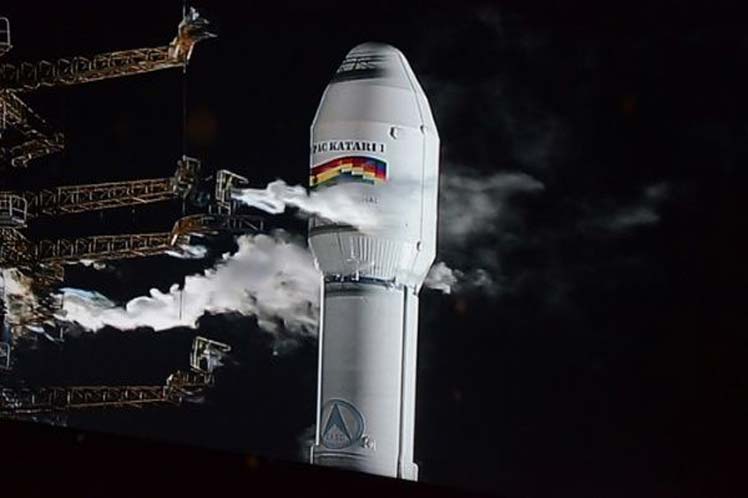
Túpac Katari, five years of Bolivian sovereignty in telecommunications
By Lemay Padrón Oliveros *
Translated and edited by Walter Lippmann for CubaNews
La Paz (PL) – When Evo Morales spoke of the possibility of Bolivia having its own space satellite, some thought he was joking.
Five years later, however, the first Bolivian satellite, Túpac Katari (TKSAT-1), is a reality and has enabled the South American country to enjoy true sovereignty over telecommunications.
Until then, Bolivia had been contracting foreign satellites for 35 years to use these facilities, with the consequent disbursement in dollars and the effect on the national economy.
Today, in addition to that function, TKSAT-1 has generated revenues of $102.2 million in its five years of operations, according to Iván Zambrana, manager of the Bolivian Space Agency (ABE).
Zambrana explained that the satellite’s annual turnover went from seven million dollars in its first year in orbit to 25 million dollars annually from 2016.
If we didn’t have a satellite of our own, that money would have gone outside,” said the director.
In addition, Zambrana recalled that the device managed to reverse the situation of ‘exclusion and inequality’ in access to telecommunications in the country, especially in rural areas, where more than three million Bolivians live.
This does not mean that we have now solved all the problems, but we have made significant progress in erasing this inequality that existed in the Bolivian population, he said.
According to the manager, there are only 50 countries in the world that operate telecommunications satellites, and four are Latin American: Argentina, Bolivia, Brazil and Venezuela.
Zambrana explained that in the first quarter of next year Bolivia will launch the service ‘Banda Ancha en tu Casa’ [Broadband in Your Home], which will offer internet service at low cost, with 30 percent of free space that still has the satellite Túpac Katari.
He also added that a service will be enabled that will allow people to visit the Amachuma earth station free of charge on the first Friday of each month.
The device, owned by the Plurinational State, was placed in orbit on December 20, 2013, from the Xichang Satellite Launch Center in China.
The vice-minister of telecommunications, Gustavo Pozo, recalled that when Evo had this idea he encountered much resistance, especially because of the high cost of the device, but the president was always clear that the benefits were much greater than the costs.
Currently, TKSAT-1 guarantees all Bolivians 30 television channels, six of them in high definition, and 26 radio stations totally free anywhere in the country.
In addition to its basic services, Túpac Katari has made it possible to transmit information via satellite to all corners of the Bolivian population, the reduction of the tariffs of the communications company Entel in calls, and that state satellite television has a price 80 percent cheaper than the others.
Among its fundamental benefits was the coverage of the Odesur Sports Games, which took place this year in Cochabamba (center), and were broadcast live and in high definition to the 14 participating countries.
It is located in a geostationary orbit, on the plane of the Earth’s Equator, 87.2 degrees west longitude and 36 thousand kilometers above the Earth’s surface, approximately on the Galapagos Islands, in the Pacific Ocean.
The satellite is controlled from the Amachuma Earth Station in the city of El Alto, located 4,000 meters above sea level, about 20 kilometers from La Paz, and from the La Guardia Earth Station in the department of Santa Cruz (east).
In total, the Agency has 65 workers, all Bolivians, and is in charge of more than 2,500 telecenters, more than 600 new radio bases, an implemented telehealth network and an educational television, all thanks to the implementation of TKSAT-1.
ABE’s main clients are the state-owned Empresa Nacional de Telecomunicaciones (Entel) and the private telephone companies Viva and Tigo, as well as other institutions such as Customs and the General Personal Identification Service of Bolivia.
Initially, ABE planned to work on another project for a second satellite, Bartolina Sisa, to support prospecting and natural resource management tasks, monitor agricultural projects and strengthen the search for water resources, but it has been deferred by a budget issue.
Túpac Katari and his wife Bartolina Sisa were indigenous leaders who were dismembered in retaliation for their uprisings against the Spanish colony in the 18th century.
Impossible for his executioners to imagine that three centuries later, the Aymara warlord would travel in the form of a satellite to give his compatriots sovereignty over telecommunications.
* Latin Press Correspondent in Bolivia.
You must be logged in to post a comment.