Those who won’t go forward will go backward
Those Who Won’t Go Forward Will Go Backward
By Manuel E. Yepe
September 2009
http://manuelyepe.wordpress.com/
A CubaNews translation.
Edited by Walter Lippmann.
Not every sector of the U.S. society, nor all U.S. citizens, is frustrated at President Barack Obama’s performance so far or his failure to keep his promises of change.
Small wonder, taking into account that the election of the young and charismatic senator raised hopes on both ends of the U.S. society’s spectrum over something he could not possibly accomplish.
To the elites holding the real power, Barack Obama was a necessary risk to save capitalism and U.S. dominance at home and abroad, as they had realized even before George W. Bush’s first mandate ended that Obama looked as promising as Franklin D. Roosevelt once was to a newly-formed imperialism following the Great Depression.
We must bear in mind that despite widespread hopes worldwide and many experts’ predictions, the conservative right has seen more victories than setbacks under Obama in matters of war policy while still treating him as an adversary. They have managed to considerably neutralize an antiwar movement whose members remain hopeful nonetheless, albeit not without certain reservations, that Obama will keep the promises he made during the presidential race, however long it may take him to.
The number of rallies and protest campaigns has decreased, never mind that Iraq remains an occupied country, the death toll in Afghanistan keeps rising and the war, far from decreasing, is now threatening Pakistan. Likewise, the torture center in Guantanamo is still operating under an assortment of pretexts, and the practices of “preemptive detention” and relocation of suspects in other countries are anything but over while every effort is made to hinder any investigation launched into cases of crimes against humanitarian law.
The number of military bases around the world “to fight drug trafficking” is growing rather than decreasing, and troops are withdrawn only when they can be replaced with “security contractors” –mercenaries– in the interests of privatizing all wars of occupation.
A sort of impasse in favor of the new U.S. president is also noticeable in Africa and the Caribbean, as many leaders and citizens from those regions feel committed to their support of Obama’s campaign, by virtue of a very conveniently manipulated racial identity which has made it possible for the superpower to revive its ties with them, regardless of the Third World’s repeated demands that the president be as good as his word.
At domestic level, the wealthy have profited more from Obama’s achievements than the middle class and the poor: his huge bailouts for the benefit of banks and insurance companies have put Wall Street’s mind at rest; the acquisition of the car industry with the Government’s backing to protect Corporate America from the labor union has been praised by the owners of that sector; and the $800 billion value pack for big business, as well as the mortgage loans to appease discontent among the workers, have definitely paid off.
Obama’s trips to other nations in order to restore old alliances and friendly links destroyed by the 8-year-long Bush administration are to the big companies’ liking, since they mean more investment and a bigger share of those alternative markets.
His promises to make reforms in the health system look fine to the right-wingers as long as they’re nothing more than a few cosmetic changes properly screened by the powerful giants of the pharmaceutical, biotechnological and health insurance companies.
For all the obvious steps Obama has taken to save capitalism and U.S. hegemony, the conservative elements who really call the shots offstage stick by their strategy of keeping the president always on the defensive by allowing, if not promoting, that he is branded as communist and criticized for his slightest criticism of racism.
When he came to the rescue of the banks, many likened him to Lenin and Stalin and warned him they would accuse him of trying to come up with a Union of Socialist American Republics. The governor of Texas threatened to set up a secessionist movement to fight against the U.S. president’s “socialist” economic plan.
Obama puts himself across as a leader committed to the promises that earned him a vote of confidence by most U.S. citizens and the Third World’s hopes of a change of direction in the superpower’s peace efforts, but one whose initiative invariably gives in to the pressures of a conservative right intent on keeping him more worried about defending himself than about making any progress.
Note from the Archbishop of Havana
- English
- Español
Note from the Archbishop of Havana
Government authorities informed the church about developments in the investigation of the murder of Spanish priest Mariano Arroyo Merino
July 2009
A CubaNews translation.
Edited by Walter Lippmann.
1. The morning of July 16, government officials informed the church about developments in the investigation, which is not yet concluded, of the murder of Spanish priest Mariano Arroyo Merino. The crime was committed during the early hours of Monday, July 13 of the past year (2008).
2. The excellent police investigation revealed the location and led to the arrest of the perpetrator presumed to have committed this abominable crime, and his possible accomplices. In addition to having collected evidence linking him to the crime, police authorities have acquired a confession from the perpetrator.
3. The authorities also informed us before that the investigation into the murder of Father Eduardo de la Fuente, which occurred in February, continues. At least one person in custody has confessed to the crime. The perpetrators of the crime were unaware that their victim was a priest.
4. The Church is aware of the shock, disquiet and questions that many faithful Catholics must have at such unusual events as these. It also is aware that similar sentiments must circulate among the population at large. It is conscious of the media attention these events have drawn, and how it is playing out in the Cuban media and in the international press, especially in Spain and the Spanish church, which has always been so close and so supportive. The Church is in the position to firmly dispute any attempt to link these cases to one another, or to give them any religious or political significance that is totally different from the reality of the actual crimes.
5. For the crimes that have been committed against these two priests—in itself an uncommon thing in our land—that no doubt have had an extraordinary effect on our ecclesiastical lives, we pray to our Lord for the families of the victims, and for the life of the Church in Cuba and in Spain. We also pray that these inhuman acts are not repeated in our homeland.
6. Finally, as Christians, we must not forget to ask God to move those criminals to repentance, so that he may be able to bestow his mercy on those who behaved so mercilessly.
Spanish Headline Here
Sub-Title
Por Authors Name Here
Espanol Here
Benefits and Dangers of North-South Tourism
- English
- Español
Benefits and Dangers of North-South Tourism
By Manuel E. Yepe
September 2009
http://manuelyepe.wordpress.com/
A CubaNews translation.
Edited by Walter Lippmann.
As a source of foreign currency, international tourism is thirty times bigger than it was 60 years ago, with more than 700 million tourists hopping from one country to another every year.
Several rich and highly industrialized nations among the destinations most favored by foreign visitors, and some of them also happen to be top issuers of tourists not only to other no less developed countries but also, and increasingly so, to poor countries where they can enjoy a better climate, a cleaner environment and a richer cultural diversity.
International tourism should be used by the richest countries as a vehicle to repay the poorest ones for the plundering of resources they suffered for centuries as a result of colonialism, neocolonialism, unequal exchange and other forms of sacking and exploitation leading to the dramatic disparity facing mankind today.
However, capitalism has its own set of rules, imposed by big business even to the practice of North-South tourism. Given that the conditions to be met by international tourism are more and more sophisticated, the poor nations find it harder and harder to fulfill them by themselves. Placing the building and management of your hotels and the rest of the tourism infrastructure in the hands of foreign investors is no longer enough to be as competitive as the industry demands nowadays.
For instance, the cruise ships and all-inclusive resorts give the target markets very little chance to make a profit, as the foreign visitors have already paid to the tour operators back home all their travel expenses, including meals, drinks, local transport and leisure activities. In the case of the former, the tourists sleep, eat and enjoy various amenities on board. “All they do when they put into port is damage the environment and get rid of the waste generated during the trip”, grumble those who naysay of this major part of the tourism industry in poor countries. On the other hand, travelers who choose all-inclusive results pay for almost everything in advance: accommodation, meals, soft and alcoholic drinks, sports, entertainment, even the tips. Critics in the recipient countries argue this form of tourism barely helps the local economy and damages the environment to boot. Indeed, most of these resorts are in relatively distant locations far from any major urban center, which prevents tourists from shopping around or enjoying local attractions, mainly because they have paid beforehand for everything their lodgings have to offer. These resorts are owned and/or managed by big corporations that leave the local small or medium-sized enterprises hardly any room to breathe.
At first they offered three daily meals and the clientele would pay for the drinks, but the common practice in the Caribbean made it more comprehensive as a function of developing tourism and making it more social.
In the late 1970s Canada saw the birth of a new mass tourism industry generally aimed at skilled workers who were not as well paid as the traditional tourists from rich countries –which suited the all-inclusive system down to the ground– that provided charter flights, more economic hotel operations and affordable prices that made demand hit the roof.
These all-inclusive resorts promise a vacation without surprises, as the tourists who buy a value pack know that at checkout time they won’t be handed a bill in excess of their calculations.
By the mid-1990s the all-inclusive resorts had become popular throughout the Caribbean and thus forced the big beach hotel chains to jump on the bandwagon.
Nonetheless, the mass tourist operations run by the top corporations in recipient countries have also brought with them serious social damages that the clientele’s few collateral and almost accidental expenses can hardly compensate for. There’s over-exploitation of the local workforce, whose employment insecurity virtually turns them into the foreign company’s slave labor. Consequently, poor areas spring up rapidly around the tourist parks where there are no hospitals or health care centers and corruption and tax evasion, among other scourges, are rampant.
Cuba, on the contrary, has managed to make the most of this economy of scale and stay clear of the social effects that countries like, for example, the Dominican Republic and Mexico have suffered, thanks to the high level of social organization in the Island, the scope of its socialist project, and the fact that the State and its public bodies have full control over foreign investment issues.
Our tourist industry workers are protected and their rights and social benefits guaranteed –an utopian goal everywhere else across the region– and our mass tourism revenues are reinvested in the development and welfare of the Cuban population.
Memories of a Mercenary
- English
- Español
Memories of a Mercenary
By Manuel E. Yepe
http://manuelyepe.wordpress.com/
A CubaNews translation by Walter Lippmann
Exclusive to the daily POR ESTO! of Merida, Mexico. Http://manuelyepe.wordpress.com/
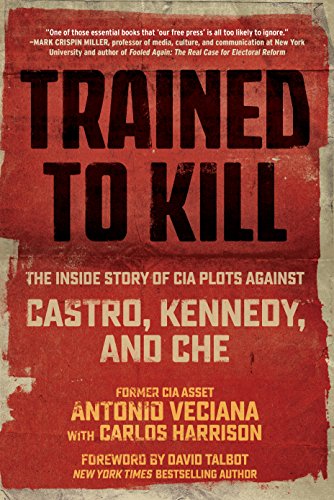
In recent days, a book written by a Cuban who has been a mercenary in the service of the Central Intelligence Agency (CIA) has been published in the United States and has played dissimilar roles in that criminal organization’s actions not only in the Washington battle against his Home country, but also to other infamous plans of the agency in other parts of the world and in the United States, including the latter, to the assassination of John F. Kennedy.
The American magazine Newsweek, in its May 28, 2017 issue, publishes a review by journalist Jefferson Morley on the book “Trained to Kill: The CIA Secrets about His Plans Against Castro, Kennedy and Che,” written by his ex Operative agent Antonio Veciana.
The terrorist “exploits” of this mercenary were widely known in Cuba and recognized by the American press, but the value of the infamies confessed by Veciana is that he adds elements to the multiple versions of the CIA’s leading role in the assassination of Kennedy .
According to Veciana, in 1960, he worked as an official of the Cuban government when, having already tried to subvert it from within, he stole official funds and used the money to finance attacks against government offices, factories and warehouses.
Two years later, he used his position in the government to distribute propaganda falsely announcing that the government planned to take custody of school-age children with the purpose of provoking panic in Cuban families and having some send their children to the United States , Where they would be welcomed by the Catholic Church in South Florida. The operation was called Peter Pan, separated 14,000 Cuban children from their families and was described in the press as “a disinterested effort to rescue the victims of communist oppression.”
Controller of Veciana for the operation was “Maurice Bishop” whose real name was David Atlee Phillips, who would become Head of the Division of the CIA for the Western Hemisphere until his retirement in 1975.
After the failure of Bay of Pigs, at Playa Girón, Phillips expressed his contempt for Kennedy, explains Veciana. After JFK’s peaceful conclusion to the missile crisis, Phillips created Alpha-66, a terrorist organization to attack Cuban targets that became a CIA instrument to pressure Kennedy with his actions.
In March 1963, Veciana and his group attacked a Russian merchant ship headed for Cuba, generating headlines around the world. Phillips sought to humiliate the Russians and embarrass JFK to take more aggressive action against Cuba. But Kennedy downplayed the issue and “Castro’s enemies, including Phillips, became even more furious,” Veciana says.
Veciana confirms how she met Kennedy’s alleged assassin, Lee Harvey Oswald, in the lobby of the Southland Center, the tallest building in Dallas, where he was introduced by Bishop.
“That was full of people, but Bishop, standing in a corner, was talking to a young man, pale, insubstantial. When he introduced me, I do not remember if he did it by his name (he might have said, ‘Tony, this is Lee. Lee, this is Tony.) But what I’m sure of is that Lee did not say anything. “
Following the assassination in Dallas on November 22, 1963, Oswald was arrested, and his face was broadcast on television. “I recognized him immediately,” writes Veciana. “He was, without a doubt, the same pale, insignificant young man he had seen eleven weeks before” in the company of Maurice Bishop. “
Veciana recalls that early in 1964 the agency man asked if a cousin of his who was a Cuban intelligence officer would be willing to state that he had conspired with Oswald before JFK was killed. Phillips offered to pay for such testimony, but Veciana replied that his cousin was communist and could not be bought.
A decade later, in 1975, when the JFK investigation was reopened, a congressional investigator, knowing that Veciana had worked for the CIA, approached him to learn more about how the agency collaborated with Cuban exiles. Veciana told her the story of her work with Bishop, including meeting with Oswald. Arrangements were made for an artist to draw a picture of Bishop based on Veciana’s description and the result was a portrait that closely resembled Phillips. Veciana was then taken to Washington for a meeting with Phillips, but he pretended not to know Veciana who, out of fear of reprisals from the CIA denied that Bishop and Phillips were the same person. “A lie that I have maintained until today”, emphasizes Veciana.
Certainly, in the confessions of this bloodthirsty terrorist there are elements that contribute data to the clarification of some half truths and manipulations in the criminal history of the USA.
June 5, 2017.
MEMORIAS DE UN MERCENARIO
Por Manuel E. Yepe
http://manuelyepe.wordpress.com/
Exclusivo para el diario POR ESTO! de Mérida, México. http://manuelyepe.wordpress.com/
En días recientes se publicó en Estados Unidos un libro escrito por un cubano que hizo carrera como mercenario al servicio de la Agencia Central de Inteligencia (CIA) y desempeñó disímiles papeles en acciones de esa organización criminal vinculadas, no solo a la batalla Washington contra su país natal, sino también a otros planes infamantes de la agencia en otras partes del mundo y en los propios Estados Unidos, incluyendo entre estos últimos, al magnicidio de John F. Kennedy.
La revista norteamericana Newsweek, en su número de 28 de mayo de 2017, publica una reseña del periodista Jefferson Morley sobre el libro “Entrenado para matar: Los Secretos de la CIA sobre sus planes contra Castro, Kennedy y Che”, escrito por su ex agente operativo Antonio Veciana.
Las “hazañas” terroristas de este mercenario eran ampliamente conocidas en Cuba y reconocidas por la prensa estadounidense, pero el valor de las infamias que confiesa Veciana radica en que agrega elementos a las múltiples versiones acerca del papel rector de la CIA en el asesinato de Kennedy.
Según Veciana, en 1960, él trabajaba como funcionario del gobierno cubano cuando, teniendo ya como proyecto subvertirlo desde dentro, robó fondos oficiales y utilizó el dinero para financiar ataques contra oficinas, fábricas y almacenes del gobierno.
Dos años más tarde, utilizó su posición en el gobierno para distribuir propaganda anunciando falsamente que el gobierno planeó tomar la custodia de niños en edad escolar, con el propósito de provocar pánico en las familias cubanas y hacer que algunas enviaran a sus hijos a Estados Unidos, donde serían acogidos por la Iglesia Católica en el sur de la Florida. La operación fue llamada Peter Pan, separó a 14 mil niños cubanos de sus familias y fue descrita en la prensa como “esfuerzo desinteresado para rescatar a las víctimas de la opresión comunista”.
Controlador de Veciana para la operación era “Maurice Bishop” cuyo verdadero nombre era David Atlee Phillips, quien llegaría a ser Jefe de la División de la CIA para el Hemisferio Occidental hasta su retiro en 1975.
Tras el fracaso de Bahía de Cochinos, en Playa Girón, Phillips manifestó su desprecio por Kennedy, explica Veciana. Luego de la conclusión pacífica abogada por JFK para la crisis de los misiles, Phillips le creó Alpha-66, organización terrorista para atacar objetivos cubanos que se convirtió en instrumento de la CIA para presionar a Kennedy con sus acciones.
En marzo de 1963, Veciana y su grupo atacaron un buque mercante ruso que se dirigía a Cuba, generando titulares en todo el mundo. Phillips buscaba con ello humillar a los rusos y avergonzar a JFK para que tomara acciones más agresivas contra Cuba. Pero Kennedy restó importancia al tema y “los enemigos de Castro, incluyendo a Phillips, se pusieron más furiosos aún”, dice Veciana.
Veciana confirma cómo conoció al supuesto asesino de Kennedy, Lee Harvey Oswald, en el vestíbulo del Centro Southland, el edificio más alto de Dallas, donde le fue presentado por Bishop.
“Aquello estaba lleno de gente, pero Bishop, de pie en un rincón, hablaba con un hombre joven, pálido, insustancial. Cuando me lo presentó no recuerdo si lo hizo por su nombre (podría haber dicho: ‘Tony, este es Lee. Lee, este es Tony’). Pero de lo que estoy seguro es de que Lee no dijo nada.”
Tras el asesinato en Dallas el 22 de noviembre de 1963, Oswald fue arrestado, y su rostro transmitido en la televisión. “Lo reconocí inmediatamente,” escribe Veciana. “Era, sin lugar a dudas el mismo hombre joven, pálido e insignificante que había visto once semanas antes” en compañía de Maurice Bishop”.
Veciana recuerda que, temprano en 1964, el hombre de la agencia le preguntó si un primo suyo que era oficial de inteligencia cubano, estaría dispuesto a declarar que él había conspirado con Oswald antes de que JFK fuera asesinado. Phillips le ofreció pagar por tal testimonio, pero Veciana le respondió que su primo era comunista y no podía ser comprado.
Una década más tarde, en 1975, cuando la investigación JFK se reabrió, un investigador del Congreso, sabiendo que Veciana había trabajado para la CIA, se acercó a él para conocer más sobre cómo la agencia colaboraba con los exiliados cubanos. Veciana le contó la historia de su trabajo con Bishop, incluida la reunión con Oswald. Se hicieron arreglos para que un artista hiciera un dibujo de Bishop basado en descripción de Veciana y el resultado fue un retrato que se parecía mucho a Phillips. Veciana fue entonces llevado a Washington para una reunión con Phillips, pero éste fingió no conocer a Veciana quien, por miedo a represalias de la CIA negó que Bishop y Phillips fueran la misma persona. “Una mentira que hasta hoy mantuve”, subraya Veciana.
Ciertamente, en las confesiones de este sanguinario terrorista hay elementos que aportan datos al esclarecimiento de algunas medias verdades y manipulaciones en la historia criminal de EEUU.
Junio 5 de 2017.
Havana Shall Not be Gentrified
- English
- Español
Havana Shall Not be Gentrified
By Manuel E. Yepe
http://manuelyepe.wordpress.com/
A CubaNews translation.
Edited by Walter Lippmann.
Proof that neoliberal capitalist domination is universal lies in the real estate speculation that underlies the neoliberal dream that “wealth is easy in the capitalist world”.
The most common evidence is finding a sumptuous building being built where previously there had been many modest homes and/or small businesses. If there is not a billboard to inform you, investigate and you will find that the new construction will house or serve a small number of families in very sumptuous conditions.
This phenomenon of capitalism is called “gentrification.” Sometimes it affects whole neighborhoods of humble population and leaves beautiful spaces that certainly can make wide sectors of the citizenship proud –even popular sectors– despite the fact that they hurt the sensitivity of those who worry about the worsening situation of those who previously inhabited those areas.
I remember that, shortly after the triumph of the revolution in Cuba, more than half a century ago, for the first time, I heard of this from a young dreamer named Eusebio Leal.
If I am not mistaken, he, being a history lover, began working as an assistant to the elder historian of the city of Havana, Emilio Roig de Leuchsenring (1889-1964). Eusebio devoted himself so thoroughly to his work that he became, first, a faithful and indispensable assistant to this erudite figure and, after his death, his replacement.
The process of restoration of the historical center of Havana City has gone through several stages after the Office of the Historian was founded –with managerial and operational autonomy– in 1938, on Dr. Emilio Roig de Leuchsenring’s initiative Its purpose was the promotion of the culture of Havana and the conservation of the valuable monumental legacy that the capital of the country treasures.
Eusebio added to his mentor’s teachings his own considerations and theories about the course to be applied to the conservation, reconstruction, and development projects of the capital city of all Cubans. He did it with such brilliance that it soon became clear that no one but he could undertake the complex task of conducting the work.
He was officially appointed Historian of the City when he had already demonstrated, in daily practice, that he was the ideal person to carry out the ambitious projects that were only in his mind but which he described as fait accompli.
So many people had to be convinced that the need to save Havana was so pressing that it would have to be taken on as a priority together with the education, public health and defense of the country.
This implied such tasks of convincing and promoting that made Eusebio Leal excel as a tribune and diplomat as well as administrator and builder.
Of course, the works and projects of the Office of the Historian of Havana earned enthusiastic patronage from the highest political leadership of the Cuban state, including that of the top leader Fidel Castro, who gave them their full support whenever necessary.
With Eusebio’s personal participation in every promotional detail, the historic center of the Cuban capital was declared a World Heritage SIOPite by UNESCO in 1982. This fueled a process of restoration that has transcended the patrimonial conservation framework and became an example of sustainable local development.
The restoration process had, as a central aim, the concept that the historic center would be not only an act of high architectural and urban value, but also the creation of a site with great cultural, economic and social potential. Eusebio was convinced that a successful rehabilitation should be self-financing and socially participatory.
The restoration process of the Historic Center of Old Havana –based on a model of self-management with a participatory and community approach– has been successful in the Cuban patrimonial context. It has contributed to the objective of guaranteeing the social achievements of the Cuban people within the socialist revolution.
One undoubted social impact of the restoration process is that it created a new awareness about the value of the city, its potential and the feasibility of its recovery.
The restoration of old hotels, the creation of hostels and extra-hotel services of various kinds has created the most visible side of the economy of the historic center. These, together with the commercial activity and handicraft production, have formed a profile that describes the historic center of the city.
Havana will not be gentrified. The population that has given it worldwide fame for its joy, traditions, hospitality, generosity and solidarity will continue to be the absolute owner of the increasingly beautiful and welcoming city.
May 4, 2017
LA HABANA NO SERÁ GENTRIFICADA
Por Manuel E. Yepe
http://manuelyepe.wordpress.com/
Una prueba de que el capitalismo neoliberal es universal en su dominación, está en la especulación inmobiliaria que fundamenta el sueño neoliberal de que la riqueza es fácil en el mundo capitalista. Lo más común es encontrar un suntuoso edificio construido donde antes hubo muchas viviendas modestas y/o pequeños comercios. Si no hubiera una valla que se lo informe, investigue y generalmente conocerá que la nueva construcción alojará o dará servicio a un reducido número de familias pero en condiciones muy suntuosas.
Este fenómeno propio del capitalismo se llama “gentrificación”. A veces afecta a barrios enteros de población humilde y deja bellos espacios que ciertamente pueden constituir orgullo de amplios sectores de la ciudadanía –incluso sectores populares- aunque hieran la sensibilidad de quienes se preocupan por la peor situación en que quedaron quienes habitaban esas áreas.
Recuerdo que poco después del triunfo de la revolución en Cuba, hace más de medio siglo, oí hablar por vez primera de este fenómeno a un joven soñador nombrado Eusebio Leal, quien -si no me equivoco- por ser aficionado a la historia, comenzó a trabajar como asistente del anciano historiador de la ciudad de La Habana, Emilio Roig de Leuchsenring (1889 – 1964). Se entregaba con tanto esmero a su labor que se convirtió, primero, en fiel e imprescindible ayudante de este sabio y, luego de su muerte, en su sustituto.
El proceso de restauración del centro histórico de Ciudad de La Habana ha pasado por varias etapas desde que, en 1938, se fundó con carácter autónomo la Oficina del Historiador por iniciativa del Dr. Emilio Roig de Leuchsenring, con el propósito de fomentar la cultura habanera y promover la conservación del valioso legado monumental que la capital del país atesora.
Eusebio incorporó a las enseñanzas de su mentor sus propias
consideraciones y teorías acerca del curso que debía aplicarse a los proyectos de conservación, reconstrucción y desarrollo de la ciudad capital de todos los cubanos con tal brillantez que bien pronto se hizo evidente que nadie más que él podría asumir la compleja tarea de conducir esos trabajos. Fue designado oficialmente Historiador de la Ciudad cuando ya había demostrado, en la práctica cotidiana, que era la persona idónea para impulsar los ambiciosos proyectos que apenas bullían en su mente pero que ya describía como hechos consumados. Había que convencer a tanta gente de que la necesidad de salvar a La Habana era tan presionante que tendría que ser asumida de manera prioritaria y simultánea con las de educación, salud pública y defensa del país.
Ello implicaba un trabajo de convencimiento y promoción que hizo que Eusebio Leal sobresaliera como tribuno y diplomático tanto como administrador y constructor. Por supuesto, las obras y proyectos de la Oficina del Historiador de La Habana obtuvieron patrocinio entusiasta de la máxima dirección política del Estado cubano, incluyendo el del máximo líder Fidel Castro quien les dio todo su apoyo cuando ello fue necesario.
Con su participación personal en cada detalle promocional, el centro histórico de la capital cubana fue declarado Patrimonio de la Humanidad por la UNESCO en 1982, algo que impulsó un proceso de restauración que ha trascendido los marcos de la conservación patrimonial y se convirtió en ejemplo de desarrollo local sostenible. El proceso restaurador apuntaba a que el centro histórico no sería solamente un acto de alto valor arquitectónico y urbanístico, sino además un sitio de gran potencial cultural, económico y social, con la convicción de que una rehabilitación exitosa debía ser autofinanciable y socialmente participativa.
El proceso de restauración del Centro Histórico de La Habana Vieja basado en un modelo de autogestión con enfoque participativo y comunitario ha sido exitoso en el contexto patrimonial cubano y ha aportado al objetivo de garantizar las conquistas sociales logradas por el pueblo cubano con la revolución socialista.
Un indudable impacto social del proceso de restauración, es que a partir de su propia labor, se ha creado una nueva conciencia sobre los valores de la ciudad, sus potencialidades y la factibilidad de su recuperación.
A partir de la restauración de antiguos hoteles, la creación de hostales y de servicios extrahoteleros de diverso orden, se ha constituido en la cara más visible de la economía del centro histórico, junto con la actividad comercial, y ha conformado un perfil que al igual que la actividad artesanal, califica al centro histórico de la ciudad.
La Habana no será gentrificada. La población que le ha dado fama mundial por su alegría, sus tradiciones, su hospitalidad, su generosidad y su solidaridad seguirá siendo dueña absoluta de la cada vez más bella y acogedora ciudad.
Mayo 4 de 2017
Democracy According to Obama
Democracy According to Obama
By Dr. Néstor García Iturbe, 2016
A CubaNews translation.
Edited by Walter Lippmann.
I recently received an objective and interesting note published by “CUBA NEWS” where academician Nelson Valdés explains Obama’s views on democracy and gives us an insight into how a single topic can get a different treatment depending on the surrounding atmosphere.
The note in question pointed out that in his speech of June 4 in Egypt, Obama said: “So let me be clear. No system of government can or should be imposed by one nation on any other”.
However, on April 13, just 52 days before, he had remarked the following: “The promotion of democracy and human rights in Cuba is in the national interest of the United States and is a key component of this nation’s foreign policy in the Americas”.
Among the explanations the scholar tried to give to the President’s contradictory approach to this issue in such a short period were:
This gentleman has either a poor memory or two speechwriters. In his opinion, Cuba is not an independent nation, but a part of U.S. territory.
As I see it, both of Obama’s phrases are nothing but a confirmation of the way his country has practiced foreign policy ever since it was founded. Besides, they throw light on the ambivalent stance the U.S. often takes on terrorism (the good one and the bad one), human rights (who violates them and who doesn’t), immigration, children’s rights, and everything they use to boast the “good things” of a system which, truth be told, becomes more corrupted by the day.
The South American Ogre So Loved By His People
The South American Ogre So Loved By His People
By Manuel E. Yepe
September 2009
A CubaNews translation.
Edited by Walter Lippmann.
Who is this monster, the United States’ worst enemy in South America, who is worse than Fidel Castro and Osama bin Laden? The who supports all terrorists and drug traffickers in the world, from Al Qaeda to Hamas, who promotes hate against the wealthy, and who can also count on enough popular support to win all the elections?
With questions such as these begins the documentary “South of the Border” by the prominent American filmmaker Oliver Stone. The film is about the leader of the Bolivarian Revolution, Hugo Chávez, to be presented on Sunday September 6, to the press at the Venice Film Festival. According to reports, the film includes testimony about the personality and career of the charismatic Venezuelan leader by Latin American presidents, Cristina Fernandez of Argentina, Evo Morales of Bolivia, Luiz Ignacio Lula da Silva of Brazil, Rafael Correa of Ecuador, Fernando Lugo of Paraguay, and Raúl Castro of Cuba.
The announcement of the completion of this film project coincided with the failure of a campaign funded by the Colombian oligarchy, supported by groups of the wealthy Venezuelan opposition, and the U.S. It was orchestrated under the slogan “No more Chavez.” The campaign sought to organize simultaneous marches on 4 September 2009 in ninety cities worldwide, “to protest the insults against Colombia which were made by the Venezuelan leader.”
According to press reports, the event was convened, by “a group of young Colombian entrepreneurs” who had predicted the event would be attended by great numbers of people, in major cities worldwide however, it only managed to attract small crowds using social networking sites like Facebook and Twitter on the Internet.
The movement, considered, by Venezuelan-American lawyer, writer and journalist Eva Golinger, to be “a call for assassination, hatred and destabilization” failed when it only brought together groups of a few hundred people in a number of cities – much smaller numbers than the projected. “They failed and were made to appear ridiculous with the demonstrations they called against Chavez for Friday and Saturday,” said the president of the Venezuelan National Assembly, Cilia Flores.
Organizers affirmed, without giving specific numbers, that they were successful in carrying out rallies in Madrid, Barcelona, Paris, Sydney, Brussels, Hamburg, Buenos Aires, Sao Paulo, Santiago, Tegucigalpa, several cities in Venezuela, as well as thirty locations in Colombia.
The most popular of these was, without a doubt, the rally that was “called” in Tegucigalpa, by the military government that took power by military coup on July 1 and which, removed the constitutional President of Honduras Manuel Zelaya. The insurgents reported that about two thousand people participated in an event led by Roberto Micheletti, the de facto head of state.
In Bogota, several groups marched from the northern suburbs of the city, areas that have high concentrations of the upper class, to the historic center. In the downtown area of Bogotá, and in other areas, the anti-Venezuela protests were rejected by grassroots groups with whom they exchanged shouts and at times, even blows.
Popular Protesters came out against President Álvaro Uribe’s proposal to make changes in current law in order to run for re-election again, and also, in opposition to Uribe’s military pact with the U.S. government. Which, according to the official version, has as its aim to put Colombian military facilities at the service of U.S. operations against drug trafficking in the region. For all the other South American leaders – primarily Chavez, this action represents the surrender of Columbia to U.S. military occupation and poses a threat to the independence of Latin America nations.
In Caracas, popular and opposition groups gathered at a safe distance from each other in order to avoid confrontation, and to express, respectively, rejection and support for President Hugo Chávez and the Bolivarian revolution. The demonstrations were preceded by appeals to keep the marches peaceful.
In the demonstration against Chavez, where a few hundred opponents chanted “No more Chavez,” the counterrevolutionary slogan launched from Bogota, the metropolitan mayor Antonio Ledezma, of the opposition, demanded freedom of expression in an act that, paradoxically, was being protected by authorities and broadcast by several radio stations and local television stations. There was also criticism of a law passed by parliament that expands educational options to low-income sectors.
On the side of Chavez supporters, thousands of citizens dressed in red, the color of the United Socialist Party of Venezuela (PSUV), and marched in support of the Bolivarian leader, while at the same time other hundreds of marches in support of Chavez were taking place in inland towns. Diosdado Cabello, a leader of PSUV reported in Caracas that the Venezuelan opposition maintains its plan of assassination because of the inability to defeat Chavez at the polls in democratic processes.
By telephone, from Tehran, Iran, where he was on an official visit, Hugo Chávez, the evil defender of the humble, the enemy of the rich and of American hegemony on the continent, ratified the Venezuelan peoples commitment demonstrated in their mass rally against the foreign ministry in Caracas, by stating, “homeland, freedom and socialism.”
Cuban Doctor Repudiated in Argentina
Cuban Doctor Repudiated in Argentina
By Stella Callóni
Thursday, June 25th 2009
A CubaNews translation.
Edited by Walter Lippmann.
Buenos Aires, June 24. Human rights organizations, family members and survivors from the military dictatorship repudiated statements made by Cuban doctor Hilda Molina and declared her persona non grata for offending the Mothers and Grandmothers of the May Plaza.
Molina, a doctor that used to belong to the Cuban Communist Party and who confronted the government when it was discovered that she received money from people for services that are given fee in Havana, recently received authorization to leave the island and make a temporary visit to Argentina. Her son, who lives here, was also accused of embezzlements against Cuba at the time. When she arrived she said she was going to be politically discreet to avoid the host country any embarrassment. When she was bombarded with interviews from the extreme right media, she forgot her commitment.
She declared to ultra-right media Perfil (Profile) that the mothers and grandmothers of the May Plaza: “suffered the persecution of a dictatorship, however they worship others, like the one in Cuba. The one in Cuba is leftist while the one they suffered belonged to the extreme right. I knew they were not going to do anything because those who worship that dictatorship like to make demons out of those who think differently.”
“If you consider the Cuban revolution a dictatorship and liken it to the Fascist and criminal dictatorship of Jorge Videla and Emilio Massera, you offend all Argentineans that suffered terrorism”, says the official statement of the Argentinean human rights organizations.
Bad guys in the movies?

Bad guys in the movies?
IN THE CRUSADE AGAINST SQUANDERERS THE ENERGY SUPERVISION GROUPS IN THE COUNTRY HAVE DONNED THE “SEVEN LEAGUE” BOOTS.
By Ortelio Gonzalez Martinez
June 23, 2009
A CubaNews translation.
Edited by Walter Lippmann.
CIEGO DE AVILA.- There are good, silent men who move quietly, without arrogance, and do not see themselves as important, but in fact they are important manuel, to the center, and francisco (left) advise an interested client on how to diminishing the electricity cost of their company.
This is how those who are fighting the battle against excessive electricity expenditure behave as members of the Energy Supervision Groups in the country (ESG). They were created in Sancti Spíritus in February 2007 and later in the rest of the country.
Those in my province don’t monopolize the press, yet many know them, and think about them, especially when they arrive at the companies and insist on saving measures, key positions, load redistribution, expenditure plan, energy balance…fight against fraud intensifies in the residential sector
ANOTHER TURN OF THE KEY IN FAVOR OF THRIFTINESS
For electric engineer Manuel Sánchez Fernández, head specialist of the Group in the Basic Electric Organization (OBE) in Ciego de Avila, it is time to give another turn to the key in favor of thriftiness; because, there is a hidden source of energy that needs to be found and exploited for the good of all. “The thing is to avoid spending more energy than the one planned. Reserves appear and it is our duty to find them, by organizing work better, and changing for the better the disposition of those that squander it”, he declared.
He said that Load Distribution Manuals had appeared since the ’70s. . Companies were supposed to follow them to determine their saving policy. However, those books were kept in the drawers and very few mangers – and fewer workers – consulted them.
Nowadays, when the world crisis threatens us, the country spent during the first four months of this year 40 000 tons more fuel for electric generation than planned. These groups are necessary – I would say crucial – to discover anomalies and provide counsel when needed.
“In the beginning – Manuel asserts -, company managers resented us, especially the squanderers. This is changing, although we have to sensitize many managers. There are still places which don’t even have an expenditure plan. For this reason up to June 19, 42 companies had been denied electricity service. Most of them belong to MINAZ, MINAGRI and Trade and Gastronomy.”
In our province the Group is formed by four experienced specialists and, contrary to what some people think, they aren’t snipers. Yet, they are uncompromising with those who disregard the saving policy indicated by our country’s maximum leaders. There is no alternative.
Real life shows us that there are leaks of electrical energy, caused by lack of control, and irresponsibility.
What should we call those that do not study the company load, do not read the counters and care more about the expenditure of fuel than that of electricity?
Inspections made (more than 100 in the province) discovered anomalies everywhere. It is no laughing matter, for example, that in certain workplaces they ignore the existence of an expenditure plan, or that in a store of the Interior Trade Ministry the inspection detected a large expenditure of electricity even when the freezer was not in working order. Further investigation revealed that several nearby homes were connected to the store and the residents did not pay for electricity.
In the opinion of Thermo-energy Engineer Francisco Ramírez Díaz, also member of the ESG, saving is not possible without management supervision. Thus, he brings another problem out on the open; the ineffectual analyses made countless times by Management Councils, Party committees, Young Communist organization committees, and union representatives at workplaces.
During the enquiries, Granma found out that the way the issue is discussed is boring, repetitive and, therefore in spite of good intentions, the reason for excessive electricity expenditures is not found.
The issue of energy consumers is in the agenda of every workplace visited. We concede that. However, comments on the subject are restricted to: “How much electricity did we use? We cannot overdraw the expenditure plan. It is necessary to work in that direction… “, Discussions should dig deeper than that during collective debates.
CUT OFF THE POWER…
It is not a matter of “cutting off the power and turning on the gas lamp” as the popular saying goes. Engineer María Antonia Valdés Alfonso, head of the Rational Use of the Energy Managerial Base Unit of the OBE in Ciego de Avila province, affirms that the maximum leaders of the country have stated this as the last option.
Without forgetting the residential sector, for the time being emphasis is put now on the state sector, the biggest consumer in the county. When companies and state units overdraw their plans service is withdrawn. “Service is withdrawn for 72 hours to those [companies] who consume electricity over the amount planned. If they recur, more severe measures are applied to managers. They put the squeeze and it has given results.”
Engineer Aidel Suárez López, who also walks with the control calendar always ready, is categorical: “Most managers think that their companies have done everything possible merely because they have turned off lights and motors; that this solves the saving problem. They push to the background very important words like energy balance, load redistribution, deviation from the real consumption, energy efficiency…, but we won that battle. The final objective is to put the cork back in the bottle.”
At least in Ciego de Ávila, the “cork” is beginning to stop squandering. Since June 1st when saving measures began, to the 19th, the province fulfilled the 15 day plan. This result is due in part to the “bad guys in the movies”. Nobody doubts that.
But their performance should not be restricted to moments of crisis. It should be systematic and they should work every day against squanderers and the inefficient use of energy carriers.
You must be logged in to post a comment.