
17 Minutes of Silence, 7000 Empty Shoes

17 Minutes of Silence, 7000 Empty Shoes
Symbolism in tribute to the fallen in shootings in U. S. schools precedes March 24 March Against Gun Violence in the country.
By Juventud Rebelde digital@juventudrebelde.cu
Published: Wednesday, March 14, 2018 | 09:14:07 PM
Translated and edited by Walter Lippmann.
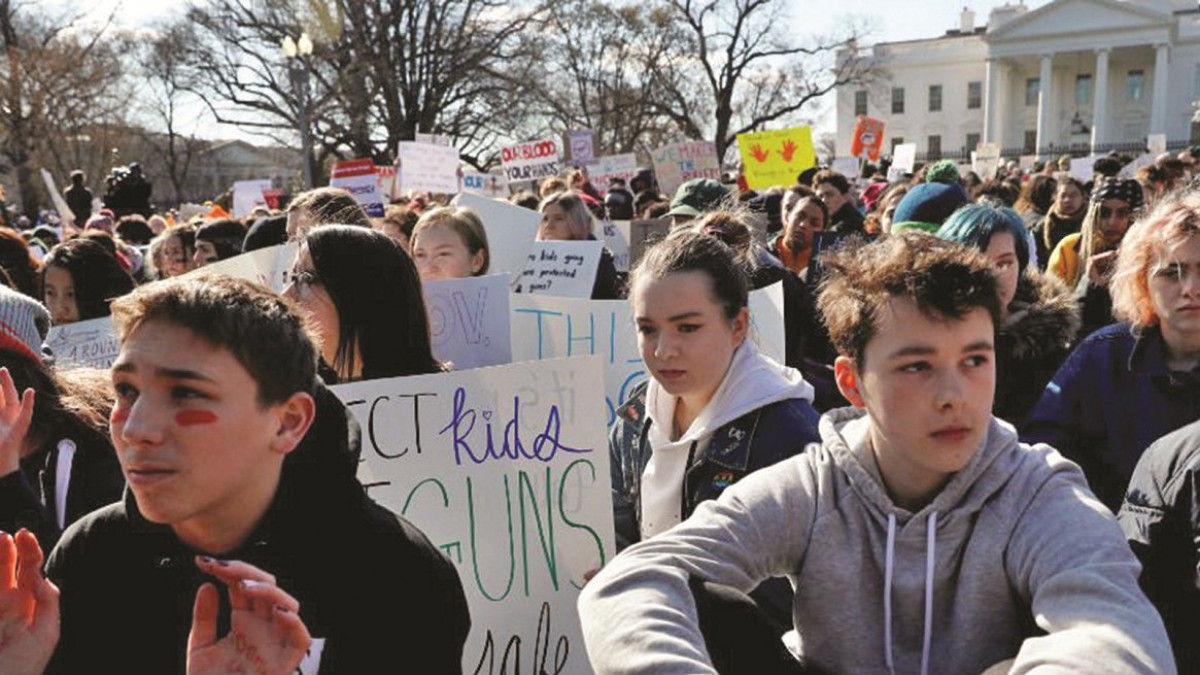
The students are asking their government to protect them and not the weapons. Author: Reuters Published: 14/03/2018 | 07:39 pm
WASHINGTON, March 14. – A month after the shooting at Marjory Stoneman Douglas High School in Parkland, Florida, students from across the country left their classrooms for 17 minutes to commemorate the 17 victims who lost their lives in the incident.
Thousands of U.S. students on Wednesday honored those fallen in the latest massacre inside a school in the northern nation and joined demands for greater gun control.
“When students protest, our school staff will respond appropriately and allow them to express themselves,” Robert Runcie, superintendent of Broward County, Florida, where Marjory Stoneman High School is located, told Reuters.
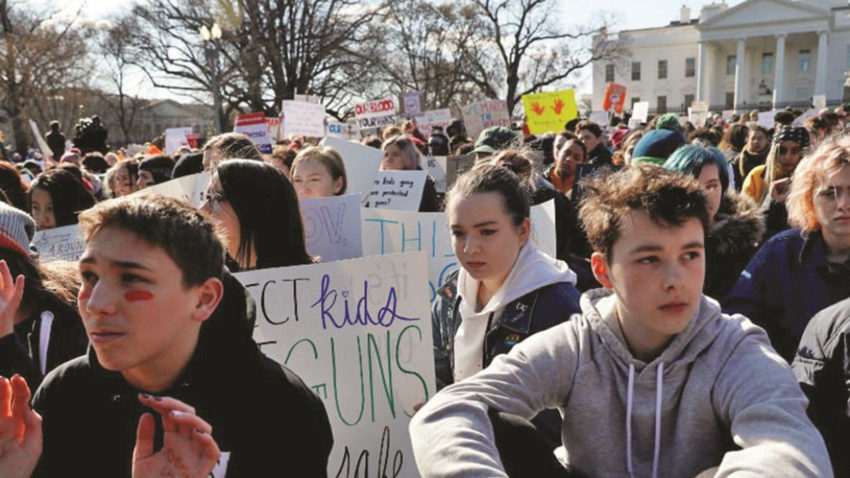
In Washington, D. C., Pennsylvania Avenue became a giant silent space for exactly 17 minutes, while hundreds of young people stood on the road with signs demanding urgent action against gun violence, Notimex said.
“Enough, no more deaths “,” Make our schools safe again ” and “Protect the boys, no more guns” were some of the messages written on the posters waved by high school students, who marched to the Capitol to demand, among others, reinstatement of the ban on assault weapons, raising the minimum age for purchasing rifles from 18 to 21 years old, and to apply the background check to the police.
During their tour, the young people chanted slogans against the National Rifle Association, which opposes greater regulations for the purchase of arms.
This day’s protest was a foretaste of the massive mobilization that will take place in Washington on March 24.
A day earlier, activists and volunteers placed 7,000 pairs of empty shoes in front of the capitol, representing the 7,000 children and young people who have died in school shootings since the success of Sandy Hook in 2012.
The shoes, which come from relatives of victims, celebrities and citizens across the country, were placed in front of Congress to demonstrate their protests against legislators’ inaction in the face of frequent school shootings, HispanTV reported.
This is trying to portray, at the legislators’ own door, the cost in human lives of refusing to pass a gun control law,” said Emma Ruby-Sachs, deputy director of Avaaz, the organization that planned the protest in Washington, Reuters reported.
17 Minutes of Silence, 7000 Empty Shoes
17 Minutes of Silence, 7000 Empty Shoes
Symbolism in tribute to the fallen in shootings in U. S. schools precedes March 24 March Against Gun Violence in the country
By Juventud Rebelde digital@juventudrebelde.cu
Published: Wednesday, March 14, 2018 | 09:14:07 PM
Translated and edited by Walter Lippmann.
The students are asking their government to protect them and not the weapons. Author: Reuters Published: 14/03/2018 | 07:39 pm
WASHINGTON, March 14. – A month after the shooting at Marjory Stoneman Douglas High School in Parkland, Florida, students from across the country left their classrooms for 17 minutes to commemorate the 17 victims who lost their lives in the incident.
Thousands of U.S. students on Wednesday honored those fallen in the latest massacre inside a school in the northern nation and joined demands for greater gun control.
“When students protest, our school staff will respond appropriately and allow them to express themselves,” Robert Runcie, superintendent of Broward County, Florida, where Marjory Stoneman High School is located, told Reuters.
In Washington, D. C., Pennsylvania Avenue became a giant silent space for exactly 17 minutes, while hundreds of young people stood on the road with signs demanding urgent action against gun violence, Notimex said.
“Enough, no more deaths “,” Make our schools safe again ” and “Protect the boys, no more guns” were some of the messages written on the posters waved by high school students, who marched to the Capitol to demand, among others, reinstatement of the ban on assault weapons, raising the minimum age for purchasing rifles from 18 to 21 years old, and to apply the background check to the police.
During their tour, the young people chanted slogans against the National Rifle Association, which opposes greater regulations for the purchase of arms.
This day’s protest was a foretaste of the massive mobilization that will take place in Washington on March 24.
A day earlier, activists and volunteers placed 7,000 pairs of empty shoes in front of the capitol, representing the 7,000 children and young people who have died in school shootings since the success of Sandy Hook in 2012.
The shoes, which come from relatives of victims, celebrities and citizens across the country, were placed in front of Congress to demonstrate their protests against legislators’ inaction in the face of frequent school shootings, HispanTV reported.
This is trying to portray, at the legislators’ own door, the cost in human lives of refusing to pass a gun control law,” said Emma Ruby-Sachs, deputy director of Avaaz, the organization that planned the protest in Washington, Reuters reported.
Constant Violence in the USA, Part II
Constant Violence in the USA, Part II
By Lázaro Fariñas
Cuban journalist living in Miami.
Monday 12 March 2018 | 06:56:50 PM
Translated and edited by Walter Lippmann.
The controversy over gun control in the United States has been red-hot. The numerous and repeated massacres that have been going on for many years are leaving the millions of citizens without arguments and against the wall who, in this country, support the Second Amendment of the Constitution, that which gives the right to all the people who live here to possess a firearm.
The National Rifle Association is a very powerful organization with hundreds of thousands of members and immense financial resources. It is the main advocate of the famous Second Amendment. It is the NRA that provides millions of dollars to politicians in this country to maintain strong support for the upholding of that constitutional right. By direct or indirect means, they channel all that money to members of Congress to avoid any legal changes regarding firearms.
So far, no bill of any kind aimed at controlling, changing or eliminating the Second Amendment has been able to prosper. Some presidents have tried to pressure senators and representatives, but none of them have been successful, even though some congressmen have been victims of attacks. Several presidents have been murdered in the course of this country’s history. Nine have survived attacks, but four did not survive. These were Lincoln, Garfield, McKinley, and Kennedy.
At the moment, America has been creating a state of opinion in favor of doing something about how easy it is for citizens to acquire such deadly equipment. They are likely to make some sort of change, but I doubt that they will be able to get the amendment protecting gun ownership completely removed.
It is estimated that there are currently more than 300 million firearms in the possession of the population. This indicates that, if a law banning the sale of firearms in all states of the Union were to be enacted tomorrow morning, it would be totally impossible to remove all that arsenal from the hands of the inhabitants of this nation. To think that this was possible would be like daydreaming, rather, as an impossible mission.
But it seems that the number of weapons on the streets and in the fields is not enough. Now, President Donald Trump has come up with the brilliant idea that, in order to prevent further killings from occurring in schools, ten to 20 percent of school teachers should be armed. If we estimate that there should be about seven million of these at the primary and secondary levels, with only about ten percent being armed, it would be roughly 700,000, and almost one and a half million more if it were 20%. What do you think? Mr. Trump wants to create an entire army of armed teachers. It’s as if to say,”We were few and far between and Catana gave birth.”
The problems of this society are getting more complicated every day. As I said in a previous commentary, I do not believe that the problem of violence in this country will be solved only by the elimination of the aforementioned amendment. We must try to reverse a whole way of thinking and acting in this society. We must create a social consciousness for the citizens that is different from the one that has prevailed until now. That is not easy to do. Violence is so deeply rooted in the lives of the people of the United States that I find it almost impossible, over the years, to achieve, not eliminate, or even mitigate it.
This state of opinion, which I spoke of in previous paragraphs, has gradually been created by citizens who are aware that something has to be done. Different organizations and groups have been forming, but all in all, there are many ways to walk and little time to avoid new massacres.
Thousands of heavily armed and trained militias are scattered around the country. Hundreds of thousands of deranged militias roam the streets of cities without medical treatment, thousands of lone wolves are locked up in their homes waiting to claw their way out. Tens of thousands of war veterans wander traumatized by clinics, alcoholised and psychologically destroyed, drug addicts, murderers, drug addicts and drug addicts alike.
I know I am showing a dark and terrible panorama in this commentary, but it is not pessimism on my part, it is the reality that surrounds us. For the good of this country, where I have lived almost all my life, where I have made a family and to whom I sincerely wish the best, I wish things were not as I am painting them.
Constant Violence in the USA
Constant Violence in the USA
By Lázaro Fariñas
A CubaNews translation.
Edited by Walter Lippmann.
Posted: Monday 26 February 2018 | 06:09:11 PM
Updated: Tuesday 27 February 2018 | 02:55:25 PM
Three days after the murder of 17 people at a high school in South Florida, a gun show took place in a facility less than an hour’s drive south of the scene. The exhibition featured weapons of all types, from low-caliber weapons to assault rifles such as the famous AR15.
Hundreds of such events are held annually in the United States and are attended by thousands upon thousands of citizens who, for a small fee alone, have access to the exhibition.
The exhibitions are not only to show the different types of weapons that are on the market for sale, but also, so that those who want to buy are able to do so right there and leave with their preferred weapon.
With incredible insensitivity, the organizers of the exhibition held in Miami told the press that they could not suspend the event because they had spent a lot of money on organizing it. While the relatives of the victims of the massacre buried their loved ones, a few miles to the south, merchants of the death boasted of how well they were doing with the sales of such deadly equipment.
Any sensible person would have to wonder what madness that is? How come it’s so easy to acquire a firearm? How can one justify the fact that it is legal for an adolescent to be able, calmly, to locate a gun dealer and acquire an assault rifle that in reality only serves as an offensive weapon?
I don’t really think anyone rational has a rational answer to this question.
What kind of society has this great country created that cannot prevent firearms from being legally purchased without any restrictions as easily as you can buy onions in a grocery store?
The right to possess the weapon of choice is enshrined in this country’s Constitution and dates from the 18th century. Today, in the 21st century, the same law as it was more than 200 years ago continues to apply. And the worst thing is that the constitutional amendment that protects this citizen’s right has been almost impossible to repeal or alter, given that there is a lot of money involved in trying to prevent that from happening.
The theory of those who blindly advocate that the famous [Second] Amendment remains in effect. It says we all have the right to have a firearm for our personal or family defense. But the argument is not even as to whether that is desirable or not, but as to the type of weapon and caliber that the law allows being purchased.
Can you justify a parent having a weapon of war in his or her home? What are you doing with an assault rifle that’s only produced for combat?
No one who has the ability to respond or create laws to make it illegal to possess assault weapons or any other weapons in the hands of private individuals dares to act.
Representatives, senators, governors, mayors and even U. S. presidents who have dared to mess with the firearms industry are few and far between. The economic power of that conglomerate is so great that most politicians do not dare go head-to-head with it and create laws that prevent anyone, including crazy, insane, mentally ill, teenagers, murderers or a normal, rational person, from reaching a gun dealer and buying the gun they want.
In reality, it is very difficult to imagine what the solution to the problem facing American society could be.
We should also ask ourselves whether, by preventing arms from being bought for without limits, the problems facing this country would be solved? I don’t think that with only laws that prevent their acquisition or possession, these massacres that occur so often will end.
There are other factors involved that lead to the creation of a society as violent as the North American one. These include its own history of wars, invasions and massacres by governments, the proliferation of organized mafias, the assassinations of presidents in office, the annihilation of indigenous peoples, police abuse, high drug use, TV serials with a high level of violence, action movies, violent video games, the loneliness in which children are raised, etc., etc.
The violent acts are in the DNA of this country, therefore, I fear that unfortunately, every now and then, we will continue to see and regret events such as those that occurred in the Florida high school where 14 teenagers and three adults were murdered.
Democracy in Cuba and the United States
Democracy in Cuba and in the United States
 By Manuel E. Yepe
http://manuelyepe.wordpress.com/
Exclusive for the daily POR ESTO! of Merida, Mexico.
Translated and edited by Walter Lippmann.
Democracy and freedom are two very manipulated categories by the elite that governs the United States. It has installed them in the minds of most of its citizens as qualifiers of the model of the capitalist system that governs that North American nation, which is assigned by a manifest destiny to spread throughout the world.
The “merit” of its ideologues for having managed to control the psyche of its inhabitants is even greater if one notices that they are two categories – democracy and freedom – that in today’s U. S. society have acquired diametrically opposed characteristics to those that semantically correspond to them.
There are other concepts commonly manipulated by the ruling elite in the world superpower. These include human rights and governance, which they systematically use, relying on their immense resources and the possibilities given to them by the control of the media they exercise on a global scale.
It is, for example, insultingly ironic and misleading that the United States uses the economic blockade as a coercive measure against many nations. In the case of Cuba, it has seen all the rights of its people violated for more than half a century. Nevertheless, the US boasts to world public opinion that they are the main defenders of the human rights of peoples. To pretend to act, at the same time, as prosecutor and judge, in cases of violations that it only detects in governments that do not bend l./to Washington’s will and convenience is the height of cynicism.
The practice of presenting itself as a model for the world is intended to challenge and control the management of the internal affairs of the countries that are subject to them. They always link the characteristics of such submission to their responses to requests for financial assistance, technology transfer or support in political conflicts with third countries. It should be noted that, when the Cuban revolution came to power in 1959, the struggle that unified the Cuban people for self-determination was, first and foremost, the struggle for human rights and justice, aspirations that had the Washington authorities as their main opponent.
Cuba is probably the only country in the world where no single prisoner has ever been tortured since 1959, where no extrajudicial executions have ever taken place in this period and where no police forces have ever used jets of water, battering or other humiliating forms of repression against demonstrators. Cuba is currently the only country in Latin America where, in the last 58 years, there have been no paramilitary forces or death squads, no killings, no disappearances or torture of prisoners, and no violence against the people.
In Cuba, since 1959, (with the exception of the U. S. Naval Base at Guantánamo Bay), no prisoner has ever been killed, tortured, sexually raped, taken abroad to be remotely tortured, locked up without trial or simply “disappeared”, in the style of the brutal Latin American dictatorships sponsored by Washington during the shameful Plan Condor.
In Cuba, since 1959, only in the naval base that Washington has illegally maintained next to Guantánamo Bay, could one find civilian and military leaders who promote or permit physical torture or other equivalent forms of humiliation against detainees.
Such shameful practices were introduced in Latin America by the U. S. Defense Department’s School of the Americas. Officers are trained there for the armed forces of the countries controlled by the superpower.
Methods of breaking prisoners include: sensory deprivation, isolation, sleep denial, forced nudism, fear inspired by trained animals, acts of sexual or cultural humiliation, simulated execution and threats of violence or death against detainees or their loved ones, among other inhumane practices. These were spread through the barracks and military and police stations of the continent on the advice of counselors and instructors from the United States.
In Cuba, there are no political prisoners, if by that we mean people imprisoned for propagating or professing political ideas against the government.
Anyone who has doubts about where democracy works and where it is pure fiction can compare, objectively and comprehensively, Cuba’s electoral system – where the people are the ones who postulate, elect and control their leaders without intermediaries – with the one that led Mr. Donald Trump to the presidency of the United States.
Or, without going any further, with the recent elections in Colombia applauded by Washington.
March 13, 2018.
NRA Responds to U. S. Protests

NRA Responds to U. S. Protests with AR-15 Rifle Picture
Translated and edited by Walter Lippmann for CubaNews
Washington, 14 Mar (PL) As thousands of students in the United States today demand concrete action against gun violence, the powerful and controversial National Rifle Association (NRA) published an image of the type of weapon used in a recent massive shooting.
“I’ll control my own weapons, thank you,” reads a Twitter publication of the main lobby in favor of these artifacts in the country.
That message is written on a picture of an AR-15 rifle, similar to the one used a month ago by the murderer who left 17 dead and as many injured in a secondary school in the city of Parkland, Florida.
Next to the image is added the label #2A, referring to the Second Constitutional Amendment of the United States, which establishes the right of citizens of this country to bear arms.
The tweet generated numerous reactions, including from supporters of the NRA’s viewpoint, who argue that advocating for greater arms control is tantamount to violating the amendment, or that mental illness is the cause of mass shootings.
But many Internet users criticized the organization for its rejection of any regulation that would make access to these devices more stringent.
“It is completely possible to have control of weapons and possess them at the same time. That’s common sense,” wrote one Twitter user, while another said the NRA is no longer a security group for hunting and weapons possession, but “a cowardly shriek for gun and ammunition manufacturers”.
Another of the responses to the lobby’s tweeting image pointed out that it always leaves out the most significant part of the second amendment, which speaks of the need for “a well-regulated militia”.
The same Internet user called for a ban on assault weapons and high-capacity loaders, universal background checks and raising the legal minimum age for acquiring a firearm.
Measures like these are being demanded by survivors of the February 14 shooting and by students who left their classrooms today for a 17-minute strike and other actions in honor of the victims of the massacre.
The NRA has reiterated its opposition to such proposals and has been the target of frequent criticism for that position and for its influence on the country’s politicians, especially Republicans, such as President Donald Trump, in whose campaign the organization invested millions of dollars.
“Hey, hey, NRA, how many kids did you kill today?” (NRA, how many children you killed today) screamed students who rallied this Wednesday in front of the Trump International Hotel in Manhattan, New York.
pgh/sea
US Students Strike for Gun Control
U. S. Students On National Gun Control Strike
Translated and edited by Walter Lippmann for CubaNews
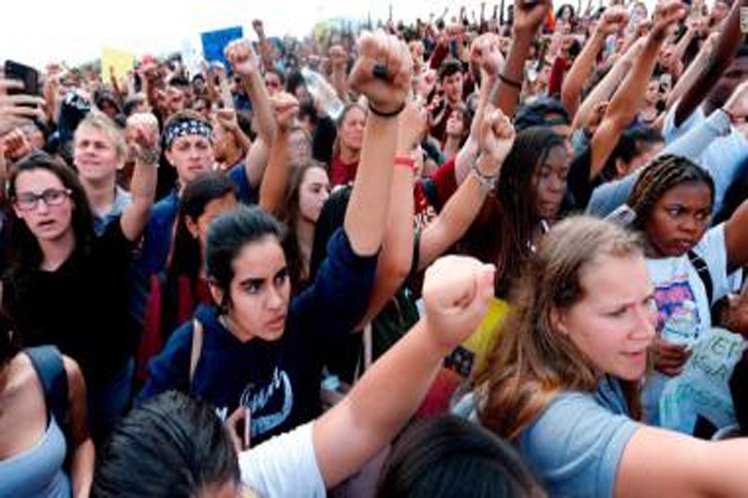
Washington, 14 Mar (PL) Students from many U. S. cities will go on strike today to demand changes in the country’s gun control laws when the first month of the massive shooting in a secondary school in Parkland, Florida comes to an end.
Students from more than 3,100 schools and universities signed up to participate in this Wednesday’s initiative, during which they will leave classrooms for 17 minutes to show solidarity for the 17 deadly victims of the massacre in the southern territory.
The organizers of the event, called by a youth branch of the Women’s March, called for the participation of students from all schools, from elementary schools to universities, as well as parents and teachers.
Although the action is national in scope, student groups and educational institutions are expected to hold a variety of additional events at the local level, including assemblies, class discussions and memorial services.
According to USA Today, students at some schools such as University High School in Tucson, Arizona, will recite the names of the dead in Parkland and make plans to flood local lawmakers with lawsuits against guns.
“My colleagues and I feel that there is no moment more important than this to make it clear that we have had enough armed violence. For too long, it has made us feel insecure in our communities and in our classrooms,” said Dej Dej Foxx, a teenager from that school.
The action of this day follows other demonstrations in the days following the shooting in Parkland, which generated great activism among the survivors of the massacre, who called on politicians in the country to turn their backs on the National Rifle Association.
This Wednesday contrasts the stance of many educational institutions that support planned demonstrations and even encourage students to be active protagonists, with others that warned students with disciplinary actions if they interrupt classes.
This is the case for adolescents in some parts of New Jersey and southeast Texas, who were alerted last month that if they participated in the strike, they would face a three-day suspension.
According to Curtis Rhodes, superintendent of the Needville Independent School District, about 40 miles southwest of the Texas city of Houston, disruptions would not be tolerated because’ a school is a place to learn’, and he said they will impose disciplinary punishments’ regardless of whether it is one, 50 or 500 involved’.
Meanwhile, some districts in the country, such as one in South Carolina, said they will prevent the media from going to school during the protest, in order to discourage youth participation.
mem/sea
Che Guevara evening, with Janette Habel

Louise Michel Society:
Che Guevara evening, with Janette Habel on February 24th.
Saturday, March 3, 2018 – 15:09
Translated and edited by Walter Lippmann for CubaNews,
Thanks to John Barzman for translation assistance.
Che was murdered in Bolivia fifty years ago. He was 39 years old.
On many continents, he remains one of the few positive figures among the revolutionary leaders of the 20th century. Is that why in Paris this anniversary was a pretext for an outburst of gross slander against him? Targeted, beyond him were the Cuban revolution and everything related to communism.
Che certainly played a decisive role in the Cuban revolution. Janette Habel underlines how much of a “geostrategic anomaly” it was: taking power by armed struggle, in a poor island, 200 kilometers from the shores of the American empire, and wanting to build socialism there!
Guerilla, then minister, Che was a central figure in the Cuban experience. However, it is difficult to attribute to him responsibility for the latter’s subsequent trajectory.
Janette Habel developed the themes that seem important to her when we look back at the history of this revolution and refrain from rewriting it.
First, the issue of armed struggle to conquer power. The foco strategy was not theorized by Che as a model that can be reproduced everywhere. The failures suffered in Latin America cannot therefore be explained on the basis of an alleged error on this point. All the more so as the other strategies – [such as] “changing the world without taking power”, parliamentary and electoral channels to change society… – have not demonstrated that they are a viable alternative and tend to lead to dead ends as well.
Then there is the difficult question of how much democracy is possible in situation of revolution and war with imperialism. The repressive aberrations of a government that quickly took authoritarian forms are indisputable. It remains to resituate them in this context and to understand the obstacles to this revolution and the limits of those who led it.
The third theme, on which Che has contributed a lot, is that of transition. As Minister of Industry, Che organized discussions with Bettelheim and Ernest Mandel to reflect collectively on these difficult issues. Criticism of the USSR was central, and was explicit in the discourse of Algiers. And it was on the challenges of economic diversification and industrialization that Che (and Cuba!) was to fail.
Dismissed from power and Cuba under Soviet pressure, Che made his move to Congo, then into the Bolivian adventure. Isolated, he was to fall under the blows of murderers. His call to “create two, three, many Vietnams” resonated powerfully in this century, but without allowing him to escape a lonely and tragic death…
A rich exchange followed Janet Habel’s presentation, confirming that Che is not only a romantic icon, let alone a demonic character as nreaction claims, but a revolutionary fighter and thinker of emancipation.
Janette Habel, member of Attac’s scientific council, lecturer, researcher at the Institut des Hautes Études d’ Amérique latine, specialist in Cuba.
PLEASE NOTE: The video below is in French.
Immigrants’ Voices Heard

La Opinion (Los Angeles, California)
Immigrants’ voices heard on International Women’s Day
They demand respect, they’re not afraid, but they also demand no end to fighting for their rights.
By Araceli Martínez Ortega. Reporter for the newspaper La Opinión since 2006.
March 8, 2018
Translated and edited by Walter Lippmann for CubaNews
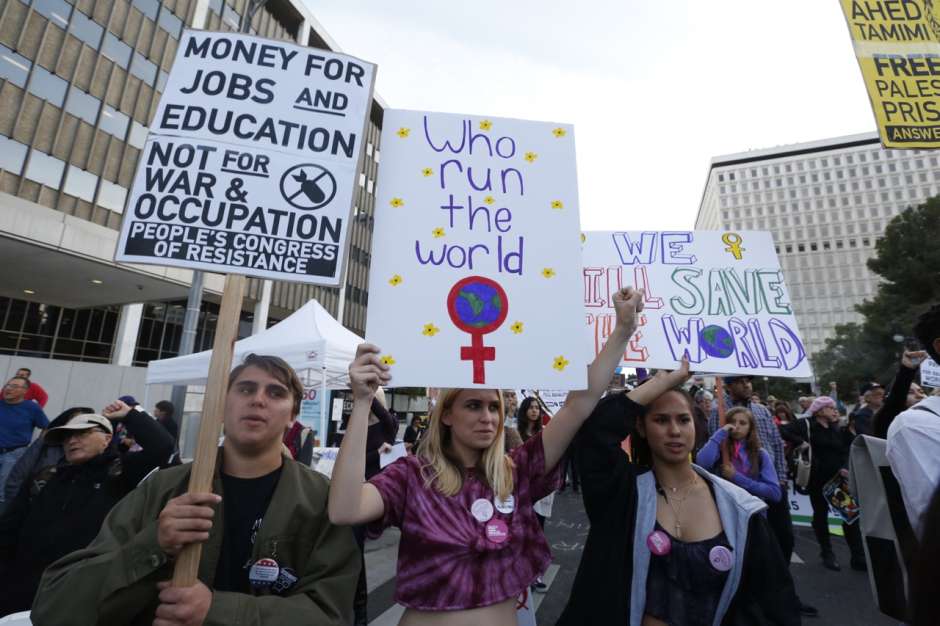
Hundreds gathered in downtown Los Angeles. Photo: Aurelia Ventura.
Alondra Becerra, a young university student of the English literature career, a dancer, and who has two jobs, one as a waitress and the other serving coffee, took time on her busy schedule to attend and lead a march in downtown Los Angeles to celebrate International Women’s Day.
“I’m here for my mom who raised me as a single, sick mother. She is a Mexican immigrant who inspired me to fight for people. I am here for mothers and women who do not know that they have rights and do not go out to fight. For them, I’m here,” Becerra said as she stood in front of the marchers with a long blanket that read “International Women’s Strike.
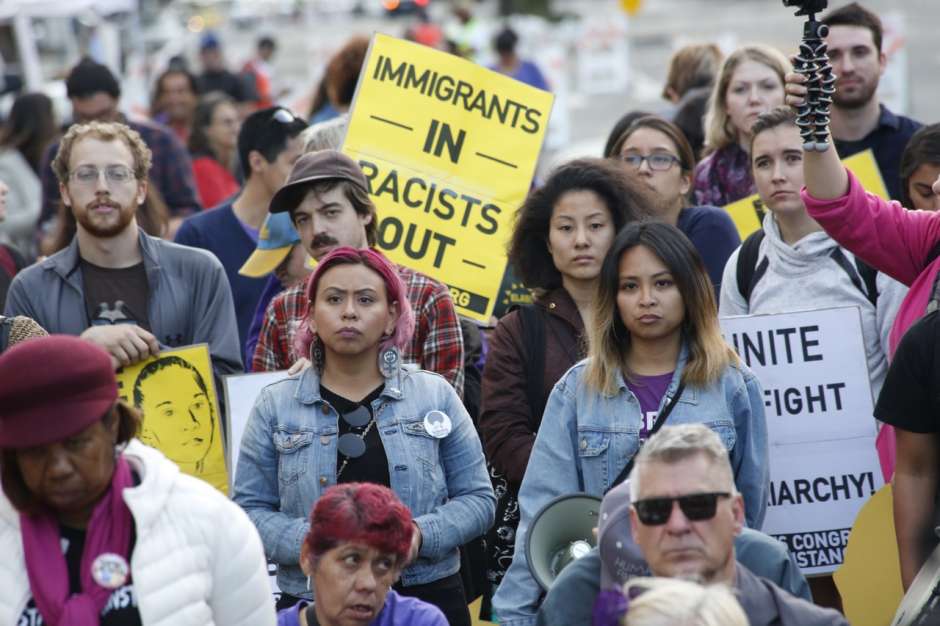
Immigrants in; racists out,” read one of the march’s posters. Photo: Aurelia Ventura
AUTHOR’S VIDEO: https://www.instagram.com/p/BgFhXn4hNrN/
To immigrants like her mother, she told them to be patient, to keep fighting for change. “I am 21 years old and I will help my mother with her papers,”she said.
This young activist was part of the festive demonstration and march that gathered some 300 women in the evening. Armed with banners and blankets with messages against inequality, poverty, violence, criminalization and discrimination, they sang, danced and prayed. The group left the federal building in downtown Los Angeles to walk around a few streets.
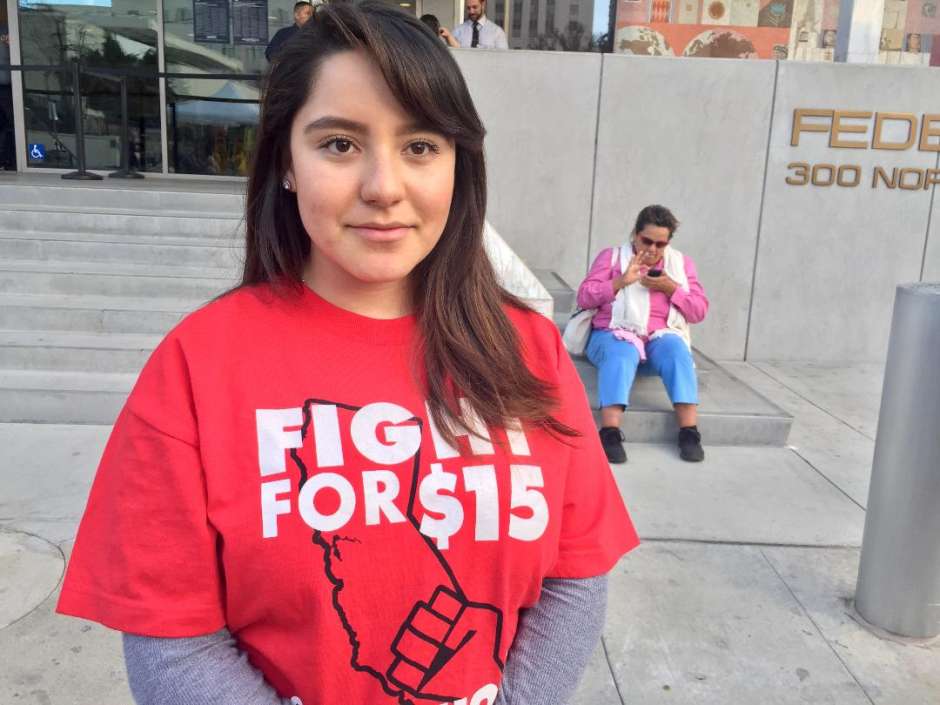
Alondra Becera, a young student and worker who participated in the struggle to raise the minimum wage to $15 per hour in Los Angeles, was one of the speakers on International Women’s Day. (Araceli Martínez/La Opinión).
They are part of a worldwide movement
Angela Sambrano, chairman of CARECEN’s board of directors and immigrant rights activist, said they came together to celebrate women as women from more than 52 countries around the world did.
My message to immigrant women is that we demand a halt to deportations, to the separation of our families and that we stand together and support California’s continued status as a sanctuary so that police and government employees don’t collaborate with the Immigration and Customs Enforcement (ICE),” she said.
And he added that immigrant parents are not likely to be afraid to take their children to school, to the hospital or just go shopping for food. We are struggling to keep our families together,” she said.
Sambrano urged immigrant families not to stop fighting. “Know that you are not alone. We are fighting to ensure due process because only together will we change the racist, xenophobic and patriarchal system that has produced someone like President Trump who doesn’t want immigrants and is only interested in protecting the rich behind the backs of the poor, workers and women,” she said.
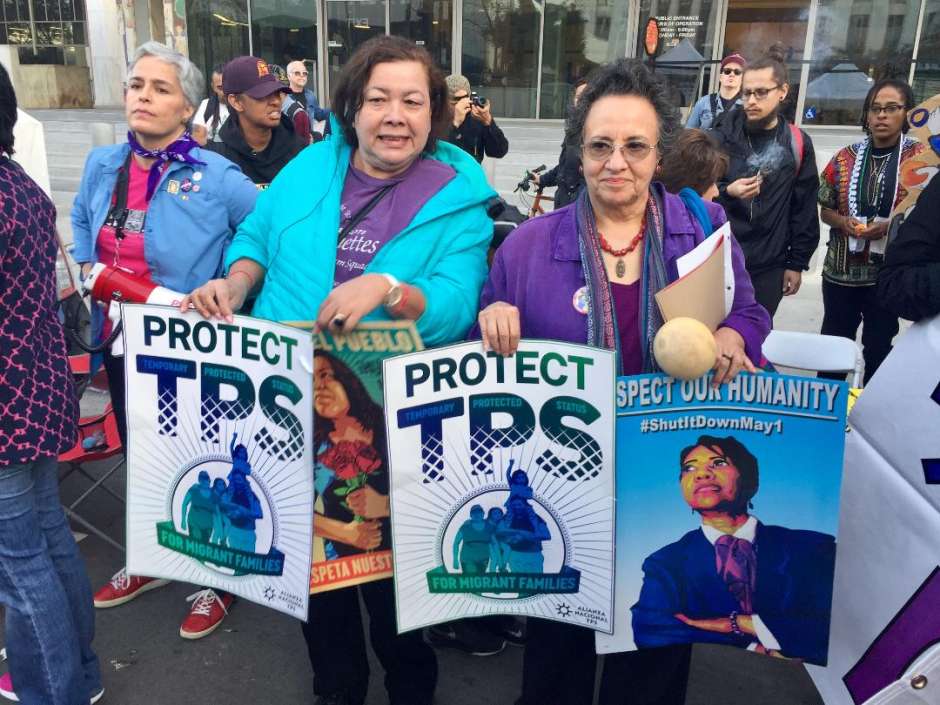
Angela Sanbrano, immigrant rights activist and Edith Anderson Hernandez participated in the march for International Women’s Day. (Araceli Martínez/La Opinión).
TPS holders in the struggle
Edith Anderson Hernandez, an immigrant from El Salvador, arrived at the march with signs alluding to the defense of Temporary Protected Status (TPS), the program that allows Salvadorans and other immigrants to live and work in the country. President Trump set a deadline to end TPS for Salvadorans, September 2019.
“I have a brother, a brother-in-law, my nephews and a lot of family with the TPS. I need my family,” cried Anderson Hernandez without releasing her banner.
She called on TPS beneficiaries not to be afraid and stick together.
“It’s the only way we can make a difference. We are in this country for many reasons. We immigrants bring a very hard story. I left my children under 4,8 and 9 years old to come here so they would be able to eat,” she said.
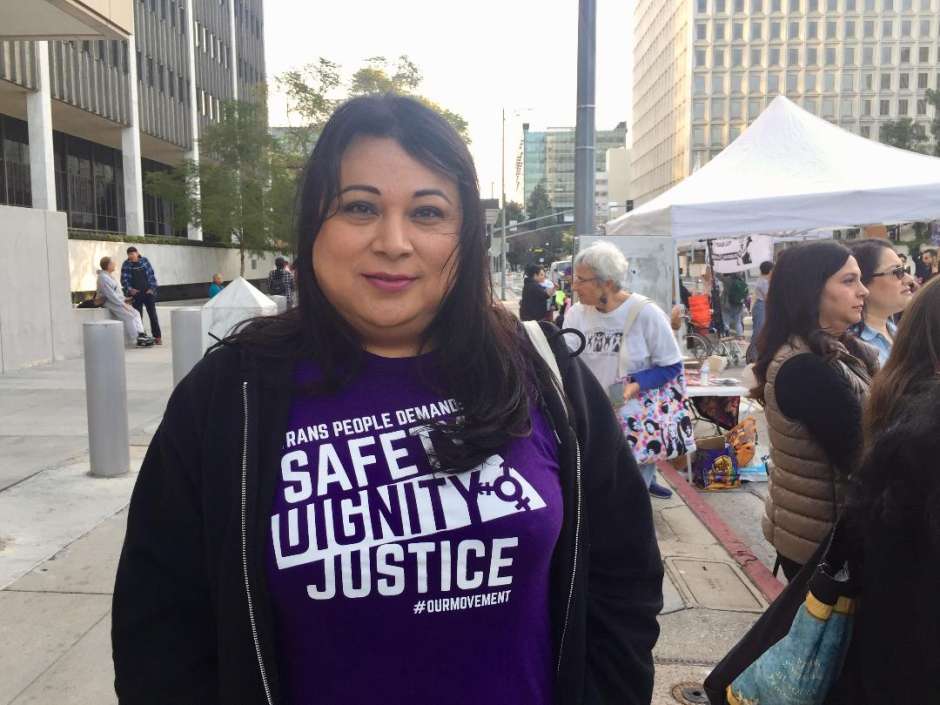
Transgender activist Jennicet Gutierrez of TQLM Family spoke about the injustices suffered by transgender women. (Araceli Martínez/La Opinión).
Transgender Present
Jennicet Gutierrez, a transgendered Mexican immigrant and activist for the Trans Queer Liberation Movement “TQLM Family” had the opportunity to take the microphone during the demonstration.
As a transgendered woman, it is very important to be present to tell compañeras and women in general that we are part of the struggle and we must not tolerate injustice, violence, discrimination and attacks, day after day,” she said.
She stressed that it is important for the voice of transgender women be heard on International Women’s Day because they too suffer a lot of violence, rejection and injustice.
“I want to tell transgender people and all of them that there are strong and powerful women, fighting to stop them from suffering and putting an end to abuses, whether in detention centres, prisons or being rejected by their families,” she said.
Gutierrez stressed that the International Women’s Day march is an opportunity to show unity in resistance. “Go on with all your dignity day by day. We are human beings and deserve respect!”, she said.
What Elections Are About in Cuba
Ever Wonder What Elections Were About in Cuba?
If you haven’t bought the propaganda that there are no
elections in Cuba, I’m sure you have.
by Merri Ansara, February 16, 2018
It’s so interesting to be here during the time of nomination (January) and now consideration of the candidates for 6 weeks until the March 11 elections for National Assembly. While everyday life goes on seemingly unperturbed, there was a strong undercurrent of hopefulness and anticipation as the candidates were rolled out at the start of the month. This is the big one, the one where there will be a new president. More it is the first generational change in top leadership since the start of the Revolution.
A lot of hard work at all levels has gone into preparing for these elections over the past year or year and a half and the rollout was accompanied by a lot of fanfare.
There are a number of things the elections are not.
These are slate elections, not competitive elections. These are not party elections with varying platforms from which to choose. The Communist Party sets the direction and goals for the country and so voting the party up or down is not at play. Not all candidates for the National Assembly are in the Communist Party or even in the Communist Youth. As membership in the party is considered a badge of honor and merit rather than an affiliation (see below as to how people join the party), it is weighed among other criteria as the electoral commission tries to achieve a balance of representation of the existing society. A complicated concept for those of us with a different set if criteria.
(In Cuba, joining the party is a rigorous process of nomination, review, probation, and approval. Obviously, some bad apples slip through but it is considered a privilege and responsibility, not a bene to be in the party, not a right of position or privilege, and there are as many simple workers in the party as so-called elites).
There is no individual campaigning. The fact that these are block (slate) elections, of course, makes such competition unnecessary. You are voting up or down.
Here is what the elections are.
The first step in the national election process took place late January, as I said. 12,000 candidates were proposed in 970 meetings of the mass organizations — Cuban Central Trade Organization, Committees for Defense of the Revolution, The Cuban Women’s Federation, The National Small Farmers’ Association, the University Students Federation, and the High School Students Federation.
The Election Commision with subcommissions throughout the country at the provincial and local levels then sifted through the 12,000 visiting the institutions, organizations and work centers of the nominees as well as the neighborhoods in which they live, conducting interviews and collecting opinions and impressions. The goal was to ensure the proposal included 50 % municipal assembly representatives, members of civil society, candidates representative of the varying interests at the local, provincial and national level.
The findings then went district by district to the 168 Municipal Assemblies (12,515 local representatives who been voted in at the municipal level in the fall elections ) who then made the final nominations for their districts. All voters 16 or over in each district will be voting (up or down) for the candidates to represent their district in the National Assembly. Voting is not compulsory but usually is between 87 and 95%.
And if you think this sounds complicated, it sure seems so to me too and I hope I haven’t gotten any of it wrong. (You can see the Cubans national elections site on the web, with charts and graphs, www.cubaenelecciones.cu or at www.cubadebate.com)
So where have we ended up?
287 of the 605 candidates to National Assembly (47.4%) are currently local delegates to the municipal assemblies. Every district has at least two candidates, one of which is a local delegate.
338 of the nominees are first-time candidates
The average age is 49, with 80 candidates between 18 and 35 years of age.
53.2% of the candidates are women.
38% are considered Afro Cuban or mestizo.
The historic generation of the Revolution is well represented but 89.25% of candidates were born after the Revolution, that is after Jan 1, 1959.
Other than ensuring that every district has at least one delegate? The further breakdown on the election website mentioned previously is
28 are farmers or members of farming cooperatives
24 are in scientific and other kinds of research
12 are in sports
47 are in education
22 in the armed forces
4 are small private business entrepreneurs or self-employed
39 are local, provincial or national leaders of mass organizations (such as CDR, FMC)
11 are leaders of social or civic organizations
9 are student leaders
4 are members if religious organizations
46 are political body leaders
7 are judges or other members of the justice system
41 are members of the government, meaning ministers or similar kinds of posts
22 are members of fiscal, administrative and other types of bureaucratic offices
That may not add up to 605 as I may have missed some. You can go yourselves to www.eleccionesencuba.cu and see anything I’ve missed. For instance, I haven’t noticed who’re candidates from culture and the arts, and I won’t have a chance to sort that out before sending this.
So there is no campaigning as I think I said.
Still, as everyone is voting for candidates from their own district, if people have gone to any of the neighborhood meetings, or pay attention to sports, news, or television many of the candidates will be known.
Candidates have been posted in the newspapers with their pictures, age, occupation and organizational affiliations, and in special voting supplements. All candidates are also posted in multiple locations in the district where they are candidates, with the same information and alongside, a list of voters in that district (everyone over the age of 16). All candidates are also posted on television repeatedly throughout the day, province by province, 3 at a time.
The big question, of course, is who will be president. The president is elected by the new National Assembly once seated, so it will be April.
Speculation is rampant, centering not just on the so-called obvious successor, Vice President Diaz Canal but on two others in leadership, one in Havana and one in Santiago, both young and very well liked.
What we do know (we think) is that for the first time in Cuban history since the Revolution it won’t be a Castro. And it won’t be a member of what’s known as the historic generation.
It’s a very exciting time to be in Cuba. No one can be sure what’s ahead and while the country is moving ahead slowly along its chosen path, too slowly for many, moving ahead it is. Despite the local defeatists, cynics and naysayers one encounters, there’s still a sense of peace and stability rather than uncertainty and not either a sense of resignation. As a friend and strong supporter of the Revolution told me yesterday after a heated discussion with his 35-year-old son, “He told me, ‘look, Dad, we don’t agree on a lot of things but it’s still my country and my Revolution too. When push comes to shove, if anything happens you know I will be with you on the same side.'” Which he took to mean that even for the discontented youth, dignity, sovereignty, peace and well being are the paramount values and vision.
As I face going home to the cynical cartoon of government in Washington, the aftermath of another mass shooting in a school, and all the uncertainties we face on a daily basis, it’s a vision I wish I could look forward to too.
Merri
Havana February 16, 2018
As written with one finger on a phone, please excuse all typos. Please also excuse and feel free to forward verified corrections.
Please also forward to anyone you feel will be interested
You must be logged in to post a comment.