Granma increases its savings inspectors

Granma increases its savings inspectors
Author: Sara Flat Sariol
August 8, 2009
A CubaNews translation.
Edited by Walter Lippmann.
GRANMA. – Because it increased the number of inspectors, this territory expects to be able to follow up the program designed to achieve bigger electric power savings in factories and service units.
The insufficient number of inspectors hampered the detection of management flaws in controlling the measures to optimize savings. In July – to mention one period – the territory exceeded its expenditure plan by 3,6%. This means it used around 2,000 MW*hour more. This is equivalent to covering the demand of the territory for more than 24 hours.
According to information received from managers of the Electric Company of Granma, the province was able to employ one hundred new supervisors. This will allow it to systematically control each of its units.
Examiners in each Popular Council, will support these inspections, which will intensify during this month of August when the celebration of carnivals in Bayamo and Manzanillo can increase electricity expenditure.
Although daily assignment has been raised for this period with respect to the previous month, local authorities insist on carrying saving measures to the maximum. They plan to influence those companies that persist in using electricity without defining their [savings] plans or that do not follow self reading procedures, among other frequent violations.
Honduras A coup d’état concealed behind euphemisms
Honduras: A coup d’état concealed behind euphemisms
Author: ALBERTO NÚÑEZ BETANCOURT
Havana, July 7, 2009
A CubaNews translation.
Edited by Walter Lippmann.
Honduras is living proof that, if describing the violators of democracy is up to powerful mass media, we’ll never see words such as ‘coup d’état’ or ‘usurping government’, let alone phrases like ‘legitimate, constitutional president acclaimed by the majority of the people’ to talk about Honduran dignitary José Manuel Zelaya.
Once again, injustice hides behind euphemisms: ‘coup’ is replaced by ‘forced succession’, a term often used by CNN in its Spanish broadcastings, as if to make sure it ends up engraved on the mind of its large audiences.
Since June 28th, when the coup took place, CNN News has reported that a new government ‘unanimously’ approved by Congress had been legally set up and was even ‘consolidating’ its newly appointed cabinet.
That day an anchorwoman kept proudly repeating that all e-mails received in the network stated their support of the de facto regime. Nicaraguan president Daniel Ortega was right when he said that CNN was the coup faction’s channel.
Just hours after the swipe, plenty of carefully edited footage showed a rally in support of Micheletti, whose actions enjoyed extensive coverage while the popular opposition was barely mentioned despite the fact that increasing numbers of people were gathering in the area around the Presidential House and all roads and highways were jam-packed with citizens who were heading for the capital city from all over the country. ‘Groups of Zelaya’s supporters’ is how CNN in Spanish prefers to call that great mass of citizens seemingly undeserving of many camera shots.
You’ve got to laugh at the argument initially employed by the CNN correspondent that she could not get anywhere near the Presidential House to take pictures of the first demonstrations in favor of the Honduran constitution. Nevertheless, she fought for, and managed to get in no time, an interview with Micheletti, whom she even called ‘President’, in clear recognition of he who had just taken the Presidency by force.
Meanwhile, a fearless Telesur network got by at best it could to transmit objective news from streets and rooftops at the cost of seeing its film crew arrested.
History repeats itself. Much like in Venezuela in April 2002, powerful media are now striving to do a real balancing act to justify the coup in Honduras. Everything goes, from blaming Chávez for the conflict caused by a stubborn Honduran oligarchy to presenting analysts who swear that Manuel Zelaya violated the Constitution, hinting at the convenience of a ‘political solution between the parties’ to help the country return to normal, or fabricating a climate in which Nicaragua, Venezuela and Cuba are portrayed as enemies of Honduras’s sovereignty.
No information monopoly is in the least interested in clarifying that Zelaya’s intention to hold a referendum is by no means in violation of his nation’s Magna Carta.
Why don’t they explain in one of their many news programs that the current chaos in this Central American country is a result of a crystal clear conspiracy planned by the brass hats, the judiciary and power-thirsty congresspeople? Why not remind us that the Hondurans were peacefully getting ready to take part in a plebiscite? Why not decry the gag order given since day one by the de facto government?
Countless questions come to mind on what the big media have to say now about their much-trumpeted concepts of democracy and freedom of the press, because their outrageous attitude makes their words sound empty or funny, to say the least.
No less noticeable is the fact that some networks would rather broadcast the latest jet-set gossip or cartoons for entertainment and misinformation than what’s going on in Honduras today.
Euphemisms as masks: that’s some lesson we’re receiving these days from the media at the service of oligarchs and liars!
Alberto Yarini: Legend and mystery of a pimp
Alberto Yarini: Legend and mystery of a pimp
07/29/09 – Cubarte: News Service (Havana)
By Graziella Pogolotti
A CubaNews translation.
Edited by Walter Lippmann.
Among my most distant memories, the name of Alberto Yarini comes to mind. Grown-ups would mention him with a wicked smile, which aroused my curiosity. I gradually came to learn that he was a famous pimp who had been killed in a fight by his French rivals in the San Isidro neighborhood. Supremely elegant, he projected a singular image, that of an aristocratic pimp riding around the city. Later Carlos Felipe turned the legend into myth. With his famous Requiem, he gave a tragic flavor to the announced death of a hero of a nocturnal and marginal Havana, a recurrent obsession of the author, who also wrote El chino. The director Gilda Hernández, however, provided quite a different perspective of the production on the occasion of the premiere of the play. The realistic approach showed the character-portrayed by Helmo Hernández-in his underpants in a sordid setting. Social referents were emphasized by this point of view, including the stage curtain which served to project obituaries of the family of resounding names and of the Conservative Party, signed by generals and commanders of the Liberation Army as well as by notorious San Isidro pimps.The character has come back to the present in the recently premiered feature film, Los dioses rotos (The Broken Gods).
The second edition of San Isidro 1910, by the researcher Dulcila Cañizares, was launched at a recent book fair. Supported by numerous testimonials and a conscientious exploration of archives, the book reveals the character’s environment, located in the limited urban universe where he exercised control. The examination is intentionally made from the bottom in a republic which had hardly freed itself of colonial ties.
The neighborhood is brought back to life by a meticulous reconstruction of squalid tenements, cheap eateries, small stores, movie houses where musicians, who would some day be famous, play, places where pornographic images are viewed. From the background of this sordid everyday life emerges the indistinct figure of Yarini, settled in his house on Paula Street, surrounded by his harem, flanked by his staunch friend Basterrechea, an ambiguous bond of unknown origin.
Self-contained, the neighborhood lies on the city’s fringes, just as Carlos Felipe sensed it in his classic Requiem. But strong and subtle steel threads connect him to the ruling classes of the newly-formed republic. Barely a silhouette designed in the background, Yarini represents the link between these two worlds. Hence the reason for his actual strength and his lasting symbolic image. Deep down, beyond any differences imposed by social conventions, a common substratum converges in the field of values, a trap that subjugates whoever gets involved in politics, where no one manages to avoid the mud stains on their white attire. Yarini goes through the concentric circles of the Havana society of the time. Born into a well-established family, both financially and professionally, he stops by the bohemian and semi-parasitic scene of the “Louvre sidewalk”-also suggested by Estorino in some of his plays-where white slave trade and the commerce of journalism subsist, to establish his personal domain in San Isidro.
Coinciding with the pattern devised by Carlos Felipe, the anthropological perspective adopted by Dulcila Cañizares constructs the character as seen through the eyes of others. Unlike the playwright, the researcher places the neighborhood and its memories at center stage. The main character will grow and will be recognizable following his death with the significance of his remains and complicities extracted from the impersonal prose of legal documents. Here, as on the stage, class differences are noted in the refinement of the wardrobe and the value of the pendants, in contrast to the vulgar striped shirts and pants worn by small-time pimps. The quick execution of the French victim takes place by way of a pearly pistol and an accurate shot to the middle of the forehead.
The search for the truth is carried out through the disclosure of successive layers that hide new, perhaps unfathomable, mysteries. In Dulcila Cañizares’s book a key character, unknown until now, is outlined. Basterrechea, the inseparable shadow of the famous pimp, the handsome young man with green eyes who lacks trade and lineage will be his avenger. A shadyarea in his sexuality is sensed in the “San Isidro macho” with his harem of women that never included virgins. The documents of the period hint at actions taken by powerful political authorities to abandon the legal process and wipe Yarini’s avenger’s record clean. Jail will be for others, for the second-class perpetrators in the settling of scores with the French pimps. Basterrechea survived the republic in total obscurity, living on small government positions that were always available to him despite the frequent dismissals, hurricane winds that were inseparable from every electoral process. His silence was, without a doubt, part of the commitment made to the people who ultimately freed him from the administration of justice. At the time of the outcome, he left the scene in the same manner as the mysterious lady in black restored by Carlos Felipe. They left no trail. Memory and legend preserved only the reminiscence of the surprising social pact represented in the funeral where the neighborhood prostitutes and the representatives of the so-called active classes of the nation, representatives of high politics and high society, converged. The great show removed the stains, dressing the most sordid complicities in clean clothes. From a multiple set of voices and documents, Dulcila Cañizares opens up the silent zones and gives us back a disturbing vision of a past that is also a part of our cultural heritage. Because the yesterday that is within us has dazzling luminosities of struggle, generosity and creation. Inscribed in a context of values forged in the needs of survival, the memory of a sordid past, the source of a corruption that permeates society, interacting with the high and low strata of society, still lives on. These are the ones that are revealed in Carlos Felipe’s universe and, with more restrictive precautions, in Miguel de Carrión’s as well. Let us welcome then this necessary evocation of San Isidro 1910.
An Interview with Camilo Guevara, Son of El Che
An Interview with Camilo Guevara, Son of El Che
10/16/98 – HUMO (Belgium)
A CubaNews translation.
Edited by Walter Lippmann.
Q: You didn’t really know your father. You where five years old when he died. You probably know him like we all do: out of books.
Guevara: I have a few memories, but vaguely, things I’m not even sure off that they really happened or that I dreamed them, fantasy. I know him through the stories that my mother, family and friends of my father have told me.
Q: For believers in the free market and the Americans, he is a devil.
Guevara: That’s their problem, not mine. He is a devil for the U.S. government and American multinationals. Not for the North-American people. I am convinced that many North-Americans admire and respect El Che, that they love him and that they fight injustice in American society under his banner. In the U.S. there is a movement that declares its solidarity with Cuba and tries to lift the economic blockade.
Q: Your father’s life ended in controversy. He left Cuba because the Soviets came, whom he did not trust, so they say, and had problems with Fidel Castro who became more and more a pragmatic head of state.
Guevara: That isn’t true. My father left Cuba because he was an eternal revolutionary. He wrote as much in letters that might soon be published. He had no quarrel with Fidel at all. Fidel and Che stayed friends, brothers and comrades until the end. That they had problems with one another is a lie which was already launched before El Che’s death. The period he was in Congo during the sixties and the capitalist countries didn’t know where he was, the Western press wrote some crazy stories: he was dead; he was locked up in a Cuban jail. With these lies they wanted to harm the Cuban revolution and Fidel Castro as one of the international leaders of the left and of the poor in the world, still eighty percent of the world population today. On the other hand they tried to convince people that the revolutionary Guevara, this great symbol, wasn’t all that, but a man who had to flee from Cuba because he had problems with his colleague – revolutionary Fidel Castro.
Q: How is life for the son of El Che in Cuba?
Guevara: You want to know if I’m privileged? Children of ‘the symbol’ have one advantage: a great part of the Cuban people still loves El Che. I often feel awkward about it, but a lot of Cubans treat us, the children of El Che, more warmly than others. I feel that the Cubans convey the affection that they had for my father onto me and my family. In that way we are indeed privileged.
Q: How are things in Cuba today? The economic situation seems to improve gradually?
Guevara: 1994 was rock-bottom for us. After that the Cuban economy gradually began growing again, which was a miracle, really. And El Che had nothing to do with it! (Laughs) Or maybe, a little. That year made a great impression on us all. Imagine: a country which is the victim of a rigorous economic blockade all of a sudden also loses eighty percent of its trade due to the collapse of Eastern Europe. At the same time the blockade is even tightened, and the prices of Western goods, which we desperately needed just like any other Third World country, keep on rising. And still we managed to let our economy grow. That is the miracle. A very dangerous example. We achieved this without one cent from the International Monitary Fund, nor of any other international financial institution whatsoever! We have showed that you can achieve a lot without money, but with a great political will. I suspect that capitalists around the world are a bit anxious that this example might be followed in other countries. That’s why they try to destroy us with even greater vigour.
Q: El Maximo Lider Fidel will sooner or later disappear from the scene. He is 72 now. What will happen then? In Florida huge groups of Cuban exiles are waiting for the day they can reclaim Cuba.
Guevara: There are few thing of which one can be sure in this world. (Laughs) The Cubans in Florida where already convinced back in 1959 that they would re-conquer Cuba quickly. Ha! We are forty years further now, and they are still in Florida. When Eastern Europe collapsed, they knew for certain: we take Cuba back! In the meantime that’s nine years ago.
For sixty years, from the beginning of the century until the end of the fifties, Cuba was a colony of the U.S. . We know capitalism, we have experienced its deeds. Until Fidel and a group of youngsters launched the revolution. What do you think the Cuban people are going to do after Fidel’s death? Do you think that everybody wants to go back to the period before 1959; that the people will allow the U.S. to come and boss us around?
Q: Wouldn’t it be possible that the Cuban regime imploded? The consumption goods of capitalism are very seductive. One notices it these days in Havana.
Guevara: In the West capitalism seduces many people, yes. And maybe a few ignorant people in the Third World too . . .
^ Back To Top
Q: Oh come on, the Cuban youth wants Nikes and Marlboro’s, Coca-Cola and walkmans too.
Guevara: Without a doubt, without a doubt. But that isn’t the majority of youngsters. Never! The Cuban people have reached a level of political and cultural awareness that cannot easily be ignored. The Cubans have seen what has happened to Eastern Europe: before the collapse of the Berlin Wall they had promised these people heaven, but what did they get? Nothing, absolutely nothing, except chaos and exploitation. We Cubans know this, we see it and we don’t want it to happen to us. OK, there are still some people that want to sell us out to the U.S. . But they are a minority.
Q: Wouldn’t it be wiser to completely ignore the U.S. and tighten the economic ties with Europe?
Guevara: The Europeans aren’t philanthropists either, hey. You have to be realistic: our relationship with Europe depends on what we can earn from one another. But the U.S. executes pressure onto Europe, a lot of pressure. Northern-Europe resists the Helm-Burton law (American law that tries to prevent non-American industry to trade with Cuba) and we are glad about that. But is that because the Europeans are in love with Cuba? No, its a question of sovereignty. How can one country accept that another country forbids it to trade with the rest of the world?
Q: Until recently Cuba was a isolated socialist ‘paradise’. Now you receive thousands of tourists and businessmen from Europe and South-America. Is that positive?
Guevara: Cuba has never been as isolated as you think. We have always had good contact with Europe. With Eastern-Europe, sure. But we have always been open to the European culture. In the past we have never promoted mass tourism from Western-Europe because we didn’t need it. Now it has become our most important source of income and a way to attract foreign investments.
Q: But mass tourism has a shadow side too: prostitution.
Guevara: For me it has more to do with the crisis of human values all over the world, than with tourists coming to Cuba.
Q: You really believe that?
Guevara: There’s prostitution in Belgium as well. I have seen it with my own eyes. People who have enough money to live on don’t prostitute themselves. People who lack money, do. Why?
Q: Because they want money?
Guevara: No! If I had no money and would go hungry every day, I would not prostitute myself! It is a question of values. So, what can we do about it? Must we throw out all tourists, or do we have to make sure that people do not only have enough money, but also have respect for the essential human values? In any case we are working hard to force back prostitution.
Q: You work for the Ministry of Fishery. Strange that you have such ministry. Cubans hardly eat fish.
Guevara: That’s true. But there is improvement. In the past, eating fish was for the poor. Or food for cats and dogs. Now we try to promote the fish consumption through fairs and feasts.
Q: Even Fidel seems to interfere?
Guevara: Yes, he once did an advertisement on TV. One saw an empty table in an empty room. Fidel entered and sat himself behind the table, looked into the camera very seriously but didn’t say a word. After a while a waiter entered and served him a plate of fish. Fidel ate the fish in silence. This took a few minutes. When only the fish-bones where left on his plate, Fidel rose up, looked imperatively into the camera, and spoke to his people the historical words “And now, YOU” And now we all eat fish.
Women’s Counseling Homes: an Indispensable Service
Women’s Counseling Homes: an indispensable service
Author: LUZ MARÍA MARTÍNEZ ZELADA
La Habana, jueves 20 de agosto de 2009. Año 13 / Número 233
A CubaNews translation.
Edited by Walter Lippmann.
In the last 19 years, around three million people have been received in Woman and Family Counseling Homes in Villa Clara province, a sign of the social impact these services have on the community.
The first of these facilities was opened in the capital city Santa Clara on September 8, 1990 as a prime objective of the work undertaken by the Federation of Cuban Women (FMC), in charge of a 170-strong network of these centers nationwide.
Their main purpose is to deal with concerns related to real gender equality, child upbringing, legal guidance and the provision of training in several skills of citizens who don’t work or go to school.
Provincial FMC board member Mayelín Díaz told AIN the organization will celebrate its 49th anniversary on the 23rd with outstanding results in this sphere.
New projects like the Family Courts –consultancy on legal topics regarding couples and childcare– come on top of this effort, she added, which our centers provide in the form of interpersonal communication skills and measures to prevent family violence, alcoholism, AIDS and drug use.
Idalmis Pedroso, a beautician who has given hairdressing and cosmetology courses in one of these local institutions for 18 years, talked about the importance of these programs to help men and women who neither work nor study to learn a a trade and better reinsert themselves into society.
All the 17 Counseling Homes in this central province are staffed by half a thousand volunteer professionals, including psychologists, teachers, attorneys, doctors and speech therapists.
We need to save. But, …how?
We need to save. But, …how?
Author: Leticia Martinez
August 8, 2009
A CubaNews translation.
Edited by Walter Lippmann.

I confess I don’t know much about electricity. Both my parents are Automatic Control Engineers and still, I was not the least bit interested in the subject. Besides realizing electricity is needed to move the world, I was never curious as to how they generate it or how much does it cost. Lately, everyday we hear about the need to save it and announcements have brought the subject to the fore.
Dozens of articles on saving or wasting kilowatts, on measures to complete energy plans, on stealing electricity, and on the work of inspectors reach my hands. But, day-to-day reality is more complex. To tighten the belt of saving up to the point of asphyxia has motivated me to write some lines. First I must declare I lift a banner of rationality. I am for saving with intelligence and after proper studies.
As one who is ready to part with something very valuable, I went to the pizza place located on one side of the Trianon Theater. I was celebrating an important date and money was not the most important issue that day, or worrying about what I would do at the end of the month. If what happened to me hadn’t been so absurd, it could move people to laughter. When I ordered two pizzas the waitress answered: “From 6 in the afternoon to 10 in the evening we don’t make pizzas because we are not allowed to turn on the oven”. My mouth fell open, not because I was ready to fill it with the desired pizza, but because behind me other customers were asking for the same thing and leaving absolutely astonished.
I remember it was a Saturday and lots of people were leaving nearby theaters. Others were beginning to enjoy the night and Linea [one of the main streets in Vedado] was full of people. In the meantime, the pizza place waitresses looked very bored leaning against the counter. They were lamenting not being able to sell pizzas. This is the time when most people come by. But, we cannot sell because now the priority is saving, one of them said with the tone of one who doesn’t believe in what she is saying.
And, if this were the only instance there would be nothing to worry about. But, one of my colleagues told me the same thing happened the other night close to the Monaco Theatre, where more than three cafeterias were closed for the same reason. It seems absurd that services are not offered because of some saving plan.
Something similar happens in convenience stores, where these days the only thing we find is an unbearable heat and the dull and sweaty faces of clerks, who are more intent on feeling cooler than on selling. How many clients simply decided no to buy anything rather than withstand such torture, and how many more bought only the most needed things to end it quickly. The pleasure of entering a store and calmly looking for whatever one wanted, or maybe even something extra, has vanished.
We might add to our prior arguments that there is also the possibility some food products might deteriorate, and that it is not very healthy to remain in closed spaces full of clients. Furthermore, if under ideal conditions sometimes clerks do not treat clients well, now it is commonplace.
Focus has been placed on the use of air conditioners, and we can understand why. But, has anyone considered that it can be very harmful to turn them off in certain places? Is it logical to turn them off in places with no windows and full of personnel and computers? Has anyone calculated how many computers could break down because of the heat? And, could it be that turning conditioners on and off is also bad for them? How much are we really saving if later we have to invest to buy new ones?
Yes, I believe that we should save, more and more. But, we cannot grow crazy. Measures cannot be the same everywhere. We have to save in an orderly fashion.
Sometimes it is easier to get to the goal through the shortest road, or as the story goes “to throw away the sofa”. Instead, we have to analyze and study each measure to be taken.
Criticizing a Cuban Critic

Criticizing a Cuban Critic
By Guillermo Almeyra, 2009
A CubaNews translation.
Edited by Walter Lippmann.
Last week two Cuban historians – Orlando Cruz and Felipe Perez Cruz – tried to reply to my article “The options of Cuba”, published in La Jornada. I am glad so many of those that can have Internet in Cuba read my newspaper and what I write. I am equally satisfied that the first one – who was harshly criticized by his readers – calls me comrade, and the second, a respectable professor, although both, showing their colors, at the end of their literary pieces suggest that I am under the influence of liberalism, counterrevolution, anticommunism and anti-sovietism, and other boogey men of [political] discussions.
For this reason, before responding to Felipe Cruz, I want to state some facts. Since I was 13 years old (I am now 81) I am a socialist and a militant revolutionary Marxist, since I was 19. Already in 1957 I was secretary to the Argentinean committee of solidarity with the Cuban revolution (which I founded), and I was put in a high security jail for that reason. I defend the Cuban revolution since then, without necessarily saying amen to all revolutionary government’s positions. For some, calling someone a professor is a pejorative epithet suggesting a stay at home intellectual, who writes sitting at a desk without any contact with the people. Nevertheless, I am proud of what I taught, of what I did and what I teach in the classrooms, before and now. And, not only as a professor, but [actively] in the workers movement and in the political and social life of Mexico and Argentina, not to mention other countries.
I, on the other hand, follow closely and with passion what goes on in Cuba and, of course, in this world connected by cybernetics, I don’t lack first hand information. Therefore, I can request that they don’t purport I said what I didn’t say nor what I am not, just because it is convenient for [to win] the polemic. I don’t ignore what the revolution has accomplished; neither did I say nor do I think that the country is irrevocably heading to an implosion (I did talk, however, about a very serious crisis that any responsible Cuban can see). I didn’t say that the communist party is similar to what the Soviet one was (I believe that the best people and also the worst of Cuban society belong to it; that is to say, exemplary revolutionaries and opportunists, sectarians and climbers). And, above all, I never confused communism with the Stalinism, which is its negation; nor did I [confuse] the rejection of Stalinist bureaucracy with anti-sovietism, because it destroyed the soviets, Lenin’s party and the III International. I believe that objectivity is basic to any discussion (F. Cruz titles his critic Opinions on G. Almeyra’s comments and it is almost five times longer than my note).
I should also thank F. Cruz, who writes better than his colleague, although he says he is responding to the ‘acertos’ (with a c) for ‘asertos’ (meaning assertions) of a certain commentator (evidently well-known in the official media) giving opinions (officially?) to refute my statements. However, one thing is syntax (and even certain patriotic, and not solely bureaucratic passion that one can intuit) and another elementary logic. If, according to my critic, in Cuba everything is going the best possible way and everything that needs to be done is done, then why did Fidel denounce the dangers of bureaucratic counterrevolution? And why is there a crisis, in particular a moral crisis of the young people? Not all young people mind you – how could I say that when it is for them that I write – but an important part of urban youths?
In Bulgaria 99 percent of the people voted (formally there were no sick people, nor opposition, nor anything). But, was this a good social thermometer? Does the participation in Cuba of 96.89 percent of the voters in the elections mean that all those voters agree totally with everything? There were14 thousand 500 assemblies to postulate candidates for representative positions. But, wasn’t there a previous selection made by the party? Can anyone really present himself as a candidate? Deputies, it is true, can be revoked by their electors: has this ever happened? Were Lage and the other leaders revoked by their voters or by their peers? Or was it by the critics made by Fidel, who has no official position in the State?
In the union assemblies, which are summoned to discuss plans and to approve budget projects, can the agenda be modified to include other critical points and proposals, or to choose delegates by basis resolution? In school and other study center assemblies, is it possible to discuss and reject programs and teaching methods? Also, if the party is as democratic as my critics paint it, why did it expel Celia Hart, in spite of the unanimous vote of her cell against it? Don’t these historians know that Marxism-Leninism – the one that the State wants to disseminate – was an aberrant invention of Soviet bureaucracy and that it would be better to teach the history of socialist ideas and of the world labor movement? Do they know that Mella was expelled and joined in Mexico the Leftist Opposition? Don’t they know that the concept of the Pope’s infallibility belongs to the Catholic Church and not to Marxism? And that, although Fidel is a revolutionary and has great merits, he has also made big mistakes? Why should we have faith, as religious people, in the old generation of revolutionaries when what we should be doing is preparing those that will come after them? For this we need to enhance their preparation and encourage the political participation of young people and workers.
Lastly, anti-imperialist patriotism truly awakens energies and provides an absolutely necessary mystic. But, what one is trying to do is not only to build an independent country but to advance towards the construction of the basis of socialism. Socialism which is synonymous with internationalism in analysis and in action; synonymous with democracy, with widespread self-management…
=========================================================
SORRY, exact date and link to original in La Jornada not handy today.
The investigation that brought about the downfall of several officials began three years ago
The investigation that brought about the downfall of several officials began three years ago – A video hints at Lage’s and Pérez Roque’s disloyalty to Cuba’s historical leaders – The then-vice president referred to them as fossils and dinosaurs.
By Gerardo Arreola, correspondent
06/29/09 – La Jornada (Mexico)
A CubaNews translation.
Edited by Walter Lippmann.
Havana, June 28. The investigation leading to the demise of the most well-known faces among the new generation of Cuban leaders blew up three years ago after Raúl Castro received an anonymous tip, according to a video making the rounds of Havana in a series of closed-door meetings.
People who have seen the recording have told La Jornada that the said tip involved Dr. Raúl Castellanos Lage, advisor with the Cuban Institute of Cardiology and Cardiovascular Surgery and cousin to then-vice president Carlos Lage, who allegedly leveled constant and virulent criticism at the government.
“We get plenty of anonymous tips and many of them we disregard,” Castro stated at the high-level meeting held on March 2 that ended with the dismissal of Lage and other officials. He mentioned, however, his order to put a tail on Castellanos.
The tape is about Operation Medusa, launched by the Cuban State Security, which includes footage, photographs, live and wiretap recordings now being disclosed to government staff, the armed forces, and members of the Communist Party (PCC) and its junior branch, the Young Communist League (UJC).
Back in the 1980s, Castellanos had worked with Carlos Aldana, then the powerful head of the PCC’s ideological and international division and regarded as Cuba’s ‘number three’ before he fell from grace in 1992. Sources have it that the tabs kept on Castellanos soon revealed his links with Conrado Hernández, an old friend of Lage’s and the second piece of the puzzle.
Hernández also drew attention to himself for the considerable leeway he had while moving around government circles, where he used cousin Lage’s name to get confidential information beyond his reasonable clearance as the Basque Country’s business representative.
It was by happenstance that Carlos Valenciaga, Fidel Castro’s personal secretary since 1999, was also brought to the fore.
On September 16, 1999, according to sources, Valenciaga celebrated his birthday in a party he threw at the Palace of the Revolution, very near where the Cuban leader was going through the most severe stage of the illness that eventually kept him away from public view.
Soon after it was set in motion, the surveillance of Castellanos, Hernández and Valenciaga led to Lage and others close to him, like Foreign Affairs minister Felipe Pérez Roque, Council of Ministers vice president Otto Rivero, and PCC International Relations secretary Fernando Remírez.
Hernández is said to be shown –and heard– in the outdoors section of El Templete, Havana’s most popular restaurant with diplomats and businessmen, as he arranged his cooperation with an official from Spain’s National Intelligence Service.
Consulted by this diary twice in the last two months, Spanish diplomatic sources have denied such relationship, although Madrid announced last month a reshuffle of their CNI’s personnel in Havana. Hernández was arrested last February 14 at the airport as he was about to leave for Spain, reportedly carrying copies of Cuba’s assessment of the Basque elections scheduled to be over by the first of March.
On March 2, Raúl Castro calls Lage, Pérez Roque, Rivero and Remírez dishonest for refusing to admit his accusations before he showed them everything that State Security had compiled on them.
Barring the charges against Hernández, the video allegedly does nothing but link data with footage and recordings. It comes to no conclusions; it just suggests.
What can be inferred is that there was disloyalty to the historical leaders, influence peddling, and abuse of privileges at odds with the public discourse of austerity.
Castellanos was taped as he talked with Lage on February 24, 2008, hours after Raúl had been elected Head of State and José Ramón Machado Ventura appointed second-in-command.
Castellanos implies they could have easily harmed Machado when the current first vice president underwent artery surgery, and is heard saying they would be doing the country a favor. Lage, in turn, speaks of a leadership of fossils and dinosaurs.
On March 2, 2009 Raúl Castro makes Castellanos’s arrest public, and points to a table covered with documents, pictures and tapes which he describes as evidence for the whole case available to whoever wished to take a look.
An angry Raúl speaks about Valenciaga’s party as he produces photographs of Fidel Castro’s former secretary wearing a soldier’s cap and holding a bottle in his crotch. It was an obscene party, the Cuban president remarks, while his brother was fighting for his life.
The video shows the bonds among the involved parties: how Rivero and his wife went on Conrado-sponsored trips to the Basque Country; Rivero’s briefings to the latter about plans of investment; gatherings at Conrado’s private farm in Matanzas province, where they enjoyed food and drinks way beyond the reach of ordinary Cubans; a river diverted from its course to benefit the estate; political reports that Remírez had given to Conrado; a diplomatic passport that Pérez Roque issued for him in a matter of hours, and even information he supposedly received about Fidel Castro’s health.
From Quebec, with love…
From Quebec, with love…
August 20, 2009
Author: MIGUEL FEBLES HERNÁNDEZ
A CubaNews translation.
Edited by Walter Lippmann.
From the cold and faraway Canadian city of Quebec arrive every year the warm solidarity and the sympathy of hundreds of citizens who turn a deaf ear to all anti-Cuban campaigns to travel to our land and get to know it through its people.
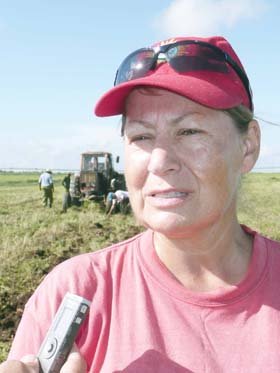
Colette Lavergne: “Every visit to Cuba makes us more confirmed in our conviction to fight for a better world”
So was the case of Colette Lavergne, a Quebecois through and through who found out in 1992 that the Cubans were something more than just a hospitable, party-loving people.
“I didn’t want to come. There’s so much misinformation and negative promotion about Cuba in my country, and they vilify and discredit the Revolution and its achievements so much that I expected to find here a sad, downhearted, oppressed people…
“It was quite the opposite, however: I found a happy, dignified and resolved people who defend what belongs to them. They have a country where they live with their head held high and not on bended knee. Since then I fell hopelessly in love with the Cubans.”
Two years later, when the special period had reached crisis point, Colette took her first steps as an activist for solidarity and friendship between Quebec and Cuba.
“I remember my first experience at the Cándido González High School in the city of Matanzas. Ten children had come with my daughter, who was then taking part in an international education program, and a wonderful unity and understanding grew among all those boys and girls.”
Their visit was such a success that in the following year reality went beyond all expectations:
“We organized a preparatory meeting for the following trip and over 300 people turned out who were eager to know Cuba. We had no choice but to rent a plane that we jam-packed with 160 Quebecois. That time we went to Consolación del Sur, in Pinar del Río province.”
Quebec’s solidarity has been steadily mounting ever since by means of various projects to become familiar with life in Cuba, not as simple visitors but through coexistence, involvement and mutual knowledge.
From family to family
Never did the little Guillaume Fournier ever imagine that Fidel and he had the same birthday, let alone that he would once celebrate his harvesting sweet potato, a root vegetable he’d never seen before to boot.
He came with his mom Manon, his sister Annie-Kim, and rest of the Quebec Solidarity Brigade members who these days are visiting Camagüey, since last year the host province for the so-called Family Camp program.
“This project –says Colette, leader of the solidarity organization ARO-International Cooperation– aims at the exchange between families. That’s why we have children with their parents and even a grandma now and then.
“Working in the fields like we’re doing now has been an unforgettable experience and a singular way to bring Cubans, Quebecois and foreign students who live here together in solidarity.”
Alain Menard, a post-office worker who brought his daughter Sabrina so she could see what he felt in five previous trips to Cuba, agrees with Colette:
“This is a country of simple, outgoing, nice people. Every time I come I return to Canada full of optimism and confidence that we can live in a peaceful world where human beings can be brothers and sisters.”
Since 1994, around 5,000 Quebecois have come to Cuba as part of the programs set in motion by Colette Lavergne, a woman who put aside one of her greatest passions –Medical Science– to devote herself body and soul to the work of solidarity with Cuba and its people.
A passion for baseball
- English
- Español
A passion for Baseball
By Manuel E. Yepe
http://manuelyepe.wordpress.com/
A CubaNews translation.
Edited by Walter Lippmann.
Over the last few years, groups of baseball history aficionados from the U.S. and Canada have been flying to Cuba to visit historic sites related to this sport and various ballparks to watch Cuba’s provincial teams at play.
Because of the measures implemented by the George W. Bush administration to strengthen the U.S. economic blockade, especially the travel ban imposed on American citizens, these groups are made up exclusively of Canadians, all of them Major League Baseball fans.
While here they meet with some of the country’s great sporting figures who used to play in a number of professional baseball leagues in the U.S. or elsewhere in our continent and whose careers and records are known to them, and share memories and news with the ex-players about others who live here or there or have passed away.
These groups also visit the graves of outstanding Cuban athletes, as well as commemorative plaques and monuments put up either to Cuban ballplayers or Canadian nationals in honor of their achievements in domestic or international matches.
Likewise, they get to greet, always with great admiration and respect, many of the current first-class players of Cuban baseball whose performance in Olympic or Pan American Games, world baseball championships or friendly games with MLB or other professional teams have brought them stardom.
Some of these Canadians even keep up with our National Tournament through the Internet.
Particularly emotional is their usual visit to the cemetery of Cruces, a town in the province of Cienfuegos, where Martín Dihigo (1912-1971) lies buried, and to the Municipal Museum, where there’s a hall dedicated to the famous Cuban player deemed by many the most complete the world has ever seen.
Martín Dihigo filled in every position in the field and is the only one included in four Halls of Fame in three countries: Cuba, Mexico and the U.S. (for his record in both the Big Leagues and the Negro League). He was a fantastic pitcher and a great hitter who set plenty of records, some of which are yet to be broken.
Another significant event is their meeting with Cuban veterans who played in the Majors and gladly share highlights of their life as ballplayers.
I attended one of such meetings where the fantastic African American hitter and Negro League Hall of Famer Monte Irving was present. Now in his eighties, Irving held a friendly argument with the Cuban former MLB pitcher Conrado Marrero, currently a nonagenarian, about a game they played 60 years ago in which the Cuban first struck him out with runners on base and then, in his next at-bat, Irving hit a huge homerun. They both remembered every detail of that game and had a great time exchanging other unforgettable moments of their long-lived friendship on baseball diamonds.
Striking, the way these visitors are delighted at the noncommercial character of Cuban baseball, something they put on a level with the original spirit of the game that North America has lost or is on its way to losing as a result of the growingly suffocating profit-oriented schemes imposed on sports.
If any of them grumbles about a defensive error caused by a flaw of the infield surface or complains that a quality game should not be marred by the use of worn-out balls, there’s always someone who remarks that the authenticity of this sport justifies everything.
It’s incredible to see, when they visit any of the many baseball fans’ discussion circles spread across the country, how well they communicate with the Cubans despite the language barrier, shatter by gestures that all baseball buffs master and use at will, not only in the hurly-burly of a stadium but also in their raucous give-and-take with foreign fans.
Batting averages, ball exit speed ratios, base-running skills, a coach’s strategy and tactics… they’re all described with baseball-like mime and lots of shouting on the side, enough to turn Havana’s Parque Central or any other venue into a genuine, if noisy, friendship forum.
I must point out that some local fans are somewhat distrustful of the visitors, as they don’t rule out the chance that the Canadians might be talent scouts with their eyes on Cuban ballplayers, motivated by political or simply profit-making purposes. They banish all suspicions from their mind, however, as soon as they hear Professor Kit Kriger, a longtime leader of teachers’ labor unions in the city of Vancouver and organizer of these trips, exhort baseball players and fans alike to maintain the purity of the game and keep it beyond the reach of merchants and state with certainty that Cuban baseball outranks American baseball both in terms of competitiveness –as evidenced by the final standings in the 2006 World Baseball Classic– and sportsmanship.
He urged our athletes to devote themselves totally to community sports, turn a deaf ear to siren songs, and always stand by their people, whose support is worth more than any amount of money or consumer goods.
Many of these Canadians interested in the history of baseball have strongly condemned the action taken by the U.S. government to prevent Cuba from being in the abovementioned Classic, as they came within an inch of frustrating one of the most significant events in baseball’s recent history. On the other hand, they highly praised the decision taken by the Cuban government and players to donate any money received at the tournament to the victims of hurricane Katrina, which had destroyed New Orleans only days before, mainly for lack of official involvement. It was Cuba’s attitude what saved the Classic, they assured.
The fact that Cuba finished second –ahead of every other team of the American continent– and even knocked the superpower’s super-team out of the Classic was described by some of them as proof that, far from contributing to the quality of the game, the exorbitant mercantilism ruling over baseball in today’s world detracts from it.
The damage caused by the four-decade-long U.S. blockade on Cuba amounts to more than $80 billion, that is, some $2 billion a year on average. And every year the world votes almost unanimously in the General Assembly of the United Nations against such a flagrant violation of international law.
Something that hardly any U.S. citizen knows is that every time a Cuban player succumbs to a financial offer –made for political reasons rather than for the athlete’s intrinsic qualities– and accepts a contract to play professional baseball in another country, the news travels fast as part as the smear campaign against the Island and its social and political achievements.
How sad that a game otherwise helpful to bring together the peoples of Cuba and the U.S. who love it so much –as shown by these group visits of North American baseball historians– should be used to distort the facts of the Cuban Revolution and encourage defection by promising resources completely alien to the humanism and solidarity values inherent to Cuban sports players.
“Socialism is voluntary”, goes a motto that Cubans proudly voice whenever any high-performance athlete makes such an unfortunate choice and decides to relinquish his or her compatriots’ admiration and affection.
Pasion beisbolera
Por Manuel E. Yepe
Espanol Here
You must be logged in to post a comment.