August 30, 2018 3
Paranoia For Intervention in Venezuela
Paranoia For Military Intervention in Venezuela
By Manuel E. Yepe
http://manuelyepe.wordpress.com/
Exclusive for the daily POR ESTO! of Merida, Mexico.
Translated and edited by Walter Lippmann.
“Bomb, invade, occupy a country to see it flourish.” Such is the logic of the absurd philosophy of imperialist interventionism that has been applied by the United States throughout the world in the name of the defense of freedom and western culture.
But war is the worst human calamity and, despite the feverish hopes and utopian promises of its promoters, humanitarian interventions almost always result in unimaginable killings, devastation, horror and suffering added to the situations that “justified” them.
The most recent United States wars (Afghanistan, Iraq, Libya, Iraq, Yemen and Syria) should serve as sufficient proof of this fact: Future humanitarian warriors make serious professions of humanitarianism and end up killing many of those they promised to help.
I consider it very interesting to assess this dilemma from the point of view of the defenders of humanitarian warfare as an ideal mechanism to ensure its geopolitical and/or class advantages in circumstances such as the current ones we are analyzing here.
Let us examine what the imperialist camp is proposing about a possible U.S. military intervention in Venezuela by Doug Bandow. He is a senior researcher at the Cato Institute, a libertarian think tank founded in Washington D.C. in 1974 as the Charles-Koch Foundation, dedicated to lobbying and promoting capitalist public policies that challenge socialism based on the free principles of individual freedom, limited government and the pro laissez faire markets.
Bandow was President Ronald Reagan’s assistant and author of the book “America’s New Global Empire.
Previously, the warmongering “humanitarian” interveners went straight to looting but, over time, they refined their rhetoric and began to talk about trade and investment opportunities, increases in GDP and other more subtle forms of robbery.
According to Bandow, last year, President Donald Trump asked his aides if the United States should intervene militarily in Venezuela. Everyone argued against the idea. He then asked for the opinion of several Latin American leaders who also strongly opposed it.
However, the US intervention had to be assessed from the point of view of the economic benefits that this could bring, both for the oligarchic sectors of Venezuela and for the hegemonic interests of the United States.
Cynically, it was argued that the number of people killed by an American assault on Venezuela would be reduced. Extrapolating data from the U.S. assault on Panama cites an estimate of 3,500 civilian casualties.
He didn’t consider that war is not just another political tool. It is based on death and destruction. No matter how well-intentioned, military action is often indiscriminate. The course of the conflict is unpredictable and often unexpected.
Bandow admits that the pinkish predictions about the results of a U.S. expeditionary force landing in Venezuela are highly questionable. Such intervention could result in a mixture of civil war and insurgency in which the “good guys” would undoubtedly win, but the costs would be severe.
The Cato Institute researcher acknowledges that it is grotesque to try to justify military action on the grounds that fewer people could die if it didn’t happen. Should lives be treated as abstract numbers in an account balance? Whatever the number of victims, a war would mean that thousands of people would otherwise be alive and would die.
Who authorized US politicians to make that decision? who anointed Washington to play God with the future of other peoples?
If the security and humanitarian arguments are insufficient, the economic justification is laughable: How much economic benefit for life, American or Venezuelan, justifies war? Imagine a president writing to the families of the dead soldiers explaining that his sacrifice was justified because it helped to increase Venezuela’s annual GDP rate.
And then the height of cynicism: “The most important thing would be the impact on the United States. The main responsibility of the U.S. government is to protect its own people, and its uniformed officers, who should not be treated as pawns on tactics in some global chess game. Their lives should only be in danger when their own nation has something substantial at stake.”
Finally, it is striking that these assessments emanate from the ranks opposed to Chavism, and it is certainly the case that attempting a U.S. military intervention in Venezuela would be the worst, and perhaps the last, madness of U.S. imperialism!
August 29, 2018.
This article may be reproduced by citing the newspaper POR ESTO as the source.
Of John McCain and Other Truths

Of John McCain and Other Truths
The media has reflected that McCain’s wife will be the one to take office in the Senate, a practice that demonstrates the unique logics of American “democracy”.
—————————————————————–
Translated and edited by Walter Lippmann for CubaNews.
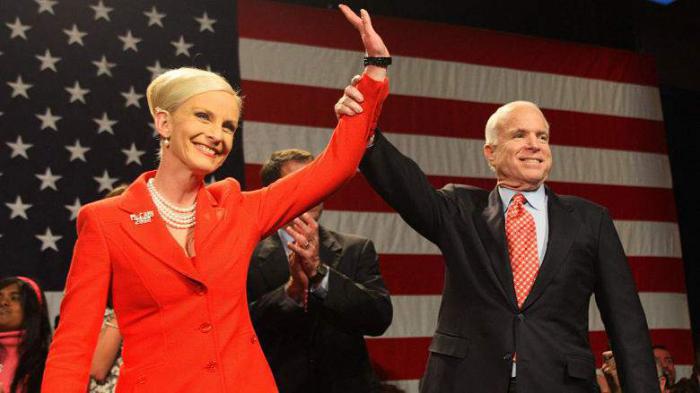
John McCain, who ran for president in 2008, with his wife Cindy. Photo: Lasexta.com
He went to war in Vietnam and did so at ease, convinced that by bombing the people of that country he was helping the greatness of the United States, while striking blows against communism, then identified as the Soviet Union.
This is Senator John McCain, who died recently at the age of 81, who at only 31 was a lieutenant colonel in the U.S. Navy and on October 26, 1967, during an action against the Vietnamese population, the fighter jet he flew was shot down by a Soviet-made missile during his 23rd mission to the north of the Asian nation.
After their physical disappearance, due to cancer, not a few stories and fables have been spread to the world by the big media. An attempt has even been made to establish a supposed critical stance against the current president, Donald Trump.
Little or nothing, however, is brought to the international community’s attention regarding the war against Vietnam and the hundreds of thousands of Vietnamese deaths, many of them from Agent Orange, a toxic chemical used savagely by Washington.
The war in Vietnam – I am sure – scarred this man of war and the system he represented, not only for the five years he was a prisoner of the Vietnamese army. In this regard, the period of time between his death and the broadcast by the media of the most varied lies, exhibits as an example those that stand out in the supposed “torture” that the U.S. military suffered.
Today the mainstream media highlights one aspect of McCain’s posthumous letter, in which he emphasizes the the deceased’s recommendation that Americans not hide behind walls. “It’s a veiled critique of Donald Trump,” reports the northern nation.
It is also recalled that whoever was a candidate in the 2008 elections, had numerous public confrontations with Trump despite being colleagues in the Republican Party. In his posthumous letter he calls for understanding between different positions.
As an example of the media’s treatment of the death, John McCain lived at a time when the political, military and cultural power of the United States was unrivalled in the world.
The Republican senator was born a few years before World War II and came to adulthood at the dawn of the United States becoming a global superpower. “Now he is leaving during what is, perhaps, the twilight of U.S. domination as the nation focuses inward, concerned about the potential risks and challenges of immigration, multilateralism and the global economy,” says Anthony Zurcher, BBC correspondent in Washington, D.C.
Another issue that has not escaped the media hype has to do with the occupation of McCain’s Senate seat and the references that his widow, Cindy, will be the nominee, since an Arizona state law – very “democratic” in the style of the United States, by the way – determines that it is the governor who appoints his replacement until 2020.
Although there has been little time between the death of the former U.S. military man who bombed Vietnam and the media coverage with its excesses and adulterations, would it not be too much to ask that, in moments of recollection like this, at least remember what happened in Vietnam.
Or is it that the truth may be different when it comes to the United States?
Facebook and Radio and TV Marti

Will Facebook close the fake accounts of Radio and TV Marti?

Cuban journalist. First Vice-President of UPEC and Vice-President of FELAP. She is a Doctor in Communication Sciences and author or co-author of the books “Antes de que se me olvide“, “Jineteros en La Habana”, “Clic Internet” and “Chávez Nuestro”, among others. He has been awarded the “Juan Gualberto Gómez” National Journalism Prize on several occasions. Founder of Cubadebate and its Editor-in-Chief until January 2017. On twitter: @elizalderosa
Translated and edited by Walter Lippmann for CubaNews.
To be, or not to be: that is the question. (Hamlet, Act III, Scene I).
The new digital platforms favor the emergence of groups of individuals organized like a claque, ready to unconditionally applaud the one who pays. Anyone who isn’t in a blockaded country like Cuba can create content, invest in it for specific groups to see and even rent or buy virtual applause to generate “likes” on Facebook or “followers” on Twitter.
This is the business model of these technology platforms, thanks to which, for example, in the first quarter of 2018 Facebook had a turnover of $11.79 billion, almost four billion more (49 percent) than a year ago. Of that total, about 98.5 percent comes from advertising.
Such a thing happens every day and it is difficult to generate a perception of popularity on networks without hundreds of thousands of followers. These are usually achieved by registering artificial identities that promote messages of support, and the favor is not free. There are hundreds of companies that offer this service without any complexes. Simply enter “buy followers” in any search engine to find them. And it is not expensive: the price of a thousand followers is between 15 and 20 dollars. Getting ten thousand more people to follow us costs less than $120.
“Troll farms” – editors responsible for spreading false information on the Internet – have been used by politicians, entertainment stars, American spies, Donald Trump’s campaign team, Macri’s campaign team, the British military, Israeli propaganda organizations and many others who have made these huge profits from the platform founded by Mark Zuckerberg possible and placed it among the ten largest companies in the world, according to its value on the stock exchange.
The numbers are impressive and not just for the profits: a study published in March 2017 by the universities of South Carolina and Indiana estimated that, within Twitter, the proportion of “troll farms” that use automated applications to replicate messages (known as bots) was between 9 percent and 15 percent of their total users. The number of automatically-controlled fake profiles is between 30 million and 48 million.
Not out of moral compulsion, but to tune in to Washington’s anti-Russian and anti-Iranian discourse, Facebook has been willing to shut down some “troll farms” and escape, even momentarily, from the wave of criticism that has fallen on it for buying and selling data without the consent of its more than 2.4 billion users. This is how hits decided to eliminate hundreds of accounts with “inauthentic behavior” on Tuesday, according to a press release
We eliminated 652 pages, groups and accounts for coordinated “non-authentic behavior” that originated in Iran and were targeted to people across multiple Internet services in the Middle East, Latin America, the United Kingdom and the United States.
But while Facebook eliminates foreign-generated fake accounts, allegedly of Russian or Iranian origin, it tolerates the U.S. government’s “troll farms” without any crisis of conscience. Before any of us had heard of this machinery of fake accounts, fake news and Cambridge Analytica – the London-based company that intervened in more than 200 elections by manipulating the users of Facebook – the Pentagon was already publicly boasting that it was using the blue thumb network as propaganda bait for its operations.
Defense One magazine reported in November 2016 that Michael Lumpkin, former director of the Global Engagement Center (GEC, Pentagon propaganda department), described how the Center used Facebook data to maximize the effectiveness of its operations:
“Using Facebook ads I can get an audience, choose Country X, a specific age group between 13 and 34, filter people who like Abu Bakr Al Baghdadi or any other group… and I can shoot and hit them directly with messages,” Lumpkin said. He stressed that with the right data, effective message targeting can be done with only pennies per click.
Yesterday, the Miami New Times, a weekly newspaper in Florida, released a document proving that a US government-funded broadcasting organization is creating fake Facebook accounts in disinformation operations. These are directed against a country, Cuba, that has not done the slightest damage to the United States and that cannot access the Facebook ad manager because of the US blockade laws.
The Broadcasting Board of Governors (BBG) will spend more than $23 million in fiscal year 2019 on its Office of Broadcasting to Cuba (OCB), which controls Radio and TV Martí, and its projects include no less than a troll farm.
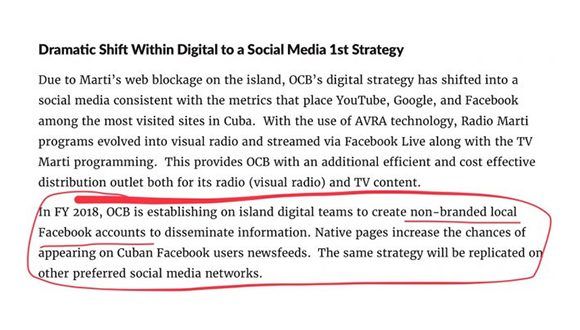
Budget requested for OCB.
According to the budget requested of Congress for 2019, OCB will use the money in fake Facebook accounts of the kind that it perfectly classifies as “non-authentic behavior” to promote regime change on the island.
Considering the disaster of inefficiency, waste and corruption that has accompanied Radio Martí and TV Martí in 33 years of existence at a cost of more than $800 million at the expense of the US taxpayer, the former head of the US Interests Office in Havana, Vicki Huddleston, echoed on Twitter the news of the digital propaganda project against the island, to which she added a phrase of contempt: “Same-old-same-old!!”.).
Will Facebook close the US government’s “non-authentic behavior” accounts, starting with those of Radio and TV Martí? To be or not to be, that’s the question, right, Zuckerberg?
(Taken from Cubaperiodistas)
You must be logged in to post a comment.