Latin America 7
Mujica backs Cuban doctors for Nobel
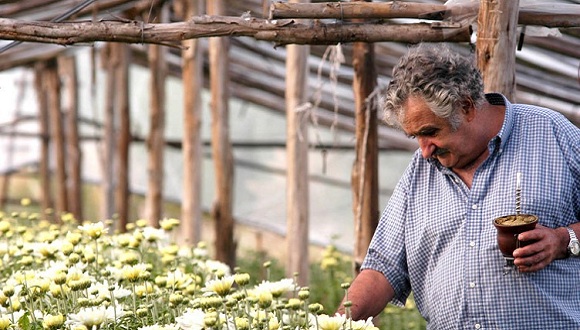

Pepe Mujica: “It is an honor to support the candidacy for the Nobel Peace Prize for Cuban doctors”.
 By Maribel Acosta Damas. Cuban journalist, specialized in Television. She is a professor at the Faculty of Journalism of the University of Havana and holds a PhD in Communication Sciences.
March 12, 2021
Translated and edited by Walter Lippmann for CubaNews.
Pepe Mujica, Minister of Livestock and Agriculture in the first government of Tabaré Vázquez in 2005 and then President of Uruguay between 2010 and 2015. Photo: Resumen Latinoamericano.
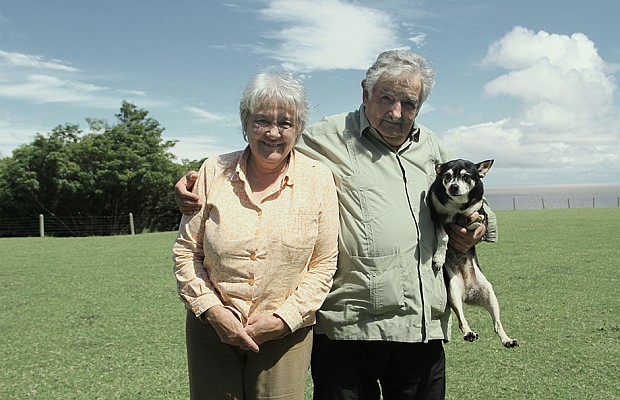
Photo taken from Cubaenresumen.org
In my living room I have a picture of Che, and I have his letters in my memoirs, in a notebook. It turned out that Evo Morales wanted to make a faithful reproduction of Che’s wallet in the Bolivian guerrilla, the last one he had. Evo Morales had it made as a gift to his friends, and I have it. Inside there is also the facsimile copy of the campaign diary and a notebook… I keep it hanging… and I always show it to them when they come to visit. Che is still there. For us, it is an indelible attitude, no matter how much time goes by…
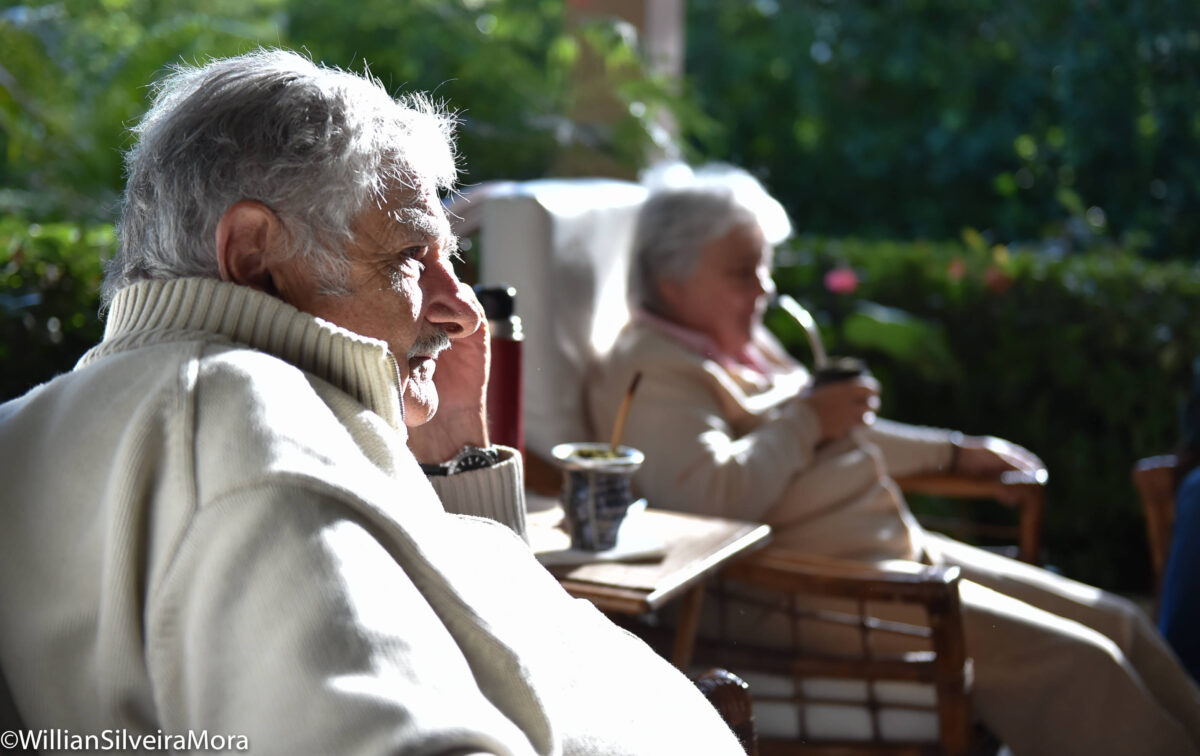
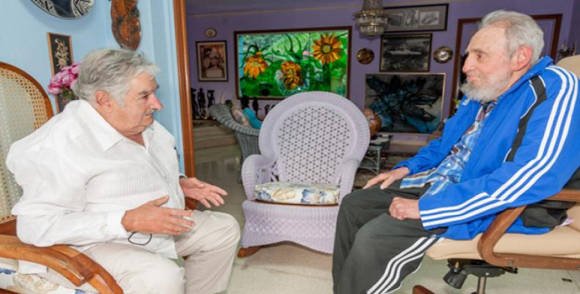
José “Pepe” Mujica and Lucía Topolansky at the Uruguayan ambassador’s residence in Havana, January 25, 2015. Photo: William Silveira Mora
We receive all this when we are born. So we have to try to leave something behind for those who will come after us. The world will not improve if there are no people who are concerned about its improvement. The world improves because of the work of people who make an effort.
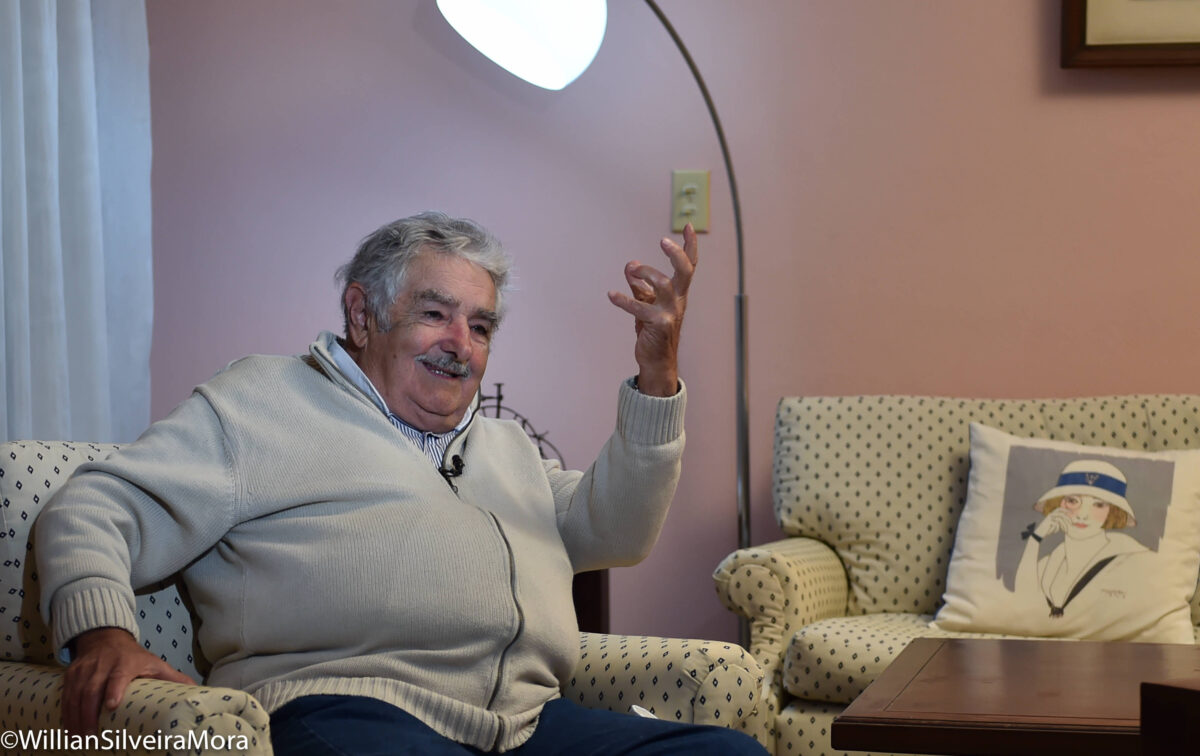
Pepe Mujica gives an interview to Randy Alonso Falcón for the Round Table, Havana, January 25, 2016. Photo: William Silveira Mora
Now there is the internet, there is the university, so it is as if the old people are superfluous, they are left over… It is a world that only wants young people, absolutely young, and then the old men and women disguise themselves to look younger. They all want to be young and they revoke themselves: they dye their hair, they remove wrinkles, they bother with fatness… in short…
Old people are on the way to being discarded. However, sometimes old people see farther because they have lived longer and if they are not yet crippled they have the function of trying to tell things to younger people that probably they are not going to understand them at that moment, but one day they will realize that they did not see part of reality… In Asian villages there is a great reverence for old people, but in Western villages there is no reverence. That is why it is good to retire…
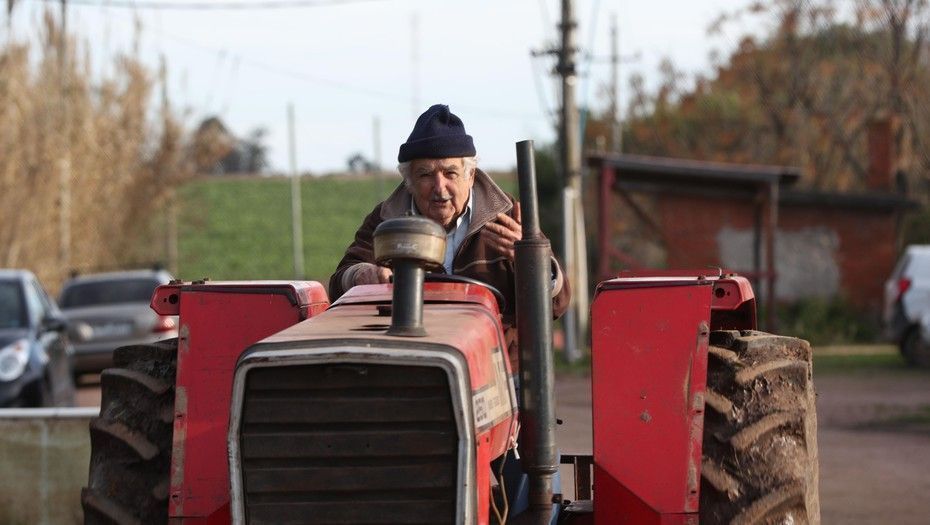
The former Uruguayan president is known for his modest lifestyle and direct speech. Photo: EFE
AMLO’s Victory: Parting of the Waters
AMLO’s Victory, a Parting of the Waters in Latin America
By Manuel E. Yepe
http://manuelyepe.wordpress.com/
Exclusive for the daily POR ESTO! of Merida, Mexico.
Translated and edited by Walter Lippmann.
There is no doubt that we are facing a wave of extreme right-wing movements. In order to understand what is happening, it is important to turn to a historical perspective. For that, we turn to the explnation given by John Bellamy Foster, Professor of Sociology at the University of Oregon and editor of the US left-wing magazine Monthly Review.
The political map on both sides of the Atlantic seemed to reveal a rise of the extreme right in the world. In most European economies, from the largest and strongest to the smallest and weakest, there was an increase in electoral support for right-wing forces. Meanwhile, on the other side of the Atlantic, these forces of reaction achieved one success after another with impunity by resorting to various forms of disguised violence.
But the clean and resounding electoral triumph of Andres Manuel López (AMLO) in the race for Mexico’s presidency seems to have been a watershed towards a different reality.
It is known that, against this great victory by the Mexicans, there was put into practice a great clandestine Berlin operation. It’s named after the name of the street in the Mexican capital where the clandestine headquarters of the imperialist operation operated.
They used cyber techniques similar to those used shortly before, under the direction of the CIA. They targeted the electoral processes in Brazil, Ecuador and other points in Latin America and Africa that left distorting fruits of popular will, Operation Berlin was carried out in Mexico. Only this time, in Mexico, they failed. Marxist theorists, along with most historians, have explained that fascism has as its backbone a political alliance between monopoly capital and a certain stratum of the middle class (or petty bourgeoisie).
Historically, the extreme right, too, has gained followers from the countryside, from established religions and from sectors of the armed forces. Fascism is always marginally present in all capitalist societies. It never emerges with all its strength on its own. It is consolidated as a movement only in those cases in which the capitalist class offers its encouragement and support, mobilizing the most reactionary elements of the “middle class”, which acts as the rear of the system.
If, in a period of economic and political crisis, the liberal state becomes an impediment to capitalist government, the existing powers will seek to preserve, consolidate and expand their rule through a regressive change in the capitalist state using the political forms provided by the extreme right.
Neoliberalism de-legitimizes the state. It encourages the development of radical right-wing or neo-fascist movements that oppose neoliberal political elites in the exercise of power and influence impoverished sectors through bribery.
Emerging neo-fascism in the United States is rooted in the “white supremacism” that goes back to slavery and the predominant thinking of the first British settlers, mixed with all sorts of new ideological elements.
Trump’s militant political base is estimated to be between 25 and 30 percent of the electorate and is located in the lower-middle stratum, with family incomes of about $75,000 a year.
It is a very white sector of the population that finds itself in a position of extreme economic insecurity. Its ideology is national-imperialist, with militant racism. A large part of this demographic group is associated with right-wing evangelism. It is something similar to the mass in Brazil that supported Jair Bolsonaro.
Trump’s main value for the ruling class lies in the fact that the radical right has been able to deliver added value to the rich: it has removed obstacles to market dominance over the whole of society.
The notion that coheres its social base is the construction of a wall along the Mexican border and new detention centers. These symbolize a war against poor immigrants. But the economic policies of the Trump administration have little to do with the demands of its social base. Trump has increased the power of financial monopoly capital, given huge tax and subsidy exemptions to big business and the rich. He has promoted economic and environmental deregulation, undermined unions, privatized education, expanded the penal state, destroyed the little progress which had been made in health care, and waged a relentless war for U.S. hegemony. Hence, Mexicans can feel like they are on the cusp of a well-deserved future.
October 31, 2019.
The urgent need for a resistance front
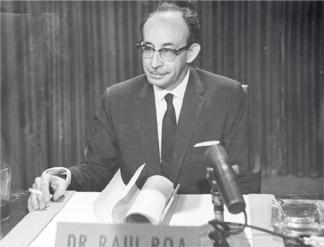

from the left
The urgent need for a resistance front
If democratic forms of government have been subjected to the harshest tests in recent times, nowhere have they been so fiercely attacked and placed in such a serious disruption as in our America.
Author: Raúl Roa García | internet@granma.cu
November 4, 2018 22:11:08
A CubaNews translation.
Edited by Walter Lippmann.
“Peace is the supreme aspiration of the man who feels freedom as an imperative of conscience. Photo: Archive.
If democratic forms of government have been subjected to the harshest tests in recent times, nowhere have they been so ferociously attacked and placed in such a serious disruption as in our America. From south to north, military lodges, lords of the earth, merchants of power, wild oligarchies and big companies, in a sinister consortium, have been abolishing the fundamental freedoms of man and of the citizen, without the UN and the OAS giving them a break, The cynical adulteration of the popular will, or the violent substitution of constitutionally-elected governments by autocracies using typical totalitarian rhetoric, characterize this dramatic process, which threatens to be generalized to the whole continent.
Pseudo-Marxist fifth columnism and imperialist greed today lord it over a beam of invertebrate nations, at the mercy of unscrupulous swords, gamonales, politicians, bankers and businessmen. Scarce governments of popular roots, the majority undermined by administrative corruption, social imbalances, electoral demagoguery and colonial exploitation, complete this gloomy picture. There is no doubt that the fate of democracy is cast. The unavoidable urgency of forming a broad front of resistance to the unbridled aggressiveness of the enemies of popular liberties is obvious.
It is indisputable that the democratic conception of life, society and the state is consubstantial with the spirit and historical development of our peoples; but, no less, that conception is currently threatened by the most regressive and rapacious forces of our time.
The central question to be debated is how to galvanize the democratic regime, to the point of promoting, in the peoples, the passionate determination to defend it, at the price of life, in all contingencies and avatars. A democratic regime without economic content, without a broad social base and without the active participation of the people in the orientation of public power, is a useless piece of junk at this historic juncture of transition. There can be no room for circumlocutions or euphemisms.
The fundamental problem facing democracy at this time is how to organize society without compromising freedom. On a universal level, it is now imperative that democracy clearly distinguishes subjective rights from patrimonial rights. Questions concerning the human person can only be resolved with the “discovery and establishment of a fairer legal structure, which allows the problem to be reduced to its true terms”.
Economic rights can already exist only in function of society. No individual interest, which pretends to oppose the social interest, is legitimate. If we aspire for man to recover his “lost fertility” and to develop, to the full, his aptitudes and powers, it is indispensable to socially discipline things. The task ahead of the democratic movement is extremely complex.
In the particular case of our America, we have to count on what history has given us. In material and cultural terms, much progress has been made so far this century. Considering the process as a whole, we must agree, however, that the economic, social and administrative structure of the Latin American peoples is in need of a substantial transformation. This transformation must go hand in hand with respect for public liberties and an international policy of militant repudiation of all regimes that violate human dignity.
It should be insisted that only through clean elections, administrative honesty, public freedoms, economic welfare, social justice, diffusion of light and consolidation of sovereignty can the representative institutions in this hemisphere be saved. The opportunity is unique to provide content and historical projection to the fight against the American dictatorships.
The American states have acquired the commitment to guarantee freedom and justice to the peoples by signing the Charter of Human Rights in the UN Charter of the Rights and Duties of Man at the IX Inter-American Conference in Bogota.
Peace is the supreme aspiration of the man who feels freedom as an imperative of conscience. The role that the leaders of the working forces will play is of the first line. No one like them will be able to contribute the most urgent and effective formulas for social improvement to strengthen the democratic regime.
Nor can the problem of the industrialization of our America be uncontroversial. Increasing the economic potential of our peoples is one of the most effective means of strengthening and consolidating the democratic regime and of putting at bay the imperialists of every sign and of every bay.
The American states have made a commitment to guarantee freedom and justice to the peoples by signing the Charter of Human Rights in the UN Charter of the Rights and Duties of Man at the IX Inter-American Conference in Bogota.
Peace is the supreme aspiration of the man who feels freedom as an imperative of conscience. The role that the leaders of the working forces will play is of the first line. No one like them will be able to contribute the most urgent and effective formulas for social improvement to strengthen the democratic regime.
The problem of the industrialization of our America cannot be uncontroversial either. Increasing the economic potential of our peoples is one of the most effective means of strengthening and consolidating the democratic regime and of putting at bay the imperialists of every sign and every bay.
The way in which the most developed countries can contribute to this increase in our economic potential must be considered, in the light of this question: could governments that are representative and respectful of public liberties and those that are born of the usurpation of the will of the people and deny their governed the enjoyment of the essential rights of man and of the citizen, be placed on an equal footing with regard to this aid? Nor can the question of the recognition of de facto governments be ignored. On this matter ,there are no guidelines within the inter-American public law, nor unanimity of criteria in the chancelleries.
If democracy needs both America to overcome the deep crisis it is going through, it is essential that the policy of good neighborliness be effectively restored. After the death of Franklyn Delano Roosevelt, on many osions the “good guys have been us and the neighbors them. May the government of the people, by the people and for the people, cease to be the government in the name of the people, without the people and against the people! And may they live on an equal footing, in peace and harmony, the America of Juarez and the America of Lincoln!
(Excerpts taken from the book 15 años después [15 years later], Editorial Librería Selecta, Havana, 1950).
The Cards Are On the Table in Brazil
The Cards Are On the Table in Brazil
By Manuel E. Yepe
http://manuelyepe.wordpress.com/
Exclusive for the daily POR ESTO! of Merida, Mexico.
Translated and edited by Walter Lippmann.
Just over a month before Brazil’s October 7 presidential elections, the judges of the Supreme Electoral Tribunal rejected, four votes to one, the candidacy of the population’s undisputed favorite in the largest and most populous nation in Latin America.
This occurred despite the fact that a resolution to this effect by the International Human Rights Committee of the United Nations (UN) stipulated that the Brazilian State must allow former President Luiz Inácio Lula da Silva to exercise his political rights as the presidential candidate of the Workers’ Party and a coalition of movements and parties that are already legally entitled to compete in the upcoming elections.
No one doubts that Lula da Silva would be a broad winner in these elections but it happens that, since April, Lula has been held in a Federal Police cell in the state of Curitiba. He has been sentenced to 12 years in prison in an arbitrary trial, with no sign of legality, on charges of passive corruption and money laundering. No evidence of such charges against the top left-wing political leader, simply because the crimes have never existed.
The latest polls published make it clear that Lula da Silva, who has almost 40% of the voting intentions, would be elected in the first round. But if he fails to do so, he will wipe out all the other contenders in a possible second round of voting.
Former army captain and deputy Jair Bolsonaro, candidate of the Social Liberal Party, which represents the extreme right, is second in the polls, with 19% of the intention to vote.
The candidate considered to be the representative of the (not extreme) right is the one presented by the Brazilian Social Democratic Party (PSDB) with the support of the Brazilian Democratic, Labor, Social Democratic and Solidarity parties. He is the former governor of Sao Paolo Geraldo Alckmin. He is ranked third in the polls with about 5% of the declarations of intent to vote.
Other parties that have announced their own candidates are the Communist Party of Brazil (PCdoB), with Manuela d’Avila as its presidential candidate and the ruling Brazilian Democratic Movement (MDB) of former Finance Minister Henrique Meirelles, both with very low voter intention rates.
Alckmin’s campaign strives to gain followers among the owners of capital with an irrational, homophobic, racist and misogynistic discourse. They have very abundant financial resources, but the public fears that a large part of the right wing will choose to join the right-wing extremist campaign.
There has been massive manipulation by the unelected government of Michael Temer and the U.S. Embassy in Brasilia to prevent the election of Lula as president of the largest nation in South America. This has transformed the Brazilian popular leader, from a central protagonist and determinant of a national electoral process into an emblematic figure of Latin American independence in the face of the imperialist hegemonic power of the United States.
Thus, Brazil will have a presidential election this year that should have been aimed at restoring to the South American giant the precarious normality it had achieved in 1985. After 21 years of a military dictatorship widely supported by the owners of capital and representatives of imperialist interests in Brazil, Brazil’s tenuous normality was broken by the institutional coup that removed Dilma Rousseff in April 2016 and culminated in the arbitrary imprisonment of Lula two years later.
The solution could be in the hands of the magistrates of the Superior Electoral Court or, ultimately, those of the Supreme Court of Justice. However, this would require that the country’s vital decisions be returned to the hands of the Brazilian people.
Unfortunately, in Latin America, the approach of the legal system to politics has given rise to repeated behavior in which judges and prosecutors prevaricate and lend themselves to the persecution of popular leaders. This has been shown in the cases of Brazil, Argentina and Ecuador, where former presidents Lula, Cristina Fernández de Kirchner and Rafael Correa are being harassed and prosecuted for crimes that they did not commit and which obviously cannot be proven.
In the event that the manipulation of the process through violence or corruption is imposed and Lula’s inclusion on the ballot is prevented, it is expected that a sufficient number of voters will choose to do so in favor of Fernando Haddad, former mayor of Sao Paolo and former minister of education during the government of the popular labor leader, who is already registered as an aspirant for the vice presidency with Lula.
In Brazil, the cards are on the table. What their people want is known. What is also known is just how much violence and cruelty imperialism and the local exploiters is capable of to impose their rule.
The Sao Paulo Forum’s Great Mission
The Sao Paulo Forum’s Great Mission
By Manuel E. Yepe
http://manuelyepe.wordpress.com/
Exclusive for the daily POR ESTO! of Merida, Mexico.
Translated and edited by Walter Lippmann.
“Prevent the release of Lula in Brazil, issue an arrest warrant for Rafael Correa in Ecuador, threaten Cristina in Argentina with jail, round up Daniel Ortega in Nicaragua, incriminate Paraguayan Lugo, deploy an offensive at all levels against Nicolás Maduro in the Bolivarian Republic of Venezuela, and focus fire on Cuba. In just these four lines, Peruvian journalist and writer Gustavo Espinoza M. summarizes the difficult situation that the Latin American left was going through at the beginning of the 24th meeting of the Sao Paolo Forum that is being held in Havana from 15 to 17 July.The Sao Paulo Forum (FSSP) is a mechanism for bringing together left-wing and progressive political parties and movements in Latin America and the Caribbean. It is a space for convergence, discussion and joint action resulting from the Meeting of Left Political Parties and Organizations of Latin America and the Caribbean, which took place in 1990 under the auspices of the Workers’ Party (PT) of Brazil. It was an initiative of the historic leader of the Cuban revolution, Fidel Castro Ruz and the leader of the Workers’ Party of Brazil (PT), Luiz Inácio Lula da Silva.
In addition to its plenary meetings, the Forum holds an average of five annual meetings of its Working Group. It organizes conferences, seminars, and workshops on various topics, holds exchanges with political and social forces in Africa, Asia, the Middle East, Europe and North America, and participates in the meetings of the World Social Forum, the Americas Social Forum and the European Social Forum.
The FSSP develops a broad and multifaceted agenda that has embraced issues such as the world capitalist crisis and its impact on Latin America and the Caribbean; the new forms of political, economic, social and cultural domination of imperialism, with emphasis on U.S. imperialism and its projection into the region; the increase in aggression78p-, occupations and foreign military bases; the struggle against colonialism; the construction of new emancipatory paradigms; the promotion of integration, cooperation and coordination in the Caribbean and Latin America, and solidarity with the struggles of its members, as well as with the struggles of those political and social forces in other regions.
The FSSP was formed to bring together the efforts of left-wing parties and movements in the southern hemisphere in the complex international arena following the fall of the Berlin Wall. In addition, it aimed to counter the consequences of neoliberalism for the peoples of the countries of Latin America and the Caribbean through reciprocal support among its members.
At the time of its foundation in 1990, the only member with executive power in a sovereign country was the Communist Party of Cuba. Twenty years later, most of the countries that are members of the Forum have agreed for some period of time, through the ballot box, to exercise government or to be part of official coalitions. Several have also become the first opposing forces in their respective countries.
The election of the revolutionary military man Hugo Chávez in 1998 in Venezuela was the first time that a member of the Sao Paulo Forum came to power.
Then came the triumphs of the Brazilian Workers’ Party in 2002 with Luiz Inácio Lula da Silva; the Frente Amplio in Uruguay in 2004 with Tabaré Vázquez; the Movimiento al Socialismo with Evo Morales in Bolivia in 2005; Michelle Bachelet of the Partido Socialista de Chile in 2006; Rafael Correa for Alianza PAIS in Ecuador in 2006; Daniel Ortega for the Frente Sandinista de Liberación Nacional de Nicaragua in 2006; Fernando Lugo for the Patriotic Alliance for Change (now the Guasú Front) in Paraguay in 2008; José Mujica for the Frente Amplio in Uruguay in 2009; Mauricio Funes of the Farabundo Martí National Liberation Front of El Salvador in 2009; Dilma Rousseff for the Brazilian Workers Party in 2010; Ollanta Humala for the Nationalist Party of Peru in 2011; Nicolás Maduro for the United Socialist Party of Venezuela in 2013. In 2014, Michelle Bachelet won the elections again and in 2014, Salvador Sánchez Cerén of the Farabundo Martí National Liberation Front in El Salvador won.
These successes, however, were followed by an intense counter-revolutionary offensive that could have ended with the recent electoral victory of Andrés Manuel López Obrador at the head of the Movimiento de Regeneración Nacional (Morena), in alliance with the Labor and Social Encounter parties, which could have been a turning point in continental political events.
With a prestige that rests essentially on his honesty and a program that is in line with “Mexico’s hopes”, as his electoral slogan states, everything suggests that the great victory of Andres Manuel López Obrador has come at the right time to save not only Mexico but Latin America as a whole from the right-wing wave.
The Sao Paolo Forum has the floor.
July 16, 2018.
A Crazy President, But Not So Much
A Crazy President…But Not So Much
By Manuel E. Yepe
http://manuelyepe.wordpress.com/
Exclusive for the daily POR ESTO! of Merida, Mexico.
Translated and edited by Walter Lippmann.
The madman was advised and suspended his visit to Lima where he would have attended the VIII Summit of the Americas as head of the U.S. delegation. Nor will Donald Trump travel to Colombia, as officially announced. The reason given for this was that the president had to deal with the situation in Syria, a country over which a threat of war hangs as a result of the president’s own outbursts. These are based on the worn-out, paradoxical and proven-false accusations against the government of Bashar Al Assad of having used chemical weapons in its internal war against terrorism.
Sarah Sanders, White House spokeswoman, announced that Vice President Mike Pence will be in charge of Washington’s delegation, both in Lima to conduct bilateral talks with Latin American leaders who will be present at the hemispheric meeting and in Bogotá for the meetings Trump had scheduled with Colombian authorities.
There is no doubt that the pretext of the situation in Syria will serve to prevent the United States from having a resounding catastrophe in its relations with the governments of the nations of Latin America.
History shows that when the countries south of Rio Grande act together they are able to shock the empire at its deepest roots. But hardly anyone expected that, as a result of the right-wing movement that has emerged as a result of various US coups d’état on the continent, such unity would be able to achieve such encouraging results.
The planned Summit of the Americas was announced as a likely trigger for the fury of the peoples of the continent against Washington’s most recent impositions and manipulations. But the arrogance and irresponsible actions of President Donald Trump have reached such an extreme that even the rulers of Latin America, who have shown themselves to be more servile in their ties with Washington, have jumped with unprecedented firmness.
An extreme case was produced by the president of Mexico, Enrique Peña Nieto, who suggested that the New York magnate review the origin of his anger. “If your recent statements stem from frustration over domestic policy issues, your laws or your Congress, you should address them, not the Mexicans. We are not going to let negative rhetoric define our actions,” Peña Nieto said, when it was announced that President Trump had ordered the deployment of between 2,000 and 4,000 military personnel to support the Border Patrol agents on the southern border of the United States.
The Mexican president’s message also responded to a series of tweets and comments by the magnate-president, motivated by a caravan of Honduran migrants who sought to reach Mexico’s northern border with the United States.
Trump warned that he would cancel the North American Free Trade Agreement (NAFTA) negotiations if the Mexican government did not detain Central American migrants.
“It is better that the great caravan of people from Honduras, coming through Mexico to our border of weak laws, stop. NAFTA is at stake, as are foreign aid for Honduras and the countries that will allow this to happen. Congress must act now!“the president tweets threateningly.
To general surprise on the continent, Peña Nieto declared that Mexico will not be afraid to negotiate with the United States, but he demands respect. “We will never negotiate in fear.”
The Mexican Senate also demanded respect from the president of the United States and demanded that the Peña Nieto government suspend binational collaboration on immigration matters.
The four candidates for the presidency of the nation: Margarita Zavala, Ricardo Anaya, Andrés Manuel López Obrador and José Antonio Meade immediately joined in the rejection of the deployment of U.S. troops on the Mexican border. “When it comes to defending national dignity, we all speak with one voice and demand respect,” independent Congresswoman Margarita Zabala wrote to Donald Trump in her tweeter.
Peña Nieto mentioned these statements in his message to the nation while underscoring the negotiating tone with which his government has addressed the U.S. president. “The Mexican government’s efforts have been aimed at building an institutional relationship of mutual respect and benefit for both nations.
The relationship between the two countries “is intense and dynamic but that does not justify threatening attitudes or lack of respect between our countries,” insisted Peña Nieto. “If you want to reach agreements with Mexico, we’re ready. As we have shown so far, we have always been ready to engage in serious, good faith and constructive dialogue.
April 12, 2018.
Returning To Coups In Latin America
- English
- Español
Returning To Coups In Latin America
By Manuel E. Yepe
http://manuelyepe.wordpress.com/
A CubaNews translation.
Edited by Walter Lippmann.
Venezuela and Brazil are the scenes of a new form of coup d’état that would set the continent’s political calendar back to its worst times. Meanwhile, in Argentina, the brutal model for the demolition of democracy is set forward by the continental oligarchic right and the hegemonic forces of US imperialism who wish to impose their model in the region.
As we can see in the previews that test the memory of the peoples in the continent, it is difficult to accept that the new types of coups are actually softer and more covert than those which Latin America suffered for so long.
What has been shown so far in Argentina is no less cruel, in terms of contempt for the masses, than the coups carried out by the bloodthirsty dictatorships that sprouted in time of Operation Condor.
In Venezuela the president of the opposition majority in the National Assembly, Henry Ramos, openly declares that in view of the severity of the economic crisis, he fails to see Maduro concluding his term and adds they should put an end to Nicolas Maduro’s legitimate government within six months. Such statements did not compel the Secretary General of the Organization of American States, Luis Almagro, to formulate even the mildest rejection to such a coup-like declaration. This indicates they are returning to the era of open and brutal coups in the backyard of the United States of America.
Meanwhile, in Argentina, the newly-elected president, Mauricio Macri, moves forward the implementation of his “democratic model” with a brutal demolition of all the advances the nation had made after the collapse it suffered as a result of the neo-liberal economic and political crisis from which it had been rescued by the consecutive popular governments of Nestor Kirchner and Cristina Fernandez de Kirchner.
Argentinean writer, journalist, and researcher Stella Calloni, explains that the current coup in Argentina began the same day Macri took office. He is an extreme-right businessman who, since 2007 (according to Wikileaks) offered his services to the US embassy in Buenos Aires.
“The coup offensive began with decrees that allowed for the intervention of institutions and absolutely illegal measures, such as the appointment by decree of two judges to the Supreme Court. All economic measures favor the powerful and mark a path of exclusion for the common people,” says Calloni.
Violating the constitution and the laws, and ruling by Necessity and Urgency Decrees
(NUDs) since December 2015, Macri took a road that evidently seeks to deliver the country to the global hegemonic power and the destruction of a work that had earned Argentina worldwide admiration and respect. He is delivering the country to the
sinister designs of the International Monetary Fund and other agencies, banks and foreign institutions. All his economic actions favor the powerful and mark a path of exclusion for the population”.
“The negative opposition in Congress is part of the ongoing coup the US and its local puppets are carrying out against Venezuela,” Calloni says.
While the United States and its network of partners and local employees –with applause from the hegemonic power– support Macri’s unconstitutional decrees, in Venezuela, the decree of “economic emergency” signed by President Nicolas Maduro, was rejected by the legislative opposition with the acquiescence of the same power.
Never before was the right more willing to violate the Constitution and call to sedition, warned former Venezuelan Vice-President and journalist Jose Vicente Rangel. “Seldom in our country had a coup been announced so clearly and at the same time so elusively; the option would be the presidential recall, but this option –within our constitution– is only tangentially alluded to.”
According to Rangel, the opposition sails in two rivers by affirming, on the one hand, that within six months Nicolas Maduro will leave –by peaceful and constitutional means–Miraflores Palace (seat of government) and, on the other, that they will not even wait that long to oust the Venezuelan president.
“The right has grown presumptuous after its legislative victory of last December 6. But they still remember the failed coup of 2002: a resounding failure that made them switch to peaceful methods –as the ones they are apparently trying to use now– to overthrow the socialist power, But neither the soft blows, the carnival costumes used to confuse, or the violent coups can occur with impunity,” concludes José Vicente Rangel.
April 19, 2016.
DE VUELTA EL GOLPISMO EN LATINOAMÉRICA
Por Manuel E. Yepe
http://manuelyepe.wordpress.com/
Venezuela y Brasil están siendo escenarios de una nueva modalidad de golpe de estado que haría retroceder el almanaque político del continente a tiempos peores. En Argentina, mientras tanto, se adelanta el modelo de demolición brutal de la democracia que pretenden la derecha oligárquica continental y las fuerzas hegemónicas del imperialismo estadounidense en la región.
Según se advierte en los adelantos que ponen a prueba la memoria histórica de los pueblos del continente, es difícil aceptar que los nuevos esquemas de golpes de estado sean realmente más blandos y encubiertos que aquellos que ha sufriera durante tanto tiempo América Latina.
Lo que se ha mostrado hasta ahora en Argentina no tiene nada que envidiar, en términos de desprecio por las masas, a los golpes de estado que implantaron las sangrientas dictaduras que brotaron en tiempos de la Operación Cóndor.
Cuando en Venezuela el presidente de la mayoría opositora en la Asamblea Nacional, Henry Ramos Allup, declara abiertamente que ante la gravedad de la crisis económica no vislumbra a Maduro concluyendo su mandato y que se debe terminar con el gobierno legítimo de Nicolás Maduro antes de seis meses, sin que ello lleve al secretario general de la Organización de Estados Americanos, Luis Almagro, a formular el menor reparo por tamañas “goriladas”, se advierte que se está regresando a la época del golpismo abierto y brutal en el patio trasero de Estados Unidos.
Entre tanto, en Argentina, el recién electo presidente Mauricio Macri adelanta la implementación de su “modelo democrático” con una demolición brutal de todo lo que había avanzado esa nación tras el derrumbe que sufrió como resultado de la crisis económica y política neoliberal de la que fue rescatado por los sucesivos gobiernos populares de Kichner y Cristina.
La escritora, periodista e investigadora argentina Stella Calloni, hace ver que el golpismo actual en Argentina comenzó el mismo día de la asunción de Macri, un empresario ultraderechista que desde 2007 (de acuerdo a WikiLeaks) ofreció sus servicios a la embajada de Estados Unidos en Buenos Aires.
“La ofensiva golpista comenzó con decretos que determinaron la intervención de instituciones y medidas absolutamente ilegales, como el nombramiento por decreto de dos de los jueces en la Corte Suprema. Todas las medidas económicas favorecen a los poderosos y marcan un camino de exclusión para el pueblo”, afirma Calloni.
Violando la constitución y las leyes, y gobernando por Decretos de Necesidad y Urgencia (DNU) desde diciembre de 2015, Macri inició un camino que con toda evidencia busca conducir al país a su entrega al poder hegemónico mundial y la destrucción una obra que le mereció a Argentina admiración y respeto de todo el mundo, entregándola a los siniestros designios del Fondo Monetario Internacional y otros organismos, bancos e instituciones extranjeras. “Todas sus medidas económicas favorecen a los poderosos y marcan un camino de exclusión para el pueblo”.
“La negativa opositora en el Congreso es parte del golpismo continuo que Estados Unidos y sus títeres locales ejecutan contra Venezuela, sostiene Calloni.
Mientras Estados Unidos y su red de asociados y empleados locales apoyan los decretazos anticonstitucionales de Macri, tan aplaudidos por el poder hegemónico, en Venezuela el decreto de “emergencia económica” firmado por el presidente Nicolás Maduro fue rechazado por la oposición legislativa con la complacencia de ese mismo poder. Nunca antes la derecha estuvo más dispuesta a violar la Carta Magna y llamar a la sedición, alertó el ex vicepresidente y periodista venezolano José Vicente Rangel. “Pocas veces en nuestro país se había anunciado un golpe de Estado de manera tan clara y, al mismo tiempo, tan elusiva; la opción sería el revocatorio presidencial, pero solo se alude tangencialmente a esa figura que consagra la actual ley de leyes”.
Según Rangel, la oposición navega en dos aguas al afirmar, por un lado, que en seis meses Nicolás Maduro saldrá por vías pacíficas y constitucionales del Palacio de Miraflores (sede del Gobierno) y, por el otro, que ni siquiera esperarán ese plazo para arremeter contra el mandatario.
“La derecha está ensoberbecida por la victoria legislativa del 6 de diciembre pasado. Pero recuerda todavía el fallido golpe de Estado de 2002, un fracaso rotundo que le hizo cambiar a métodos pacíficos para derrocar al poder socialista, como el que al parecer intentan utilizar ahora. Pero ni golpes blandos, ni disfraces carnavalescos utilizados para confundir, ni los golpes violentos pueden darse impunemente”, concluye José Vicente Rangel.
Abril 19 de 2016.
You must be logged in to post a comment.