




• CUBAN 2018 REPORT TO UN ON BLOCKADE
  • Why Cuba, Why Me?
  • Archive

Dizzy

  • Cuban Chronicles
  • About Walter
    • Why Cuba, Why Me?
    • More from Walter Lippmann
    • Photos by Walter Lippmann
    • A few things to think about…
    • About that “Other” Walter Lippmann
    • Privacy Policy
  • Translations
    • CubaDebate
    • CubaSi
    • Dr. Néstor García Iturbe
    • Esteban Morales
    • Frantz Fanon
    • Fidel Castro In His Own Words
    • Fidel Speeches Translations
    • Granma
    • Juventud Rebelde
    • La Jornada
    • Paquito
    • Manuel E. Yepe
    • Rebelión

Families Code 3

Cuban Families Code 2022 – Summary

3 years ago TranslationsFamilies Code

Translator’s note: The complete draft Cuban Families Code is 65,000 words and a 104pp pdf document. Because of its length, the Cuban New Agency (ACN) prepared the following summary, about 4,000 words, and a 30pp pdf, with the principal points of the document. What follows is the text of that summary, without the graphics. 
=============================================
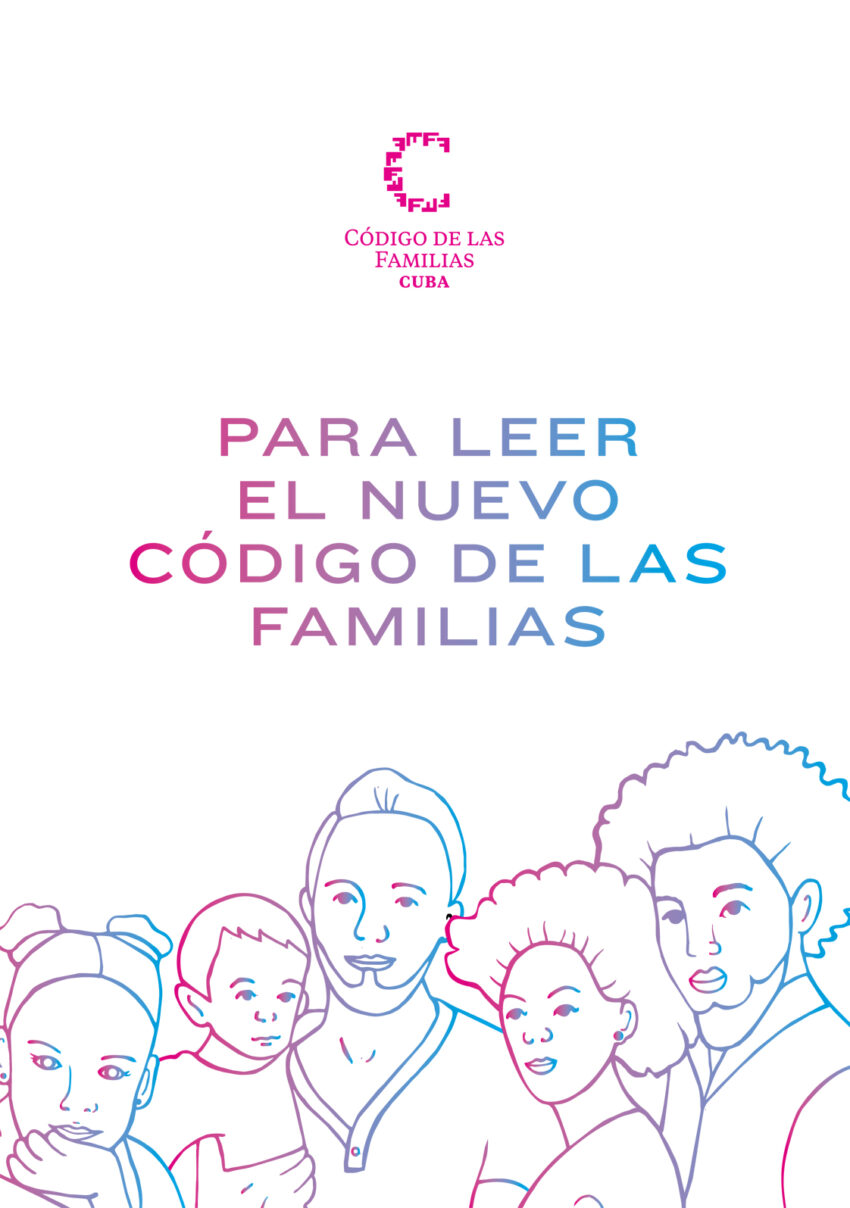
To read the new Families Code

This code, which in September will undergo social scrutiny through a referendum, something unprecedented so far in Cuba for this type of normative provision, has developed something extraordinarily exceptional: affection as a legal value. This is why it has been called the code of affection, which is not a slogan, it is an essence. This norm has an undisputed ethical value; it teaches us to think and gives us the tools to educate future generations. 
—Miguel Díaz-Canel Bermudez July 2 3, 2 0 22 

Design: Ernesto Niebla Chalita and Marien Lazo Regalado; Proofreading: Maykel Reyes Leyva; Illustrations: Maray Pereda Peña

About this edition: © Cultura Popular, 2022

All rights reserved. No part of this work may be reproduced without the authorization of Empresa de Artes Gráficas Federico Engels, to which the publishing house Cultura Popular belongs.

ISBN: 978-959-7047-39-1

Empresa de Artes Gráficas Federico Engels Via Blanca No. 551, between Primelles and Palatino Cerro, Havana, Cuba.

Translated by Walter Lippmann for CubaNews.
Thanks to Amelia Rodriguez, Madeleine Monte and Abel Gonzalez for their invaluable assistance.

THE CODE OF FAMILIES

It takes affection as the fundamental axis of family relationships.

1-It brings to the Law of Families more coherence with the Constitution

2-Sociologists, jurists, psychologists who research and work on the protection of Cuban families have participated in its elaboration.

3-It responds to the international commitments undertaken by Cuba, in particular:

The Convention on the Rights of the Child.
The Convention on the Rights of Persons with Disabilities.
The Convention on Violence and Harassment.

4-It is based on the secularity of the Cuban State.

5-It is not a Code for violent persons.

6-It is concerned with guaranteeing the protection of those persons who may be in a situation of vulnerability or disadvantage, of any kind, within the family.

With its approval by a national referendum, the new Family Code will govern the practice of family law in Cuba. So far, it is made up of 11 titles, which are broken down into several chapters. To this is added a section dedicated to Temporary Provisions, and another to Final Provisions.

TITLE 1
Frames the application of the Code within family relationships.

TITLE 2
Refers to discrimination and violence in the family framework. It defines:

* Its scope.*
* Manifestations and types.*

It addresses the liability for damages that may be caused by family violence.

TITLE 3
Refers to kinship and the obligation to guarantee everything necessary to live (food, footwear, clothes, recreation, protection…) to children, adolescents, older adults and disabled persons who cannot do it by themselves.

A-On the sources of kinship:
*Kinship that has arisen from an affective relationship is recognized.
*Mothers, fathers, grandparents, and related sons and daughters are recognized as family figures.
*The right of communication between relatives by blood, affinity and by persons affectively close to each other is extended.

B-Regarding the obligation to provide everything necessary to live:
* It is recognized between members of an affective de facto union.
* The persons obliged to do so are extended (to uncles/ aunts, nieces/nephews and mothers, fathers and affinity daughters).
* The cessation of this obligation is defined in the event of manifestations of violence.
* The exclusion of this right is defined when the person who supposedly needs them has put itself in this state.

TITLE 4
Accepts four sources of filiation:

These two are perfected:
* The consanguineous    
* The adoptive                                 
Other new ones are introduced
* Filiation as a result of assisted reproduction
* Socio-affective filiation
* It is defined that a child or adolescent can be adopted until he/she becomes of age.
* Both heterosexual and homosexual couples may adopt, without distinction, whether married or in affective de facto partnership.
* Solidarity gestation [non-profit surrogacy] is introduced as an alternative for assisted reproduction. It is based on solidarity as a cross-cutting principle of family relations.

Legal, medical and judicial mechanisms are foreseen for the strict control of these processes.

TITLE 5
Develops the entire content of parental responsibility.

The responsibilities of mothers and fathers are strengthened and consolidated.
The classic definition of patria potestad is updated and perfected and is replaced by the concept of parental responsibility. Other legal figures are introduced, such as:
* Residual parental responsibility.
* The temporary delegation of certain powers of exercise in favor of third parties.
* Temporary guardianship and care.
* Protection in digital environments

Violence is regulated as an express cause for deprivation, suspension, prohibition of guardianship and care and limitation of communication. 
The figure of shared guardianship and care is incorporated and the right of family communication to other family members is reinforced.

TITLE 6
Recognizes the right of all persons to formalize a marriage. Marriage is prohibited for persons under 18 years of age.

TITLE 7
Recognizes the stable and singular union where a life project is shared, as another of the forms of organizing life as a couple and forming a family. It recognizes that covenants of cohabitation and economic regime can be made.

TITLE 8
Develops figures of protection and support of the child and persons in situations of disability:

* De facto guardianship.
* Family foster care.
* Institutional foster care of minors in social assistance centers.
* Voluntary feeding.

Guardianship is reserved exclusively for minors. It can be plural.

* It recognizes and protects the person who assumes total or partial responsibility for the care of another.
* Respect for autonomy and dignity of care is recognized.
* Violence is prohibited in the caregiver-care-receiver relationship.
* It defines their rights and duties.

TITLE 9 
Regulates the rights of the elderly and people in a situation of disability to:

* Family life with dignity.
* Autonomous and independent life.
* To choose a place of residence.
* Family life free of violence.
* An accessible environment.
* Self-regulation of future protection.
* Family communication.
* Respectful support of their preferences.

TITLE 10  
* Refers to mediation as an alternative for the solution of conflicts.
* It defines its scope as an extrajudicial procedure.
* Determines which are the matters that can be mediated.

TITLE 11
Regulates any family situation where any of its members is a foreigner or lives outside the country.

TEMPORARY PROVISIONS
The rights acquired under the Family Code of 1975 are maintained. The judicial matters that are in process when the new Code enters into force, will continue their process. The guardianships of persons of legal age defined under the Family Code of 1975 will be reviewed and valued. Marriages performed under the Family Code of 1975, may agree on new cohabitation and economic regime pacts.

FINAL PROVISIONS
It incorporates modifications to several articles of the Cuban Civil Code:

* Persons may not be declared incapable and shall be provided with support, from the simple to the most intense, according to their specific situations.

* It is foreseen that donations can be under condition and revocable.

WHAT ARE THE NOVELTIES AND WHY ARE THEY NECESSARY?
Families also change, they are no longer that photo that remained frozen over time. Their fundamental changes in Cuba can be summarized as follows:

Small families and households where adults work outside the home are on the rise.
More and more couples are living together without formalizing their union.
Fertility is decreasing.

The family in Cuba transcends the narrow framework of cohabitation in the home and there is a much more comprehensive system of relationships.

All these people form a network of support, of material and emotional support that must also be considered when talking about family.

SOME RELEVANT DATA
* Almost half of all households are headed by women.

* Only in one out of three households there are children under 15 years of age, and in four out of ten there is an older adult.
* There are fewer and fewer extended and
* Almost half are nuclear.
* Thirty percent of children and adolescents live only with grandparents.
* The majority of young people of reproductive age with a partner live with their family of origin or that of their partner.
* Fertility among young people remains below replacement, and the average age of reproduction is around 26 years for women.

This family diversity that characterizes Cuban society indicates the need for a new Family Code. Of the eleven titles that make up the draft Family Code, four are totally new, and five present numerous transformations. There are many new features compared to the current Code that we approved almost fifty years ago. The range of alternatives and possibilities that were taken into account is so wide that any person, no matter how conservative he or she may be, will always find something that benefits him or her, as a grandfather or grandmother, as a brother, as an uncle, as a partner, as a wife. 

THE OBLIGATION TO PROVIDE WHAT IS NECESSARY TO LIVE
In this booklet, there is no room for all of them, but we bring some of those most commented upon in the neighborhood discussions: Within each of our families, there are basic obligations that we assume. One of them is the “obligation to provide food”, understood as the responsibility to guarantee what is necessary to live. We are not only talking about the responsibility to put on the table the food to be consumed at home. The term also refers to the roof that we must guarantee, to the clothes, to the education of our children and adolescents. It is about everything necessary for life, both materially, spiritually and in the affections that we share and help to build.

Among the novelties that appear in this section is the definition of the reciprocal nature of this obligation: whoever asks for food today may have been obliged to give it before, and if he/she did not fulfill his/her responsibility before, now he/she cannot claim it. In other areas, this new bill also recognizes that it is the duty of adult children to contribute to the satisfaction of their parent’s needs, even in old age.

In addition, solutions are proposed to problems that currently do not have a fair solution. For example, a pregnant woman does not currently have the legal mechanisms to claim alimony, which can only be claimed after the birth of the child. With the new Code, it is defined that it is necessary to ensure their care even from the gestation period and guarantees their care.

ADOPTION 
In terms of adoption, the changes introduced by the new Code are important.

For example, if under the current Code, children can only be adopted up to 16 years of age, the new Code proposes that adoption be extended to 18 years of age.

Another example: the current Code establishes that only two people can adopt in the case of a married couple. Now, this possibility is extended to affective de facto unions, which would have the same right to access adoption as marriage has historically had.

With the background of frequently facing long, cumbersome processes, with a high emotional price for couples who decide to initiate this type of request, the new Code clears subjectivities that hinder and make it very difficult for any couple to complete the whole process.

3. SOLIDARITY GESTATION [SURROGACY not for profit] 
The new Code takes into account the diverse realities we live in, in coherence with our plural, integrating and solidary sensibility. Being consistent with this, it leaves implicit that access to Assisted Reproduction Techniques must be admitted in a broad and egalitarian way without any discrimination in order to guarantee the essential right of all people to form a family.

In the specific case of surrogacy, nothing forbids its presence as long as both the giver of the womb and the future parents of the child act altruistically, disinterestedly and based on family or affective solidarity; and to leave no room for ambiguity, the document is explicitly against any interpretation that would turn this type of alternative into a lucrative business based on the exploitation or objectification of women.

4. RIGHT TO COMMUNICATION
The current Code is concerned with guaranteeing communication rights when there are mothers and fathers in separation disputes, but these results are narrow, asymmetrical and almost never take into account the rights of other family members such as grandfathers and grandmothers to maintain stable and clear communication with the children.

The Cuban family has always been very united, has always been very willing to exchange in all areas, including communication, and at this time they do not find a solution to the difficulties that may arise within the families.

Taking into account the numerous benefits that the possibility of frequent and unhindered communication offers for the healthy and happy growth of our children, and also how necessary are the environments of affection and harmony for grandmothers and grandfathers, the new Code recognizes the right of communication as a kinship right.

With this incorporation, we would be protecting the possibility of overcoming any conflict within the family, any limitation and facilitating the way for people to have their relational right to communicate in the family environment recognized.

5. PARENTAL RESPONSIBILITY AND PATRIA POTESTAS
For some people, the incorporation in the new Code of the concept “parental responsibility” may be unnecessary;it may provoke fears or may even be seen as an intervention in the ways in which they decide to relate to their sons and daughters.

In reality, its inclusion is not removing or eliminating what we have known until now as patria potestas (parental authority). In practical terms, it is only giving to that set of “…powers, duties and rights that correspond to mothers and fathers for the fulfillment of their function of assistance, education and care of their minor children, which affect their personal and patrimonial sphere and which are always exercised in their best interest…” a name that is more coherent with its content.

Far from being weakened, the ties between parents and children are strengthened, but not in terms of power or subjection, but in terms of responsibility towards them.

What are the guiding principles? Progressive autonomy, the best interests of the child and the right to be heard.

What do they mean? The best interest of children and adolescents do not mean responding to their whims or turning them into orders. Ensuring the best interests of our children implies that our decisions as parents should be aimed at their welfare. And also that they have the right to say no if -for example- an attempt is made to impose child labor, sexual abuse or physical injury on them,

Progressive autonomy and the right to be heard, as several specialists comment, are simple things to understand. Yamila Ferrer, vice-president of the National Union of Jurists of Cuba, said that for example, if we allow our 17-year-old daughter to decide whether she wants to be a lawyer or an engineer, and we support her, we are applying the principle of a progressive autonomy. If, in addition to taking our son to school in first grade, we also teach him to cross the streets safely and prepare him to be able to go on its own when he is in sixth grade, we are also applying this principle.

To take this idea as a starting point in the education of our children is to take on the need to provide them with the necessary tools so that they can reach their optimal development.

6. PROTECTION AGAINST ALL TYPES OF VIOLENCE IN THE FAMILY SPACE
There are problems that arise in the daily life of families in Cuba. For many they may be distant realities or difficult to understand, but if we review some research conducted in recent years, we can see, for example, that between 2016 and 2019 sexual abuse against minors increased by 24 percent, according to the Cuba Report on Preventing and Confronting Human Trafficking and Protecting Victims; we can read that violence towards our older adults is shown in its various faces and shades, from old women or men who are stripped of their money and property, or suffer direct robberies or are pressured to change their wills; we also hear the stories of violent experiences suffered by numerous women in their relationships with their partners.

In order to respond to these and other problems that locate stories of aggression, abuse and beatings in the family environment, the new Family Code proposes mechanisms to remove aggressive people from the space shared with the family, to protect those who may be vulnerable to this type of situation and need the backing and support of both close relatives and the community or the State. In this sense, we condemn violence against children, against people with disabilities, against the elderly, and against those based on gender inequalities. It does not matter whether these expressions of violence are physical, verbal, psychological, moral, sexual, economic, patrimonial or due to negligence; they are all relevant and all will have judicial consequences for those who commit them. 

7. MARRIAGE STRUCTURE
The new Family Code introduces modifications in the elements linked to the legal status of the patrimony obtained by the couple during their married life. It means that the kind of agreements reached by any marriage over properties and acquired assets is diversified.

The current Family Code regulates a single and compulsory regime, called “matrimonial community of property”. However, in the new Code, in addition to this option, couples can choose between two other alternatives: the Mixed System and the Separation of Property System, which gives the couple the possibility of agreeing which of these to select and which assets could be part of that community.

8. MARRIAGE BETWEEN TWO PERSONS OF THE SAME GENDER 
As another of the novelties included in the new Code, the rule that enshrines the right to marriage is marked by the principles and values of equality and non-discrimination, enshrined in the 2019 Constitution.

The world has not stood still. Family dynamics and ways of understanding and embracing affections have changed over the years. The transformations in the societies in which we live have also been expressed in the very nature of human relationships and among them, in the ways in which we look at marriage, giving new forms to the traditional concept. Different forms of affective, sexual and mutual solidarity relationships have emerged, which in turn have led to legal changes in the institution of marriage.

Beyond guaranteeing the couple’s procreation, marriage nowadays undertakes, as a legal figure, the purpose of granting reinforced protection to the family, of guaranteeing material rights such as the possibility of having a voice and a vote in the family; the possibility of having a voice and vote in medical decision making, the possibility of immigration benefits for foreign spouses, and of sharing property rights, among others. To deny these, to prevent homosexual couples from having access to this legal figure, leaves them unprotected; it prevents them from fully exercising those rights and duties that, on the other hand, are guaranteed to heterosexual couples.

9. CHILD MARRIAGE 
In Cuba, almost a thousand girls between the ages of 14 and 17 marry each year, and almost always to men much older than themselves. These are often short marriages that break up almost always after a baby arrives in the couple’s life. As a result, after a while the girls find themselves alone, without studies, with the responsibility of a son or daughter to protect and educate.

Faced with this situation, which affects not only the reproductive and affective rights of adolescents, but in many cases deprives them of human rights such as access to education, to have a full life, the new Code prohibits the marriage of minors under 18 years of age. 

10. PEOPLE WITH DISABILITIES
In 2012, the Population and Housing Census of Cuba registered more than forty thousand children and adolescents with some type of disability. If these figures are added to those of young people and adults who also live in some kind of similar situation, they add up to around five percent of the country’s population. In this context, under the principle of making an inclusive society effective, mechanisms are defined to provide dependent persons with the possibility of counting and deciding on their welfare. 

11. ADOPTION BY SAME-GENDER COUPLES
Protecting children in any situation of neglect, guaranteeing the right of children and adolescents to live in a family, and ensuring their welfare and integral development are the fundamental interests of the new Family Code that will regulate the adoption process in the country.

In order to be able to do so, persons must demonstrate their capacity to fulfill their functions as parents: to be 25 years old and have a difference of 15 years with the adoptee, to be able to meet their economic needs and to have a conduct that allows to presume that they will fully comply with the duties inherent to the exercise of parental responsibility.

In the same way, the bill clearly defines and leaves no room for ambiguity when it lists the reasons that disqualify them as candidates to adopt: Those who do not meet these requirements and those who have been found guilty by final veredict in criminal proceedings as perpetrators or accomplices of crimes related to gender or family violence, or for crimes against freedom and sexual indemnity or against children, youth and the family, or those who have ever been deprived of parental responsibility for their own children for serious causes, may not adopt.

Any person who complies with these defined legal requirements will then be able to access the adoption process, without distinguishing whether the adoptive parents are heterosexual or same-gender couples. 

WHAT HAVE WE DONE SO FAR? WHAT IS REMAINS TO BE DONE?
Feb. 2019 The new Constitution is approved with 86.85% of the votes. The Third Chapter is dedicated to Families in its articles 81 to 89 of Title V, devoted to rights, duties and guarantees. This analysis is complemented by the values and principles contained in Articles 40, 41 and 42: dignity as the basis of all the rights enshrined in the Constitution and those of equality and non-discrimination.

Jul. 2019 The temporary working group in charge of drafting the preliminary draft of the new Family Code is created. It is made up by sociologists, jurists and psychologists who research and work on the protection of Cuban families.

Mar. 2021 The Council of State approves the Commission in charge of giving continuity to the work carried out by the temporary group.

Sept. 2021 Version 22 of the Preliminary Draft of the Family Code is released. A consultation process is initiated with specialized institutions; the opinions of the population are received via e-mail; a new version of the preliminary draft is prepared.

Dec. 2021 The National Assembly of People’s Power discusses and approves the draft Family Code.

Feb.-Apr. 2022 The popular consultation called by the National Assembly is held to gather the opinions and recommendations of the population.

+ 79,000 meetings
+ 6,500,000 participants
+ 397,000 proposals to the draft 61% of the proposals are favorable to the draft Code
20.36% are proposals for modification
12.69% are proposals for elimination
3.47% are proposals for addition
1.72% are proposals for doubts.

Jul. 2022 New discussion of the project in the National Assembly of People’s Power.

Sept. 25 2022 National referendum called by the National Assembly of People’s Power.

“Each family is a unique, unrepeatable path, as unrepeatable as each person is. Families are an expression of the most delicate social fabric. They are where we come from, where we are formed, where we receive the highest values and principles with which we are educated. Families are like the homeland, they provide us with identity, civility, solidarity, respect, and altruism. 

The bet for the approval of the family code in the referendum is also for democracy, for the virtue of being Cubans, for the happiness of each child or adolescent, for the autonomy and decision-making power of each senior citizen, for the inclusion of each person with disabilities, for the condemnation of family abuse, for the respect of family diversity”.
––Miguel Díaz-Canel Bermudez July 23, 2022

Here is the full, complete Codigo (104 pages, pdf)
https://www.gacetaoficial.gob.cu/sites/default/files/goc-2022-o87.pdf

Share this:

  • Click to share on Twitter (Opens in new window)
  • Click to share on X (Opens in new window)
  • Click to share on Facebook (Opens in new window)
  • Click to share on LinkedIn (Opens in new window)
  • Click to share on WhatsApp (Opens in new window)
  • Click to email a link to a friend (Opens in new window)

Esther Perel: Happiness is in the balance

3 years ago Juventud Rebeldecouples, Esther Perel, Families Code, sexuality

JuvReb

Happiness is in the balance

The human couple is like a microcosm where cultural ideas penetrate and then pass to the children. A kind of portal in space and time that, like everything that responds to society, usually changes its model as the times change.

Author:

Mileyda Menéndez Dávila |sentido@juventudrebelde.cu

Published: Friday 13 April 2012 | 08:52:24 pm. Updated: Thursday 21 September 2017 | 09:34:28 pm.
Translated and edited by Walter Lippmann for CubaNews.

Desire is fire, and to grow it needs space. Author: internet Posted: 09/21/2017 | 05:19 pm

“Sexuality is a window to enter society,” says Belgian psychologist and anthropologist Esther Perel, with whom we spoke last January during the Sexology 2012 congress.

This New York-based therapist defines the human couple as a microcosm where cultural ideas penetrate and then are passed on to the children. A sort of portal in space and time that, like everything that responds to society, tends to change its model as the times change.

In her opinion, modern marriage left behind the old sexuality of reproduction and obligation to open the way to a new sexuality centered on erotic desire and governed by principles forged with Romanticism, that cultural movement that transformed the world from the 17th century onwards.

However, that romantic notion of the “passionate marriage” that is so much pursued today carries in its essence a historical contradiction: passion and commitment is a dialectical pair that we try to reconcile in order to satisfy in one person very different needs, such as adventure and stability, surprise and comfort.

“Today we women ask for more… and we divorce more because we get disillusioned very quickly. Although we still see a partner as a partner to raise a family and achieve economic security, in this century we are looking above all for our man to be our friend, our lover, our confidant.”

Modern women lead a life more open to individual projects, to social protagonism, to the decision to have fewer descendants and to fulfill themselves outside the home, but this takes a heavy toll on their intimacy, she says.

“It is an existential dilemma that all couples who manage to be stable go through: eroticism is our way of feeling alive, but without realizing it, we redirect it towards those who follow in our footsteps in the family and we neglect our erotic world,” she says.

“Many women stop grooming themselves to look beautiful, but they get satisfaction from watching their daughters do it. Others stop ‘taking care’ of their husbands to be jealous of their teenage son, and most adult married couples barely organize outings a couple of times a year, yet financially and materially support the weekly recreation of their young offspring.”

Sexually “savvy”
Esther has traveled to dozens of countries studying couples in their own historical and cultural context to try to answer those questions that everyone has ever asked: “Why is the forbidden so erotic, and after it is obtained it no longer excites us? Why is everyday sexuality, done with love, usually not as passionate as a casual encounter? Why does sex make children, and then children kill sex?”.

In fluent Spanish and full of metaphors, Esther talked to several Cuban journalists about the success of her book Erotic Intelligence, published since 2007 by several publishing houses, in which she tries to discuss these questions. [In English, the book is called Mating in Captivity]

According to what she told us, the term came up as a joke from her husband (she has been married for 30 years), but then they both made sense of it: if we are already talking about emotional intelligence, why not accept that sex demands its own share of knowledge and intuition?

In this day and age, a sexually “intelligent” woman with a secure attachment style looks for men who want her, not need her.

The difference is easy to detect, Esther assures: “In the first case they say “I love you”, while in the second case they ask “Why don’t you love me?”, even when you have given all the proof of love they have asked for throughout the relationship… And this is also true the other way around: emotionally dependent women who demand too much from their partners.

The diversity of manifestations of this dependence is above all cultural: in women, open complaint predominates; in men, it is more hidden or it emerges with a lot of aggression, especially in countries with a macho tradition.

Desire is fire, and to grow it needs space. Things will go better in many marriages when they understand that this is not a conflict to be resolved, but a paradox to be managed, like so many in this century: “You can be happy in a stable marriage, but the way to that happiness is the balance between individual freedom and mutual commitment”.

Be smart with your partner
If you want to apply erotic intelligence to your life as a couple, here are several tips discussed on the Terra site as a marital “survival list”:

-Be interested in your partner’s hobbies and show him/her what you like.
-Remember that you are not Siamese twins, you don’t have to go everywhere together.
-Work activities must be compatible for life as a couple.
-Avoid erosion in communication: get out of the house to talk about intimate things.
-Don’t fight against your partner’s quirks, incorporate them into your routine.
-Don’t try to change the other person, accept their bad side along with their good side.
-Balance the balance of roles, don’t try to be always and both the dominant voice.
-Put yourself in your partner’s shoes before judging why he/she acts one way or another.

Share this:

  • Click to share on Twitter (Opens in new window)
  • Click to share on X (Opens in new window)
  • Click to share on Facebook (Opens in new window)
  • Click to share on LinkedIn (Opens in new window)
  • Click to share on WhatsApp (Opens in new window)
  • Click to email a link to a friend (Opens in new window)

For homes without violence

3 years ago CubaDebate, TranslationsFamilies Code, Gender Violence

cuba-debate

For homes without violence, the other successes of a Code

By: Ania Terrero
Posted in: Gender Letters
In this article: Constitution of the Republic , Cuba , Gender Inequality , Discrimination , Family , Gender , Woman , Violence , Gender Violence
November 21, 2021 
Translated by Walter Lippmann for CubaNews.

Image: Morphart / El Colombiano.

I wish we didn’t have to write more about gender violence. I wish there was no need to organize activism days against it or designate orange days. I wish November was a month to celebrate its end and not to remember the many ways in which it manifests itself, how much it hurts. I wish it was no longer a problem, not here or anywhere. But it persists, also in Cuba. And hurts.

Therefore, because we cannot remain silent, because it is necessary to make their many faces visible and build collective solutions … again this column takes advantage of November – the month in which the 16 days of activism against gender violence begin – to carry out a series of works on the subject.

We intend to continue denouncing a conflict that affects one in three women in the world, even more in times of pandemic. But also explain its characteristics, contact experts, cross opinions and identify experiences of activism and confrontation. During the next few weeks, we will approach this phenomenon from different perspectives, we will explain some of its manifestations and above all, we will look for ways to put an end to it. Your doubts, opinions and experiences are welcome here.

When violence happens at home

Ana María Álvarez-Tabío Albo. Photo: Roberto Garaicoa

“Although we are sorry, gender violence is a phenomenon that is still present in Cuban society, also that which occurs in the family sphere. Consciously or unconsciously, we are a little complicit in its various manifestations, ” Ana María Álvarez-Tabío Albo, professor at the Law School of the University of Havana (UH), commented to Cubadebate.

Beyond physical attacks, he has many ways of expressing himself just as harmful. From the perspective of this jurist, when we passively observe verbal abuse, disqualification and other psychological aggressions that occur against women in the street, in a certain way we contribute to their permanence.

“All of this becomes even more acute inside the home. There are not so many witnesses there, but it is a palpable reality. There is gender violence in the family space in all its manifestations, including verbal, psychological, economic or patrimonial ”, the expert specified.

Leonardo Pérez Gallardo, president of the Cuban Society of Family Law, confirms this. During an interview with the Women’s News Service in Latin America and the Caribbean (SEMlac), she expressed that although physical abuse is the most obvious and identified, there are “other, more silent forms that do as much or more harm, and which are also present in Cuban daily life, such as psychological violence and manifestations of economic violence. “

Inside Cuban houses, all these attacks are observed that lead to the spiritual collapse of the victims and the disqualification of their potentialities. In addition, it is common for women to bear the greatest amount of domestic responsibilities and care work.

“They are the ones who usually stop working to take care of their children, the elderly and other family members, they are the ones who abandon their personal and professional projects and almost never receive the necessary collaboration. This implies that women in Cuba, although they have the same salaries as men, in the end, do not receive the same remuneration because they have to miss their jobs or leave them,” Álvarez Tabío explained.

Experts confirm it: gender violence is still a latent issue within many homes. Precisely because of the implications it has there, we decided to start this series of works by talking about one of the resources that could help put a stop to it. The project of the new Family Code, which our country is discussing these days, has a marked objective in confronting this matter.

“This Code is not for the violent”

Since version 22 of the draft of the new Families Code was published last September, the challenges facing legislation that defines, regulates and protects all households, regardless of their differences, have been high points on the agendas. media, political and of course, public.

The document put up for discussion is in line with article 85 of the Constitution of the Republic, according to which “family violence, in any of its manifestations, is considered destructive of the people involved, families and society, and it is sanctioned by law “.

Therefore, it expresses the right to a family life free of violence in any of its manifestations -whether it is gender, against older adults or people with different capacities or against girls, boys and adolescents- and presents protective formulas against these situations.

Yamila González Ferrer, vice president of the National Union of Jurists of Cuba (UNJC) and member of the drafting commission of this document, told Cubadebate that it maintains the spirit of the National Program for the Advancement of Women (PAM) and the Comprehensive Strategy Against Gender Violence, approved by the Council of Ministers . Above all, it clearly raises the possible consequences for those who carry out this type of aggression.

“This Code is not for the violent. If we talk about affections as the axis of family relationships, the document seeks to promote a harmonious way of solving conflicts ”, he said.

According to Álvarez Tabío, who is also a member of the drafting commission, his first achievement is to clearly identify the existence of the problem. “ In Law it is very important to name things: now we have identified gender violence in the family space, it already has a place in the draft Code. Everything that means physical, verbal, psychological, sexual, economic abuse, negligence and neglect, whether by direct or indirect action or omission, is recognized there. This allows us to take effective measures for the protection of the victims ”.

The regulations establish responsibilities and palpable consequences for those who attack others, in each of the defined institutions. In addition, it states that all matters regarding family violence must be of urgent judicial protection.

Among the protective formulas that it resorts to, it stands out that the legal obligation to provide food can cease when the obligee engages in violent behavior. “If I am the person legally obliged to provide food to another and that other has manifestations of violence in any of its expressions against me, that obligation cannot be maintained,” explained the UH professor.

Within couple relationships, respect and non-violence are explicitly recognized among the duties of the spouses or people together; and the possibility of separating the assets during the validity of the marriage is established when violent acts are present, systematically or not and according to their magnitude.

In addition, among the impediments to adopting, we have been punished for crimes related to gender violence. Exercising mistreatment also constitutes a limitation for the denial, suspension or modification of family communication regimes. ” You cannot promote communication, much less with children and adolescents, if the person in question is violent, ” Álvarez-Tabío insisted.

Related to this principle, the document identifies aggressiveness as a possible cause of deprivation of parental responsibility, even if it is not directly exercised against children.

“If a father or mother mistreats their partner and that exchange is witnessed by the children, it may be cause for the deprivation of parental responsibility. Similarly, the guardianship established in favor of a minor can be removed in cases of gender violence ”, he added.

Confronting violence, beyond the norm

Yamila González Ferrer. Photo: Roberto Garaicoa.

Although the project of the new Families Code recognizes the acts of violence present in that space and establishes a response to them, it is not enough to resolve them, Álvarez-Tabío said.

Yamila González Ferrer agrees. In her opinion, the legislative improvement in this matter should also cover areas such as family criminal law and civil, family and criminal proceedings, which would strengthen the spectrum of protection in situations of violence. “Similarly, ongoing and systematic awareness and training of legal professionals is essential to guarantee an interpretation and application of our legal norms from a gender perspective.”

It is clear, the Code will not come with a magic wand. It cannot solve by itself a phenomenon that, moreover, transcends legislative resources. “Although from the legal point of view we will be able to solve something when each normative body makes an express mention and foresees legal consequences in the face of these types of events, the battle goes much further,” said the UH professor.

To the actions from the Law must be added the confrontation from the social, educational and cultural aspects, among other perspectives. It is urgent to assume that violence in the family space is not a private matter, it is not an individual problem; rather, it affects us all as human beings, as a society.

“A lot of communication is necessary, talking with our sons and daughters so that they do not reproduce these behaviors, making them aware that they cannot remain undaunted in the face of abuse in any of its manifestations. It is also the work of teachers, doctors, of any professional who from within its scope, it can contribute ”, Álvarez-Tabío pointed out.

Ultimately, it is about articulating efforts so that violence does not continue to hurt inside homes. And on that path, luckily, the new Code can be a great ally.

Share this:

  • Click to share on Twitter (Opens in new window)
  • Click to share on X (Opens in new window)
  • Click to share on Facebook (Opens in new window)
  • Click to share on LinkedIn (Opens in new window)
  • Click to share on WhatsApp (Opens in new window)
  • Click to email a link to a friend (Opens in new window)
 Subscribe to Blog via Email 

Enter your email address to subscribe to this blog and receive notifications of new posts by email.

Join 133 other subscribers
November 2025
M T W T F S S
 12
3456789
10111213141516
17181920212223
24252627282930
« Aug    
 Tags 
Cuban SocietyWomenUS SocietyCuba-US relationsCovid-19US politicspeopleLGBTblockadeFidel CastroCuban economymoviesviolenceVenezuelatourismus foreign policyDonald TrumpcoronavirustechnologyChinaBoliviaracismCuban FiveCuban PoliticsBlack strugglebioUS-Cuban relationsbooksMexicoRussiaCubamusicPalestine-IsraelSexGender ViolenceterrorismsubversionTrumpU.S. SocietyCuban healthBarack ObamaPCCArgentinaBidensports
 Meta 
  • Log in
  • Entries feed
  • Comments feed
  • WordPress.org

Privacy Policy

WL-Logo
 Fair use notice of copyrighted material: 
This site contains some copyrighted material that in some cases has not been specifically authorized by the copyright owner. We are making such material available in our efforts to advance the understanding of politics, human rights, the economy, democracy, and social justice issues related to Cuba. We believe this constitutes a 'fair use' of any such copyrighted material as provided for in section 107 of the US Copyright Law. In accordance with Title 17 U.S.C. Section 107, the material on this site is distributed without profit to those who have expressed a prior interest in receiving the included information for research and educational purposes. For more information go to: www.law.cornell.edu/uscode/17/107.shtml If you wish to use copyrighted material from this site for purposes of your own that go beyond 'fair use', you must obtain permission from the copyright owner.
November 2025
M T W T F S S
 12
3456789
10111213141516
17181920212223
24252627282930
« Aug    
2015, 2016, 2017, 2018, 2019, 2020, 2021, 2022, 2023 © Walter Lippmann
Touched by
 

Loading Comments...
 

You must be logged in to post a comment.